Article
Interview with Germano Dushá, curator of 'Ultratremor' at the Museu Nacional de Arte Contemporânea - Museu do Chiado
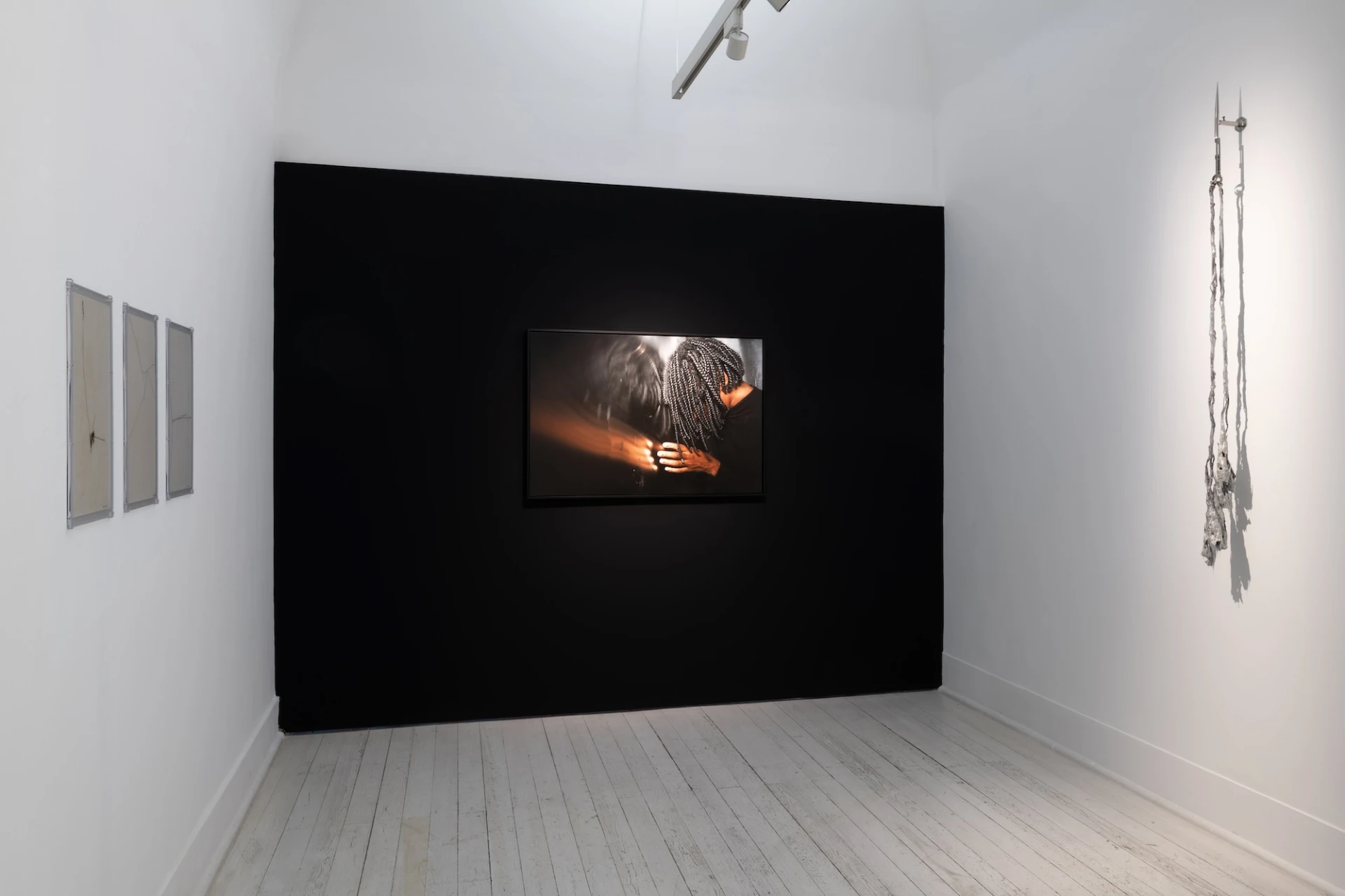
On display until October 4th at the Museu Nacional de Arte Contemporânea - Museu do Chiado, the group exhibition Ultratremor brings together the work of 16 Portuguese and Brazilian artists, curated by Germano Dushá.
OVB: Starting with the title, Ultratremor… The word “tremor” struck me as particularly charged, especially in relation to Lisbon, a city whose memory is deeply marked by the 1755 earthquake. Did this history resonate at all with your choice of the title? And why Ultratremor rather than simply tremor?
GD: I think there is a great deal of intuition involved when you are mapping something conceptual but also a poetic image. When I think about a group exhibition like this, bringing together artists with very different trajectories and practices, I am interested in a sort of vibration or energy that allows them to inhabit the same space and establish relationships with one another.
I was concerned with a phenomenon, a frequency that reaches a certain amplitude and creates a field of communication between different planes: the material and the immaterial, the physical and the ethereal. I think of an atmospheric tremor, a vibration of the incorporeal, as if it were opening a portal through which the occult could manifest. Perhaps the “ultra” is precisely that maximum point of the unnameable: something we cannot name, but whose presence we might sense through its high frequency. Ultimately, Ultratremor is a vibration that knocks us off balance, making something happen that lies, in a sense, beyond language.
OVB: In the text, you say that the artists are connected by a sort of “common frequency” rather than formal, thematic or narrative affinities. What do you mean by it? As a curator, how do you recognise it?
GD: I think a lot about emanation: what does a work emanate? What does it invoke? There is an energetic state connected to something we don’t know how to name, but that we can feel. I am interested in vibrations that inhabit borders: a border of language, like a hybrid being you cannot define as human, animal or something else, or the ghosts of history, where you don’t know where history begins, where it ends, or how it continues to live.
The word uncanny is useful here. It is that unsettling—even eerie—feeling of being drawn to something precisely because it sits between the strange and the familiar. In Freud, the uncanny is the familiar element that was repressed and returns to us in a distorted, creepy way. This is close to the frequency I am talking about: not just the desire for the unknown, but a pull toward something intimate that has become foreign to itself. A hybrid being works in this exact way: it's not just suspended between the human and the animal, the organic and the artificial, but it is the point where one discloses the other. And it's the same with the ghosts of history, as the past keeps resurfacing, in different forms, within the present.
Freud’s uncanny describes something that troubles us because it is simultaneously strange and familiar. Perhaps this frequency is that magnetism: the desire to approach something familiar that at the same time remains profoundly strange.
As a curator, I try to approach works through this energetic openness, trying to receive what the work emanates. What does a drawing by Mira Schendel have to do with a sculpture by Adriano Amaral or a painting by Lucas Milano? What connects them is a desire to inhabit indiscernible zones of contact, transition and transmutation.
OVB: Was there a work from which Ultratremor began to take shape?
GD: For me, one of the icons of the exhibition is the group of three works by Mira Schendel in the first room. They have something almost of psychography (as in spirit writing) about them, a kind of intuitive drawing. The gesture is minimal, a line on paper, and yet you have the feeling that she is possessed, that the hand drawing is no longer the artist’s hand. It is as though the line itself wants to appear and tell us something. This says a lot about what precedes language.
From the beginning, the idea was also to create a dialogue between Brazil and Portugal. This is where Ana Hatherly became fundamental. She is an extremely important artist and poet in Portugal, but very little known in Brazil. Schendel and Hatherly are artists from almost the same period, with very different practices, yet it is as though they arrived at a similar place by different routes: this poetry of the minimal gesture. This dialogue, then, is a pillar for the project.
OVB: You found a rather unusual way of bringing Brazil and Portugal into relation: through resonances and frequencies rather than explicit historical or identity-based references. Is it possible to construct a space between Brazil and Portugal without colonial history inevitably becoming its defining coordinate?
GD: Colonial history is already there. You cannot discuss anything in Brazil without taking into account that it is a country founded through slavery: any honest discussion has to begin there.
But what I am proposing belongs more to the realm of sensory experience. Although those questions are unavoidable, Ultratremor is dealing with something that comes before and goes beyond them: a spiritual inquiry. What do we do with this thing that inhabits the interior of all things, that moves what we cannot see? We can discuss how this operates within colonial trauma, but it also operates elsewhere. I was interested in how subtle, and sometimes abstract, triggers might help us think about these questions rather than having to return to the well-known discourses.
OVB: That makes me think about the invisible. Boaventura de Sousa Santos uses the concept of epistemicide to describe the destruction or delegitimisation of forms of knowledge through colonialism. In an exhibition that brings Brazil and Portugal into relation through spirituality and ways of knowing that are not necessarily rational, could the “invisible” also be what colonial history made invisible?
GD: Despite everything we have gained from urgent discussions brought to the centre of contemporary art and cultural critique, we have also seen a certain flattening of the debate, and the reiteration of obvious statements. What I try to do in this exhibition is approach things that are not forms of knowledge ruled by Western and colonial thought. In Paulo Nazareth’s ritualistic works, for instance, there is an incisive historical critique of the colonial past, but it is articulated within a larger and deeper dimension. He is talking about the spirit, ancestral mythology, and ways of producing not only knowledge but reality itself that escape the death drive and the epistemicide carried on by colonial forces.
What capitalism did, completing the work of colonisation, was to reduce all vital possibilities to a single way of living and understanding the world. Cartesian, rational, Western, colonial thought wants to name and classify; as soon as something appears, it has to be placed inside an ontological box. Ultratremor wants instead to enter nebulous zones, spaces between things where distinctions are less clear, and ask: what does language mean at that point?
OVB: There is also a noticeable generational distance between the artists. What allowed you to bring practices from such different historical contexts into relation?
GD: Following this approach allows us to transgress the typological limits through which we normally organise thought and exhibitions. Historical contexts matter, of course, but it becomes exciting when you put radically different things together: minimal, conceptual drawings by Mira Schendel (1919) and Ana Hatherly (1929) beside a photoperformance by Iara Izidoro (1991), or a gore, sci-fi, cyberpunk sculpture by Adriano Amaral (1982), and somehow the works appear almost as though they were born together.
That is what excites me about curating: taking points that are extremely distant from one another and suddenly seeing the relationship stand on its own. Across radically different sociopolitical and cultural contexts, you can find a human phenomenon that exceeds us, a manifestation of the spirit that uses the human being as its conduit. It can happen at any moment, in any place, in any era.
OVB: Talking about ghosts and artists from different generations, I started thinking about transmission. Could the “ghost” of an artist somehow pass into the work of a younger one?
GD: I love this idea. We have artists who have already died, so they can almost become ghosts themselves. Then there is the spirit of the time, the ghost of history, and the ghost of language. I am less interested in the apparition of the ghost itself than in the processes of apparition. What allows something to manifest itself? I think form is less the final result than a series of internal processes through which something acquires a contour to manifest itself in the world.
The most literal image of this might be a séance, or someone incorporating a spirit in a terreiro. In Maranhão, the state where I come from, for instance, there is encantaria (that can be literally translated as enchantment): an Afro-Amerindian practice based on the cult of beings who once inhabited this world, who are no longer here, but who have not ceased to manifest themselves within it, be it as entities who inhabit an invisible dimension or transforming into aspects of nature. But desire, thought, and language also work like this. They are flows of energy that find a vehicle through which to make themselves present and to act in the world. What interests me is therefore not exactly what manifests itself, but the phenomenon of manifestation: the tremor intense enough to make the ghost appear.
OVB: Did the finished exhibition reveal any frequencies or relationships that you had not anticipated?
GD: I work very intuitively. I sometimes feel that ideas choose me more than I choose them, and then I investigate, through practice, what they might become. When you put things together, there is a kind of magic that a group exhibition can produce. Perhaps this one is almost a meta-exhibition, because it is precisely about what it means to put one thing beside another and see what happens in between. Once the works entered the space, I could see how each vibrates on its own and then differently when another work is placed beside it. A third thing emerges between them.
Ultratremor, after all, is a concept I invented in my head. It describes a vibration of such intensity that things can manifest between different dimensions. The different rooms become small chambers of experience, but ultimately we always return to this energy that precedes language: this impulse, this thing that is not quite here yet, that has not yet become a word. I think that is what Ultratremor is about.
BIOGRAPHY
Orsola Vannocci Bonsi is a cultural producer and advisor who has called Lisbon home for eight years. Through her work, she fosters connections through her research and the projects she helps bring to life. With experience as a sales director and gallery manager in various Portuguese art galleries, she was also project manager and artistic director of FEA Lisboa, founded the curatorial collective Da Luz Collective, and contributed to the programming of festivals in Italy and Portugal.
ADVERTISING
Previous
Article
21 Sep 2026
Life Inside Homes #1: Behind closed doors
By Zara Ferreira
Next
Agenda
22 Sep 2026
Cycle of conversations ‘FLAD Collection: The Dialogues’
By Umbigo
Related Posts
Article
21 SEP 2026
Interview with Germano Dushá, curator of 'Ultratremor' at the Museu Nacional de Arte Contemporânea - Museu do Chiado
By Orsola Vannocci Bonsi
Article
21 AUG 2026
Visceral Hum: June Crespo at Kunsthalle Lissabon
By Orsola Vannocci Bonsi
Article
16 JUL 2026
Walking, Therefore Perceiving: On Luísa Jacinto's So Many Names
By Orsola Vannocci Bonsi
Article
14 MAY 2026
La Chantin, by Cisco Merel: the shell we are
By Orsola Vannocci Bonsi