article
The Elusiveness of Time: on the exhibition ‘Uma Árvore’ by Daniel Moreira and Rita Castro Neves at the Palácio da Galeria in Tavira
"“Skill and delicacy of gesture, coupled with a restrained yet intense gaze, are qualities that shine through in the exhibition Uma Árvore by Daniel Moreira and Rita Castro Neves. The tree in question is a carob tree that has stood on the ground in the eastern Algarve for several centuries, which the artist duo observed, named and sought to depict over the course of three years.”
In Filosofía Vegetal, Fernando Calderón Quindós wrote, concerning the observation of natural phenomena by botanists and other scientists of the eighteenth century, that ‘the success of observation depends to a large extent on manual dexterity and delicacy of movement’ (2018, p. 27). The Spanish thinker reflected on Natural History, its relationship with Philosophy and with language changes, and the mutual interdependence between the science of human phenomena and other natural occurrences. The desire to understand plants has always inspired philosophers, poets and artists, and Calderón Quindós draws on figures ranging from Aristotle to Diderot, and from Daniel Defoe to Jeanne Baret, to reflect on trees and flowers and their manifold scientific representations – in terminology, in naturalistic drawings, or in herbariums. Towards the end of his A Charca, Manuel Bívar summarises this line of thought, focusing on the act of looking and on the plant as an object: ‘A certain restraint is required to look intently. That is the garden, a sort of precursor to the scientific method’ (p. 107).
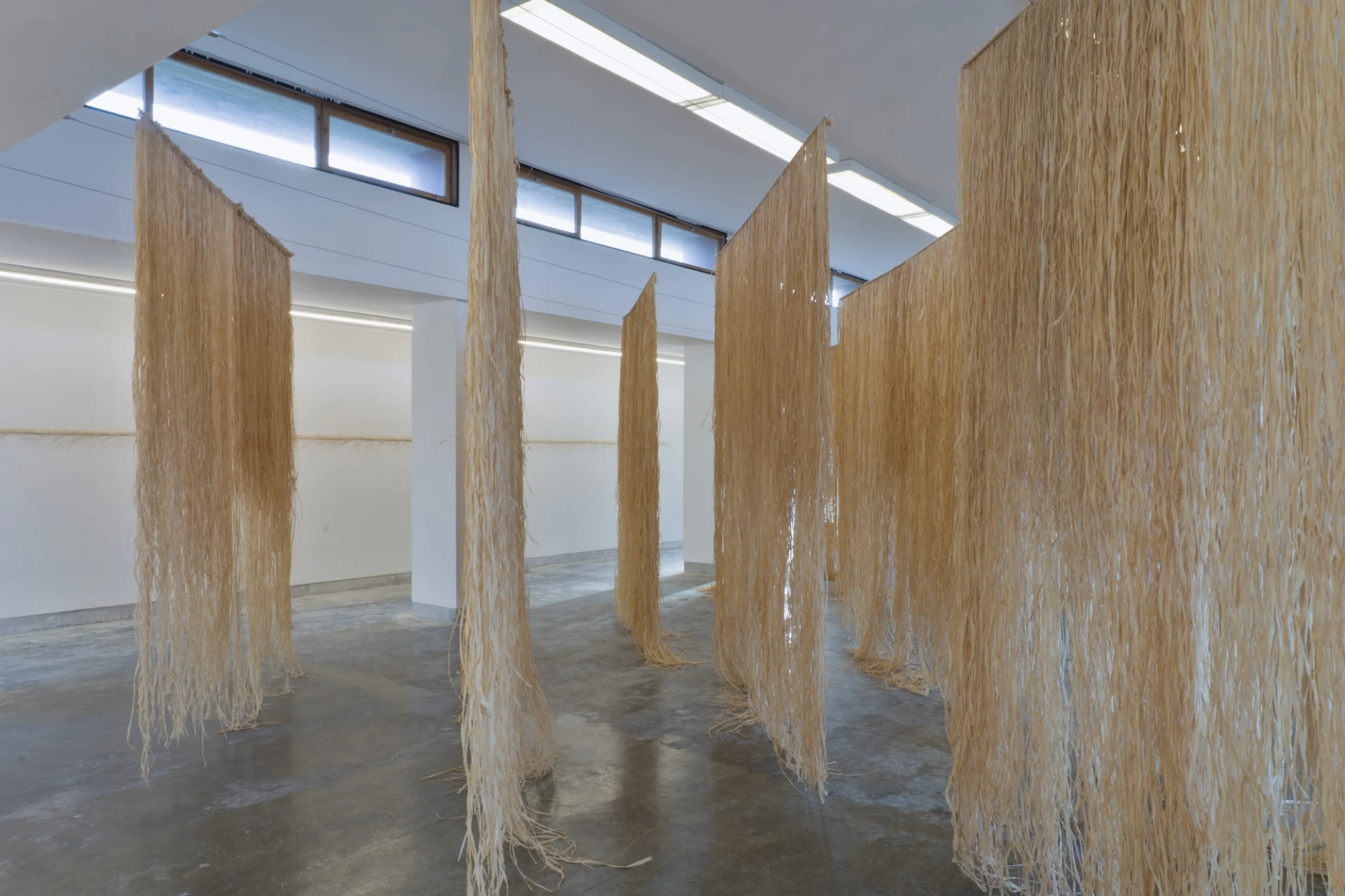
Skill and delicacy of gesture, coupled with a restrained yet intense gaze, are qualities that shine through in the exhibition Uma Árvore by Daniel Moreira (DM) and Rita Castro Neves (RCN). The tree in question is a carob tree that has stood on the ground in the eastern Algarve for several centuries, which the artist duo observed, named and sought to depict over the course of three years. Time is one of the subjects that most occupy the human mind, and this exhibition explores it in a particularly vivid and complex way: whilst DM and RCN’s relationship with that particular tree lasted for three years, this period is brief compared to the carob tree’s lifespan; for its part, the exhibition on display in Tavira is open to visitors (that is, its objects and artefacts arranged in a particular way, as determined by the artists and the curator, Ana Anacleto) for around three months, a substantial reduction in the timeframe of the process of its preparation. What is revealed in this exhibition, then, is not merely the usual collection of works, exhibition pieces or artistic techniques – it is also the necessity and the possibility of accepting (and the willingness to do so), when appreciating art, ideas concerning the limitations of what is observed. It is the tree that imposes this negotiation, for it is the element which, consisting essentially of a time that refuses to condense, allows glimpses of this constitution to be seen. Ana Anacleto puts it this way in the exhibition leaflet, shifting the focus to space, a category inseparable from time: “due to their positioning (they do not move across the territory, but are fixed within it), plants – and, in particular, trees – have developed a superior ability to recognise, well in advance, even the slightest changes in their environment”.
The artists recognised this and sought to convey it, for example, by displaying – alongside fragments and images of the tree itself – traces of an ecosystem that has accompanied it throughout its existence: in the first room, four display cases (built for this purpose by DM and RCN) hold small pieces of pottery and earthenware, fragments of pottery items collected from the ground around the tree at Quinta da Parra (Moncarapacho), arranged as if on display in an archaeological exhibition. A propósito da arqueologia do lugar (‘On the archaeology of the place’) is the title they have given to this collection of pieces, which they describe as ‘gleaned elements and shards of pottery’, and from which they propose interpretations of the social landscape of rural life – such as the story the shards tell of women and men who travelled between regions (primarily from the Alentejo to the Algarve) for the harvest season and who took plates with them for the meals they ate in the fields where they worked. Looking at a tree is not just looking at a tree, and the fascination with the narratives that the tree reveals is the driving force behind RCN and DM’s work. “We didn’t know this,” I heard them say during one of the guided tours of the exhibition: more than a confession or a lament, the phrase serves as a methodological principle of the exhibition: to observe is also to discover that which can never be fully summarised or known.
The very same drive for knowledge and representation that Calderón Quindós spoke of underpins the artistic work of Uma Árvore, but the result is not a scientific entry on a plant (even though one of the pieces in the exhibition, specifically titled ‘time’, includes a print of a ‘tangential histological section of a branch from the carob tree at Quinta da Parra’): it is the construction of a universe that grapples with the elusiveness of time; it is an attempt to reveal what the process of observation was like, to bear witness to a time through edges constructed in anticipation of it, towards its future. Whilst it is impossible to see what this carob tree looked like in 1680, a hollow parallelepiped is constructed which, breaking through the wall, spans two adjoining rooms: the boundary between two dimensions is symbolically torn down, as if traversing space allowed one to traverse different times: on one side, the tree is depicted; on the other, one of its fruits is displayed, blurring the lines between invention and sketch, mastery of time and nostalgia for its loss. What is sought here is not an ethnographic record – yet ethnography forms part of the artistic process, and on display are both the pole used to prune the tree and a burlap sack that forms part of the Municipal Museum’s collection. Both artefacts coexist with pieces created by the artists, whether in drawings or in sculptures made from objets trouvés: a small spade, a rake, an ancient Venus, a pair of eyes formed by two snail shells. To look is not merely to observe, but to invent with what already exists. It is to embrace the creative sap that animates the tree. ‘The fingertips are also the eyes of the observer,’ wrote Calderón Quindós (2018, p. 27), but the two artists behind Uma Árvore could just as easily have said it themselves, for they too assert that “embracing speculation and wonder is part (…) of the open ways of working that we wish to pursue” (2025, p. 36).
There is an undeniable ethical dimension to this interplay between wonder and speculation in the observation of this carob tree. It is by no means insignificant that this is a tree from the dryland orchard, a species that asks for nothing more than attention: to be near it in different seasons of the year, in different years; at different times of day (note the use of light boxes in the beautiful photographs and videos); returning; touching the tree, sketching it, gathering from it and from its immediate surroundings fragments of the environment it inhabits, from which it draws sustenance and which it generates.
The exhibition unfolds continuously through movements of temporal expansion and condensation. Time expands over the three years of observation, in the tree’s centuries-long lifespan, in the indeterminate history of the objects found on the ground; it condenses into a drawing, a photograph, a slice of wood, a seed, a fruit. In the drawings of the cacti that serve as a natural fence around the carob tree (ink lines on rice paper), at the entrance to the exhibition, the presence of the tree is announced. DM and RCN stated (regarding the previous project) that ‘things, materials, have an effective presence in our work. (...) The roughness of a stone, the speed of water, the lightness of a stick, the lingering scent of broom in a room—these are lessons (or prolonged moments of attention?) that are necessary when we wish to work with them. (…) It is like ‘infralabour’” (2025, p. 37), work that precedes the moment of creative decision, just as the sight of the prickly pears precedes the appearance of the carob tree, or its fixation at the time of the exhibition – the latter is bound to disappear, lost in a gallery’s calendar; the carob tree will continue to exist, even if invisible to those who create and to those who visit the exhibition. Art, too, continues.
Uma Árvore confirms the Palácio da Galeria’s commitment to an ongoing programme of contemporary art (as seen, for example, in Gabriela Albergaria’s exhibition in 2022). May Tavira Municipal Council continue along this path and choose other venues for exhibitions of a different nature – which are equally of great interest, but which diverge from the aim of cultivating audiences for contemporary art.
The exhibition is open until October 24, 2026.
.
References:
Manuel Bívar (2021). A Charca. Lisbon: Língua Morta.
Daniel Moreira and Rita Castro Neves (2025). Faca na Pedra Olho Solar. Lisbon: Documenta | Sistema Solar.
Fernando Calderón Quindós (2018). Vegetal Philosophy: Four Studies on Philosophy and Natural History. Madrid: Abada Editores.
BIOGRAPHY
Ana Isabel Soares (b. 1970) has a PhD in Literary Theory (Lisbon, 2003), and has been teaching in the Algarve University (Faro, Portugal) since 1996. She was one of the founders of AIM – Portuguese Association of Moving Image Researchers. Her interests are in literature, visual arts, and cinema. She writes, translates, and publishes in Portuguese and international publications. She is a full member of CIAC – Research Centre for Arts and Communication.
ADVERTISING
Previous
article
08 Sep 2026
A reflection on architecture and landscape by Fernanda Fragateiro at Escola da Vila, Porta 33, Porto Santo
By Joana Duarte
Next
agenda
11 Sep 2026
The Odemira Art and Science Biennial launches its pilot edition between 3 and 5 October 2026
By Umbigo
Related Posts
article
14 SEP 2026
Space and time: lugar-depois, at Museu Zer0
By Ana Isabel Soares
article

09 SEP 2026
The Elusiveness of Time: on the exhibition ‘Uma Árvore’ by Daniel Moreira and Rita Castro Neves at the Palácio da Galeria in Tavira
By Ana Isabel Soares
article
26 AUG 2026
Museu das Expectativas, by Pedro Gomes: What is a museum?
By Ana Isabel Soares
article
19 JUN 2026
Passenger Side: Drift, movement
By Ana Isabel Soares