article
THIS IS (NOT) A CHURCH: Can a church be a place for encounter?
“And so the outline for the 16th edition of Manifesta took shape: This Is (Not) a Church. Building on proposals presented by a team of cultural mediators, the Biennial takes over twelve churches, not with the aim of restoring their religious function, but to explore new ways of inhabiting them. What new forms of community might emerge within these structures? How can we preserve the spatial generosity of architecture designed for gathering, whilst opening it up to new social realities? And, if architecture played a central role in the post-war reconstruction of the Ruhr, can art today contribute to a new form of reconstruction?”
For over three decades, Manifesta has travelled across Europe as a nomadic biennial. Each edition is temporarily based in a city or region, seeking to respond to the specific social, cultural and spatial characteristics of its host territory. Rather than simply moving an exhibition from one place to another, Manifesta seeks to understand a place’s invisible infrastructures, the spaces that shape everyday life, the institutions that sustain local communities, and the buildings whose future remains uncertain.
But how, after all, can a nomadic biennial produce something meaningful for the communities that host it? The risk associated with nomadism is evident: a certain narcissism disguised as cosmopolitanism, a self-centredness that tends to place the biennial above the local community, and an elitism that contributes little (if anything) to the concrete realities of the territories where it is held. Whilst this is a risk inherent to the nomadic condition, when executed well, nomadism may, on the contrary, enable the biennial to establish itself as a space for listening: an external perspective, without for that reason being any less attentive to the territory. For this to happen, the process of building Manifesta begins long before the exhibition opens to the public, through sustained research and interdisciplinary collaboration.
It was on this basis that the 16th edition of Manifesta took place in the Ruhr region of Germany, between 21 June and 4 October 2026. Designed in collaboration with the architect and urban planner Josep Bohigas, this edition is based on a territorial study that sought to understand not only the region’s historical and cultural context, but also the series of transformations which, over recent decades, have forced it to renegotiate its identity. Deeply shaped by heavy industry, mining and steel production, the Ruhr is one of Europe’s largest metropolitan regions and has a unique urban morphology. Unlike the monocentric model of many European capitals, it takes the form of a sort of urban archipelago, a constellation of cities and urban centres linked by an extensive infrastructure network. Beyond this geographical distinctiveness, Ruhr is a particularly fertile ground for reflecting on some of the pressing issues facing contemporary Germany: profound demographic changes, the industrial crisis and high unemployment rates, alongside the gradual decline of the church as a central institution in community life.
Germany has more than 40,000 churches, and more than half of them are thought to have lost their religious function over the past decade. The scale of this phenomenon, however, goes beyond the preservation of built heritage. Historically, churches have been much more than places of worship; they have been spaces for gathering and socialising, closely linked to education, music, charity and mutual care, where a shared future was forged. The gradual disappearance of their religious function thus raises a question that is both social and spatial: what should be done with buildings that continue to occupy a central position in neighbourhoods, but whose original function is in decline?
In Ruhr, this issue takes on particular significance, given the historical link between religious architecture and the region’s processes of reconstruction and transformation. The destruction wrought by the Second World War was followed by an ambitious process of urban reconstruction, in which churches played a central role. Particularly in the post-war decades, numerous religious buildings were erected, reflecting the reorganisation of everyday life. The architecture of these spaces reflected the spirit of an era: modernist, experimental and, in many cases, designed to foster community, contributing to a broader community infrastructure. Today, many of these churches lie abandoned and/or have been deconsecrated; some face demolition, others privatisation or conversion into commercial premises. Faith also appears to be in decline, and Christian churches, entrenched in their Code of Canon Law, are proving incapable of welcoming the growing Muslim population settled in the region. Now, if the Church no longer fulfils – whether it is unable or unwilling to do so – the role of a meeting place that it has historically played, whether due to the decline in religious practice or to demographic changes in the region, the question then becomes how this collective dimension can survive beyond the institution itself. It is urgent to find other purposes for these buildings.
And so the outline for the 16th edition of Manifesta took shape: This Is (Not) a Church. Building on proposals presented by a team of cultural mediators, the Biennial takes over twelve churches, not with the aim of restoring their religious function, but to explore new ways of inhabiting them. What new forms of community might emerge within these structures? How can we preserve the spatial generosity of architecture designed for gathering, whilst opening it up to new social realities? And, if architecture played a central role in the post-war reconstruction of the Ruhr, can art today contribute to a new form of reconstruction?
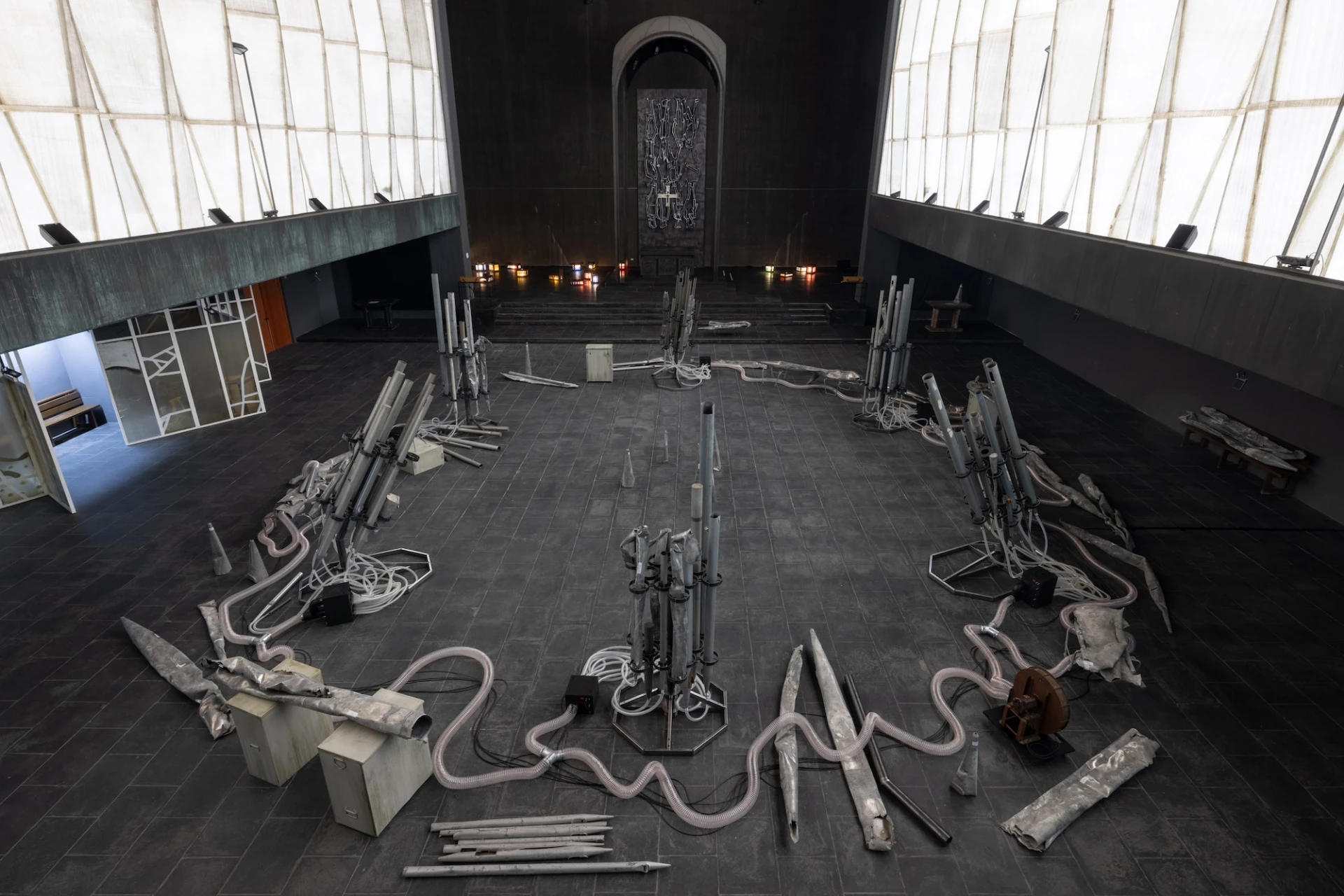
It is around these issues that Manifesta brings together a group of artists and projects which, from different perspectives, explore the myriad challenges facing the region. Particularly noteworthy are those who have opted for a more literal approach, drawing on forms and symbolic elements from religious architecture. In Duisburg, at the Kulturkirche Liebfrauen, Abbas Zahedi takes the church’s old organ – an instrument that has been out of use for several years, with many of its pipes missing – as his starting point to create Ouranophobia 47051 (2026), an acoustic installation made from organ pipes sourced from various European churches. For the artist, the silence left by the old instrument is a sign of the disappearance of a sense of faith and a shared experience. His response, therefore, involves reconstructing the organ according to a different logic. Rather than reproducing its vertical and hierarchical structure, the new instrument expands horizontally throughout the space, transforming itself into a platform for collective listening.
In a similar way, drawing on the image of a bell, Mariana Napushkina presents Kein Gelaut (2026), an inflatable sculpture installed on the lawn in front of Gethsemane Church. The work recreates the shape of a historic bell produced by the Bochumer Verein für Bergbau und Gußstahlfabrikation, which was originally part of the church destroyed during the war, and transforms it into an object of a radically different nature. The lightness and interactive nature of the structure contrast with the inscription ‘We’ll never go back!’, creating a tension between play and the experience of displacement to which the work alludes. In Naprushkina’s practice, shaped by the political realities of Belarus and the conditions of displacement and exile in Europe, the bell—traditionally associated with summoning and bringing together a community—becomes an unstable, suspended object, unable to find a place to settle. The work thus alludes to the experience of communities with migratory histories, within a European context marked by the tightening of immigration policies and the so-called Migrationswende.
In other churches, the artists’ focus shifts towards creating a moment of encounter. Sometimes (so often), this collective experience is evoked through sound – as, indeed, was announced at the Biennale’s press opening, which was accompanied by the Duisburg Philharmonic Orchestra. Elsewhere, this gathering takes on a playful character. In FAIL LOUDER (2026), the Catalan collective Cabosanroque transforms St Ludgerus into a basketball court. Sports equipment fills its central nave, and the organ has been adapted so that the impact of the ball sets it in motion. The church is thus transformed into a commonplace for practising sport, for making mistakes together, as loudly and melodically as a church organ. This is also the case with Analı Kızlı — With Mother and Daughter (2026), by Mehtap Baydu, presented at the Gethsemane-Kirche, situated in an area of Bochum characterised by a strong Turkish community. The meal-performance involves eleven women from the city, who have formed a collective to cook a meal, reclaiming a close relationship between food, language and gender. In Turkish, several dishes have names that refer to women or parts of their bodies, such as Dul Avrat Çorbası (widow’s soup), Dilber Dudağı (beloved’s lip) or Analı Kızlı (with mothers and daughters). In this context, food also becomes a matter of language. A meal ceases to be merely something shared at the table and becomes, above all, a way of fostering a sense of community – whilst, at the same time, questioning the linguistic structures that underpin it.
This encounter can take many different forms, and it is interesting to note that it is both human and interspecies. The School Non-Cyclopaedia — A Living Language Archive of the Classroom (2026), by Julia Nitschke, for example, reinterprets the idea of the dictionary and the encyclopaedia from a feminist, queer and poetic perspective. Replacing the normative definitions that organise knowledge, the project proposes a living archive rooted in subjectivity, contradiction, humour and creativity. Pupils, families and neighbours become the authors of a shared language, producing texts that record the multilingual reality of the classroom and celebrate everyday languages, dialects and sociolects. In her book All About Love, bell hooks writes about the importance of finding a common language to think about love: ‘Imagine how much easier it would be to learn to love if we started with a shared definition’. Similarly, Julia Nitschke revisits the idea of constructing a common definition as a first step towards understanding. Defining and naming is, after all, a first creative act – and it is just as necessary to find a common language as it is to recognise that this is not fixed, but collectively constructed and negotiated.
This negotiation, in fact, transcends human language. In Antifascist Bird Communication System V02.1 (2026), part of the Radical Climate Action Bird project (2025–ongoing), Dennis Siering explores the potential for communication between humans and birds through birdsong. In collaboration with ornithologists and sound designers, and using artificial intelligence, the artist has developed a series of solar-powered sound installations that translate anti-fascist melodies and protest songs into ‘artificial birdsong’. The blackbird, known for its ability to learn and for the persistent presence of its song in urban spaces, becomes a kind of voice of resistance that can be heard and reinvented. By embedding protest within nature, Siering envisions another form of community, beyond the boundaries of the species.
The idea of encounter — multifaceted in its essence — seems to converge, in different ways, on a single theme: the building of a house. At St Marien’s Church, Annika Kahrs presents Le Chant des Maisons (2022), a video installation that combines sound, movement and architecture. Filmed in a deconsecrated church in Lyon, the work documents a collaborative performance between musicians and carpenters who are building a wooden house inside the church. The structure gradually takes shape to the sound of hammers, screws and the tools used in its assembly, transforming the act of building into a sound composition. Among the many works presented by the Biennale, this is perhaps one of the images that best encapsulates its vision. Le Chant des Maisons reminds us that spaces can be transformed collectively and that, within a building that seems to have lost its function, other ways of inhabiting it can still emerge. There is, after all, a possible home within each of these churches.
After this edition, Manifesta will continue its journey through other regions. In 2028, it will take place in Coimbra, in an unprecedented model of co-creation with Anozero — Coimbra Biennial of Contemporary Art. The decision to partner with a biennial already firmly established in the region extends, in a way, the premise of this edition, fostering the longevity of the proposals presented. Whilst in Ruhr the approach involved listening to existing structures and revitalising them through art, in Coimbra the challenge will be to continue this work in collaboration with a community and an institution that are already established in the region. In this case, the ‘home’ will not need to be built from scratch, but simply inhabited together.
BIOGRAPHY
Maria Inês Mendes is studying for a master's degree in Art Criticism and Curatorship at the Faculty of Fine Arts of the University of Lisbon. She completed her bachelor’s degree in Communication Sciences at NOVA University Lisbon and wrote about cinema for CINEblog, a website run by NOVA’s Institute of Philosophy. She is currently in charge of managing UMBIGO online, where she publishes regularly. Contributes to BEAST – International Film Festival and À Pala de Walsh.
ADVERTISING
Previous
article
27 Aug 2026
ARQUEOLOGIA REMIX: On Time and Its Uncertainty
By Guilherme Sota
Next
article
02 Sep 2026
Serapinas and Ourahmane at the Porto Municipal Gallery
By Mafalda Teixeira
Related Posts
article
01 SEP 2026
THIS IS (NOT) A CHURCH: Can a church be a place for encounter?
By Maria Inês Mendes
article
14 JUL 2026
To Whom It May Concern, at Carpintarias de São Lázaro
By Maria Inês Mendes
article
02 JUN 2026
¿De qué casa eres?, by Ana Pérez-Quiroga
By Maria Inês Mendes
article
11 MAY 2026
Brief notes on Art Brussels 2026
By Maria Inês Mendes