Article
Could the Venice Biennale kill?
Sometimes, it is worth remembering the privilege of encountering work that is good and inspiring.
A deafening resonance chamber.
Or something like that.
What critics write should not be separated from the social and professional phenomena from which it emerges. This is especially true of a dying profession – many would say already extinct – in which individuals seem to justify their relevance in the face of the world's deafness. Critics are not immune to validation phenomena, which, over time and by force of circumstances, transform into self-validation phenomena within the niche of specialised journals, subject as they are to the economy of attention and knowledge promoted by social networks. This means that criticism – even criticism – suffers from the same symptoms as the commentary that has become accustomed to easy, superficial, hasty, limited criticism, in search of epidermal irritation, confusing art with politics, politics with art, and institutional criticism with art criticism. Or, even more perverse, forgetting one type of criticism in favour of another. What sells is what’s easiest to digest and most likely to spark controversy, whether or not it’s proven true, because the algorithm’s law—built on the simplest passions and instant irritation—reigns supreme.
This means that, in group phenomena, criticism tends to align with issues that are already established. Institutional criticism is easier to undertake than art criticism, which calls for more time, dialogue, consideration, and, above all, introspection and subjectivity. Art criticism draws on History and Truth, both of which require the leisurely pace of turning pages and the weight of books.
In other words, criticism – even criticism – is a reflection of the times in which it lives, the means by which it is practised, and the civilizational portrait that contemplates it. Criticism does not arise from the abstract.
It's not that institutional criticism is incorrect or seems implausible. No. That's not the point. All institutional criticism has a reason for being, scrutinising – although less and less – the networks of power and hierarchies that operate behind the scenes of art institutions.
It's more about recognising that a certain type of criticism tends to replace another, forgetting the ontology or essence of art criticism itself.
Specifically, it's easy to criticise the political positioning of certain institutions and the (yes, neoliberal) framework in which they operate. But it's harder to accept that this criticism, too, must exist within the (also neoliberal) environment surrounding the economy of knowledge, given the web of dependencies shaping the means that make it possible. Let's be honest: nobody can live like Diogenes, by the roadside or in a cave, because, ultimately, domestic reality—everyday reality, if you prefer—will always tend to speak louder. And, vanity of vanities, that Italian or French item of clothing would be suitable even for inaugurations, even if it came from Humana.
This responds to the already exhausted discussion surrounding the 2026 Venice Art Biennale, from the central exhibitions and curatorial choices to the national representations, in a world – especially the art world – that operates beyond that, assuming a more post-national than national character.
To reiterate, in this case it is fair to criticise the ideological frameworks of certain countries, notably the United States of America, Israel, and Russia. It is fair to criticise the European Union’s (hypocritical) relationship with the Biennale, and it is both fair and essential to discuss the funding and the Machiavellian logic behind it. But is it fair to forget the works of art—to cancel or confine them—that occupy these countries’ pavilions? Can an artist work beyond political and national issues, accepting nothing more than the gravity of matter, the body, and gestures? Would that make their work any less valuable, relevant, or interesting? Amid all that has been posted on the social media accounts of specialised magazines—comments, memes, and judgments—where is the art criticism? Where is the criticism that reveals what lies dormant beneath the fury of the moment?
That said, maybe it's time to return to the critique of the critiques of the Venice Biennale. The truth is that there has been a disproportionate amount of what has been written, commented on, and judged regarding the Biennale.
But this is not where such an undertaking will begin, because here we prefer to frustrate expectations.
The Breath of Time.
Alma Allen's work in the United States pavilion is a marvel of technique and a surrender to the material nature of sculpture. Allen takes us back to the plasticity of art and the genius of an artisan who manages to infuse stone and metal with a divine breath. The biomorphism of the pieces, the undulations carved from the material, the sheen of the surfaces, and the mineral textures of the rocks are worked beyond human capacity. Allen dematerialises the rigid, imposing nature of the stone, playing with the veins and the metamorphic composition of minerals and sediments. Everything seems to share a lightness that was experienced three centuries earlier by Giuseppe Sanmartino, when he made stone into a veil resting on the death of Christ.
Everything has a soul, a wind that animates and makes the stone and metal swirl; sometimes the pieces resemble a handkerchief thrown haphazardly into the agitated atmosphere of a coastline. At other times, a malleable, twisted body adjusts itself to the gaze of the artist and the spectator; perhaps something akin to the liquefaction of a hard compound – the trunk of a very old tree, which seems to melt into drops in a round lobe of water, with the rings of time bordering the warm, deep brown surface. The pieces implore what is forbidden: touch. The sensuality of the forms begs for an embrace, a prolonged caress with the fingers, the palms of the hands, allowing us to listen to their matter, to what is cold, soft, or rough about it. It is not only the artist's carnal surrender to the works, but also the spectators'. And it is in this tension awakened by a forbidden temptation that the artist moves the human psyche and compels it to an imaginative effort born from the restraint of the body, which can only have gaze, time, and movement, but never that complete surrender that the body makes one yearn for.
Ultimately, it is the nature of the artwork itself that is also worked on by the artist – this magnetic condition between a body that pleads and a culture that conforms and makes it retract gives art a unique character.
Discreetly located in the Arsenale rather than the Giardini, the Israeli Pavilion presented a moving work. A black rose rests on the white surface of artificial ice inside a freezer. Rose of Nothingness emerges from a broth of life and death, from the chaos and suffocating order of the Third Reich, from despair and pain. As the text points out, it is a flower sprouting from the bitterness of Paul Celan's black milk, made of death upon death, madness, and profound fear. In the installation that follows Rose of Nothingness, Belu-Simion Fainaru immerses us in this despairing milk, mindful of the history of the people he carries with him and of the critical moment his country is experiencing: an era without principles, marked by disenchanted generations, hopelessness, and a complete neutralisation of their political agency. The black pool, filled by drops and waves of tears falling from the ceiling, becomes a mirror of a kind of self-annihilation, a self-liquidation that dissolves the viewer's face in the destructive miasma they inhabit—and have helped create through their silence, apathy, and anomie.
But none of this is popular.
In fact, all of this is quite unpopular.
Criticism, however, must distance itself from popular media if it wants to pierce the fat of the times and the breath of an era entrenched in contradictions and violence. Criticism goes against the current, reluctantly, according to the taste for what is unpleasant. It is an inglorious task, which aspires to nothing beyond the truth – that one – that very truth! – which has ceased to matter, which has succumbed to the fascination of lies and power, and is always inconvenient to criticism itself.
Looking at these artists and their works is more difficult than looking at a reality that enters an echo that expands into indifference. Taking the opposite path... that should be the way of criticism.
Bodies, Bodies, Bodies.
And everything is sperm, faeces, and urine. The scatological principle of life is funny because it is the truth of the human animal. We try to hide and repress what seems to us to constitute a natural indignity, when we find ourselves at the mercy of a body capable of interfering with the most Apollonian designs of the human being. In a global community that is only culture, that has become bourgeois to avenge Culture over Nature, looking at the scatological gene is an exercise of immense discomfort. Because here inside, in this unfathomable core of viscera and pain, we know ourselves profoundly as animals, nothing more than an eccentric appendage created by nature, which believed it had autonomy over the cosmos and its flesh.
It is important to remember, however, that in the Portuguese language the term "escatologia" [eschatology and scatology share the same word in Portuguese] has a double meaning, covering two distinct concepts. The study of excrescences follows the Greek etymology of skatós. This is the case in the Danish Pavilion, the Luxembourg Pavilion, the much-publicised Austrian Pavilion, and also in the Japanese Pavilion (one of the most complex from a social and ethical point of view). But the study of humanity's ultimate destiny, based on History and Theology, is actually rooted in eschatos. And in this case, we have the Greek Pavilion, with a huge escape room, a historical legacy from which the people cannot escape and which binds them in a perpetual fact.
The global decline in fertility rates was the key impetus behind Maja Malou Lyse’s design for the Danish Pavilion. Yet despite the gravity (?) of the subject, artist and curator Chus Martínez does not treat it as an entirely serious matter. The fertility industry provides the backdrop for a vaguely pornographic film in which three actresses run a sperm donation clinic. Like the fragmented video, the room is elliptical in shape, as though we were inside a centrifuge. The fragmented dialogue sketches a narrative that prepares viewers for the procedure and, through irony and satire, evokes the gender politics involved in reproductive politics. In the opposite room, refrigerated sperm containers are accompanied by short videos of sperm races. Two men ejaculate into separate cups; professionals then collect the samples and place the sperm in Petri dishes to start the race, with each sperm viewed under its own microscope and connected to global cybernetic transmission networks. This is not fiction: the race exists, has its own website, and uses the slogan, "the world's smallest race". Its aim is to determine whose sperm is the most vigorous and fastest, though it remains unclear who crossed the line first. The bizarre and absurd elements highlight an anomaly: the sperm used in these recreational shows already exhibit declining quality, with motility growing weaker among men with Alpha aspirations. The effect, then, is always the same: the strongest, the fastest, the most lethal, and the most efficient… even as biology points in the opposite direction.
Within this project, as ambitious and vast as it is complex, the image—and its production and reproduction—is subjected to a critical examination of its many uses. We already know the political and social power of the constructed, manufactured, and designed image, created to tell a story and serve as a historical device. Yet images made for biological purposes often escape broader discussion. The image seduces and gives pleasure, activates libido, and serves, in short, as an engine for the global reproductive machine. But it also numbs and tires, leading the eye back to a desensitised spirit. The spaces and videos conceived by Malou Lyse enter a cyclopean, all-encompassing stage where the image appears more exciting than reality itself, now aided by augmented-reality systems of reproduction and visualisation.
Also on the subject of reproduction, and in a satirical way, the Japan Pavilion presents a maternity ward where visitors are invited to care for a plastic doll. The doll is, of course, an emulator of a six-month-old baby, some from another time, others born against the backdrop of global pessimism about the future and what some might describe as the "maturation" of bourgeois societies, in which birth rates cease to be a life goal, given the constraints and implications for family life.
Still, given the contexts in which the work was born, it seems to reflect on contemporary parenting, as if a newborn’s life were a continuous performance shaped by the social and media exposure families face. Choosing the baby, photographing ourselves with it, embarking on this pathetic journey... all of this serves the neurosis of a family governed by global aesthetic currents, without the support of generative design or the care-greater-than-love that natality presupposes. The parody lies in us and in the simulation we agreed to complete. We walk the baby, make him dance, make him burp and take a bottle, and finally change his nappy, with a QR code printed inside. Social commentary overlaps with historical commentary: after all, babies have an identity, a date of birth, and a location, all tied to historical moments.
And it is in the parody that we remain.
The Luxembourg Pavilion presents what will be the group’s most bizarre proposal: an epic about eschatology or the purity of human culture in the face of ineluctable nature. There is something Freudian and sadistic in the way Aline Bouvy treats her work – a child playfully rummaging with a stray twig at the faeces she has just thrown on the forest floor. Like someone who discovers, in amazement, what they have just produced with their body, and looks, amazed, at the matter so deformed, so ugly, that it came out of itself – another body, lying on the ground; an alien form that gains autonomy in the satanic imagination and is prohibited despite good and golden societal norms. The abject is rejected, as is otherness, strangeness and difference in life. The abject is located in that place of shadows, when there is still no discernment of that reality, or when the mental faculties regarding it have been lost. The abject punctuates the extremes of indignity, of childhood and old age, when control is lost, when we can no longer hold back the collapse of nature upon us. It is the horror of the bowels and the fear of the abyss.
Sometimes playfully drawn from sci-fi, sometimes documentary, La merde (2026) parallels Piero Manzoni’s Merda d’artista (1961). Both expose a divide between the value of artistic labor and its commodification—the culmination of an Apollonian system—by revealing how much it rests on the arbitrariness of language. This market system is one of the hypermodern era’s great achievements, shaped by mathematical order and humanity’s industrious drive to transcend reality. Yet this reality allows neither natural entropy nor forces that run counter to progress. Bouvy and Manzoni share an “anti” logic: anti-commodification, anti-art, anti-certainty. They invoke the fetishes of consumption and offer a deeply critical view of the art world’s neurotic, delirious—and, one might say, anal—celebration. But just as the video threatens to become too cerebral—like this text’s introduction—a tear appears at the lower eyelid, bringing with it the absurdity, laughter, and empathy we have developed for Bouvy’s shitty character.
In minor keys.
And whatnot.
Following a curator's premise for an exhibition gives too much power to the curator. Suddenly, a work of art is forced into a text foreign to its nature, where the concept cannibalises the viewer's subjective gaze, and the figure of the curator – who should operate in a mediating shadow between entities – gains an obtuse preponderance. Suddenly, still through the voice of the curators, the work of art is forced to "speak" of life rather than of art. But this is just a very irrelevant and unorthodox opinion. It doesn't really matter.
Notwithstanding this criticism, there were those who did so and succeeded in the task initially proposed by Koyo Kouoh.
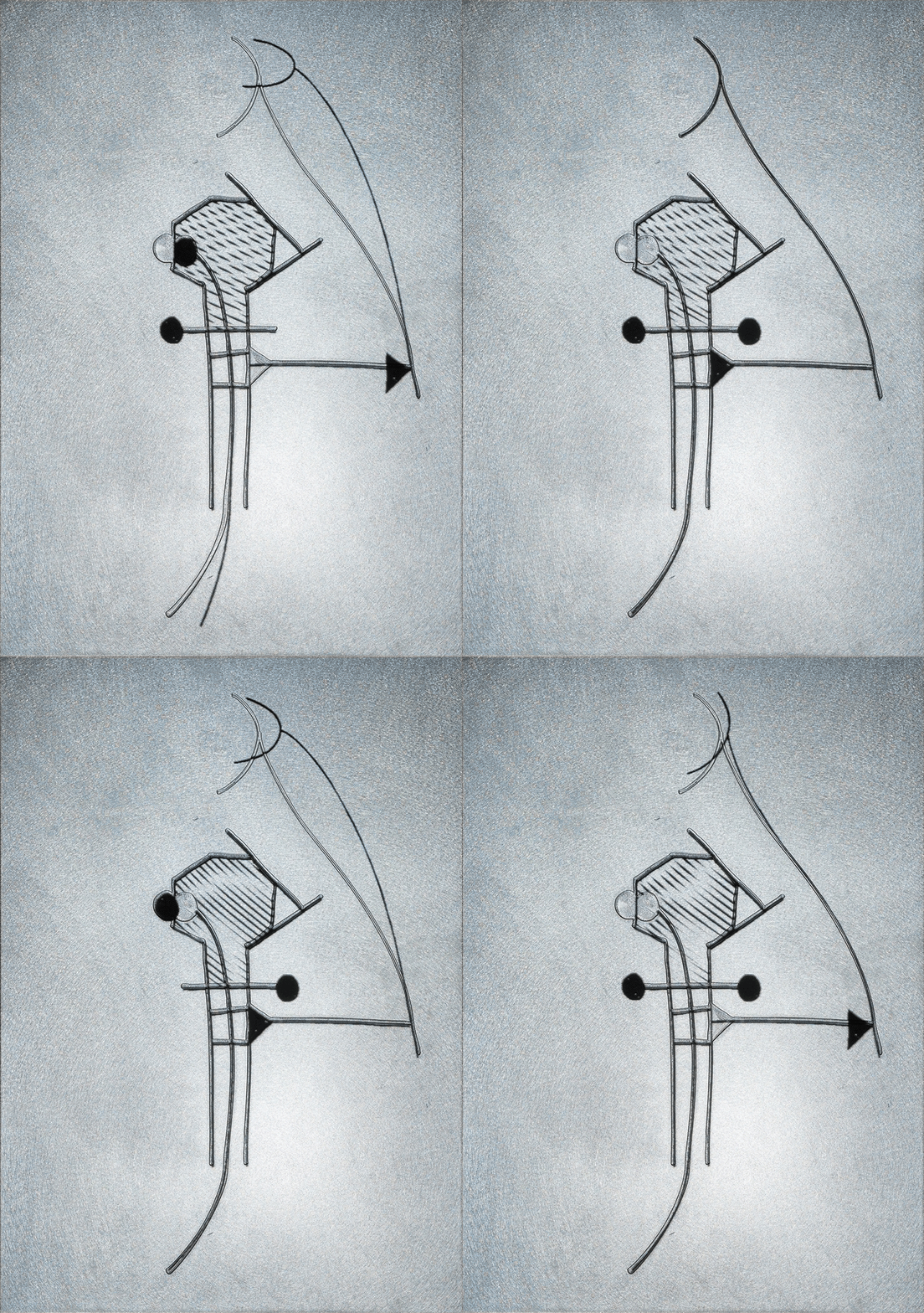
The Portuguese Pavilion stands out in this group, in a project that intelligently transcends "themes," "concepts," and "keywords" to be simply and solely art. The strength of Alexandre Estrela's work lies in its ability to reflect on time while simultaneously reflecting on art. The complex forces of nature and the human ingenuity needed to interpret and then deify them coexist within an installation essay that inquires into the design and compositional nature of images and landscape. The design is a journey that transforms into small pictograms animated by engineering and programming. The image obeys the design carved into the aluminium plates, in an endless pendular motion. The trance of the earth is felt later, when imperceptible earthquakes are captured by planetary sensors and make the walls of the pavilion tremble… this trance, it was said, is born there, in this design of rhizomatic circuits, which is first and foremost absolute sensoriality. The design reflects the nature of Estrela's work, which arises from a mediation between various technological and production fields. It is in it that we see the digital, computational, industrial, and scientific entanglement that generates images.
In a completely different register, Chiara Camoni also awakens the dormant sonorities of the fable. The chorus of clay figures and branches greets us in the murmur of twilight. Wandering among the sculptures is a profound, dreamlike experience, an indulgent sleep by the water's edge. In both naves, Camoni conjures a scenario of unfinished spaces – mental images of lived, occupied places, drawn from a repressed, forgotten memory or from "the good old days." We meander in the silence the pavilion's atmosphere demands, respecting the formation and deformation of the bodies, the evanescence of these images and places. We share a little in the stillness of things, in an event that demands the almost athletic stamina of a sport with a defined finish line. And what a pleasure it is to linger in Camoni’s art.
America, again.
Beyond each pavilion’s national ambitions, satellite exhibitions are also must-sees. These include Helter Skelter: Arthur Jafa and Richard Prince at Fondazione Prada Venezia, and Canicula, presented by the Fondazione In Between Art and Film at the Complesso dell'Ospedaletto. Both exhibitions strike a difficult balance: their art is of its time while exposing its own imagistic condition.
Jafa and Prince grapple with a society governed by images and with a fertile lexicon of appropriation and assemblage that dislodges images from their origins, placing them in diverse, contradictory, fictitious narratives where truth, fact, and authenticity no longer matter. The artists understand this better than anyone: images generate more images, especially in a fractal era of branching realities and micro-realities. Helter Skelter traces the acculturation of the American image within global ideology and the oracular character it gains through its power. As Marie-José Mondzain wrote in her essay Can the Image Kill? (2017), “has persuaded all powers, from East to West, that whoever seizes visibility is master of the kingdom and organizes the policing of gazes.” Jafa and Prince readily grasp this idea. Rather than deny it, they turn the image against itself, then re-signify it through micropolitics—as an expression of liberation movements, the anti-racist struggle, and resistance to state violence and war.
The questions are less settled in Canicula, where each work and room seems to cast new suspicion on the ontology and hermeneutics of images. It is America again, even when it is not, in its most explosive, cyclopean, demented, or corrosive form. Here, the image is a virus. Rather than call for the “image fast” once sought for spiritual reflection, it seems to infect viewers with new, diffuse images of despair and a future without redemption. The image is revelatory, claiming moral authority while remaining aware of its own ambiguous, malleable nature—and of the fictions it can serve. If the image has no autonomy, it is doomed to become an alien tool of the political and visual spectacle that shapes our days. Spectacle is everywhere in both exhibitions: in Jafa’s massive, weighty sculptures, which seem poised to topple the palazzo’s foundations into the Grand Canal, and in the fluorescent, stroboscopic kineticism of Canicula’s installations, which transform the complex’s baroque architecture and hospital wings.
The Venice Biennale is always a site of contention. Inequality among participants is stark, funding remains opaque, and the art does not always meet expectations for the world’s oldest biennale. Even so, it remains the best time to experience art and exhibitions of high production standards—and always will be.
Sometimes, it is worth remembering the privilege of encountering work that is good and inspiring.
Until 2028.
BIOGRAPHY
José Pardal Pina has been the associate editor of Umbigo since 2018. He has an Integrated Master's in Architecture from Instituto Superior Técnico, Universidade de Lisboa, and a Post-Graduation in Curatorship from Faculdade de Ciências Sociais e Humanas, Universidade Nova de Lisboa. Curator of the Dialogues (2018-2024) and Landscapes (2025-) projects in Umbigo.
ADVERTISING
Previous
Article
10 Nov 2026
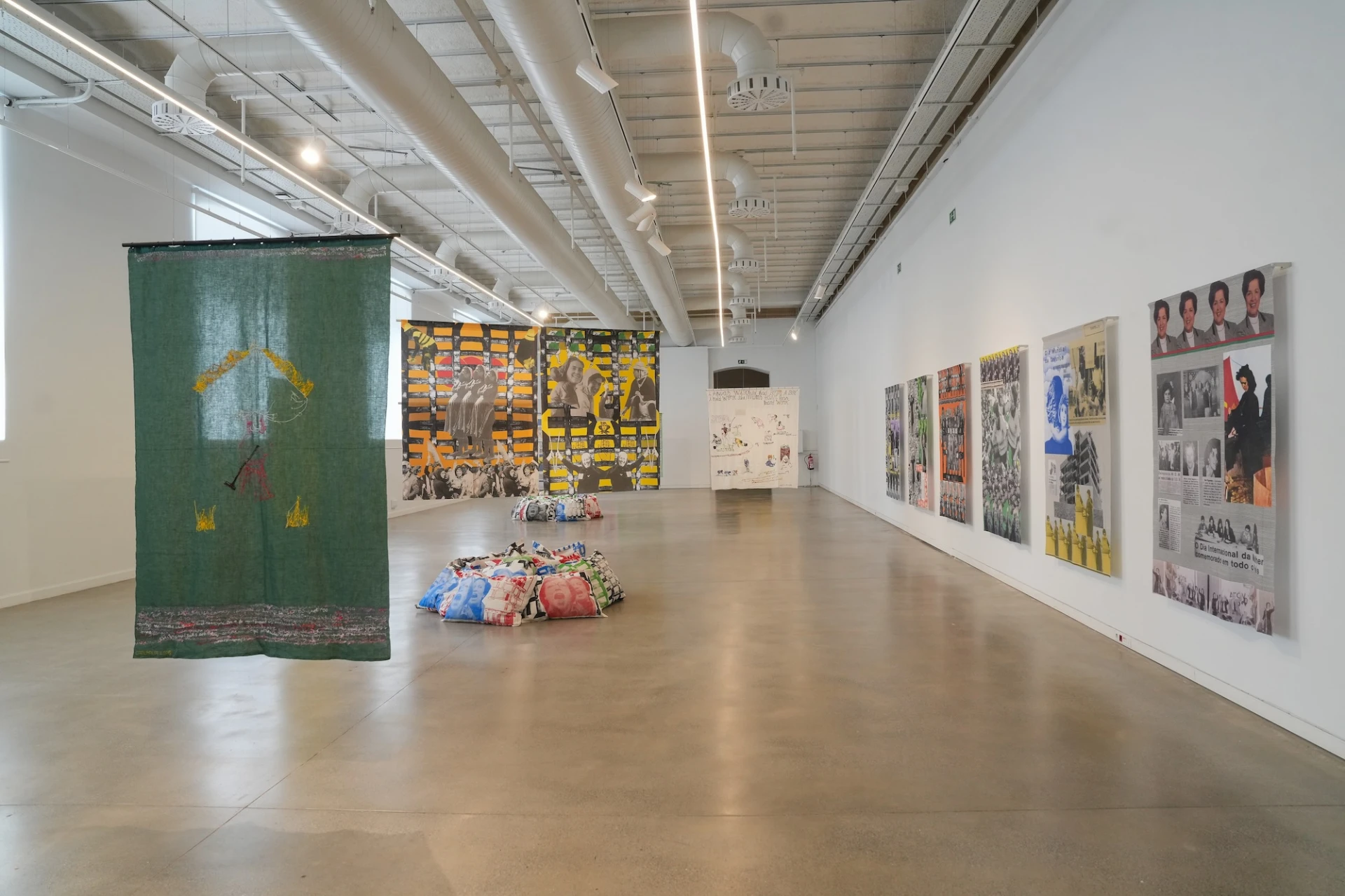
How many hands does it take to embroider a memory?: "KOOPERATIBA", at Tabakalera, in San Sebastián
By Maria Inês Augusto
Related Posts
Article
10 NOV 2026
Could the Venice Biennale kill?
By José Pardal Pina
Article
15 JUL 2026
Sacred Heart, at Fundação Eugénio de Almeida
By José Pardal Pina
Article
01 JUL 2026
landscapes change places… at the Fundação Eugénio de Almeida
By José Pardal Pina
Article
19 MAR 2026
A Oferta, by Jaime Welsh
By José Pardal Pina