article
A Oferta, by Jaime Welsh
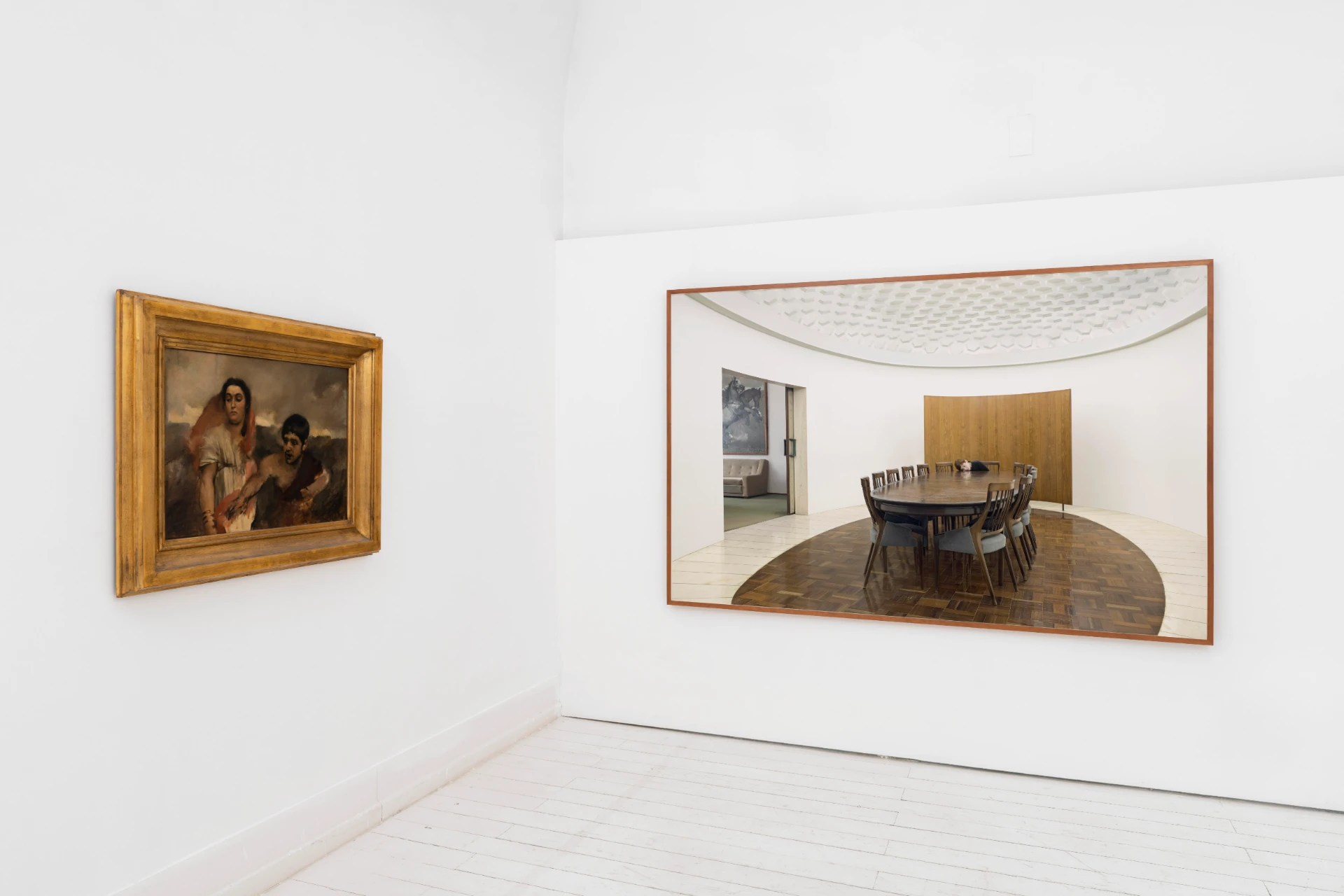
“In A Oferta/The Gift, there is a dialogue between two entities: architecture – with its orthogonality and sharp line design, thus bringing the field of drawing into photography – and the child. Both take on the form of plastic bodies, whose subjectivities and identities are constructed gradually and mutually, bargaining for a way of life or identity.”
Jaime Welsh’s work compels us to contemplate the construction of images and the structures that shape them. There is no word to guide us in this quest or inquiry. But there is a paratextuality that forces us to read beyond the photographic representation: environment fabrication, gaze economy, photography ecology, human presence that creates tension and polarizes, the entire architectural setting and contrast between small human beings and an overwhelming monastic space of rigid, cold grids and geometries, sober modernity set against Baroque construction—deeply controlled and choreographed—in short, the mise-en-scène prepared before the shutter is released. Welsh's photographic image does not simply happen, as the instantaneity that the mass circulation of photography and images has come to embody, cementing a new ontology and a different hermeneutics of the media, visual devices, the everyday, reproductions, works of art, and the (media) culture in which they are embedded; the photographic image in Welsh is produced through an investigative, compositional, thoughtful, and meticulous logic, superimposing modern architecture onto the bloodless emotion of bodies. This psychic tension is always suggestive of complexity and contradiction during its interpretation, because, although it does not stem directly from a mass visual culture, it is nonetheless produced in parallel with it.
His work's hyper-aestheticization may represent a return to pictorial tradition. Something akin to a new pictorialism, unafraid of quotation and pastiche, while simultaneously proposing a thorough and radical understanding of the very logic that precedes and follows contemporary image-making. There is an attempt to reestablish a visual and compositional tradition prior to a supposed break brought about by the advent of photography, which, rather than forgetting centuries upon centuries of a culture and practice bequeathed by the masters of the past, draws upon them to inscribe the image within this long lineage of Western culture that was early on built upon images, when Catholicism accepted representation and the image as vehicles of faith throughout Europe.
But there is more.
Welsh crafts images that share the same enchanting quality as those produced and reproduced by the media and the capitalist system. While these images may fade away, it is also quite possible that they will become imprinted onto our subconscious, bathed in device-generated blue light, and remain there as a palimpsest of expressions, atmospheres, and gestures that will eventually feed into the production of further images and be established by those preceding them.
In A Oferta/The Gift, there is a dialogue between two entities: architecture – with its orthogonality and sharp line design, thus bringing the field of drawing into photography – and the child. Both take on the form of plastic bodies, whose subjectivities and identities are constructed gradually and mutually, bargaining for a way of life or identity.
Nevertheless, this plasticity tends to exist more on the human side than on the built side. The tyranny of modern architecture, madly championed by Le Corbusier, for example, alienated bodies and subordinated them. The spaces Welsh photographs are not subject to major changes, because they carry a heavy legacy; museumified remnants of a past and heritage-designated time. They are monuments of power, “boxes” that imprison and generate conflict. Concrete is hostile. Concrete, as Anselm Jappe points out, is “the weapon of capitalism’s massive construction.” And brutalism was already brutal before it became brutalism, when modern architecture opted for brutality.
With its institutional and vaguely oppressive gravitas, the architecture of the modern era and the Estado Novo makes a recurring appearance in his body of work. These are places where symmetry conveys order and an ideology, with flat surfaces of polished stone and a clinical, cold sobriety that imposes itself upon bodies, thereby meticulously controlling flows and thwarted desires. There are no atmospheres, no plays of light and shadow, no mystery. All of the architecture's seduction lies in the rigorous adherence to a mathematical order, which is quickly discovered and quickly revealed. Before moving toward a retro-identitarianism, the rationalism of modern architects followed the rules of progress, in perfect orthogonality. This desire to move forward in time, to hasten the creation of the modern man—flexible, enterprising, restless, in constant motion—quickly ran its course in Portugal. It later evolved towards an idea of restoring that chimera called Portuguese-ness to its original state of grace, replicating the modesty of a vernacular language whenever possible and conveying a fallacious grandeur, in the shadow of colonialism, violence, and clerical patriarchy.
At the center of these rooms and foyers—which helped promote an ideological agenda—isolated, ambiguous bodies of children, somewhere in the transition between childhood and adolescence, lie like anemic Victorian infants. From this, one can infer a youth grappling with the weight of places and their identities; a youth subjugated to an order, a hierarchy, an authority. It is possible that youth, for these children or adolescents, is the initial stage of a lonely life. It is even possible that youth is a time of loneliness, when the child feels out of place, misunderstood, with no possibility of individuation or liberation.
There is a marked melancholy in their gazes, a sense of waiting, of anxiety. There is also a sense of boredom or tedium. The children surrender to languid daydreams, like small escapes from disinterested choreographies: bodies lying down, glass eyes removed from their sockets, toes curled into deformed claws. Faced with such an industry of power, the child holds onto an idea of a possible future, but without great expectations. And so, defeated, all that remains is to live and inhabit the void, amidst the spoils of a modern progress that has nullified, destroyed, and made us forget. In this way, the child looks back on an austere, autocratic, and self-devouring modernity that killed youth with its thirst for war, control, and power.
However, there is more that could be said about the exhibition A Oferta/The Gift, though this pertains more to the anthropology of the image—in which all contemporary photographs are embedded—than to the artist’s intentions per se. Nevertheless, it is worth offering this brief reflection, for it is something latent in any image produced today and is rooted in a duality that arises between the viewer/consumer of images and the representation the artist puts before us.
Something is unsettling about these seemingly lifeless and defeated children's bodies. There remains an inner tension, a forbidden compassion between the beholder and the beheld, in bodies awakening to sexuality. Luchino Visconti had already attempted this when he filmed Björn Andrésen in the movie Death in Venice. In fact, it was not a gaze of lechery or predation. It was the force of a repressed desire, which is more narcissistic than sexual, more autoerotic than pornographic, and which, nevertheless, immersed in an imagery-laden miasma that devours, obscures, and overlaps itself—without any critical stance toward the anesthesia that follows the extreme aesthetic stimulation to which the mediatization of images subjects us— it is possible that the innocence some infer from these images aligns with the numbing of the visual organ. It is important to reclaim the sense of wonder, of candor; to unearth the beauty of innocence lost to the visual miasma that assaults and corrodes the contemporary world. To make the child the hope of a lost, thwarted, forgotten empathy.
A Oferta/The Gift, by Jaime Welsh, is on display at the National Museum of Contemporary Art – Chiado Museum through April 26.
BIOGRAPHY
José Pardal Pina has been the associate editor of Umbigo since 2018. He has an Integrated Master's in Architecture from Instituto Superior Técnico, Universidade de Lisboa, and a Post-Graduation in Curatorship from Faculdade de Ciências Sociais e Humanas, Universidade Nova de Lisboa. Curator of the Dialogues (2018-2024) and Landscapes (2025-) projects in Umbigo.
UMBIGOLAB LINKS
ADVERTISING
Previous
article
16 Mar 2026
Notes on ARCOmadrid 2026
By Ayşenur Tanrıverdi
Next
article
19 Mar 2026
Burle Marx: in a garden of painted plants
By Frederico Vicente
Related Posts
article
15 JUL 2026
Sacred Heart, at Fundação Eugénio de Almeida
By José Pardal Pina
article
01 JUL 2026
landscapes change places… at the Fundação Eugénio de Almeida
By José Pardal Pina
article
19 MAR 2026
A Oferta, by Jaime Welsh
By José Pardal Pina
article
02 FEB 2026
Húmus, at the Atelier-Museu Júlio Pomar
By José Pardal Pina