article
Life Inside Homes #2: Dona Olívia
“Dona Olívia is something of an informal hub for her small community of residents. She is surely unaware that she lives in a building designed by Frederico George and Manuel Alzina de Menezes – generally speaking, the question of authorship matters little to non-architects, just as architects care little about the lives of those who inhabit their buildings once they are completed. She collects the post, looks after keys, looks after the children in emergencies, runs small errands, and knows who comes and goes. She told me she no longer knows the new residents as well as she knew the old ones. ‘And they don’t bother to introduce themselves either.’ Who has time these days to get to know their neighbours? But let’s not delude ourselves into repeating the old wives’ tale that there were only neighbourly relationships in the old days and that nowadays nobody cares about anyone else."
The man came out of the Tobacco Shop (stuffing change into his pants pocket?).
Ah, I know him; it’s Esteves without metaphysics.
(The owner of the Tobacco Shop came to the door.)
As for a divine instinct Esteves turned around and saw me.
He waved goodbye, I screamed Goodbye Esteves!, and the universe
Rebuilt itself to me without ideals nor hopes, and the owner of the Tobacco Shop smiled.
(Tobacco Shop, Álvaro de Campos, 1928)
During the summer of 2021, I was taking my first steps in the fieldwork for my PhD research in architecture. Walking around Olivais, I was trying to get to know the neighborhoods, mainly from the outside – in this post-pandemic lockdown period, public spaces were the only ones still open to me. Keeping track of the map, I walked the streets, identified buildings, checked addresses, and photographed façades, doors and windows. One day, a woman appeared in one of those photographs. She was sitting on a balcony, immersed in the colors of the pots, a bougainvillea, a cobogó’s latticework and the chequered pattern of a blanket. Her gaze, with an enviable sense of timelessness, was fixed upon the neighborhood, directed somewhere beyond the photograph. That day, we did not speak to one another. I did not know her name, which house she lived in, or how many years she had been sitting there. She was merely a human face within an architectural photograph.
Currently, research ethics guidelines promote anonymity. People have come to be referred to as ‘resident, September 2023’ or ‘interview no. 14’. I understand the reasons behind this. Still, as someone who has spent years working to protect endangered heritage or to promote little-known works and creators, I find this hard to stomach. In such endeavors, identity is precisely the starting and ending point: we document because we recognize something unique that deserves to be known and preserved; we name because it is the name that situates that uniqueness in time and space. When, during the unfathomable twists and turns of my research, I decided to shift my focus from the buildings to the people who inhabit them, I was asked to do the opposite: to remove names, faces and locations. In a city like Lisbon, increasingly devoid of character and dehumanized, this business of anonymity strikes me as collusion with the enemy.
So today I’d like to talk about Dona Olívia.
I could make up a name and an address, pretending that Dona Olívia represents some idea I fancied exploring – that too! – but she represents, above all, herself and the history of the place where she has lived for almost 60 years. She arrived in Olivais in 1968, aged 32, with her husband and a two-month-old daughter. A few years later, her second daughter was born. Now 90 years old, though the clarity in her eyes suggests she is much younger. She lives in Largo das Mamas (Breasts' Square), also known as o Largo das Tetas – são quatro brancas e quatro pretas. None of these names appear on Google Maps, in the city’s place-name registers, or in tourist guides. Nevertheless, no other name is used by the people of Olival to refer to this place, just as there is no one in her block who does not know who Dona Olívia is.
There is a special relationship in Olivais between places and names. Perhaps because the first residents arrived in a town that offered them an urban layout very different from what they were used to – with no blocks of flats, just isolated buildings scattered across a vast area, and roads separated from footpaths – they began to organize things themselves. From the Comboio Parado (Stopped Train), a 100-metre-long block of flats, and the Aldeia do Frango Assado (Roast Chicken Village), where people used to hold barbecues, through to the widespread naming of buildings after different professional groups – across the neighborhood’s various clusters, everyone knows where the buildings for judges, teachers and military personnel are located – and ending at the legendary Largo do Ferrador (Blacksmith Square), so named after the Blacksmith shops that once stood there and whose impact was such that the name remained etched on the place long after they closed, during the infamous Troika era.
Local commerce has rarely been limited to mere buying and selling. Behind every small business, there was someone who acted as the anchor of an everyday network of information, support, presence and sharing. For years now, these stores have been replaced by self-service launderettes catering to the temporary and the precarious, by the now-over-the-top avocado on toast for tourists, or by the kind of multinational chain stores that smell exactly the same everywhere in the world. Globalized capitalism has meant that our commercial landmarks – which used to be meeting places as well – now exist on a global scale and have become disconnected from specific locations. Today, it is of little use to say ‘let’s meet at McDonald’s’, yet, strangely, we feel at home when, in the middle of Kuwait, we recognize its smell. And it is precisely when we need help – such as booking a hospital appointment, for example – that we are attended to by a robotic version of Franz or Willem, from Kafka’s The Trial, which only works when life fits into the menu and, as it rarely does, ironically robs us of a year of mental well-being.
Dona Olívia and the gallery where she spends part of her days are the very opposite of all this. Dona Olívia is one of those anchors, and the gallery is an architectural feature with just the right amount of ambiguity to allow life to unfold with all its peculiarities and exceptions.
Dona Olívia is something of an informal hub for her small community of residents. She is surely unaware that she lives in a building designed by Frederico George and Manuel Alzina de Menezes – generally speaking, the question of authorship matters little to non-architects, just as architects care little about the lives of those who inhabit their buildings once they are completed. She collects the post, looks after keys, looks after the children in emergencies, runs small errands, and knows who comes and goes. She told me she no longer knows the new residents as well as she knew the old ones. “And they don’t bother to introduce themselves either.” Who has time these days to get to know their neighbours? But let’s not delude ourselves into repeating the old wives’ tale that there were only neighbourly relationships in the old days and that nowadays nobody cares about anyone else. For many years, Olívia – probably even before she began to be addressed as ‘Dona’ – was, naturally, someone who also worked full-time. She came home only for dinner and to sleep. The architects who designed these neighborhoods were grossly mistaken in assuming that women would stay at home – check out As Mulheres do meu País (The Women of My Country) by Maria Lamas! In 1960, women accounted for 31.2 per cent of Lisbon’s total working population. On the other hand, they got it right when designing spaces capable of accommodating different possibilities throughout a person’s life. Retirement allowed Olívia to give her days a different rhythm. And architecture gave her the space to make that happen.
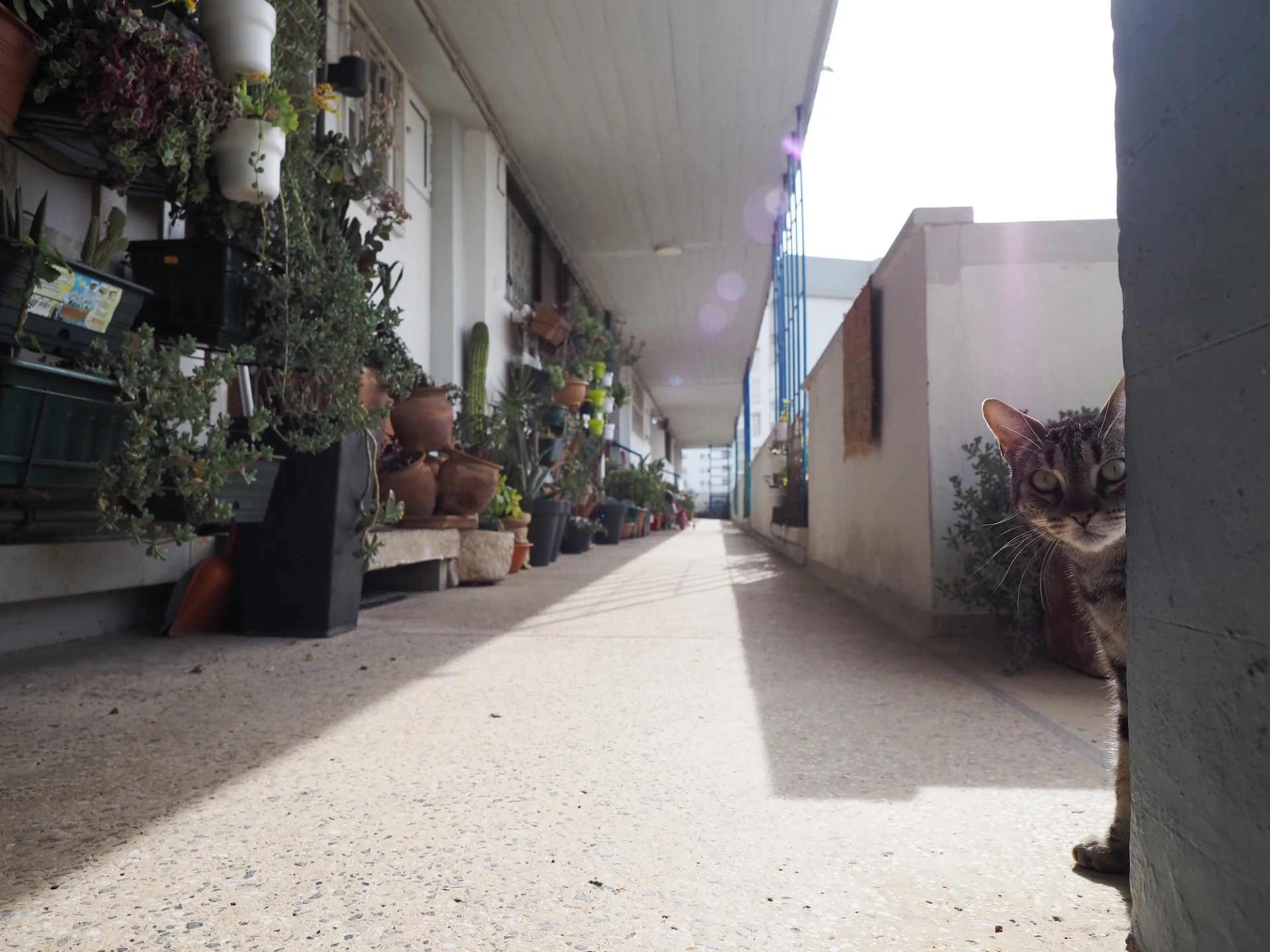
This place is what’s known as a circulation gallery. The technical term is misleading because it only describes what it’s used for when someone is passing through. Perhaps that’s why people, who know a thing or two, so often call them balconies: Olivia’s gallery is clearly a place to simply be. It allows you to step outside without actually leaving the house: to put a chair by the door, tend to the plants, exchange a few words with passers-by. Left open at times, the door ceases to divide the house from the world so sharply, and a narrow space emerges between the two where life can unfold. ‘What a sorry state of affairs,’ the villagers who have swapped the door in contact with the earth of their village for this sort of street suspended in the air might say. But for those who chose or were forced to swap the countryside for the city and come to live in such density, the gallery affords them the luxury of breathing in more air and more of the world than the enclosed entrance hall leading to box-like flats, where one enters and vanishes.
What people like Olívia also have that is special – and which only a long stay in one place allows – is that they carry the history of that place with them. “The kids would be up to their old tricks here in no time!” She recalls the days when the grass was always green and the wonder of those warm summer nights: “the parents would stay here whilst the children played down below until it got cooler enough for them to go to bed”. I heard similar stories in other galleries in the neighborhood. At the Aldeia da Roupa Branca (White Clothing Village) – still a PSP (Public Security Police) building today, designed by Vítor Figueiredo and Vasco Lobo – the widows of former officers, who today share the balconies with some young police officers on placement in the city, say that those ‘balconies’ were always used for everything: passing through and lingering, working and resting, seeing and being seen, chatting and being alone. Children roamed freely between the houses, forming a sort of extended family on the scale of the building. After a lifetime in the same place, people’s routines eventually become intertwined. Everyone knows who has left, who has returned, who hasn’t turned up yet, and who might need something. Nowadays, some of these women speak of this network as what enables them to continue living in their own homes, rather than moving in with their children or into a care home – by their own choice.
In Lisbon, one in three people over the age of 65 lives alone, which, considering the ageing population, corresponds to around one in 14 residents. Among older people living alone, around 75 per cent are women. At a time when galleries have been systematically excluded from public housing policies – sidelined by regulations which, in practice, render them unviable – it is hard to understand why a space capable of functioning as healthcare infrastructure is so readily dismissed. It is important to state the obvious: simply building an elevated walkway is not enough. A narrow, dark gallery facing a gable end will remain nothing more than a draughty corridor. In Olivais, these spaces open out onto sweeping views of the landscape or urban spaces. From there, Olívia has watched ash and plane trees grow; from there, she follows the changing of the seasons. At the end of the day, she watches the children burn off their last reserves of energy in the park whilst their parents rest before heading home. Life unfolds before her – allowing her to feel young again – whilst she offers those who are growing up a connection to the enduring elements.
A person can be part of a place’s infrastructure. Just like a tree, a square or a building. But that person can only fulfil that role because the material conditions allowed them to remain there. I am not advocating spending one’s entire life in the same place. Some people want to leave. Some want to return. Some want to live in five different cities. However, mobility is only freedom when staying put is also an option. Olívia can only be in that gallery today because she was able to stay in that house. If she had been forced out by rent increases or a property development, a part of that place’s community fabric would also have disappeared, as has been happening in so many parts of the city for far too long.
Dona Olívia no longer remembers me, but I’m unlikely ever to forget her. Now that I, too, live in Olivais, whenever I pass through Largo das Mamas (Breasts' Square) and see her sitting out on her balcony, I smile. With or without hope, more or less metaphysical, when I still come across people like Dona Olívia in my city, the universe is rebuilt for me, just a little bit. But with a touch of idealism and hope because, although I’m a pessimist, I’m still a utopian.
ADVERTISING
Previous
article
23 Oct 2026
After Hours, by Monica Coelho, at Fundação Carmona e Costa
By Mariana Varela