Article
The expanded field of architecture in Liquid Affinities: (another) affective cartography for Portuguese architecture
"Afinidades Líquidas (Liquid Affinities) is thus an attempt to foster intersection and dialogue between peers and other authors who are not usually invited to architecture exhibitions, despite the fact that many of them write or reflect on architecture. The aim is to showcase the scope of the discipline – architecture as an expanded field – in the plural sense of being together."
In 1979, in Sculpture in the Expanded Field, Rosalind Krauss reflects on the expanded field of sculpture, which, from the 1960s and 1970s onwards, came to encompass a much broader range of artistic practices, moving beyond its traditional definitions and exploring the relationships between architecture, landscape, space and nature. In the exhibition Afinidades Líquidas: (outra) cartografia afectiva para a arquitectura portuguesa (Liquid Affinities: (another) affective cartography for Portuguese architecture), we find a vision of architecture as an expanded field that extends building construction to the construction of thought, research, teaching and even criticism. Paulo David, curator of the exhibition, highlights Lourdes Castro’s archival approach in the Grande Herbário de Sombras, bringing together creators from different generations who embody a diversity of perspectives within their respective fields (architects, artists, thinkers, writers, philosophers). Aurora Carapinha, Duarte Belo, Fernanda Fragateiro, João Barrento, Lucinda Correia, Paula Melâneo and the studios AAVV, DUOMA, Eduardo Souto de Moura, Extrastudio, Ponto Atelier and SAMI are just some of the figures. Their common thread, or the affinities they share, is architecture, or an approach to the territory. The way in which architecture can be expansive and diverse makes it fluid.
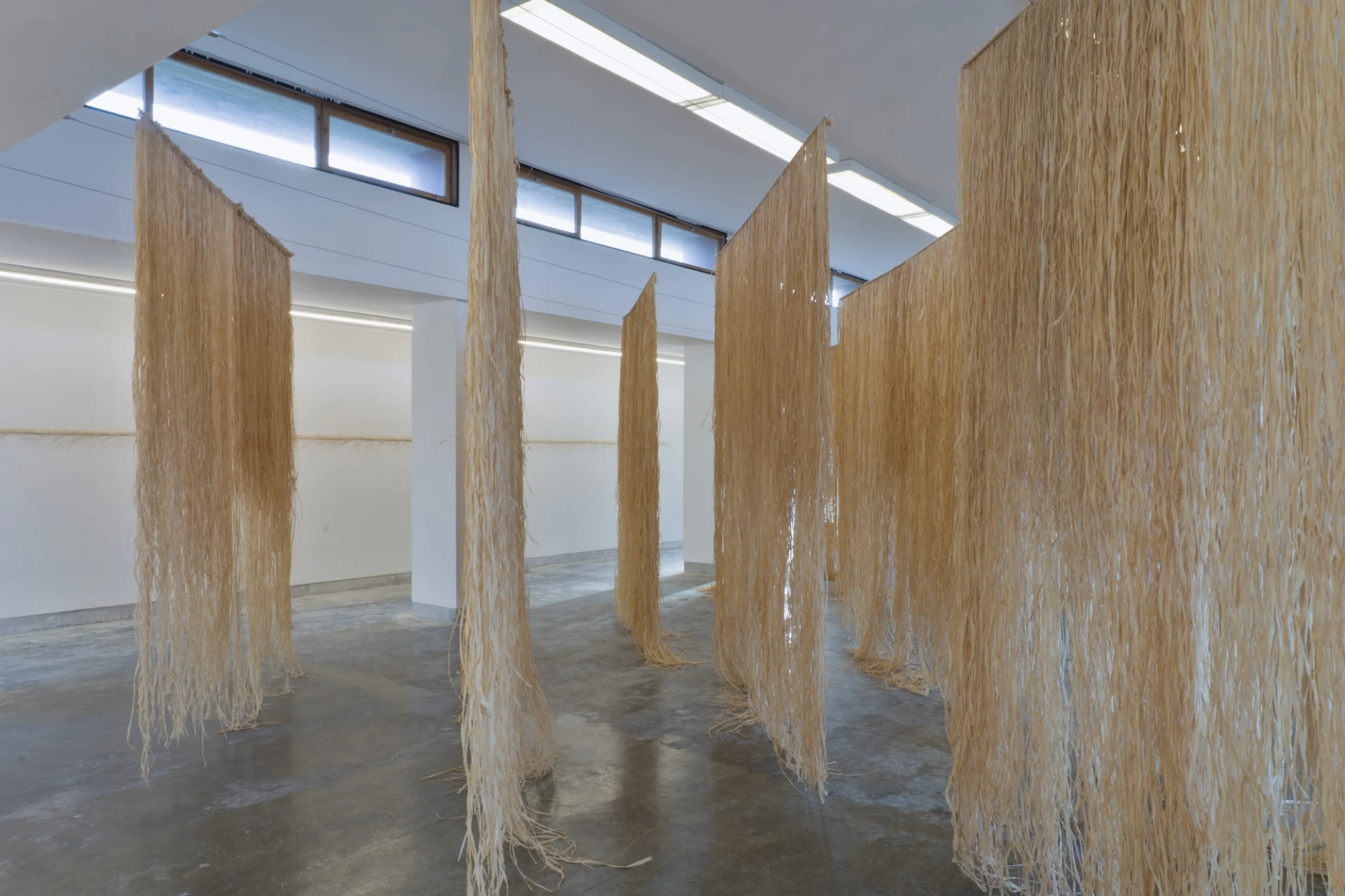
Álvaro Siza emphasizes the idea reflected in the exhibition by stating that “when it comes to thinking about architecture, the example came from writers, and amongst them poets – highly skilled masters of expression and dreams, inhabitants of solitude”.1 Just as the field of architecture extends to authors who do not work solely in the construction of buildings, the Casa da Arquitectura gallery’s physical boundaries are expanded through the use of the two adjoining courtyards. The exhibition thus comprises three sections – Clearing, Log, Clearing – and was designed by the studio of curator Paulo David.
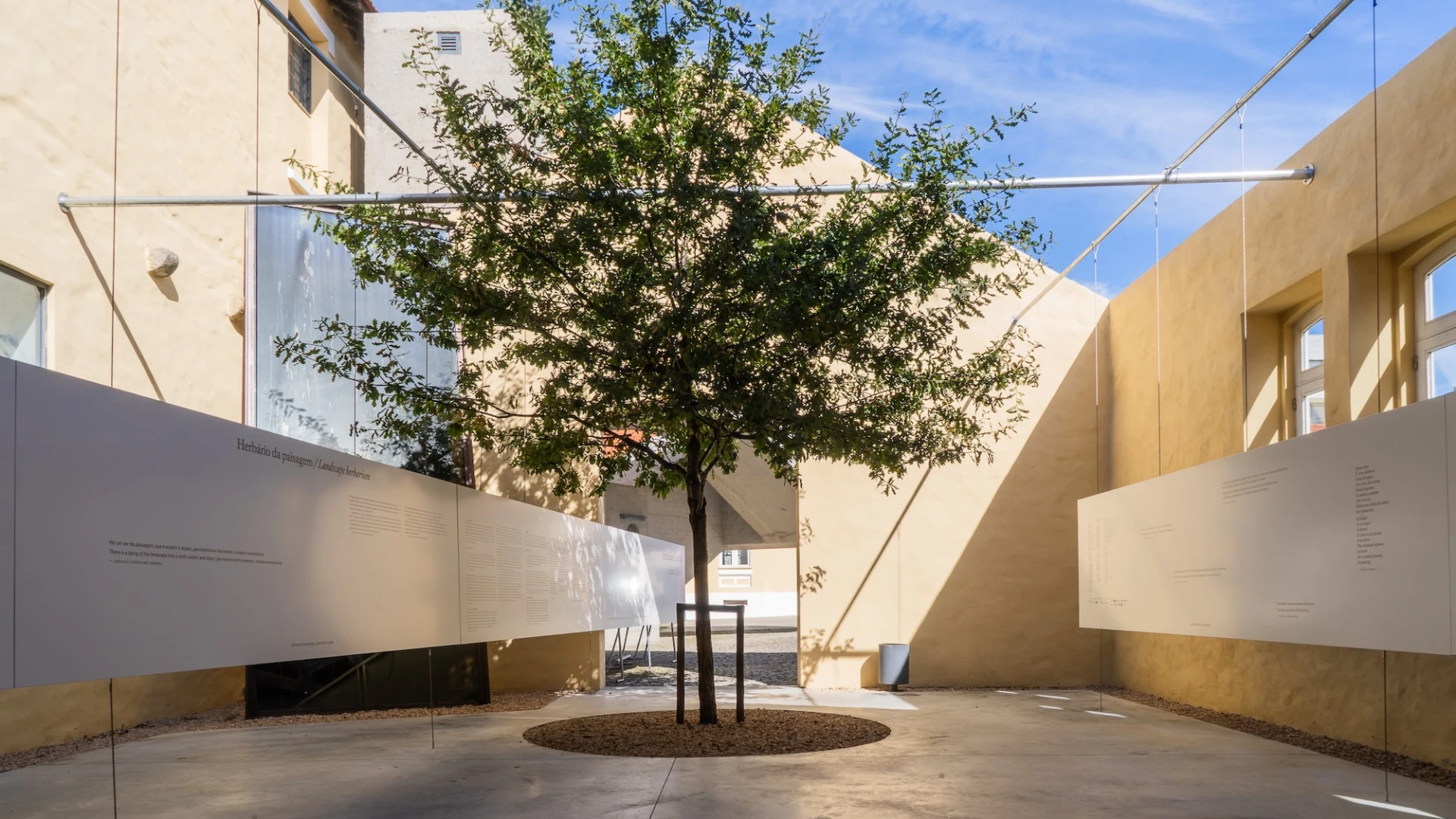
The architect referred to the first clearing, known as the Herbário da Paisagem (Landscape Herbarium), as the clearing of perception. It is a sort of prelude or reflection prior to architecture, bringing together authors – the vast majority of whom are not architects – who offer their insights on issues relating to territory, the home or the landscape. These authors shape architectural thought, helping to ground the architect’s work. The raw material is time (Ricardo Carvalho); the design of “a promise of the future” (Soraia Fernandes); the home as a “travelling place” (João Barrento), ruins as places that predate the home (Maria Filomena Molder) or the “interdependence of a poetic landscape” as a condition for the existence of “intensive architecture” (Susana Ventura).
In a second phase, the main section brings together Geografias Cristalizadas (Crystallised Geographies) and brings together works in the fields of architecture, photography, criticism and teaching, with the house as the central theme. It thus presents the designs for 15 houses situated in different geographical settings: a hollow, a valley, a slope, a ridge and a cliff. All have been designed to be contemplative, with a view to enhancing the place in which they are situated. In every case, there is a concern to shape the landscape through the building itself, based on a very careful observation of the territory. Every project ends by looking outwards from within, framing the surroundings. Ultimately, each house is a celebration and raises questions such as: “How can we celebrate the place where we live and enhance its value? How can we take what it tells us and bring out its most contemplative side?”.
The final clearing, Retrogénese or the conjugation clearing, brings together Eduardo Souto de Moura’s first project – a house in Vieira do Minho, Gerês, Braga – with João Favila Menezes’s project for a house in Achadas da Cruz on the island of Madeira, built 42 years later. This pairing occurs because both projects represent the repetition of the same gesture at different times. A gesture linked to the themes explored throughout the exhibition, which are fundamental to the architect’s profession and define a practice that spans generations of architects. Issues that have already been outlined, relating to geography, memory, material and contemplation. “We anchor houses in the territory so that we can see the place,” reads Sofia Pinto Basto’s testimony. We thus witness a repetition, a reinterpretation and a re-signification of the same gesture generation after generation, rooted in a continuous interpretation of the place. This was the starting point for the design of the exhibition, which is now being revealed at the very last moment. This clearing is, therefore, an “epilogue drawing” – here, “the end brings us back to the beginning”, as stated in the curatorial text.
The advance of globalization has led to the standardization of places and the erosion of each individual’s sense of self. In the words of Paulo David, the aim is to evoke “an awareness of place as a path of resistance in a time of polycrisis — to seek, in the earth and in what it offers, a way of remaining.” The exhibition design seeks to place all the content on display in a state of tension, under a spirit of inquiry, through two lines that run through the three sections of the exhibition, converging at a single point.
Afinidades Líquidas is thus an attempt to foster intersection and dialogue between peers and other authors who are not usually invited to architecture exhibitions, despite the fact that many of them write or reflect on architecture. The aim is to showcase the breadth of the discipline – architecture as an expanded field – in the plural sense of “being together”. According to Paulo David, “this is not an authors’ exhibition; it is an exhibition of works. Architecture is presented as a vast infrastructure, raising questions such as: how can we build affinities based on a common purpose, which is to tread upon the earth?” It calls for a renewed awareness of the earth and for a refusal to become embroiled in the polarized discourse currently prevalent in the world. Paulo David continues, “How can we live together in light of what the earth provides us with? There is an ancestral heritage that cannot be abandoned.” The aim is “to understand architecture as an attentive and sensitive practice, which emerges as a discipline capable of renewing our perspective on the landscape, affirming a timeless attitude of continuity and coexistence.”
It is perhaps no coincidence that Afinidades Líquidas: (outra) cartografia afectiva para a arquitectura portuguesa, curated by Paulo David, can be visited at the Casa da Arquitectura in Matosinhos until 25 April 2027, the day on which freedom is celebrated.
ADVERTISING
Previous
Article

25 Nov 2026
After the function: On ‘Hierofania’ by Mané Pacheco, and ‘The Conquest of Space: Collecting Installation Art Documents’, drawn from the archives of Nicolas de Oliveira and Nicola Oxley
By Margarida Prata
Related Posts