article
Foreign Monuments: Grada Kilomba at Fundação Albuquerque
“An artistic model such as the one adopted by Grada Kilomba, currently being exhibited at Fundação Albuquerque, strikes me as engaging with these very questions. Particularly because, like many contemporary artistic movements (and largely since the advent of modern art), it positions itself in contrast to the idea of the monument. The monumental is that which presents itself as superhuman, a pivotal axis around which the fleeting nature of our times and the transience of generations - in other words, the vulnerability of human life - is rooted. But Grada goes beyond a mere critique of the monument, as she is mainly interested in one of its related themes: memory.”
There will always be people willing to ask themselves what art is. It may be better, perhaps, to ask how art is possible. More importantly, perhaps, is to ask why we create art. Why does one confront a subject through a work of art, rather than a philosophical essay or a piece of historical research? Is it because we cherish that which has yet to exist, that which is merely possible? Is this the artist’s love? What about the passion for that which is vaguely glimpsed on the horizon, eagerly awaiting manifestation without ever fully revealing itself? And what does this manifestation entail? What is it able to do that other forms cannot? Could we say that the essence of art is primarily a dialogue between consciousnesses? That the artist takes whatever means are necessary to achieve an effect in the audience? The work, although autonomous and overflowing with an excess that renders it irreplaceable (as it resists any narrative attempting to circumvent it), is, despite all this, also a medium - a stage where the viewer’s consciousness is transformed.
An artistic model such as the one adopted by Grada Kilomba, currently being exhibited at Fundação Albuquerque, strikes me as engaging with these very questions. Particularly because, like many contemporary artistic movements (and largely since the advent of modern art), it positions itself in contrast to the idea of the monument. The monumental is that which presents itself as superhuman, a pivotal axis around which the fleeting nature of our times and the transience of generations - in other words, the vulnerability of human life - is rooted. But Grada goes beyond a mere critique of the monument, as she is mainly interested in one of its related themes: memory.
Although her works carry a sculptural weight, I consider them more as installations that, as they fragment throughout the space, call for the participation of the spectators. This sets them apart from icons and monuments alike - two closely related concepts in art history -, since sculpture resembles a corpse: aiming to be that which exists beyond circumstances, whilst remaining amidst them. A monument's plinth safeguards its independence and autonomy; the longevity of its material promises its endurance; and the cohesion of its design calls for intellectual assimilation. As the monument is an attempt to preserve history, here we have a specific relationship with the past: discursive, untouchable, goal-oriented, absolute - with all its strengths and vulnerabilities. The event is regarded as an unquestionable foundation of our sense of identity. The silhouette is often associated in art history with rational understanding - it is the clearly defined forms that best appeal to the recognition of the visible.
If the cohesive silhouette must be contemplated from a distance, allowing the intellect to assimilate it with its drive to measure everything, the scattered elements present in Grada’s works prompt us to engage in a short-lived process that is more deeply experienced than analysed. This allows us a subjective experience of a place rather than an objective enforcement of an image. Maybe Grada does not even intend to explore the concept of memory itself, but rather our relationship with memory – in what way are past events assimilated by the current experiences of individuals? Memory is not the event itself, but the interpretation of the event – experience always plays a part, be it imposed upon the collective or emerging within the individual.
The critical experiencing of reality is a key feature of modern art. Its first sphere of action was aesthetics, resisting both rationalist dogmatism and sceptical perspectivism - the aesthete strives to occupy a position somewhere between general imposition and personal opinion.
I see Grada embracing certain modern-contemporary discourses and practices (particularly the broad field of sculpture since the 1960s) that critique the concepts of the absolute and the objective, reflecting on the historical traumas of Blackness. However, despite aiming to steer us towards more sensitive than intellectual experiences, she is ultimately an artist drawn to the geometric, the calculated and the systematic. This tension frequently results in installations diluted across space, but whose individual parts possess, in their own right, defined forms and deliberate positions.
However, the exploration of memory also requires an investigation of the idea of history – the concept of narrative. Likewise, artists such as Mona Hatoum and Doris Salcedo confront this challenge: how to narrate without telling a story? As with Grada, they choose to evoke a story. In doing so, they employ symbolic or metaphorical systems. In Compressed Time, Grada supports a delicate black glass cube on a pile of rough, white stones: more than a narrative, we have the evocation of an event - perhaps a way of sharing stories without losing the open-ended experience of the work. By avoiding the literal and the linear, some of Grada’s works sometimes feel more like illustrations of metaphors to me. Although her works are not explicitly figurative, they can be understood as representational in this sense.
The works weave a tight relationship with both poetry and aesthetics. As such, they attempt to reconsider history not as a solid, elusive object, already cemented on the pedestal of concluded events, but as an experience to be lived in the present. This approach even alters the past itself, treating it as an open field, for it is our present experience that impacts our interpretation of past events. The three time periods influence each other. Whereas putting a sculpture on a plinth is to separate the past from the present, viewing memory as being contained within a silhouette to be merely contemplated from a distance. In Grada's perspective, however, the past still echoes in the present. We are, in fact, still living in the past - its cracks persist, and the present-day consequences of past violence are felt everywhere. The exhibition is aptly titled O Fundo do Mundo (The Bottom of the World). It attempts to uncover all records of what happened, but which are nevertheless hidden from our experience. This is the experience that the works aim to provide us with. Louis Kahn once said that a monument is not large, but complete in itself - even a pinhead is monumental, according to him. But there is no room for subjective experience within a pinhead. All we can do is admire it from a distance, in awe. Maybe this is why the most historic of Grada’s works melt into their surroundings: so that we can inhabit them, even now. The monument provides commentary on the event. The experience attempts to make it live again. Lazarus is not condemned to the tomb - he can be raised, too.
That which lies at the bottom of the world is made manifest, although not so much revealed. We more intuitively sense presences than we are assured of them. Without being figurative, Grada points to the human: we presume our own presence within a series of objects - the burnt wooden boxes in 18 Verses, the black glass cube and the white stones in Compressed Time. They are, therefore, symbolised. We do not have here an art of the corpse, historically related to sculpture as a funerary monument that replaces the presence of that which once was - we instead have tombs: boxes which both reveal and conceal. Anyone who contemplates a sarcophagus is faced with a metaphysical paradox: the invisible within the visible, the divine within the world, the large within the small. How can the mystery of death be housed in a wooden casket? However, the experience endures as long as we do not unlock the box. The metaphorical significance of her works maintains a suggestive atmosphere - the rugged volumes of 18 Verses may represent black bodies emerging from the dark Atlantic seabed, or their coffins, or burnt wood as a symbol of modernity, amongst other interpretations. They are a medium for verses, forming a fragmentary poem throughout the exhibition space that shows how impossible it is to put together coherent narratives about the most brutal events - and that is exactly the power of the fragment: never reducing to a sketch what is too vast to be understood solely through the intellect. If traditional monuments are hyperbole, perhaps Grada's installations use euphemism to explore other ways of understanding an event. While metaphysics considers the temporary and the fragile to be drawbacks, contemplating the delicate collapse of a structure nevertheless instills a faint sense of wonder (a gentle thrill?) - its brevity perhaps etches it even more deeply into our consciousness: the fragile merits a different sort of attention.
But how far would working with memory using anti-monumental structures contribute to forgetting? Would softening the impact ultimately distance the work from the historical event it concerns? The clear-cut nature of the icon is precisely meant to make it a benchmark for memory. Perhaps it is more challenging to recall sensations - when Stephen Dedalus accuses Buck Mulligan in Ulysses of having mistreated him in the past, Mulligan counters that he merely remembers ideas and sensations. Dubuffet and Fautrier dismissed delicacy, as it served to embellish what could not be adorned. Their works retain the brutality of artistic practice, so that the impact of the images accurately reflects the trauma of the Holocaust, for one example. The sophisticated evocativeness of Peter Eisenman’s Memorial to the Murdered Jews of Europe (artistically similar in spirit to Grada’s works) often fails to move the atrophied sensibilities of our age - several years ago, there was a string of frivolous selfies being systematically taken at the memorial. Remembrance is an exercise - to forget is easier. Even cyclical monuments, such as the Ise Shrine, whose temples are rebuilt every twenty years, retain the iconic nature of their image and their construction methods, and especially the iconography of the deities, whose images are transferred to the new structures, which are entirely identical to the old ones.
Ultimately, there may be another, more intriguing question at the bottom of all this, raised by practitioners such as Grada: how can the viewer’s subjective experience be converted into a collective memory? Grada focuses primarily on systemic injustices, the stories of a people, hence the complete absence of human figures, which could impose an individual dimension upon the collective. The monument is powerful simply because it stands apart from its circumstances - it is dogmatic: a concrete image, beyond individual experience. However, the subjective experience has no aim of providing the individual with the truth, but rather of making space for them to seek the truth. As opposed to a transcendent truth, it perhaps seeks a relationship-based truth, born out of circumstances: one between the viewer and the work. This is why the force of aesthetics is also its fragility. Kant attempted to overcome this with his ‘subjective-universal’, but to me this has always seemed almost like a unicorn: an elegance that cannot possibly be verified. Meanwhile, to worship the easily accessible is to look down on the viewer. Moreover, it is plain to see that history cannot exist without the individual. Past events were experienced by human beings in every way just like us, and the real power of the artistic form is perhaps this: the ability to offer a transformative experience to the viewer, even though the true nature of this experience, or its universal validity, will always remain elusive. Could this be its role in relation to history? Achieving a poetic account that provides a setting for a lasting, not always easily articulated experience, but one that unites the intricacies of private life with the violence of the public realm. And this monument would be built within the viewer’s consciousness, preserving forever a sense of uncertainty in their relationship to the monument of the other.
O Fundo do Mundo, by Grada Kilomba, is open at Fundação Albuquerque until September 27, 2026.
BIOGRAPHY
Tomas Camillis is an author and researcher based in Lisbon, working on fiction and on essays in the interplay between art, philosophy and literature. He has a master's degree in Art Theory by PUC-RJ. In recent years he has participated in researches, taught courses in cultural institutes, helped organize conferences and published in specialized magazines. He currently collaborates with the MAC/CCB Educational Service and Umbigo magazine.
ADVERTISING
Previous
article
21 Aug 2026
Visceral Hum: June Crespo at Kunsthalle Lissabon
By Orsola Vannocci Bonsi
Next
article
25 Aug 2026
Mixed media on paper #12: Masks unintended to mask
By Luísa Salvador
Related Posts
article
25 AUG 2026
Foreign Monuments: Grada Kilomba at Fundação Albuquerque
By Tomás Camillis
article
18 AUG 2026
The distant work: Ana Vieira at Galeria Vera Cortês
By Tomás Camillis
article
30 JUL 2026
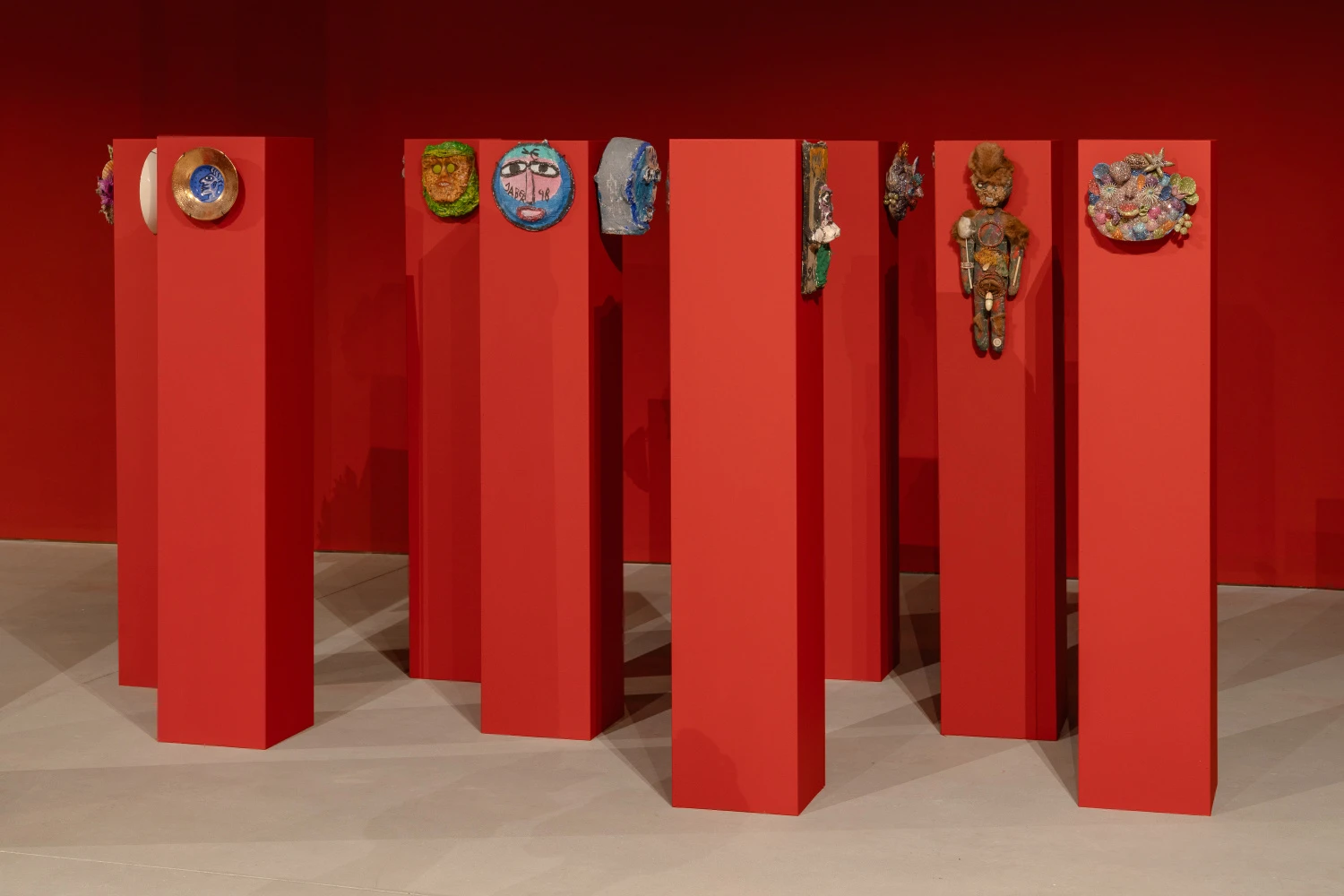
Excess and Silence
By Tomás Camillis
article
08 JUL 2026
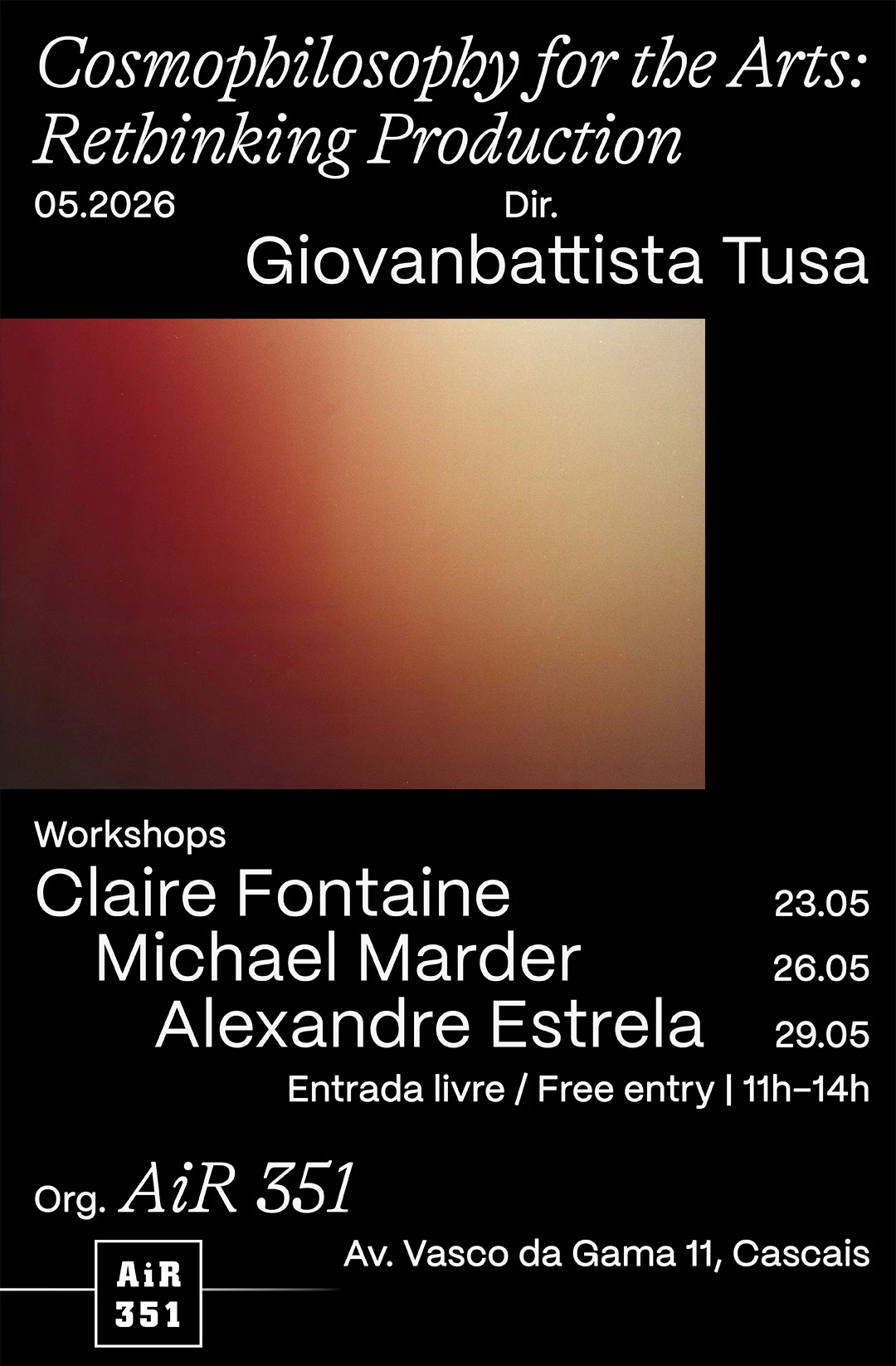
TOWARDS TERRA INCOGNITA: Interview with Giovanbattista Tusa
By Tomás Camillis