agenda
Opening of Casa Palestina in Lisbon
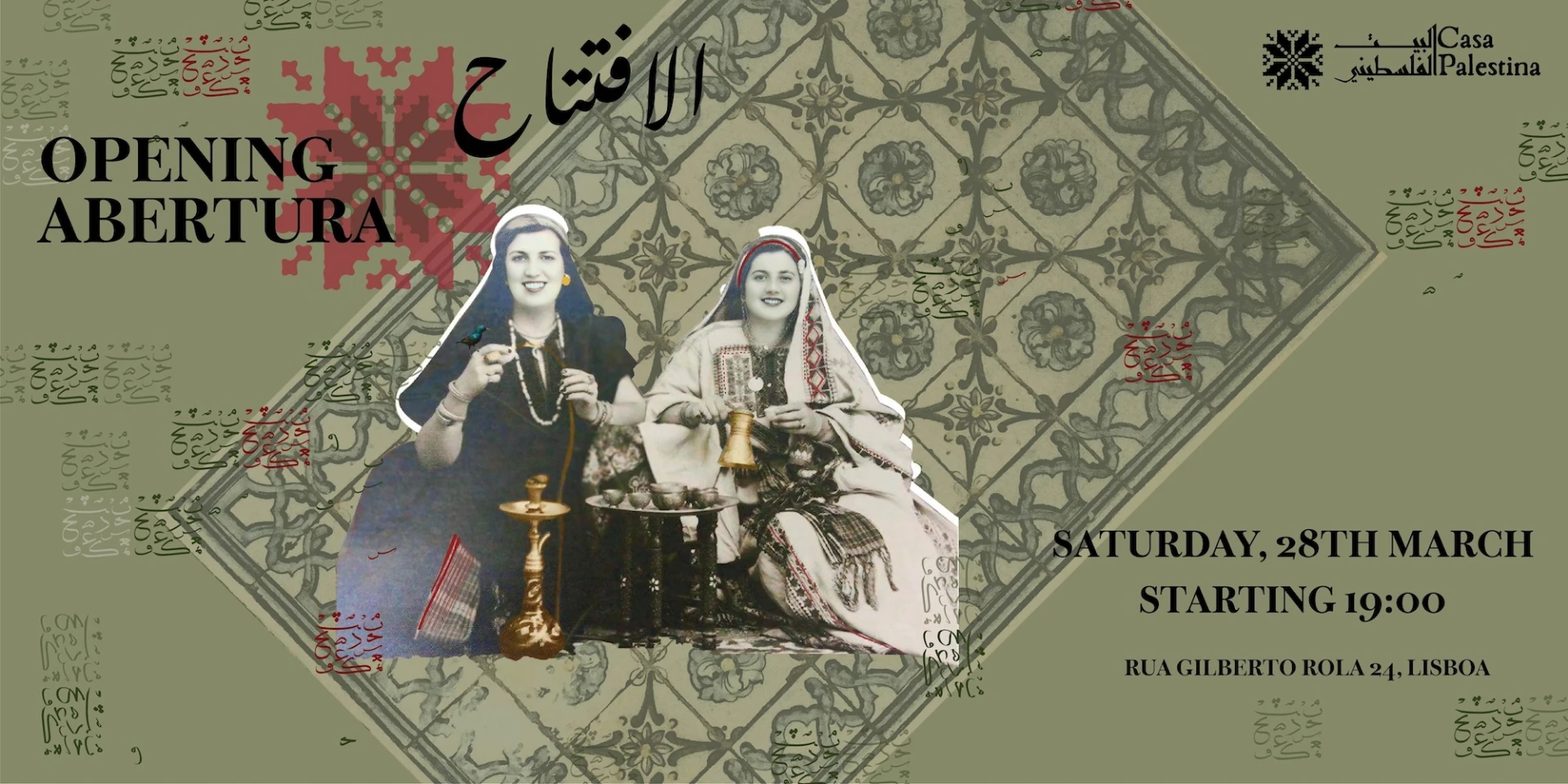
On 27 March, the country’s first Palestinian cultural centre will open its doors in Lisbon. Founded by Palestinian women in collaboration with Portuguese women, Casa Palestina aims to serve as a meeting point between Palestine and Portugal, fostering dialogue between communities and promoting artistic creation and critical reflection.
Located in Alcântara – from the Arabic al-qantara, meaning ‘the bridge’ – Casa Palestina intends to build a space rooted in collective memory, artistic practice and community life, bringing together artists, writers, educators and the public through exhibitions, performances, workshops and other events.
The opening night will feature a performance by the Palestinian singer, composer and songwriter Sanaa Moussa, accompanied by the musician Michael Rishmawi. Known for her extensive work in preserving and reinventing the traditional Palestinian repertoire, Moussa presents interpretations of classical and folk Palestinian music, whilst also exploring the musical dialogue between Arab traditions and Portuguese fado.
The programme will begin at 7.00 pm with a reception and a social gathering, during which Palestinian snacks, tea and other drinks will be served. At 7.30 pm, the founder, Dima Akram, will give a welcome speech; and at 7.45 pm, the Handala group will perform a dabke, a traditional Palestinian folk dance that conveys the rhythm of collective movement and continuity across generations.
The following day, 28 March, the programme continues with a concert at 8.00 pm by Rawan Roshni, a Palestinian artist and singer who blends traditional influences from the SWANA region with contemporary sounds. At 9.45 pm, Isam Elias takes to the stage; a Palestinian artist who places the piano at the heart of an Afro-electronic universe, blending acoustic expression with an immersive electronic sound. The evening continues at 11.00 pm with a DJ set by Adan, a Jerusalem-born artist based in London, who presents selections of minimal house and electronic music with deep basslines designed for the dance floor, bringing the programme to a close at 1.00 am.
This is the programme that inaugurates Casa Palestina, at a time of unspeakable violence against the Palestinian people. Against this backdrop, Casa Palestina will not be a neutral space. Rather, it asserts itself as a place committed to the principles of justice, self-determination and cultural continuity, defending the right of Palestinians to represent themselves, with integrity and on their own terms.
ADVERTISING
Previous
article
23 Mar 2026
May I Help You? Posso Ajudar?, at MAC/CCB
By João Pedro Soares
Next
article

25 Mar 2026
Notes on the 1st anniversary of MACAM
By João Pedro Soares
Related Posts
agenda
14 SEP 2026
The duo Carla Cruz & Cláudia Lopes was selected for the UmbigoLAB artistic residency at Fundação da Casa de Mateus 2026
By Umbigo
agenda
14 SEP 2026
The Supporting Act Foundation opens its 2026 Grants
By Umbigo
agenda
11 SEP 2026
The Odemira Art and Science Biennial launches its pilot edition between 3 and 5 October 2026
By Umbigo
article
04 SEP 2026
Deep Learning: e-book Towards an Automated Art? Learning Machines, Human Creativity And Uncertainty
By Umbigo