article
Devir-Água, at the Bienal de Cerveira
The proposal to reflect on water as a living substance, capable of bringing together territories, memories and experiences – shaping landscapes and transcending cultures – serves as the guiding principle of the DESAGUAR1 project, under the artistic direction of Mafalda Santos, which now culminates in the exhibition Devir-Água, in Vila Nova de Cerveira. Presenting a multifaceted interpretation of water as a symbolic element, an ecological resource and a force of displacement – physical, emotional, ritualistic and identity-forming – the exhibition, the third and final one of the project, marks, according to the curator, “the final moment of the initiative, not as a conclusion, but as a state of transformation”.
Water, as a common language and agent of change, runs through all the works on display, the result of research and reflection by six artists who were challenged to engage with and explore the geography of water that links Vila Nova de Cerveira (Alto Minho), Loulé (Algarve) and São Miguel (Azores), decentralised territories defined by their relationship with the river and the sea.
Establishing a sensitive connection with the places and their rhythms, the artistic creations of Ana Maria Pintora, Bertílio Martins, João Amado, Margarida Andrade, Milita Doré and Patrícia Oliveira reflect their perspective and experiences of the three regions, their landscapes and local communities. Following a principle of cultural decentralisation and building on the collaboration between curators, producers and artists, field visits, residencies, community workshops and exhibitions took place – between late 2024 and 2026 – in each of the three territories, in a shared experience that allowed the artistic creations to take shape in distinct ways, with water as the central theme.
Following Vamos aonde já estivemos?, curated by Jesse James at Arquipélago – Centre for Contemporary Arts (Ribeira Grande, Azores), and Geografias da Água, curated by João Serrão and Mirian Tavares at the Art Gallery of the Convent of Espírito Santo (Loulé), Devir-Água is now on display at the Convento de San Payo (Vila Nova de Cerveira), curated by Mafalda Santos.
Presenting itself as a space of continuity and marking a journey that has traversed different landscapes, water systems and sedimented memories, Devir-Água is situated in an intermediate time where experiences, materials and narratives remain in circulation. A particular highlight of the exhibition’s final section is the symbolic significance – given its proximity to the mountain spring – of the gathering and presentation of the works at the Convent of San Payo. Throughout the exhibition, different artistic approaches engage in dialogue through works that reflect how water defines territories, their identity and the activities carried out within them, as well as our relationship with materials. Fresh or salt water, its scarcity or abundance, its cycles and the importance it holds in each region are explored in the various works, sometimes in endogenous pieces, at other times in creations inspired by structures such as wash houses, fountains and viewpoints.
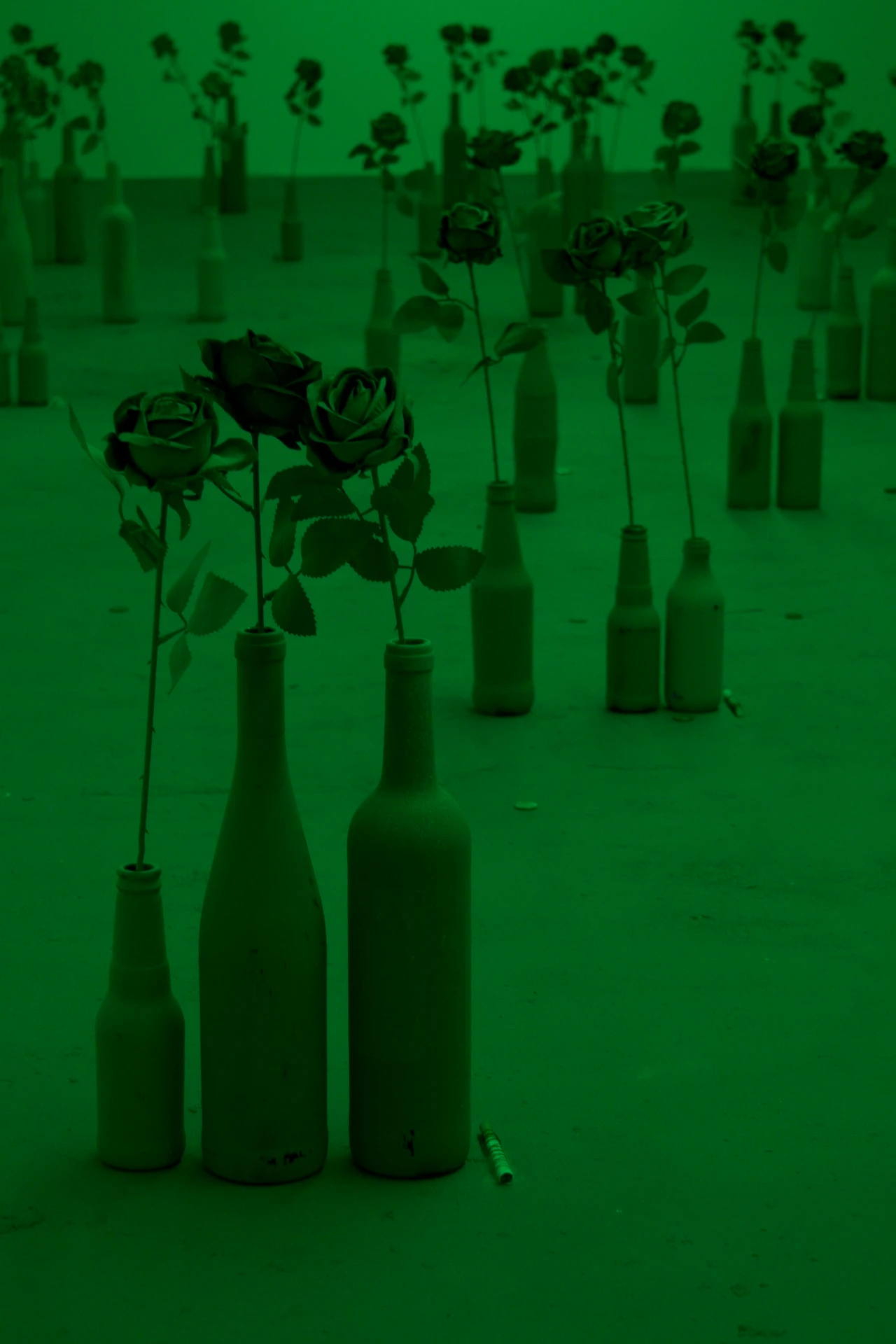
The remembrance of forgotten territories is explored in Margarida Andrade’s video triptych Enxurrada (2025), in which the constant repetition of the act of collecting and transporting water to a parched location draws our attention to climate change and the desolation of landscapes. In contrast to the accusatory gesture of the previous work and the aridity of that territory, we observe, in a painting by the artist, plants whose various shades of green evoke life and nature. In the same space, we are struck by João Amado’s sculptural figures that punctuate the exhibition circuit: Perna-Longa and Braço-Longo, whose physical anomalies stem from the distance and the search for the sea. These are figures that embody the fiction written by the artist during his residencies, and which, like papyrus, stretch along a wall down to the floor, inviting us to read memories and experiences of the territories. From the folios stitched together by the artist, we observe the textures of fountains printed in graphite on paper by Milita Doré, using the frottage technique, which transports us to other places. Similarly, Cascata (2025), also by the same artist, is a waterfall on cotton fabric that stretches across the floor, evoking the lightness and movement of water. We encounter this movement again in Bertílio Martins’ hydrographic maps, which chart the courses of the rivers in each region and whose presentation implies a performative potential in the public’s interaction with them. Ana Maria Pintora’s works reveal her experience of the local area through indigenous materials collected by the artist – stones, sand, gravel, seaweed and branches – which are arranged on a table, as they take the form of installations, resembling huts or shelters, which incorporate paintings whose colour spectrum, ranging from blue to green, captivates us. The materials and their contrasts are similarly explored in the sculptural work Arcano (2025) by Patrícia Oliveira, which, combining glass, weaving, and metal, pays homage to the local traditions of each region.
Travelling through landscapes, rivers and seas, it is in Vila Nova de Cerveira, close to Galicia, that this project reaches its final destination, revealing the process of research, creation and mediation undertaken by each artist, which led to an exploration of the country’s borders – from the far south and the Alto Minho, through the Azores archipelago in the Atlantic Ocean – transcending territorial and, above all, cultural boundaries.
The exhibition can be visited at the Convent of S. Payo, in Vila Nova de Cerveira, until 24 May 2026. Further information on the Cerveira Biennial programme is available here.
1 The DESAGUAR project was coordinated by FBAC, in partnership with Arquipélago – Centre for Contemporary Arts (Azores) and the Art Gallery of the Convent of Espírito Santo (Loulé Municipal Council), with the support of the Portuguese Contemporary Art Network (RPAC).
BIOGRAPHY
Mafalda Teixeira, Master’s Degree in History of Art, Heritage and Visual Culture from the Faculty of Letters of the University of Porto. She has an internship and worked in the Temporary Exhibitions department of the Museu d’Art Contemporani de Barcelona. During the master’s degree, she did a curricular internship in production at the Municipal Gallery of Oporto. Currently, she is devoted to research in the History of Modern and Contemporary Art, and publishes scientific articles.
ADVERTISING
Previous
agenda

21 Apr 2026
Open Call: ‘Transitional Justice with Artists’ Grant
By Umbigo
Next
article
29 Apr 2026
Sound Images: Sound Field at 3+1 Arte Contemporânea
By Tomás Camillis
Related Posts
article
02 SEP 2026
Serapinas and Ourahmane at the Porto Municipal Gallery
By Mafalda Teixeira
article
07 JUL 2026
Interview with Silvestre Pestana, author of the Umbigo.space cover
By Mafalda Teixeira
article
15 JUN 2026
ANOZERO’26 – Bienal de Arte Contemporânea de Coimbra: Segurar, Dar, Receber (To hold, to give, and to receive)
By Mafalda Teixeira
article
02 JUN 2026
Submundo, de Paulo Wirz, at Teodoro W.
By Mafalda Teixeira