article
Húmus, at the Atelier-Museu Júlio Pomar
"The exhibition-essay that Ana Rito proposes for the Júlio Pomar Atelier-Museum is one such exercise, gathering from the works of Júlio Pomar, Graça Morais, Daniel Moreira, and Rita Castro Neves an ancestral knowledge deeply rooted in Portugal. It is about them – about the artists – about their territory and their memories, that they act. They are the ones who reproduce and give form to the echoes of time, to survivals, to the technè bequeathed from generation to generation, in order to act upon the world and, ultimately, explain it."
In 1917, Raul Brandão published Húmus for the first time. Imbued with a markedly modernist impetus that accelerated, fragmented, and plunged into the depths of the human soul – its marvelous and eschatological aspects – Brandão recorded a chronicle of thought on life and death. Nature, that which shines with the splendor of the sun and the rays reflected in the dewy leaves of the morning, which bears abundant fruit and emerges upon the mystery of creation, is beautiful – said the romantics. But if there was anything the moderns were quick to recognize, it was the artifice that danced in the romantic gaze, incapable of seeing what lay hidden behind life, incapable of unveiling the monster that slept among the appearances of divine creations, and which hid, under the weight of its body, the truth. Brandão looked the monster in the face. Humus is the necrotic matter after life, the warm, pungent, fetid, and languid broth that oozes from the limbs, emptying everything of life to give way to death. It is mold, mildew, necrosis. Dreams are the escape from this irreversible destiny. It is through them that another consciousness is founded – a new consciousness. The days pass in their rhythmic monotony and neutrality. And hell, everyone fears. Damned be those who discover the truth – like Gabiru, in his fits of metaphysical madness.
Decades later, in the aftermath of a modernity that, not long ago, grappled with the demons of humanity, Herberto Helder, a wise connoisseur of Brandão's work, wrote a poem with the same title. In it, death is remembered repeatedly, as if the poet wanted to kill it once and for all – to kill death, to kill the dead, to extinguish the cries of the dead, because death dies, but appears again. He writes:
"We must kill the dead,
again,
the dead."
This serves as a preamble to the exhibition of the same name, at the Júlio Pomar Atelier-Museum, curated by Ana Rito and featuring works by Júlio Pomar, Graça Morais, Daniel Moreira, and Rita Castro Neves. Verses and phrases by Brandão and Helder accompany the constellation of works and serve as a link between the artists.
Much in Húmus (the exhibition) recalls the ethnographic turn discussed by Hal Foster in the 1990s. In The Artist as Ethnographer? Foster criticizes a discipline – art – that has allowed itself to be seduced by primitivist fantasy and a new wave of flânerie, capable of transforming all discourse about the Other into a petit-bourgeois self-analysis. And then, a certain envy on both sides: the artistic envy of anthropologists and the anthropological or ethnographic envy of artists. Neither understand the aesthetic and formal designs of art, nor the scientificity and analytical rigor underlying archaeology. Nothing in this text can be contradicted from a logical and argumentative point of view. The ethnographic turn in contemporary art is more than obvious, and Foster's critique of this turn is perfectly plausible and even identifiable in many cases. And yet, there is a certain cynicism in the whole argument – for it reveals what is problematic without recognizing what is fracturing and expansive in the artists who, with all sincerity (although preferable to authenticity) and dedication, explore the cultural forms bequeathed or left by time. For all the artists who appropriate a discourse that goes from alterity to self-othering as a way of capitalizing on a neoliberal and institutional trend, there are always several artists who access this cultural production starting from their heritages, their patrimony, the place where they work and produce, and according to a fruitful and even necessary collaboration, which seeks the best of both sides.
The exhibition-essay that Ana Rito proposes for the Júlio Pomar Atelier-Museum is one such exercise, gathering from the works of Júlio Pomar, Graça Morais, Daniel Moreira, and Rita Castro Neves an ancestral knowledge deeply rooted in Portugal. It is about them – about the artists – about their territory and their memories, that they act. They are the ones who reproduce and give form to the echoes of time, to survivals, to the technè bequeathed from generation to generation, to act upon the world and, ultimately, explain it. It is about this inspiring and transformative prescience, this knowledge rooted in the land and difficult to illuminate, that the exhibition manifests itself. To understand and experience Húmus is to excavate from the soil the subterranean within us.
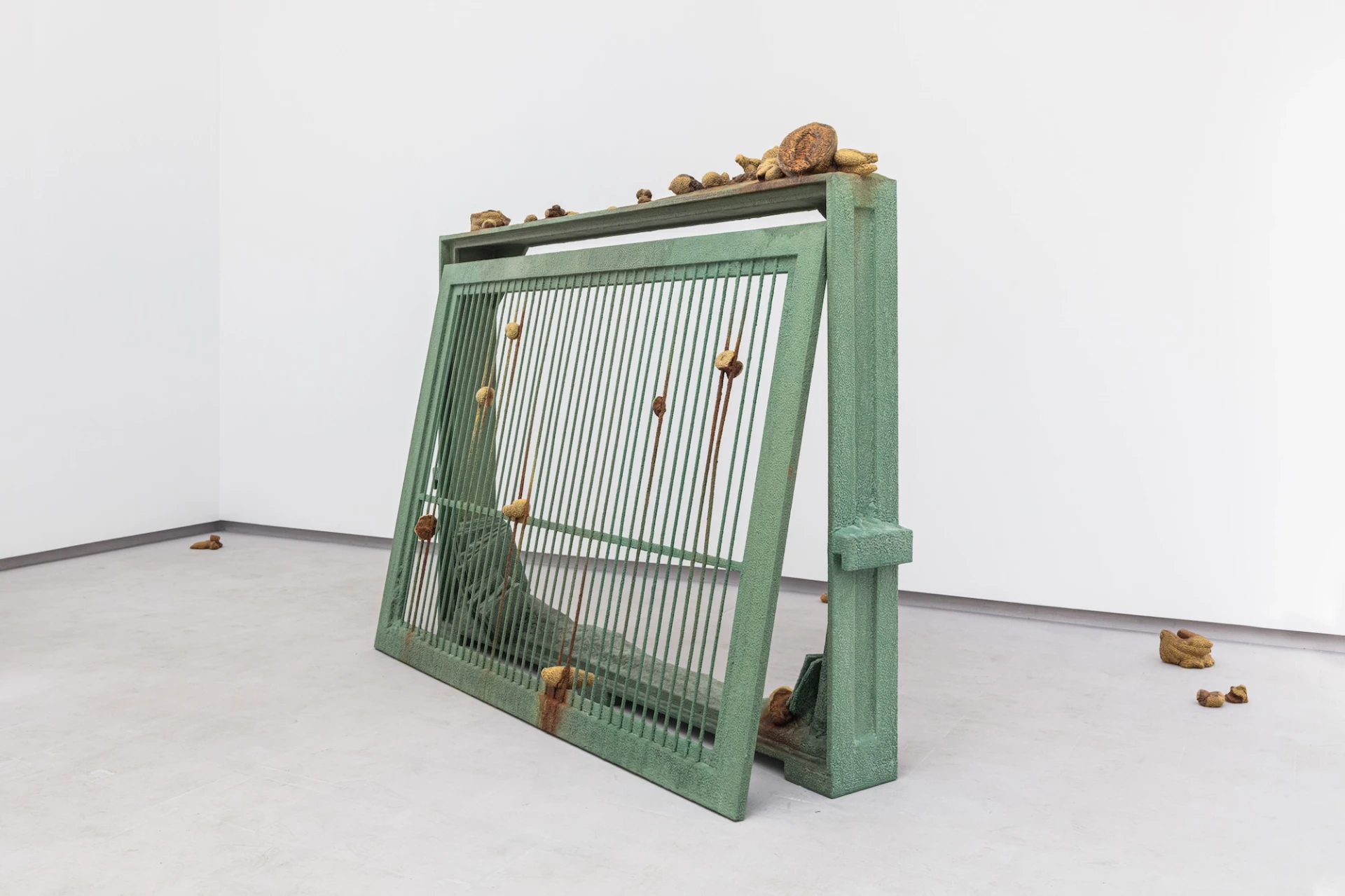
The work of Daniel Moreira and Rita Castro Neves is part of a specific territory: from Trás-os-Montes and Alto Douro to Beira Alta, the duo's work explores the ethnographic and archaeological production present there. Rurality and popular culture are inseparable from their work, and it is these that dictate and inform the materialization of the work. But much of their work also owes to experimental archaeology, a branch of archaeology that theorizes and tests technologies and behaviors through archaeological records, seeking to understand how objects and structures behaved and for what purpose.
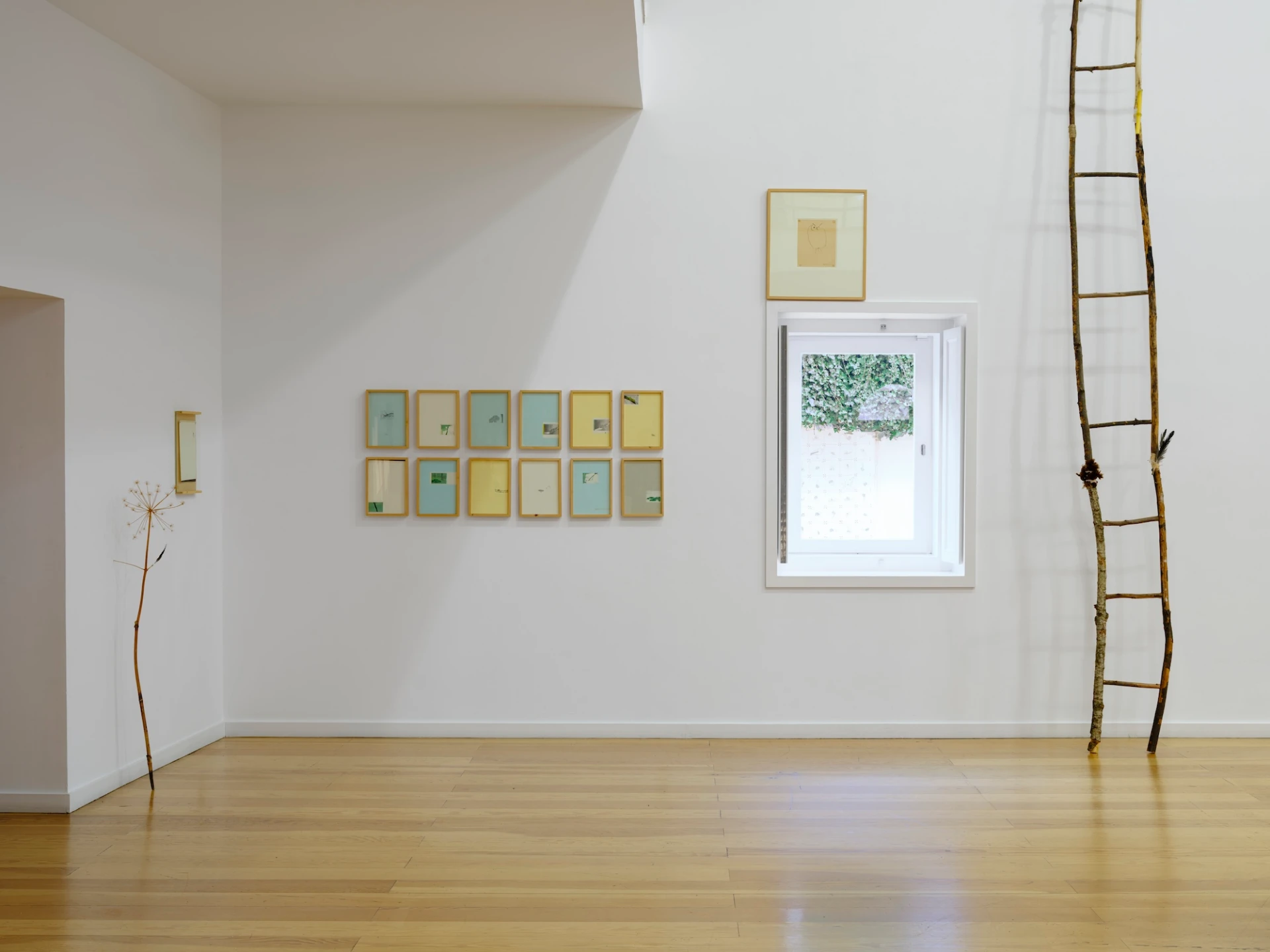
Two golden creatures greet the viewer in what was once Júlio Pomar's studio. They are reproductions and refinements of rock engravings in the Côa Valley, resulting from a long process of laboratory work and research, including nighttime surveys and visits to the reserves of the Côa Museum. Behind them, hidden within the structure supporting the silhouettes, artifacts of flint, branches, and feathers take the form of ritualistic objects. Magic and superstition open portals to other worlds or planets. These are what Francis Yates, following the Renaissance hermetic tradition, would call talismans. Through them, princes and artists could access knowledge of the planets. Giordano Bruno comes to mind.
Facing the creatures, on the white wall, is a series of sculptural objects constructed from sticks, stones, hair, rattles, and agricultural tools. The cultivation of the land is seminal in the work of the three artists. The rattles of shepherding, the agricultural implements, the cultivation of potatoes, the herding of snails and goats. All these elements restore a forgotten sensoriality to art.
Metaphysical questions return to the works of Helder and Brandão. Death lurks in a corner, with skulls and bones drawn on it. However, nothing is distressing in this representation of death. There is no fear, precisely because death is just another stage in the planet's knowledge. Art is made in dialogue with death. It always has been. On the opposite side of the wall, a staircase built with burnt tree trunks, which perished in one of the many rural fires that plague the country annually. Moreira and Castro Neves tend to the joints of the trunks, as if healing and giving new life to the remains of death. The staircase rises precariously, but resolutely, reaching for the sky to touch divine creation – a griffin feather, stuck high in the museum. This idea of circularity, this mystique of a life that is also death – cursed are those who forcibly defy the finitude of the body – is punctuated throughout the exhibition. Not far away, another feather – this time by Júlio Pomar. And at the base, written in chalk, the evidence of what is and the lament of what could be: "it's a shame".
The mythical woman, the nature-woman, was what Graça Morais explored. Female figures are insects and plants. The metamorphosis of her body seems to signify that the female body is a form that alters, merges, and becomes confused with its surrounding environment and time. Sometimes delicate, sometimes grotesque and violent; maternal and impulsive. The drawing is violent, the lines forcefully etched into the paper.
Languages coexist harmoniously in artists of different generations. But it is always astonishing to note the experimentalism and curiosity of Júlio Pomar, anticipating what would later become a concern for many artists regarding territory, landscape, and the cultural productions of the people. Pomar allowed himself to be traversed by Time. He prepared what could be called the ecology of modern art, in the transition to contemporary art; he crossed the boundaries of disciplines; and he developed a practice that, through these means, knew how to encompass all of Time, now engaging in dialogue with all artists, all movements of the 20th century, and a whole new life unfolding in the wake of his work.
This is, however, an exhibition with a strong authorial character. From a curatorial point of view, there is a voice that defines the rhythm and interpretation of the exhibition. Rito, in the excerpts accompanying certain works, highlights the exercise of plagiotropy proposed by Haroldo de Campos, which "designates a mode of reading and writing that is based on creative appropriation, transfiguration, and deviation." Unlike simple plagiarism, plagiotropy is a creative resource that "reorients" and creates a polysemic nexus that expands the collected fragments. Húmus is a plagiotropy in terms of curatorial practice: it uses the artists' work to create new narratives and assumes a total gesture. From this perspective, Ana Rito's exhibition is a curious and informative proposal about part of the curatorial exercise.
It is up to the drawing to be the primary form of the exhibition. According to Jean-Luc Nancy, "Drawing is the opening of form: [...] opening as beginning, starting point, origin, sending forth, impetus or raising, and opening as availability or inherent capacity"1. But drawing is also the idea, the design, the becoming-form. It is through it that humus – this fertile and inescapable death – materializes and becomes substantiated.
The exhibition Húmus is on display at the Júlio Pomar Atelier-Museum until April 5th, curated by Ana Rito and featuring works by Júlio Pomar, Graça Morais, Daniel Moreira, and Rita Castro Neves.
1 Nancy, J-L. (2022) O Prazer no Desenho [tradução de Jorge Leandro Rosas]. Lisboa, Fundação Carmona e Costa, Documenta
BIOGRAPHY
José Pardal Pina has been the associate editor of Umbigo since 2018. He has an Integrated Master's in Architecture from Instituto Superior Técnico, Universidade de Lisboa, and a Post-Graduation in Curatorship from Faculdade de Ciências Sociais e Humanas, Universidade Nova de Lisboa. Curator of the Dialogues (2018-2024) and Landscapes (2025-) projects in Umbigo.
ADVERTISING
Previous
article

29 Jan 2026
The self as multiple: An experimental exercise in identity's vastness
By Ana Filipa Almeida
Next
interview
03 Feb 2026
Interview with Tiago Rocha Costa, author of the Umbigo.space cover
By Maria Inês Mendes
Related Posts
article
15 JUL 2026
Sacred Heart, at Fundação Eugénio de Almeida
By José Pardal Pina
article
01 JUL 2026
landscapes change places… at the Fundação Eugénio de Almeida
By José Pardal Pina
article
19 MAR 2026
A Oferta, by Jaime Welsh
By José Pardal Pina
article
02 FEB 2026
Húmus, at the Atelier-Museu Júlio Pomar
By José Pardal Pina