article
Sound Images: Sound Field at 3+1 Arte Contemporânea
“What other experiences can sound art offer us, helping to broaden our existential relationships? Perhaps this is the central question of the group exhibition Sound Field, on display at 3+1 Arte Contemporânea, where the works on show use sound as a central medium.”
If we had eyelids over our ears, perhaps we would have developed a different understanding of the human condition. Having our ears always open means reserving, in our sense of intimacy, a constant openness to the other, a partial availability that prevents us from fully withdrawing into ourselves. We could circumvent this delicate submission through certain spatial manipulations—what purpose would walls serve if not to preserve silence? But then I already find myself outside of myself—the walls being merely prostheses for the eyelids I lack, I would also become the surrounding environment, and the things within it would become part of me, in this expanded sphere of intimacy.
I do not doubt that a staid rationalist would love to be able to close his ears, to better contemplate the perfect forms of his intellect. But whoever aims to dissolve the autonomy of the modern subject in the life-world appreciates openings—the doors and windows through which the landscape penetrates the room. In this sense, the ears are two ever-open channels that reject the experience of total isolation. For perhaps it is above all through hearing that we perceive the intertwining of all things, which detach themselves from their corporeal core to dissolve into space, affecting all other things on an existential plane that disregards the silhouettes that vision presents to us. Is this involuntary habit that things have, of fleeing from themselves to cross over to the other, the sign of a world that yearns to be one? Only the deaf feel the pleasure of solitude. And the blind, the pleasure of the dissolved.
Because silence doesn't exist. Visiting an anechoic chamber is to realize that in the absolute absence of noise, one can hear one's own organs. Hearing one's own heart is also an existential rupture—the individual becomes both the subject who hears and the object being heard. We always hear ourselves, but here we perceive not the noise of an active gesture, but the involuntary persistence of our own existential rhythm. Our organs also listen to us, as all things listen to themselves: since sound is a vibration, it imprints itself on every object it reaches. Hence, it is possible to reconstruct, with superhuman delicacy and patience, the sounds that deformed the wrinkles of a thin paper or a film of glass. At least in theory, all the events of the world are recorded on the epidermis of things.
Visual experience is privileged by the visual arts. But seeing something is also recognizing the separation between ourselves and the world. Looking is always an act of covetousness—we desire the thing looked at, but we also situate it spatially far from us, and the visual leap that aims to overcome this distance is both the ecstasy of approaching and the acceptance of distance. There is something fantastical in vision, while sound is more visceral—in hearing, it is the world that comes to invade us. Therefore, we could say that the visual arts, in addition to preserving the separation between subject and object, also promote a phantasmagorical voyeurism that is perhaps their deepest quality.
So what other experiences can sound art offer us, contributing to a broadening of our existential relationships? Perhaps this is the central question of the collective exhibition Sound Field, featured at 3+1 Arte Contemporânea, whose exhibited works find sound as a central resource. There are two groups of works: those that address sound as content and those that realize it as form, being, in fact, sonic. With this separation, I do not intend to adhere to the old misconception of isolating form and content, but rather to better understand how the silence of the sculptures and photographs presented here can lead us to listen with the ears of the mind, and how many of these sound works are not exhausted in their sonority, employing it in favor of other themes. The opium addict Thomas De Quincey used drugs when he went to the opera to hear Grassini sing—more than the ear, it is the mind that listens, receiving the raw stimuli of the world to actively compose them in sonic form. Listening is never an unreflective act, and "opium, by greatly increasing the activity of the spirit in general, especially reinforces the activity that allows us to construct, starting from the raw materials of organic sounds, an elaborate intellectual pleasure."[1] Since listening is primarily an intellectual pleasure, could we suppose that sound art does not necessarily need to emit sounds, preferring instead to explore the ambivalences of auditory suggestion?
This perhaps explains Pedro Paiva's interest in synesthesia. The ostentatious tactile qualities of his heads awaken in us a reaction that is neither purely acoustic nor purely cutaneous. They signal the modern practice of perforating the solid block of sculptures into positive voids—like us, they open themselves to the exterior in a kind of partial stupor, also because they retain distinct sensory opacities: one in the immense blind glasses, another in a constipating mask, yet another in the cutaneous furrows that close their faces. Each, in its own way, is reminiscent of a homunculus that whistles through its mouth or ears, through its open neck or central trunk, becoming almost anthropomorphic shells or flutes.
In Listen to Me, Helena Almeida’s customary interest in boundaries manifests as a linguistic non sequitur—her cries pierce the paper curtain that separates us into drawings that prevent us from fully grasping the content of her discourse. It’s not so much that form and content are dissociated, but that the generated form lies in a linguistic branch beyond our understanding—nothing prevents us from deducing the eventual creation of a vocabulary of fragments, even though for now we remain illiterate. The auditory content of the fragment, however, is permitted to us; its suggestiveness is immediate. But every sender is also an interpreter, and suggestive proximity is incapable of completely breaking through the curtain. The communicative distance remains, which Almeida also does not intend to overcome, for perhaps communication is nothing more than a misunderstanding between shadows.
Jacopo Benassi's allusive game, however, prefers to question the very existence of sound, in two photographs presenting us with the elements of a possible concert that also does not seem to be taking place: the instrument is abandoned, and the passivity of the audience allows us to question what they are hearing, or if they are even hearing anything at all. Except for the strange suggestion of an audience witnessing an abandoned instrument, nothing there confirms that it is the same event. This temporal rupture does not elucidate anything, preferring to maintain the conjecture of this suspended moment.
It is interesting to note that some artists who employ sound as a formal resource still explore themes similar to those discussed above. João Ferro Martins, for example, also explores certain communicative difficulties, especially our tendency to impose meaning on natural phenomena—in Soundscape #1 he simulates recording and reproducing the sounds of a seashell. This is actually a semiotic trap, as it reproduces the sounds of the sea breeze—but wasn't it precisely this semiotic association that taught us to hear the sea in the echoes of the shell? As if a coastal element carried the essence of the ocean, a part linking the whole. More than deceiving us, the allusive game perhaps asks us: does the artist evoke the latency of things or deposit meaning in reality?
Lea Managil, however, seems to transcend semiotic illusion to perhaps articulate a worldview of nature. In Roca and Corpo Pede Fio, the almost inaudible chewing sounds of the silkworm are amplified in the essential creaking of a nature that cannibalizes itself to persevere. Hence, perhaps the preference for disposable cups—if we all heard the noises of the world, no instant would be free from the digestive noises of this universe that recycles itself as it digests: the flower bud that spins like the wheel of fortune or the cycles of the seasons is ravaged by the worm, perhaps to make it more beautiful, in its tragedy. It feeds on it to become the white moth that also does not fly, reinforcing the immanence of a nature that is all entrails.
The constancy of inaudible sounds is also addressed in Laurent Montaron's piece, Reverb Plate, which aims to reveal the sonic texture of a vibrating universe. The pyrite stone is an antenna that captures the sonic effect of everything happening around it, transmitting it to a framed plate that reverberates the noises, revealing to us the diluted limits of our physical presence: we live beyond our own bodies, in our field of influences, with the experience of emptiness being a sensory ignorance and reality a territory where nothing exists unscathed.
In Alda, Luisa Cunha also explores the theme of identity, her speakers presenting themselves with different names and slight changes in intonation, but in the same voice and repetitive monotony. They become more indistinct with each turn, highlighting the disappointing contradiction between the desire to reaffirm oneself and the inevitable self-erasure. For what good is a name? Although we insist on seeing them as the emblem of identity, they are in fact somewhat gratuitous, especially when repeated ad nauseam to become pure musicality. In this sea of presentations, what is perhaps realized is the relativism of the individual, and the impotence of language—moreover: the collapse of meaning, our considerable ineptitude in making sense of what we hear.
During opera intermissions, De Quincey also enjoyed listening to the Italian language then spoken by most of the audience, which to his non-native ears became pure music, an aesthetic pleasure devoid of informational content. But perhaps such experiences are not so far beyond meaning—even the most basic sonic stimuli elaborate an essential language. We are not only destined to listen, but to impose meaning on every sound. And since listening is primarily a reflective process, learning to listen would also be learning to think—to welcome the sonic stimuli (including the sounds implied in images) of a work, formulating them within us as representation and valuing them in terms of content. But how speculative is the experience, in fact? This is perhaps the question that all works ask us.
The exhibition is on view until May 9.
[1] De Quincey, Thomas. Confissões de um Opiómano Inglês, Lisboa: Alfabeto, p.102.
BIOGRAPHY
Tomas Camillis is an author and researcher based in Lisbon, working on fiction and on essays in the interplay between art, philosophy and literature. He has a master's degree in Art Theory by PUC-RJ. In recent years he has participated in researches, taught courses in cultural institutes, helped organize conferences and published in specialized magazines. He currently collaborates with the MAC/CCB Educational Service and Umbigo magazine.
ADVERTISING
Previous
article

27 Apr 2026
Devir-Água, at the Bienal de Cerveira
By Mafalda Teixeira
Next
article
04 May 2026
Before the instant ends: "O Dia Está Pronto", by Francisca Pinto
By Tomás Camillis
Related Posts
article
25 AUG 2026
Foreign Monuments: Grada Kilomba at Fundação Albuquerque
By Tomás Camillis
article
18 AUG 2026
The distant work: Ana Vieira at Galeria Vera Cortês
By Tomás Camillis
article
30 JUL 2026
Excess and Silence
By Tomás Camillis
article
08 JUL 2026
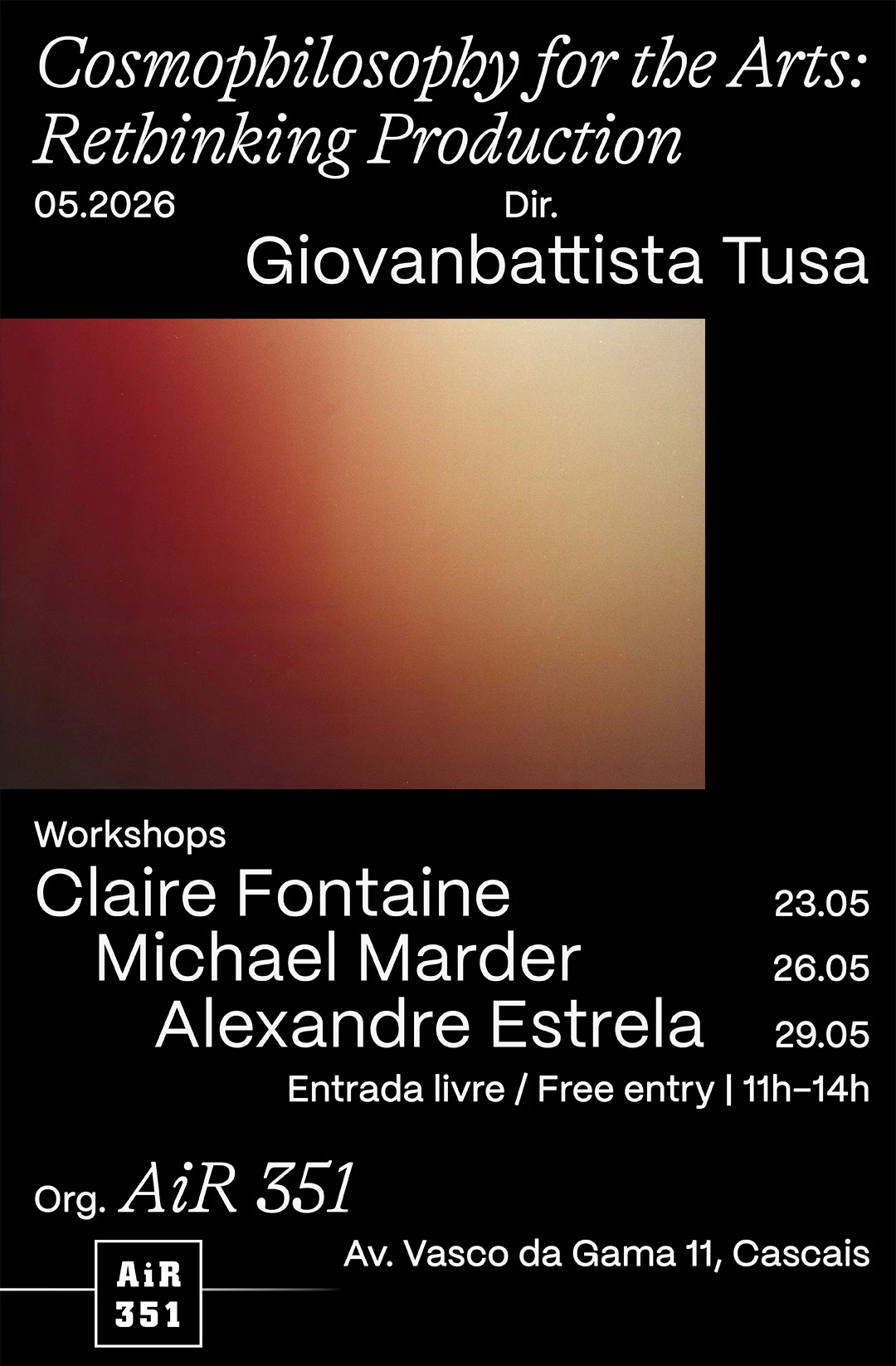
TOWARDS TERRA INCOGNITA: Interview with Giovanbattista Tusa
By Tomás Camillis