article
TOWARDS TERRA INCOGNITA: Interview with Giovanbattista Tusa
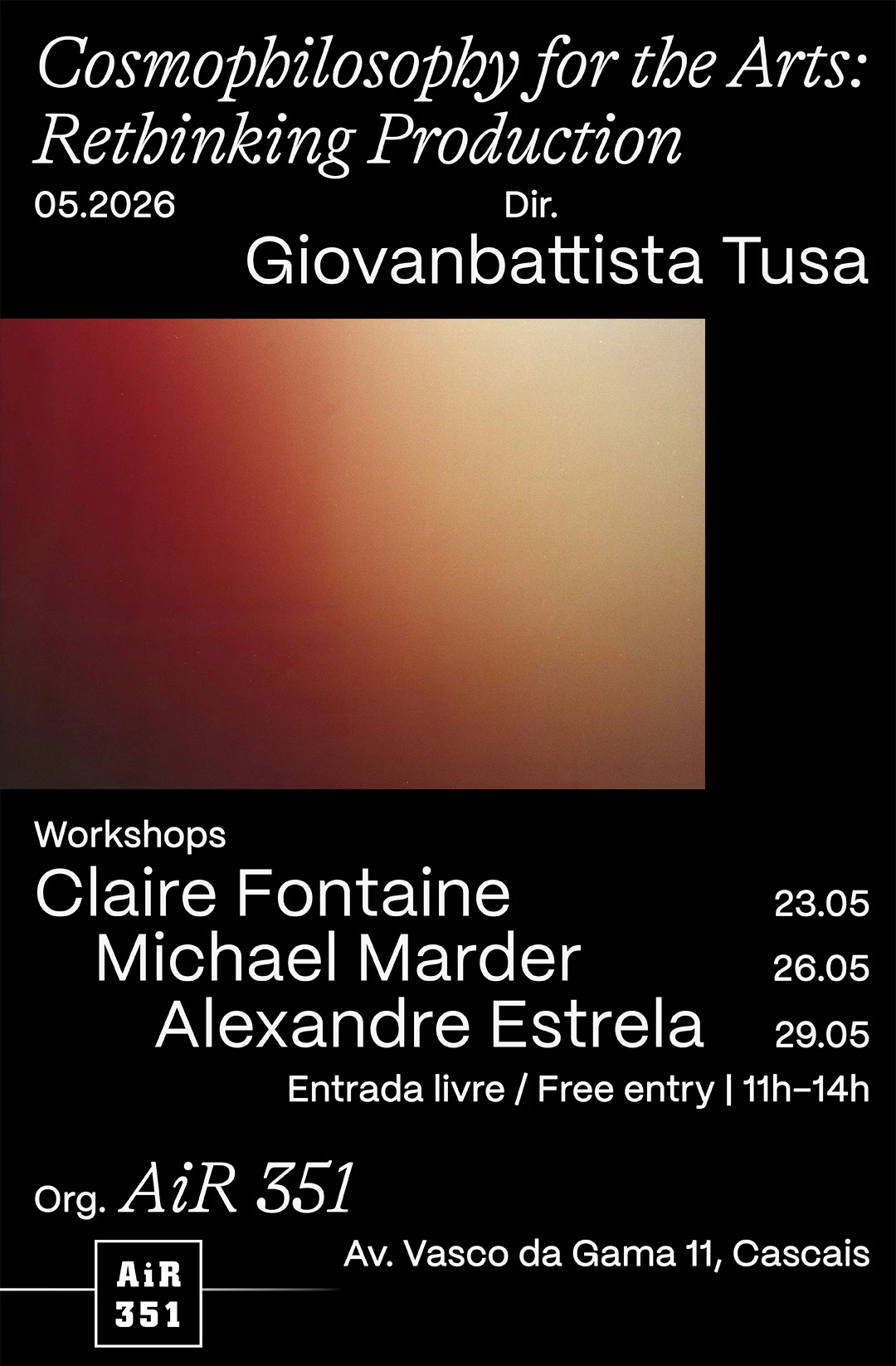
During May, the philosopher Giovanbattista Tusa led at AIR 351 the program Cosmophilosophy for the Arts: Rethinking production, where a group of selected participants was instigated to explore (through a series of seminars and workshops) artistic production as a process open to the uncertain — “the program explores production as an unstable zone where perception, material agency, and political and cosmological structures converge”. So, I sat with Giovanbattista on a June afternoon to talk about the possible relations between philosophy, ecology, art, and politics.
Tomás Camillis: Dissolving the individual into a process of uncertainty seems to be one of the central themes of your program at Air 351. In your book with Alain Badiou, The End, you discuss how the construction of a truth begins with an event beyond our control. Rancière also mentions that the artistic process involves stepping outside oneself in the service of a theme. In both cases, there is some kind of force that exceeds us, to which we devote ourselves, although it is not metaphysical.
Giovanbattista Tusa: Cosmophilosophy is not a doctrine about the cosmos; it is a practice of decentering. It begins when the subject ceases to understand itself as the origin of the work, of truth, or of action. The artist does not simply "express" an interiority; rather, they are traversed by forces, materials, rhythms, events, and temporalities that exceed their will. In this sense, the artistic process becomes cosmophilosophical when it abandons the sovereignty of the individual and allows itself to be affected by what has not yet taken form. This is not a return to a metaphysics of the Whole, nor a celebration of cosmic harmony. It is, instead, the capacity to endure uncertainty in relation to what escapes our control. The cosmic dimension belongs neither exclusively to science, although science is one of its languages, nor to the will to power, which seeks to dominate the Earth and the heavens alike. The cosmic is what compels thought to leave behind its human architecture.
TC: In times of collapse such as our own, art tends to be framed either as a political practice that ought to activate society or as a superfluous activity, devoid of immediate utility—the current cliché asks: how can one write poems in the midst of war? Deleuze argues that catastrophe lies at the heart of modern painting, to open up a space in which the new can emerge. Blanchot reflected on the possibility of artistic practice after the trauma of the Holocaust. It seems to me that both require from the artist the correct distance from the world.
GT: Emergency does not require the artist to become a propagandist, nor to abandon complexity in the name of urgency. Politically engaged art is not necessarily art that proclaims the correct position. Rather, it transforms the conditions of the sensible: what can be seen, heard, felt, and thought. In moments of catastrophe, the artist's task is not simply to represent catastrophe. That would be insufficient. The challenge is to address the forms through which catastrophe organizes perception itself. War, ecological collapse, fascism, colonial violence, and capitalist devastation are not merely themes; they are regimes of temporality, of language, of attention. Perhaps the artist's role is not to reconcile, nor to offer quick consolation or inexpensive hope. It is to open a fissure within the apparent inevitability of the present and to make perceptible, within itself, the possibility of another relation to the world.
TC: We are currently going through a general strike, the second in six months. Your program also explores the relationship between production, contemplation, and politics. Yet non-production, too, can be effective as an existential stance. There is an interesting connection between the aesthetic revolution and class struggle, insofar as both defend the right to rest and to contemplate. But contemplation is sometimes regarded as an aristocratic residue.
GT: Modern production has been captured by the logic of performance. To produce has become synonymous with existing. Artists, workers, and researchers alike are constantly compelled to themselves through measurable outputs. Against this imperative, contemplation is not passivity. It is a form of resistance. To contemplate is not to withdraw from the world. It is to suspend the violence of immediate response. Non-production can become profoundly political when it interrupts the cycle that transforms every energy into productivity, every attention into a commodity, every gesture into output. This does not mean glorifying inactivity. Rather, it means recognizing that there are forms of thought, listening, maturation, and care that cannot be translated into the vocabulary of productivity. The strike, silence, delay, refusal — these can all become modes of opening another relationship to possibility.
TC: You write somewhere that ecological thought is a participation in the multiplicity of beings, without imposing a totality upon them. Invited to lecture in your program, Michael Marder addressed the theme of epinoia, which would be an intelligence that operates on the surface between the self and others. What is the relationship between ecological thought and artistic practice?
GT: Ecological thought begins when we cease imagining the world as the stage upon which human action unfolds. We are not standing before nature; we are implicated within it. Art can render this implication sensible, not as a moral lesson but as an experience. Artistic practice becomes ecological when it recognizes that every form emerges from relations: material, historical, technical, affective, geological, and political. A work is never simply a work. It carries within it extractions, residues, gestures, energies, collaborations, and histories, both visible and invisible. It's necessary to relocate intelligence away from the isolated subject. Thinking, perceiving, and creating occur in-between. Art can be understood as a practice of this in-between space.
TC: It seems to me that the ecological stance is sometimes framed either as a pantheistic moralism or as a utilitarianism of survival. In a way, these are two fields that produce a language of clichés, closing off the artistic process to predefined aims. Is it possible to speak about ecology without morality or hope?
GT: Yes, and perhaps it is necessary. Ecology becomes impoverished when it is reduced to moralism: "we must save the planet." It also becomes impoverished when it is reduced to a utilitarian discourse of survival. The Earth is not merely something we preserve in order to continue existing. To speak of ecology without morality does not mean speaking without responsibility. It means abandoning the position of moral superiority from which humanity still imagines itself as the manager of the world. Likewise, speaking without hope does not mean surrendering to nihilism. Hope often functions as a form of anesthesia.I prefer to speak of attention and exposure to the things as they are. Ecology should begin with the difficult encounter with what cannot immediately be converted into a program, an image, or a solution.
TC: In your text Anarkhia, you relate metaphysics to the monument: the construction of fixed and autonomous structures would represent a belief in an isolated, irreducible essence. Modern art, in general, opposes the monument—the flâneur has a transient attitude that privileges the artistic process over the final product (or, in your terms, Terra Incógnita over Terra Firma). Is anti-monumentality important to you?
GT: The monument seeks to overcome time. Anti-monumental art accepts that every form is provisional, vulnerable, and contaminated. Today, anti-monumental art might be an art that works with ruins, residues, unstable archives, fragile bodies, and materials that continue to transform. It also refuses the monumentalization of the artist, of authorship, of institutional legitimacy. Terra Incognita is more interesting than Terra Firma because thought cannot install itself there as proprietor. Anti-monumental art does not celebrate formlessness; it invents forms that know they are not final.
TC: Since the eighteenth century, the aesthetic regime sought to construct a form of knowledge that was neither prescriptive nor relativistic, perhaps finding it in the belief in a judicious subjectivity. In your work, I also sense a constant tension between dogma and relativism. How to validate the diversity of perspectives in ecological thought without falling into relativism? Is there a role for aesthetics in all of this?
GT: The opposite of dogma is not relativism. Relativism says that all perspectives are equivalent. Ecological thought says something different: nothing exists in isolation. Perspectives are not interchangeable opinions; they are situated modes of relation to reality. To preserve diversity does not mean suspending judgment. It means making judgment more demanding, more attentive to the material, historical, and sensory conditions that make it possible. Aesthetics remains fundamental because it concerns the distribution of the sensible. In a world saturated with information, the central question is no longer simply what we know, but what we are capable of perceiving. Aesthetics is a politics of perception.
TC: Since the 1970s, it has become common to speak of the end of art, which perhaps signifies the transition from the aesthetic regime to the culture of information—from the object with inherent meaning (an end in itself) to the object as a vehicle for discourses (a means to other ends). I see here a relation to late capitalism, which reduces everything to a utilitarian dimension and constructs a regime filled of discourses yet devoid of meaning.
GT: The age of information produces the illusion that everything is visible. Yet this generalized visibility often conceals more than it reveals. We are surrounded by images, data and explanations, while the material processes of extraction, exploitation, and destruction frequently remain hidden. Art should not attempt to compete with the speed of information. It should interrupt it. It should create spaces of opacity and attention. Against the continuous flow, art can restore the gravity of things. Perhaps the task of art is to make us feel what information merely communicates. Information tells us that there is collapse. Art asks what kind of world has made collapse perceptible, acceptable, and repeatable, and what other world might begin to emerge.
TC: Ends and beginnings are of particular relevance to your thinking —you address the idea of new futures, defending even a kind of radical optimism. In this sense, although you question certain modern-humanist principles, I still see your concerns as almost a critical continuation of the modern project.
GT: I do not believe we can simply abandon modernity as one abandons a ruined house. We remain within its promises, its violences, and its vocabularies. The modern future was often colonial, productivist, and anthropocentric in the worst sense: it placed an abstract human subject at the center while sacrificing concrete worlds.Yet modernity also contains a force that should not be discarded: the refusal of what is given, the invention of new forms of life, the conviction that the present is not destiny. A critical continuation of the modern project would have to liberate this force from its alliance with domination, linear progress, and human sovereignty.Art imagines the future not by illustrating utopias, but by transforming our relation to possibility. It does not predict. Perhaps the future is not what comes after the present. Perhaps it is what, within the present itself, we have not yet learned how to perceive.
Bibliography:
Tusa, Giovanbattista. "Anarkhía. The Return of the Air," in Tusa, Giovanbattista and Marder, Michael (eds.). Contemporanea. A Glossary for the XXI Century, MIT Press, Cambridge (MA), 2024.
Tusa, Giovanbattista and Badiou, Alain. The End, Polity Press, Cambridge, 2019.
BIOGRAPHY
Tomas Camillis is an author and researcher based in Lisbon, working on fiction and on essays in the interplay between art, philosophy and literature. He has a master's degree in Art Theory by PUC-RJ. In recent years he has participated in researches, taught courses in cultural institutes, helped organize conferences and published in specialized magazines. He currently collaborates with the MAC/CCB Educational Service and Umbigo magazine.
ADVERTISING
Previous
article
07 Jul 2026
Luisa Cunha (1949–2026)
By Umbigo
Next
agenda
09 Jul 2026
Open Call for an International Artist Residency at Westwerk, Hamburg (2027–2028)
By Umbigo
Related Posts
article
25 AUG 2026
Foreign Monuments: Grada Kilomba at Fundação Albuquerque
By Tomás Camillis
article
18 AUG 2026
The distant work: Ana Vieira at Galeria Vera Cortês
By Tomás Camillis
article
30 JUL 2026
Excess and Silence
By Tomás Camillis
article
08 JUL 2026
TOWARDS TERRA INCOGNITA: Interview with Giovanbattista Tusa
By Tomás Camillis