Article
Koyo Kouoh's In Minor Keys and the year the Biennale stopped listening
In the Holy See pavilion, Giardino Mistico dei Carmelitani Scalzi, a monastic garden of medicinal herbs, has been wired for sound. You bend toward the beds and the recordings arrive at the threshold of audibility — not quite music, not quite speech, a register that asks you to stop moving before it will resolve. Nobody photographs it. After three days in Venice this begins to feel like a statement of method. The volume across the 61st Biennale has been turned down so far that the exhibition's real demand is postural: lean in, slow down, wait. In Minor Keys is the first major international exhibition to treat listening not as a metaphor but as art's primary operation. It is also the first to make that claim from inside an institution that had just spent a season proving it could not hear anything at all.
The facts are not in dispute. In the months around the opening, the Foundation reinstated the Russian pavilion over European objection and forfeited two million euros in Commission funding for the privilege. The international jury recommended excluding Russia and Israel, both facing allegations before the ICC, from consideration for the Golden Lion; it was overruled and resigned within three days. Twenty-seven national pavilions shut their doors in support of the art workers' strike, and the police met the demonstration outside the gates. The American pavilion, handed to a populist circle, was filled with the most weightless abstraction available, a display so committed to saying nothing that the silence reads as policy. In each case someone was perfectly audible and the institution elected not to hear, and in each case the justification was identical: that art is neutral ground, that the exhibition must stay open to all, that this is not the register in which decisions are made. Then it opened a show about the ethics of attention.
The show itself deserves better than that sentence, which is part of the problem. Cecilia Alemani's 2022 edition ran on metamorphosis and the surrealist body; Adriano Pedrosa's 2024 made difference the subject, staging the foreigner as the century's representative figure. Kouoh moved the question elsewhere. Not who are we, but how do we go on after this — a shift so quiet it barely registers until you notice how little of the exhibition is organised around nationality, gender or race as interpretive keys. What replaces them is relation: between people, ancestors, plants, water, weather, the dead. It is a serious proposition, arguably the most consequential to reach Venice in a decade, and it is now permanently attached to a scandal it had nothing to do with.
It is also a proposition its author did not live to defend. Kouoh died in May 2025, a year out from the opening, and the exhibition was assembled from her preliminary plans by a curatorial team that has insisted, plausibly and often, that the framework was settled weeks beforehand. What that produces is strange to walk through. The vocabulary is intact — the thematic clusters, the artist list, the insistence on the minor — but it has the quality of a score performed by musicians who have the notation and not the phrasing. Decisions that would have been arguments under a living director have become protocols; nobody felt authorised to depart from a document that was, by definition, unfinished. The result is faithful and inert at once, a reconstruction of a sensibility rather than the sensibility itself. This matters here more than it would elsewhere, because attunement is precisely the quality that cannot be delegated. An exhibition about listening was built by people listening very hard to an absent author, and the fidelity of the transcription is exactly what you can feel.
Kouoh did not arrive at her position by theory-shopping. She worked for a decade in a South African intellectual milieu in which Achille Mbembe's turn from the anatomy of power toward repair and planetary interdependence was a working condition rather than an academic stance, and it shows in the exhibition's grain. Édouard Glissant supplies the architecture — Relation against universality, the right to opacity against the obligation to explain oneself to a global audience — and Anna Tsing supplies the temperature: life assembling itself in the ruins rather than being rescued from them. But the texts that actually govern the Arsenale are not art theory at all. Robin Wall Kimmerer, Vine Deloria Jr. and Ailton Krenak offer an ontology, not a methodology. Deloria's reproach to European thought is that it asks when when it should ask where; Krenak's river is not a resource or a symbol but a relative. Kimmerer's reciprocity — the forest as a party to an exchange rather than a stock of timber — accounts for an entire wing given over to seed, soil, textile and collective labour, work that is neither a critique of extraction nor a lament for it but an attempt to describe what being owed something by a plant might feel like. Absorb that and the exhibition stops looking like an argument and starts looking like a liturgy, which is why its strongest rooms deal in ritual, ancestry and forms of knowledge that decline to justify themselves in the vocabulary of critique.
The twentieth century built art around the figure who speaks: exposes, provokes, indicts. Kouoh proposed the artist as receiver — not a speaker but a tuner, scanning for the river, the forest, the ancestor, the vanishing species, the history nobody transcribed. The implied politics is that attention precedes everything, that a world cannot be repaired by subjects who have lost the capacity to register it. Hartmut Rosa's wager, that modernity's injury is not complexity but the severed connection between self and world, is audible in nearly every room without appearing in a single wall text.
And this is where the alibi lives. Listening is also, conveniently, the ideal institutional register. It is infinitely receptive and it commits to nothing. It converts every conflict into a frequency to be registered rather than a position to be taken, and it flatters the visitor with the sensation of ethical labour performed at no cost. An exhibition that asks you to attune rather than decide is an exhibition no ministry will ever have to answer for; it is, in the most literal sense, the aesthetic form of the Foundation's own defence. The vocabulary that carried genuine intellectual risk when Tsing and Krenak wrote it has hardened by 2026 into a house style — mycelium, entanglement, care, repair — and house styles are what institutions reach for when they need to look as though they are thinking. Whatever Kouoh intended, what the Biennale received from her was a theory of receptivity it could deploy in the precise season it refused to be receptive to anything.
The audience declined the invitation, in its way. What actually held people, hour after hour, was not the minor register but its opposite: a queer rave in the Greek pavilion, an autofiction narrated by excrement in Luxembourg, a wall of near-naked performers in Denmark, a ceramics workshop in Italy where you could put your hands in the clay and stop thinking. File this as philistinism if you like; it is the wrong reading. The irreverent work and post-ironic extravaganza was doing something the contemplative work could not — it gave people a body to be in. Slowness offered as a corrective to overstimulation begins, by the third darkened room, to feel less like attention than sedation, the exhibition equivalent of being told to breathe. A public that has spent four years being asked to sit with grief turned out to want something loud, absurd and unashamed, and In Minor Keys has no account of that appetite at all. Attunement assumes a subject with the reserves to attune. The queues in Venice suggested the reserves are spent.
Which makes the sorting of the work unusually easy, because listening done properly is not a sensitivity. It is labour, and it costs the listener something. Gabrielle Goliath's project — dropped by South Africa, mounted independently at the Chiesa di Sant'Antonin, and the strongest thing in the city — understands this exactly: what it asks is not receptivity but endurance, the obligation testimony imposes on anyone who agrees to be present for it. Tarek Atoui's contribution to the Qatari pavilion treats hearing as a physical discipline with instruments and duration rather than an atmosphere. The Vatican garden works because the recordings refuse to meet you halfway. Notice where these things are. Goliath is outside the Biennale because her own country removed her from it; most of what survives the trip home was seen at Fondazione In Between Art Film, Palazzo Grassi, Fondazione Prada, or in projects scattered to the far end of Giudecca. The best listening in Venice happened at the edges of an institution whose centre could not accommodate it.
Against that, much of the exhibition mistakes softness for attention. Canada's water lilies, contemplated through the colonial lens. Japan's nursery of newborn mannequins. A therapeutic framing in which visual practice is described as the restoration of sensibility, a phrase now indistinguishable from the language of wellness. The curators announced a Biennale concerned with artists rather than objects, and the result is a drift into the biographical and the psychological in which grief becomes a finish applied to a surface. Grief is the show's dominant affect and it is not, mostly, the grief of defeat — it is the grief of acknowledgement, a farewell ceremony for modernity conducted in textile, soil, water and hair while the rest of the culture talks about nothing but machines. That is a defensible position. At this saturation it is also indistinguishable from consolation, and consolation is what an institution offers when it has decided not to act.
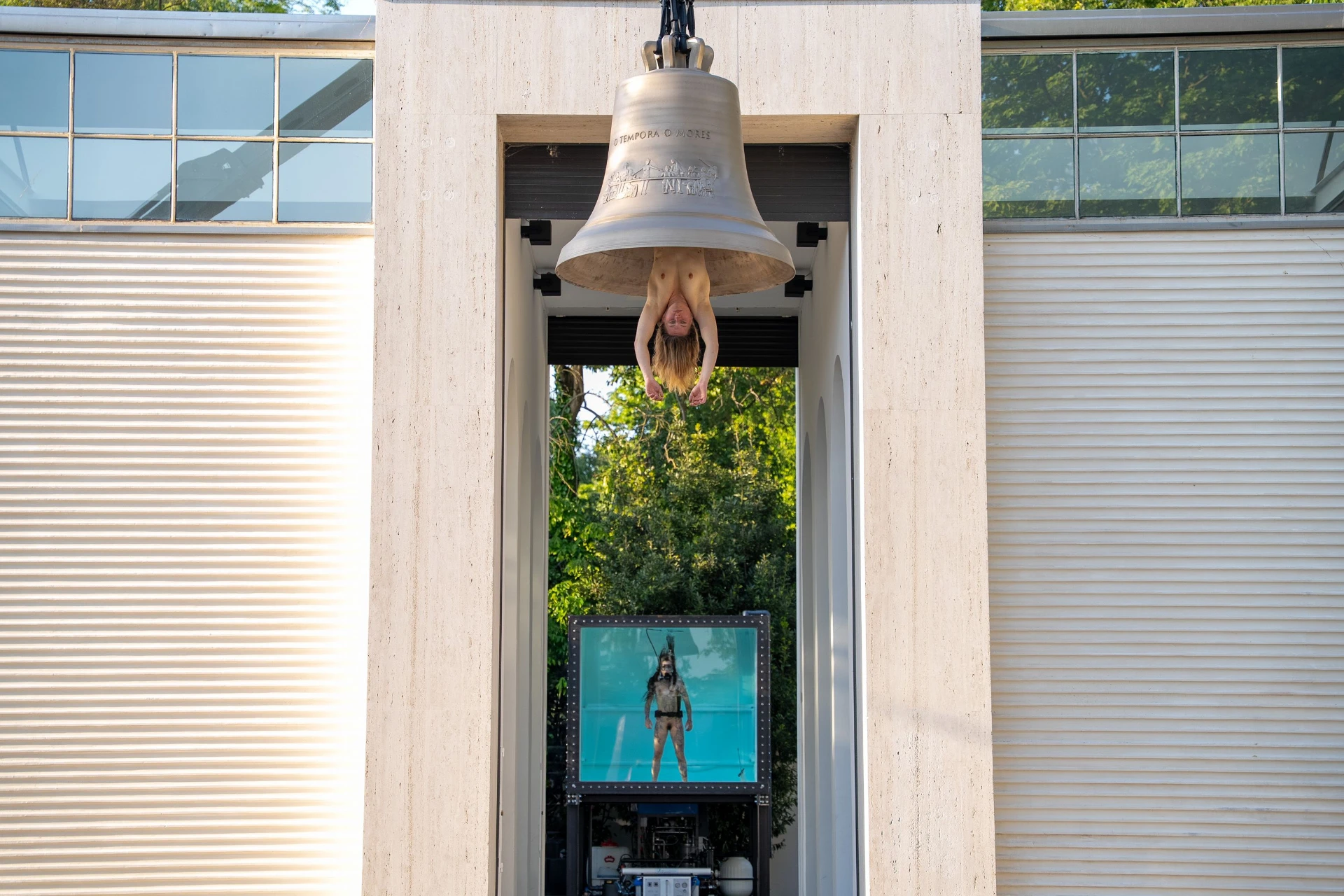
The exception stands in the Austrian pavilion, and it is the only work here that resolves the contradiction instead of illustrating it. Florentina Holzinger hangs a performer upside down inside a monumental bronze bell and swings her against the walls; elsewhere in SEAWORLD VENICE, swimmers move through an aquarium filled with water reclaimed from the visitors' own urine. The bell is the most literal listening device in Venice and it is also an instrument of violence: it makes sound by striking a body, and the body is inside it. Nothing is attuned here. Something is hit, and the noise it makes is the reason everyone came. Against a Biennale that asks its audience to lean in and receive, Holzinger points out that resonance has a mechanism, that the mechanism has a clapper, and that the clapper is a person. Kouoh proposed an exhibition that listens. This is the one work that asks what listening sounds like from inside the instrument.
The Biennale is open until November 22, 2026,
BIOGRAPHY
Alexander Burenkov is an independent curator, cultural strategist and writer based in Paris. His work extends beyond traditional curatorial roles and includes organizing exhibitions in unconventional spaces, often emphasizing multidisciplinarity, interest in environmental thinking and post-digital sensibilities, encompassing projects such as Yūgen App (launched at Porto design biennale in 2021), a show in a functioning gym or online exhibition on cloud services and alternative modes of education, ecocriticism and speculative ecofeminist aesthetics. His recent projects include Metabolizing Time: Propositions of Countering Linearity (MU Hybrid Art House, Eindhoven, 2026); Time That Grows Slowly (Dom Art Projects, Dubai, 2026); Don't Take It Too Seriously at Temnikova&Kasela gallery (Tallinn, 2025); Ceremony, the main project of the 10th edition of Asia Now art fair (together with Nicolas Bourriaud, Monnaie de Paris, 2024); In the Dust of This Planet (2022) at ART4 Museum; Raw and Cooked (2021), together with Pierre-Christian Brochet at Russian Ethnographic museum, St Petersburg; Re-enchanted (2021) at Voskhod gallery, Basel, and many others.
ADVERTISING
Previous
Article
13 Nov 2026
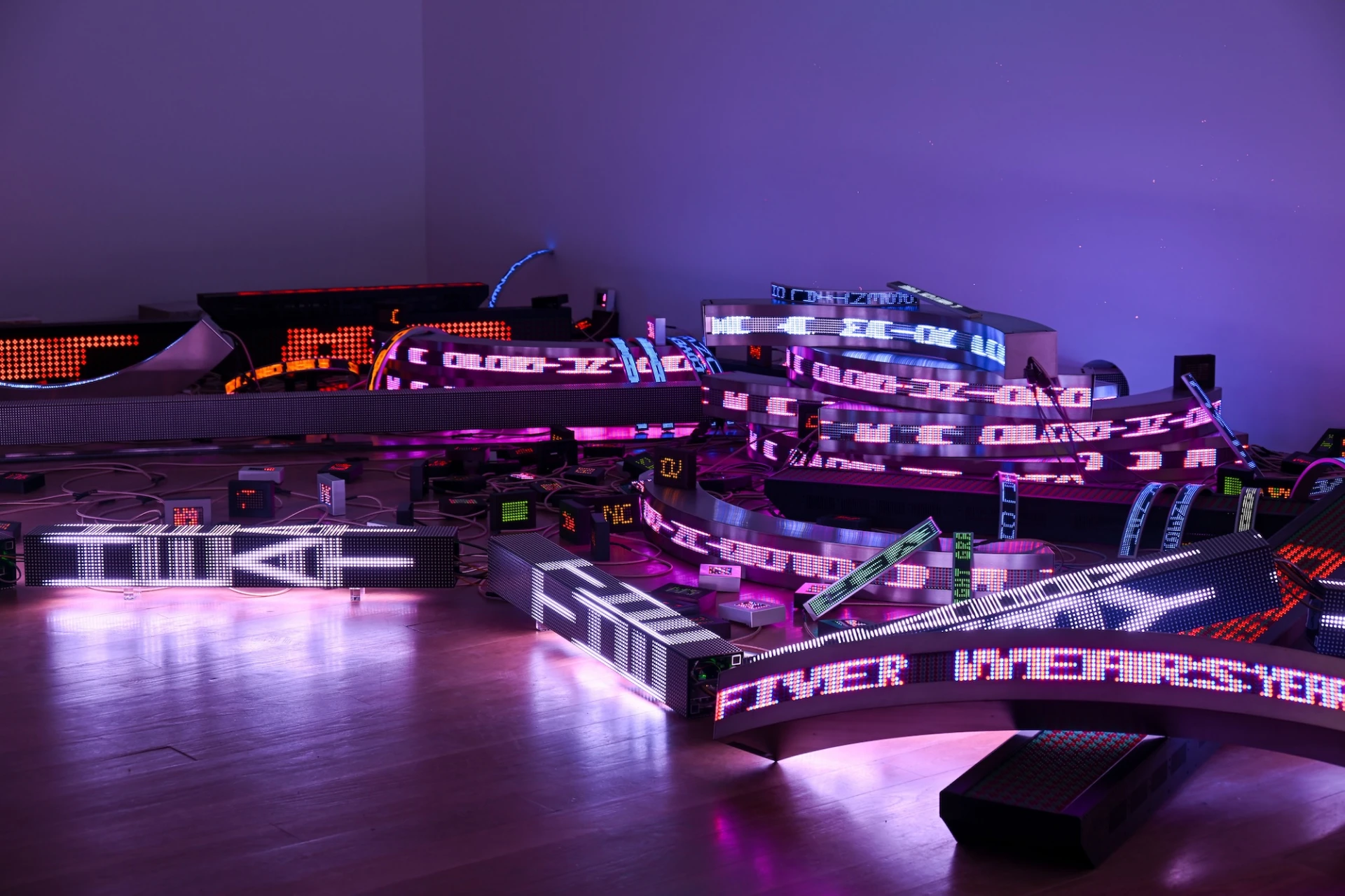
Jenny Holzer: words that seduce
By Débora Valeixo Rana
Related Posts
Article
16 NOV 2026
Koyo Kouoh's In Minor Keys and the year the Biennale stopped listening
By Alexander Burenkov
Article
03 MAR 2026
The Labubuification of Trauma: How Fenix Turns Migration into Affective Design
By Alexander Burenkov
Article
04 FEB 2026
Visions of Transit and Apocalypse in Klaipėda - Klaipeda Biennale of Contemporary Art
By Alexander Burenkov
Article
11 AUG 2025
Exercises in Public Intimacy: Wolfgang Tillmans at the Centre Pompidou
By Alexander Burenkov