Article
Giving shape to the inexplicable: Koo Jeong A at KW in Berlin
“You can count on your fingers the number of works featured in Koo’s largest solo exhibition in Germany, where he lived between 2006 and 2013, in Berlin. Spread over three floors, the exhibition at KW highlights ephemerality and perception.”
Perhaps you remember the feeling of gazing at the glow-in-the-dark stars on the ceiling of your childhood bedroom. The lights would go out, and you were supposed to go to sleep, even if your child’s body was still resisting. The daylight that had remained there, stored in the little stars, now shone. Eyes fixed on the ceiling saw movements that weren’t really there: the stars seemed to be dancing. And, amidst the twinkles that grew longer and longer, there was a sense of warmth, the certainty that it was perfectly fine to relax.
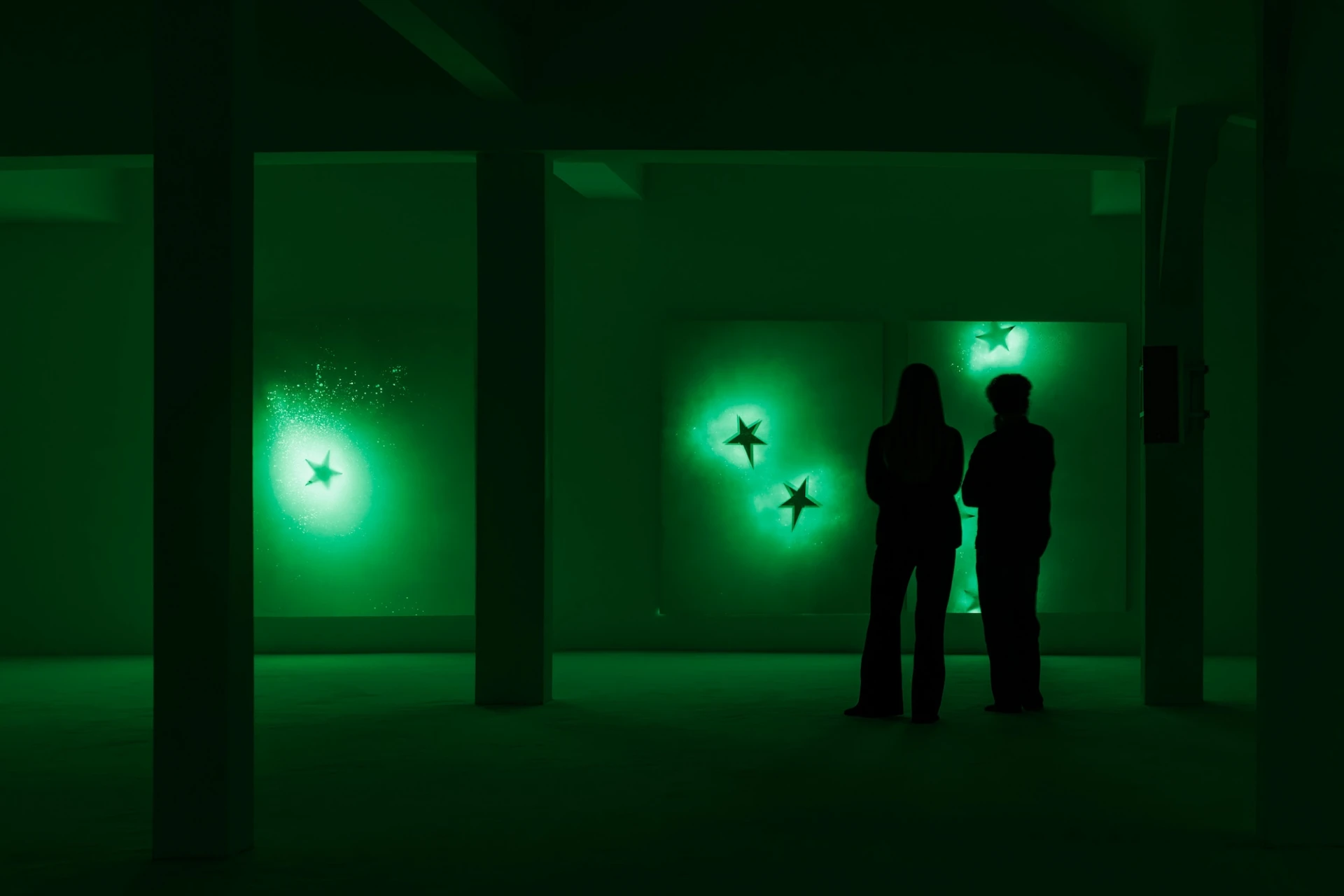
Some say that art is about giving form to the senses. Koo Jeong A’s work does not give them form, but rather offers them an outline. Memory, perception, atmosphere, scent, energy, colour and magnetism are among the materials she works with, bringing the inexplicable to the fore. In the exhibition OUSSSEAN, currently on display at the KW Institute for Contemporary Art in Berlin, the stars of childhood bedrooms inspire [SEVEN STARS], an installation in a seemingly empty, all-white room whose floor is covered with a soft white carpet. Until the lights go out, and the invisible screens reveal the phosphorescent stars for a few seconds. Accompanied by a sound installation, these seem to transport visitors to another time and space. The moment the light returns—bright and white—the luminous shock and glare take over, until the whole process repeats itself once more.
Born in South Korea, Koo Jeong A moved to Paris in 1991, aged 24, and has since lived as a nomad, living and working in various countries and taking part in major institutional exhibitions around the world. In addition to the KW in Berlin, Koo is currently exhibiting a massive show at the Leeum Museum in Seoul, entitled OUSSSMOS, and until May she had a solo exhibition at the Kunsthaus Bregenz on the shores of Lake Constance in Austria. The difficult, invented titles also allude to abstraction: to that which can be perceived, but is difficult to explain.
You can count on your fingers the number of works featured in Koo’s largest solo exhibition in Germany, where he lived between 2006 and 2013, in Berlin. Spread over three floors, the exhibition at KW highlights ephemerality and perception. [ITS SOUL] is an installation that is at once apocalyptic and silent, in which two thick walls placed in the centre of the exhibition space take turns in a brief, intense turbulence. Whilst each column shakes for a few seconds, the noise fills the space, and the air around it also vibrates. More than a literal allusion to an earthquake, Koo points to an indescribable, powerful force within human nature: creativity. “I want to portray the state we find ourselves in when we create. It is an entropic state, one of instability, chaos and, at times, difficulty. It is from this state that human beings create,” explains Koo in an interview.
Still playing with the architecture of the space, another room in the exhibition has been painted hot pink, which makes it both warm and impossible to stay in for long. The use of colour and its effects are explored extensively in her works, including the skate park that has already been installed at various exhibitions around the world, such as the 2012 São Paulo Biennial. For months, at night, Ibirapuera Park was illuminated by the phosphorescent pink light of the temporary skate park. Koo Jeong A’s olfactory work at the KW smells of coal. It evokes the past of East Berlin, where the museum is located, which until the late 1990s smelled of lignite, used to heat homes during the winter and whose combustion permeated the city’s streets. After the fall of the Wall, the modernisation of heating systems caused this odour to gradually disappear. In the exhibition, the smell of coal thus evokes the city's emotional, economic, and historical dimensions.
The relation between smell and memory was the central theme of his exhibition at the Korean Pavilion during the 2024 Venice Biennale. At one of the world’s most spectacular art exhibitions, Koo chose to show almost nothing, inviting the hundreds of thousands of visitors to the Venice Biennale to pause and breathe in the scents of Korea. As part of the Odorama Cities project, Koo launched an open call asking people from across the Korean peninsula – including North Korea – to share their olfactory memories of Korea. Among the 600 accounts, one participant described the smell of ‘dead cells’ he could detect on his grandfather’s chest, whilst another contributor described the unpleasant smell of sheep’s milk that her father used to heat up on the farm every morning. The stories inspired the creation of 17 fragrances, which were scattered throughout the pavilion and transcended all kinds of boundaries.
Ephemeral works of art can be both minimalist and powerful. They follow the passage of life, fading like thoughts, returning as memories. In Lisbon, in 2011, Koo presented the exhibition 9: Nove/Nine, in which he constructed five giant structures at the Calouste Gulbenkian Foundation’s Centre for Modern Art. The title referred to the hypothesis that the universe might have nine dimensions, although we can only conceive of four. The five structures represented precisely the remaining dimensions, inaccessible to visitors, who could only glimpse their interiors. Koo destroyed everything afterwards.
The exhibition KOO JEONG A – OUSSSEAN is on display at the KW Institute for Contemporary Art in Berlin until January 10, 2027.
BIOGRAPHY
Julia Flamingo is a cultural interpreter, historian, journalist, curator, and itinerant researcher specialising in contemporary art. She transforms academic and field research into texts, exhibitions, projects, and experiments that make complex ideas understandable to audiences beyond academia and the specialised art circuit. She holds a Master's degree in Cultural Studies from the Catholic University of Portugal. She researches the relationships between art, language, and legitimation, investigating how discourses within the art world influence audience participation. She is the founder of Bigorna, an independent platform for contemporary art education.
ADVERTISING
Previous
Article
25 Nov 2026
The expanded field of architecture in Liquid Affinities: (another) affective cartography for Portuguese architecture
By Joana Duarte
Related Posts
Article
26 NOV 2026
Giving shape to the inexplicable: Koo Jeong A at KW in Berlin
By Julia Flamingo
Article

28 OCT 2026
Where did we come from and where are we going? And what does Portugal have to do with it?- Two exhibitions curated by Sérgio Fazenda Rodrigues in Berlin
By Julia Flamingo
Article
Loop Lab Busan-7qk50.JPG)
03 JUN 2025
Loop Lab Busan: South Korea's new video art festival
By Julia Flamingo
Article
02 MAY 2025
Inauguration of MACAM, the new Museu de Arte Contemporânea Armando Martins, in Lisbon
By Julia Flamingo