article
Color and gesture - a primordial noise of the world: Fernando Mello Brum at 3+1 Arte Contemporânea
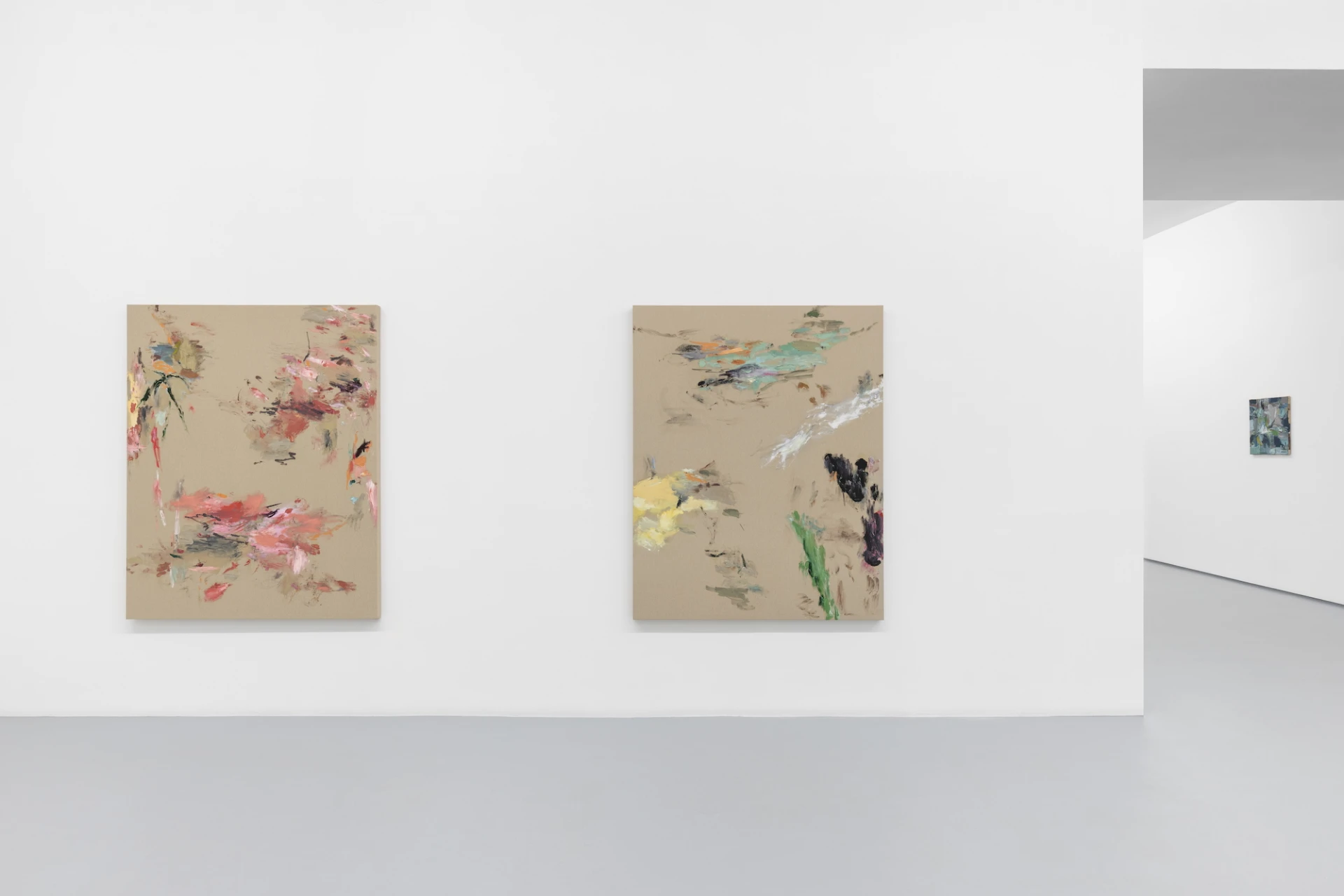
On a small side street off Rua de São Bento, the 3+1 Arte Contemporânea has reserved two floors for the exhibition Horizonte de Eventos, which brings together 12 paintings by Fernando Mello Brum. We are presented with a set of paintings with a chromatic feel, inscribed in a field of aesthetic experimentation.
In the exhibition's presentation, Mattia Tosti, who wrote the exhibition text, suggests that Brum's works can be compared to a recording device similar to the one created by the young physicist Karl Jasnky in 1928. Tasked with exploring all types of movement and signals that interfered with radio transmissions, Jasnky collected atmospheric disturbances, electrical storms, and the movements of industrial machinery for the project, until he concluded that a noise remained, regardless of the transmitter's location; suggesting a sound interference from outside the solar system.
One might, in fact, think of colors and gestures as a kind of primordial noise of the world. Preceding language, and something that language eventually obscures and conceals, the expansion and containment of the universe's movement converge in our bodies through the breathing of sensations and temperatures that overwhelm us. Meauré-Ponty said that "inspiration" is truly an apt term: we find ourselves within the movement of the universe, and we inhale and exhale with it. In this movement, there is no word and no name: there is breath and the stripping away of form and often noise before music.
In Brum's exhibition, colors initially appear as expressions of temperature and movement, in a kind of original chaos. Firestorm of stars (2025) is the first work, and the name speaks for itself. The forms are not yet fully formed: we are faced with colors conveyed through gestures, varying between impetuosity and delicacy. Especially in the first works of the exhibition, Brum abundantly uses the empty space of the greige paintings, granting breath and movement to the works. It is precisely in this movement that the landscape is formed, a landscape in progress. The interval between the colors is space, time, and energy – and the colors are forms detached from an unknown alphabet.
In Latin, sidera is the term that evokes the design of the constellations, forming the Milky Way or what we call outer space: the space of the sidera, of the stars. In Antiquity and the Renaissance, it was possible to look at the stars and ask for an answer regarding destiny. This was called "considering"—being in the presence of the stars, being among the stars. Often, however, the stars were silent. This silence and separation come to be marked by the use of de-. If considering is being with the stars, desiderare is being alone, without the support of the stars, in search of the meaning of one's destiny. And it is from this that desire, desiderium, comes, which, when transformed into a psychological feeling, comes to signify the feeling of lacking something. Desire, in this sense, is the feeling of lack, defined as the detachment of the being in the vastness of the cosmos. What I desire is what I lack—and in desiring, I move forward.
Without a central guiding point, deterritorialized, astrological, the gaze circulates, making us move alongside the painting and between paintings, as if we were inside the primordial impulse that inhabits the movement of the world. We are inserted into a kind of cosmo-optical constellation of gestures, advancing so that the impetus, the movement, and the intermediate temperatures form the first images. Gradually, in some paintings, poignant, and in others, delicate, dazzling, and swift, the brush begins to delicately transport the dark tones, suggesting depths and constantly evoking the uncertainty of the contours.
One could say that Brum floats between lyrical expressionism and lyrical expressionism, presenting chromatic landscapes that transcend the impression of a static landscape and give way to movement, impression, and climax. The painter first constructs planes of approach and distance, which will later be subverted in other, more concentrated works. Endowed with an angular organic quality, the works begin to conquer uncertain, denser, and more populated landscapes, leaving us doubting of whether or not we have found what we believe we have found. This doubt is directly related to the hybrid density of the colors, to their joining.
While this concentration is already present in some paintings on the upper floor, on the lower floor the gestures multiply and become more populated, forming a more concentrated and static landscape, in which movement is inscribed internally. Thus, works with a greater impression of completeness and excess are forged, contrasting with the already dispersed and subtly suggested elements of the first floor.
It is primarily through the choice of colors that Brum achieves a certain lyricism, especially in works such as Para encontrar o azul eu uso pássaros (2025) or Não tem altura o silêncio das pedras (2025). Pink, blue, turquoise, gray, and a balanced use of black are present. They differ to some extent from the works on the lower floor, which retain white and an autumnal, icy atmosphere. Although not absolutely divided by the curatorship between populated forms and voids hinted at by slight bursts, it is possible to notice the variations in Brum's melody in his way of inhabiting the void.
Many times, I was struck by the impression of encountering natural landscapes – mountains, dry leaves, winter. At other times, I was far from even having any such impression. There is no certainty whatsoever in what we encounter. Brum's exhibition trains us, in this sense, for the unfamiliar, for the strange and the unsettling, produced by the tension of colors with the brush, by the intertwining of gestures with colors, and by the variation between emptiness and the populating of forms.
If the painter, using Jasnky's devices, explores the forms, gestures, and textures around us, regardless of their distance or size, he also teaches us to be prepared precisely for not knowing what we find. More than that, to find it despite that. This will be, precisely, the difference between art and science. It's not about capturing anything, nor understanding anything. It's about marveling, being astonished, advancing with desire, for the sheer pleasure of marveling.
Sometimes, that's what it's all about: there is no communication, objective, or bridge in the aesthetic experience; there is a mystery that must be accepted. The mystery of resonances is basically a metaphor for the artist's eventual role in tapping into the unknown. Moving astrologically, distant, near, or minimal planets—planets that, so often, are ourselves—are captured by the painter's antenna. So often, they come to us, like moons murmuring on the water.
The exhibition Horizonte de Eventos, by Fernando Mello Brum, can be visited at 3+1 Arte Contemporânea, in Lisbon, until March 14.
BIOGRAPHY
Mariana Varela (b. 1991) is a poet and sociologist. She has published "Enigmas de Jaguar e Jasmim" (2019) and "Rotativa" (2022), both edited by Urutau. She edited the mini literary magazine "Frente!" and currently edits the literary magazine "Letra Lenta". A graduate of the University of São Paulo, with a master's degree in sociology from Universidade Nova de Lisboa, she is currently pursuing a PhD in philosophy at the same institution. She writes articles on the intersection of aesthetics and philosophy.
ADVERTISING
Previous
agenda
-fbhvt.jpg)
24 Feb 2026
ANTI-ISTO: MANIFESTO POEMA opens on 26 February at MNAC
By Umbigo
Next
article
03 Mar 2026
Mise en scène: brilha enquanto vive, na Brotéria
By Tomás Camillis
Related Posts
article
03 AUG 2026
Rosa Barba. Drawing Vocabularies, at CAM - Gulbenkian
By Mariana Varela
article
23 JUN 2026
TERRACRONIA - Masterclass with Federico Campagna in Montemor-o-Novo
By Mariana Varela
article
25 FEB 2026
Color and gesture - a primordial noise of the world: Fernando Mello Brum at 3+1 Arte Contemporânea
By Mariana Varela