article
Flaming Bodies, by Pedro Valdez Cardoso
Flaming Bodies is a title that immediately raises a pressing and burning question about some form of bodily experience. The realm of desire stands out as one of the most relevant aspects of this inquiry, a theme previously explored at certain points by Pedro Valdez Cardoso [works such as The Space Between Us (2003) or Entranhas #1 (Guts #1, 2022) immediately come to mind], though here elevated to a body of work that offers an intelligent synthesis of these questions.
David Revés's exhibition text provides a solid framework for understanding these works by revisiting themes of desire, the body, the organization of their connections, and their various ramifications, while also acknowledging their scenographic quality and their exploration of these themes as part of precarious structures—as inherent voids and flashes of melancholy— as points of tension between psychic, political, and social forces in constant conflict. It also knows how to map the broader context of these issues across the exhibited works, but from here it is also necessary to glimpse, perhaps above all else, the way in which these pieces articulate their problems to the point of suggesting these very readings, and by testing them in this way, perhaps other paths to understanding their experience may be discovered.
The exhibition, spread over two floors, begins with a series of three works, two of which are photogravures featuring images of classical statuary covered with shell fragments (Flaming Creature #01 and #02, both 2020), in a collage-like approach that owes much to surrealist language and its strange combination of everyday elements that distort their familiarity to create an unusual image. We find this strangeness in the statues’ clarity being cut through by the visual spasm of these cutouts, concealing their faces like a mask overflowing with libidinal energy, evident in the phallic aspect of some cutouts and in the instinctual quality of this mixture’s abruptness. Recourse to the mask and its exuberant display slips into this scenographic quality, and its ostentatious display of instinctual character, superimposed on the statues’ sobriety, reveals a kind of performance of that libidinal force that gives it a presentational value to serve as an identity. This identity-defining quality of exhibitionist verve suggests an external organizational mechanism with strong social connotations, suggestively aligned with performative notions of gender—a whole sense of organization and regulation that continues in the third piece of this series, An History of Violence (2026). This sculpture of a grille with a chain and a padlock, painted gray and covered in plastic and silicone that rises from its curves almost like chipped paint, clearly brings us back to the force of the imposition of limits that has always characterized the social space of sexuality. The contrast between these prohibitive signs and the tactile delight of their form—evident in their crisp, fragile chips and the softness of their silicone deposits—proposes a highly sensual sensory ambivalence, as evidence of a treatment of the libido that integrates it only to set it on a path of suppression, separation, and displacement, a violence in contrast to the identifying flame of “flaming creatures.”
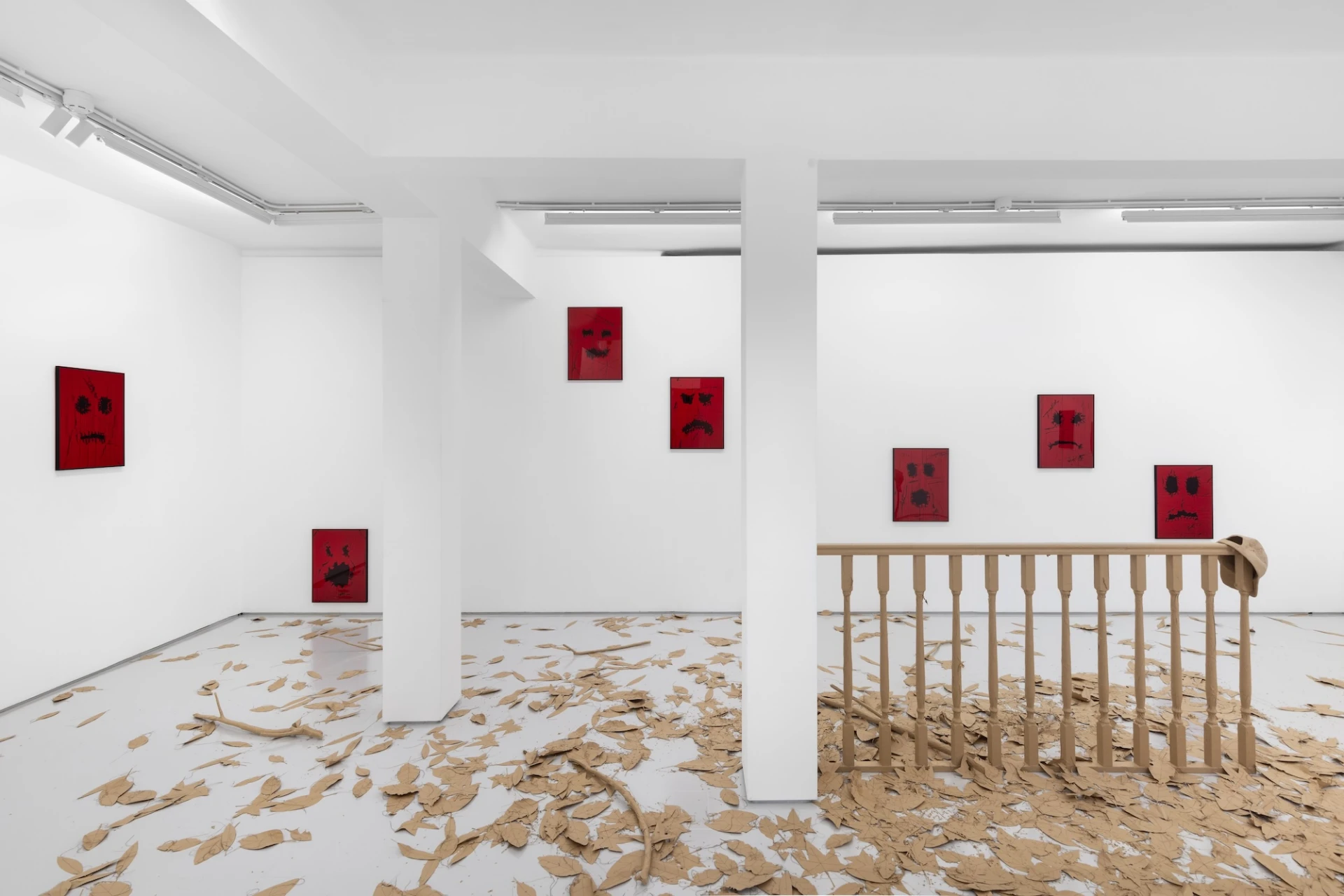
Descending to the lower floor, one discovers a new arrangement of pieces, one of which is positioned in the center of the space and surrounded by the others, which are scattered along the walls. One of these works is a sequence of 11 photographs (Skin #1–11, 2026) that immerse torn cardboard surfaces—pierced with holes and threaded with strings—in shades of black and red. These images suggest vague facial features with jagged and irregular shapes that give them the force of grimaces, of eyes and open mouths, of an expressive intensity that leads us once again to a concept of the mask and of scenographic presentation. Springing from a perforated and lacerated surface, and since these photographs are a “skin,” these masks seem to trace the path of drive forces and bring them to the surface, revealing the irregularity and chaos of the libidinal flow that requires its own organizational mechanisms and filters for external expression, much like the dazzling shells of the previous works, with which a deliberate contrast is drawn here. Considering that these pulsional tears constitute an image of turmoil arising from the hollowing out of a surface, an anguished notion of absence is thus established at the very heart of the libido’s operation in this representation—a question that finds an echo in the issues raised by Aftersun (2026), the piece that occupies this floor’s center. Here we find a balustrade and a cap resting on its tip, with these two elements wrapped in brown paper and surrounded on the floor by a scattering of branches, also wrapped in that paper, and by pieces of paper cut into the shape of leaves with a multitude of threads running through them, sometimes arranged to mimic the veins of the leaves, sometimes unfurled in a coiled languor that spills beyond the paper cutouts. Like a youthful token placed on an isolated fragment as a recovered memory, the cap on the balustrade bears the mark of a vanished or lost presence that evokes a nostalgic specter—a sensation intensified by the twilight-like suggestion of the title and the abandonment of the branches and fallen leaves, and also by the looseness of their threads, which alludes to the very detachment of these elements. This general impression, of abandonment and severed ties, seems to further justify the aggregation of these elements as a tactic to preserve them—an impulse confirmed by the wrapping applied to many of them, not only in a final attempt to protect them, but also to highlight their form as a guarantee of their potential for concreteness within the near-amorphous nature of this mixture. A renewed sense of loss then stands out in the course of this space of remembrance, afflicting the inner realm of libidinal experience in a way that continues in the third and final piece, A strange kind of love (2026), composed of a series of black gloves piled one on top of the other. Gloves tentatively connect to a more regulated and restricted aspect of human contact, in accordance with the atypical tenderness implied in the title, and the notion of such a veiled affection, related to an object that defends us, is associated with interventions that fix it at a protective distance, which does not escape an idea of anxiety regarding control over the setbacks of these drive-driven experiences, including their indomitable voids and their degenerations.
Along this entire circuit, one can discern the themes raised regarding desire and the body—between their scenography, their inescapable precariousness, and their psychic tension divided across different facets—yet the ensemble also proposes a specific presentation formula that seamlessly links these various points. The most striking aspect here—and perhaps the most interesting feature of the entire exhibition—is the precise distribution of the works across two different floors, which juxtaposes them according to a contrast between what is below and what is above. It is no coincidence, then, that the upper floor brings together pieces that revert to an organizational exteriority, from the identity masks of Flaming creatures to the delimiting control of A History of Violence, placing itself at the relational and social forefront, in conjunction with the floor’s position, to provide a mode of presentation for an inner current. In turn, the lower floor takes on a deeper subterfuge that brings together precisely the most strident pieces in their libidinal rhythms, ranging from the nostalgic longing of Aftersun, the torn grimaces of the Skin series, and the anxious restraint of A Strange Kind of Love, as if the lower floor were the unconscious with the drive-motor for the external expression of the upper floor. This relationship is affirmed in the different libidinal dispositions that dominate each floor, the upper one housing pieces that gather and integrate drives (the masks on the classical statues and the tactilely alluring grille), the lower one displaying pieces that give free rein to the compulsivity of these primordial forces (the repeated balusters, the accumulation of gloves, the erratic distribution of photographs). This totalizing articulation highlights the inevitability of these converging tensions between our primal chaos and the contingencies of its ordering, yet it also reveals the dynamism of these processes—and notably the immense fluidity with which they unfold within the limited space of each of our minds and bodies, through their various psychic and social intersections. The fact is that this particular arrangement still takes place in a small space with a relatively small number of pieces (six in total, including series and individual works), and this general scarcity corresponds precisely to the blazing speed of these tensions cutting through a body, just like those embodied in the title of this exhibition.
Flaming Bodies is on view at NO·NO until May 30, 2026.
BIOGRAPHY
Tomás Gorjão (1997) was born in Lisbon and is a researcher and critic primarily dedicated to Art History. He is the founder and director of the magazine Lote. He is published there, as well as in Brotéria, Flanzine, Punkto, among other publications. He has published poetry as well as essays and reviews on various topics, including cannabis, Diego Velázquez, Walter Benjamin, the Barbenheimer phenomenon, among others. He is the author of A tela e o jornal (Caleidoscópio, 2024), a book dedicated to the work of the French painter Henri de Toulouse-Lautrec.
ADVERTISING
Previous
article
18 May 2026
Depois de Para Sempre, at Pavilhão Julião Sarmento
By Maria Brás Ferreira
Next
agenda
20 May 2026
BEAST IFF returns to Porto from 3 to 7 June
By Umbigo