article
O céu, sol, chuva, chuva, chuva: Luísa Correia Pereira at the Panteão Nacional
It doesn’t happen often that I visit the Panteão Nacional, the resting place of poet Sophia de Mello and the symbol of resistance, Humberto Delgado. From the Greek pántheion - “all gods” - the Pantheon was once the house of the divine. In Lisbon, it has become a temple of memory, where the living encounter the dead. A space that absorbs time, its marble surfaces capture the names of those the nation chose to remember for eternity.
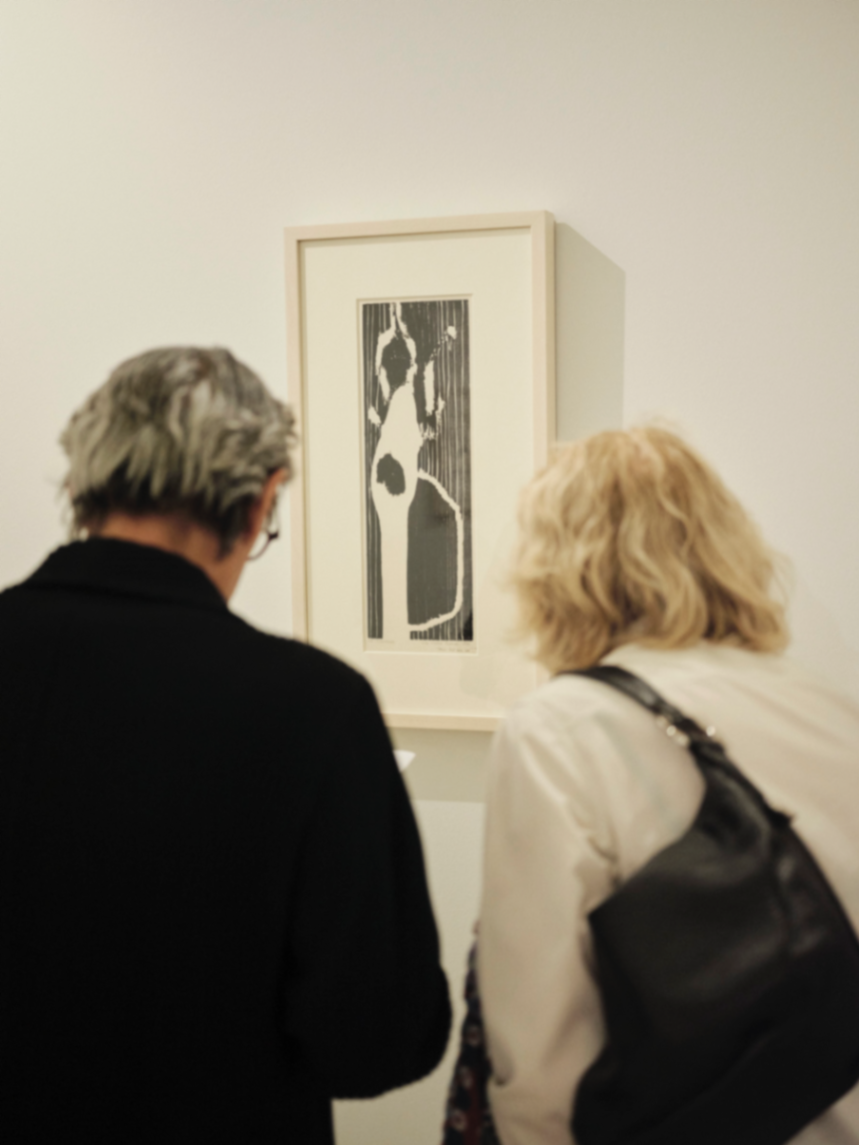
For her 80th birthday, Luísa Correia Pereira’s (1945-2009) works have temporarily taken residence in the House of Gods, bringing together prints from the Caixa Geral de Depósitos Collection, one of the most significant public art collections in Portugal. Known for its commitment to preserving and disseminating Portuguese modern and contemporary art, the collection holds many works that explore the tensions between material experimentation and poetic freedom. The pieces on view, created between 1971 and 1974, mark years of discovery and creative expansion.
Throughout her career, Luísa Correia Pereira revealed an unusual imagination in the creation of characters, narratives, landscapes, and other graphic and pictorial elements. Through an almost childlike visual language, she built a fantastic alphabet of forms, revealing dreamy meanings. Pereira’s practice, marked by humor and controlled chaos, challenges the protocols of institutional memory, her works vibrating where commemoration usually demands silence.
Between 1971 and 1974, Pereira developed a body of work that reveals both technical mastery and an unrestrained approach to experimentation. Working across grattage, monotype, xilogravura, água-forte and água-tinta, she treated printmaking less as a method of reproduction than as a laboratory of expression. As curator Hugo Dinis observes, her earlier works, such as Madeira (1971) and Deus diz que dá! (1972), already suggests a tactile intimacy with the surface, where form emerges through contact rather than control. The monotipias Sem título (1972) and Um ser a nadar – um ente nadando (1973) explore this immediacy further: simple gestures, modest materials, and the repetition of the printing process generating images of startling presence.
During her scholarship at the Atelier Friedlaender, key center for gravure in the postwar decades, funded by the Calouste Gulbenkian Foundation, Pereira worked under the supervision of Stanley William Hayter (1901-1988), who revolutionized printmaking by treating it as an experimental and collaborative art form, encouraging free form and mix of color. It allowed her to deepen her command of metal engraving and expand her visual vocabulary into more complex compositions: Works like Progressão a vermelho (1972), Céu cinzento e chuva, chuva, chuva, chuva (1973) and Stairs(1973) gather into constellations of lines and symbols, as if uncovering fragments of a forgotten story while inventing a new one. In 4 Bolas – 4 arcos – 1 pau (1973) and O Sol, a força, a terra e o céu (1973), symbols and colors correspond directly to the ideas named in the titles, turning abstraction into visual dialogue. The last prints, Source animal et vegetal (interchangeable) and Source animal et vegetal (interchangeable) III (both 1974), combine four plates printed in two colors, arranged side by side or mirrored. Images in conversation, as if the process itself were still speaking.
That these works belong to the Caixa Geral de Depósitos Collection introduces another layer of interpretation. Like many corporate collections, it frames artistic experimentation within a rhetoric of national patrimony and cultural investment. In this context, the works’ play with gesture and intuition is reframed as heritage, as a cultural value that is stabilized and owned.
It is also worth asking why Pereira’s name remains largely absent from the canon of Portuguese modernism. Her work, produced in the volatile years surrounding 1974, occupies a space of transition marked by dictatorship and freedom, by craft and intuition. Yet it has often been sidelined in narratives dominated by male experimentalists. Possibilidades de Expressão thus reads not only as a celebration but as a correction, a belated act of visibility that exposes how fragile and gendered cultural memory can be.
The exhibition Possibilidades de Expressão, de Luísa Correia Pereira, is on view at the Panteão Nacional until December 28.
BIOGRAPHY
Dela Christin Miessen is a researcher, writer and editor. She is part of Aberta Studio in Lisbon and the co-founder of Echoes Residency for socially engaged art practices.
ADVERTISING
Previous
article
22 Dec 2025
The duo Miguel Teodoro & Shuang Xu is the winner of the OpenCall for the UmbigoLAB @ Loulé Criativo artistic residency
By Umbigo
Next
article
28 Dec 2025
Terra Sol Liberdade, at the Casa de Arqueologia e Artes de Beja
By Carla Carbone
Related Posts
article
13 MAR 2026
By a thread: Helena Lapas at Monitor
By Dela Christin Miessen
article
11 MAR 2026
António Olaio at the NO·NO Gallery: On (not) Falling
By Dela Christin Miessen
article
23 DEC 2025
O céu, sol, chuva, chuva, chuva: Luísa Correia Pereira at the Panteão Nacional
By Dela Christin Miessen
article
10 NOV 2025
Nem pena nem paixão: Paulo Serra at Salto
By Dela Christin Miessen