article
Notas de Rodapé [Footnotes], at Jahn und Jahn
“More and more information arrives pre-digested, structured and summarised – a promise of acceleration designed to keep us ever more productive. The group exhibition Notas de Rodapé [Footnotes], currently on view at the Jahn und Jahn gallery in Lisbon, resists this logic. It invites us to explore the potent environment of the margins and engage in a “slow and nonhierarchical experience of approximation” to the meanings the works convey, as stated in the text by the exhibition curator, Luiza Teixeira de Freitas.”
Think about the last time you were reading a text full of footnotes – were you eager to follow them? Did you feel like you could let yourself get lost in the conversation unfolding beyond the main body of the text, linger over the small print at the bottom of the page, or give in to the ruptures in the core narrative while moving back and forth between the sentence at hand and the references at the end of the book? Or did you skip them?
In our late-capitalist society, driven by algorithms and obsessed with optimisation and fast consumption, the space for discontinuity and seemingly unnecessary side-quests is progressively shrinking. More and more information arrives pre-digested, structured and summarised – a promise of acceleration designed to keep us ever more productive. The group exhibition Notas de Rodapé [Footnotes], currently on view at the Jahn und Jahn gallery in Lisbon, resists this logic. It invites us to explore the potent environment of the margins and engage in a “slow and nonhierarchical experience of approximation” to the meanings the works convey, as stated in the text by the exhibition curator, Luiza Teixeira de Freitas.
Notas de Rodapé brings together eight artists – Sara Bichão, Catarina Dias, António Júlio Duarte, Carlos Noronha Feio, Julius Heinemann, Raphaela Melsohn, Navid Nuur and Jorge Queiroz – working across media ranging from painting, watercolour and photography to ceramics, mixed-media objects and installation. Their works stem from distinct areas of inquiry, and they can hardly be ascribed to a single generation or clearly defined group. As Luiza Teixeira de Freitas notes, although the artists share an interest in one another’s practice, some have never met in person and would not necessarily imagine their practices in direct juxtaposition. In addition, the exhibition includes both the names represented by Jahn und Jahn and those beyond the gallery’s roster.
When asked how she arrived at the list of participants for the show, Teixeira de Freitas spoke of the curator’s responsibility to draw artistic voices out of their immediate circles and to create moments of serendipity that might foster new conversations and relationships. Her curatorial position is reflected in the epigraph to the exhibition text: “Ideas relate to objects as constellations relate to stars”, quoted from The Origin of German Tragic Drama by Walter Benjamin. In this seminal monograph, Benjamin questions systematic philosophy and linear historiography, proposing a principle according to which ideas, like constellations, are formed through the configuration of disparate elements rather than through their subsumption into a totalising system.
This approach, grounded in non-linearity and decentralisation, is further translated into the spatial arrangement of the exhibition: loose and porous. Notas de Rodapé features several pieces by each artist, presented in varying combinations throughout the space. The works also extend beyond Jahn und Jahn’s allocated exhibition spaces, finding their way into the margins – the gallery’s entryway, the corridor, and the distant garden wall. There is no distinct climax to the show, nor a definitive narrative.
Attention to marginal spaces (footnotes among them), as well as to the “fragments, deviations, interruptions” and in-between meanings they hold, is central to Notas de Rodapé and to the projects it brings together. In the first room at Jahn und Jahn, two abstract paintings by Jorge Queiroz, also titled Footnotes, set the tone for the exhibition. They resemble lined notebook pages covered with fluid, colourful shapes that morph into one another and could be equally read as figures or landscapes, or just enlarged random scribbles. In an interview (given in 2019, when these paintings were made), Queiroz described his understanding of abstraction as chaotic and formless, “a romantic mental journey”, yet “essential for connecting all the thoughts of the mind”.
The same room presents another set of notes and scribbles in the works by Raphaela Melsohn. Inscribed on gesso, they recall markings made while planning an architectural project, a land art piece or a theatre set. Melsohn’s practice considers how the body relates to space and materials – a subject she also explores in REPEAT REPEAT REPEAT, a series of hand-built ceramic tubes sprouting throughout Jahn und Jahn’s spaces. Their uniform size, colour, and shape suggest an attempt at replication, one that is nevertheless destined to fail due to the very nature of the embodied process that produces them.
One of the “constellations” that could be traced within the universe of Notas de Rodapé clusters around materiality. Beyond ceramics and gesso, the exhibition extends into mixed-media practices. While Navid Nuur’s objects are made from complex materials, such as serpentinite or precious gold leaf, both of which might just as easily belong in an experimental chemistry lab, Sara Bichão assembles everyday elements – earth, fabric, wire, gravel, nutshells, and an aluminium spoon – into subtle compositions that carry poetic, sacred and symbolic resonance.
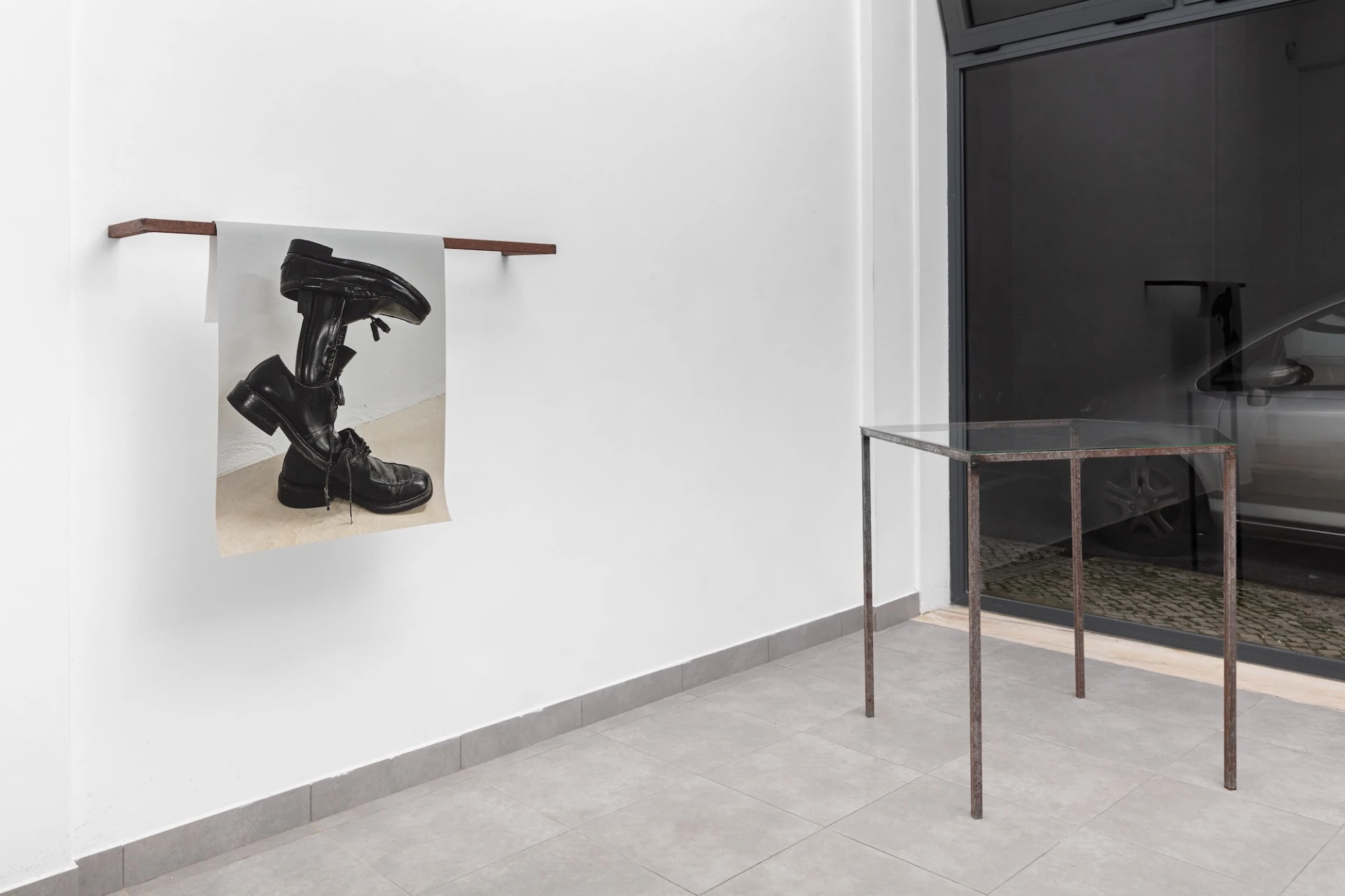
Arguably, the works by Julius Heinemann and António Júlio Duarte on view at Jahn und Jahn could act as “footnotes” to Bichão’s inquiry into artefacts of the everyday. Both artists create snapshots of reality in the form of isolated, decontextualised close-ups of objects, interiors or landscapes. While António Júlio Duarte works in photography, Julius Heinemann does so in watercolours that, in their composition and the dynamics of light and shadow, possess distinctly photographic qualities, which comes as no surprise given that Heinemann originally studied photography.
Finally, Notas de Rodapé features works that engage with text – a domain that seems hardly avoidable given the exhibition’s title and focus. In her recent body of work, Catarina Dias presents a montage of scanned images and graphic elements layered with traces of ink and paint and accompanied by non-linear poetic commentaries, printed so small they are almost vanishing. Through this interplay, she explores the spectrum of meanings that could emerge from the friction between these elements.
In contrast, Carlos Noronha Feio’s messages appear strikingly legible, taking the form of gold-plated stainless-steel letters arranged into phrases that read like political slogans, yet rendered in a poetic, bittersweet register. (crescei flores!) [grow flowers!] is installed on the garden wall at Jahn und Jahn, luring the visitor into a moment of contemplation while setting a cognitive trap. The longer one looks at the phrase, the less certain its meaning becomes: does it address human or non-human species? Are we sure the artist is speaking of vegetation, or do flowers function as a metaphor for something else? Set in brackets yet marked with an exclamation point, does it call for action or gently invoke?
Another work by Noronha Feio, presented within the gallery space, takes on a more sculptural presence: its letters are arranged vertically and spell out, “(a drop in the universe has universes of its own!)” Though not conceived specifically for this exhibition, the piece closely resonates with Benjamin’s line, suggesting that what appears as a mere drop – a subtle footnote, a marginal object – may, through the relations it enters into with others, generate dense constellations of meaning and connection, and thus reward the effort of attention and the journey it invites us on.
Curated by by Luiza Teixeira de Freitas, the exhibition is on view at Jahn und Jahn, in Lisbon, until March 14.
BIOGRAPHY
Katya Savchenko is a curator, professor, and cultural producer based in Moscow, Russia. She graduated from the Moscow Higher School of Economics in 2011 and completed her Master's degree in Arts Management and Cultural Policy at Goldsmiths University in London in 2014. Currently, she works as a junior research curator at the Garage Museum of Contemporary Art in Moscow. Along with Valentin Diaconov, she is a mentor for the Garage 2021/2022 scholarship program, supporting emerging artists. Katya Savchenko is also the coordinator and professor of Arts Management in the Master's program in Curatorial Practices in Contemporary Art at the Moscow Higher School of Economics. In 2014-2015, she was head of production for the 6th Moscow International Biennial of Contemporary Art, How to Gather, curated by Bart de Baere, Defne Ayas, and Nicolaus Schafhausen. In 2017, she was an award-winning artist-in-residence at Tensta konsthall in Stockholm, as part of the EUNIC program supporting emerging Russian curators. Katya Savchenko has also collaborated as an independent curator with the Osnova Gallery in Moscow and the Futuro Gallery in Nizhny Novgorod.
ADVERTISING
Previous
article
03 Mar 2026
The Labubuification of Trauma: How Fenix Turns Migration into Affective Design
By Alexander Burenkov
Next
article
05 Mar 2026
Ontem já era tarde: Vítor Serrano at andar de baixo
By Laurinda Branquinho
Related Posts
article
 11.53-mk8cv.jpeg)
15 SEP 2026
One Million Points of Light: Alfredo Jaar at Galeria Francisco Fino
By Katya Savchenko
article
29 JUL 2026
Sweet Dreams, at OSTRA practice
By Katya Savchenko
article
10 JUL 2026
João Penalva at Culturgest: Characters and Players
By Katya Savchenko
article
![Notas de Rodapé [Footnotes], at Jahn und Jahn](https://umbigo.s3.us-east-1.amazonaws.com/public/space/rodapé 1 -y0ecj.jpeg)
04 MAR 2026
Notas de Rodapé [Footnotes], at Jahn und Jahn
By Katya Savchenko