article
Trajectories, at Reverso Gallery
“One of the galleries that has made sure that the jewelry field is healthy and vigorous is Reverso, which encourages young artists and offers a platform for local makers. Over the years, Crespo has formed long-lasting relations with the artists. The conference series Trajectories presents ten of these artists, giving them another means than an exhibition to present their journey.”
Reverso Gallery, led by Paula Crespo, has been enriching the local contemporary jewelry scene in Lisbon since 1998.1 Contemporary jewellery is an art form that hasn’t yet made it to the shiny arena of Contemporary Art like textiles, ceramics and other crafts have. Yet the field is bubbling with ideas and masterful execution, also in Portugal. There are exhibitions, various jewellery schools, and also the Lisbon Contemporary Jewellery Biennial, which will take place again in September 2026. One of the galleries that has made sure that the field is healthy and vigorous is Reverso, which encourages young artists and offers a platform for local makers. Over the years, Crespo has formed long-lasting relations with the artists. The conference series Trajectories presents ten of these artists, giving them another means than an exhibition to present their journey.
The Trajectories series is a welcome contribution that aims to reflect on the current landscape of contemporary jewelry in Portugal. Through artist talks and presentations, artists trace their journeys back to the beginning, focusing on twists and turns along the way. Each artist follows a particular and personal path, focusing on a specific theme of interest. For some, this theme and focus of work are found during their studies, while for others it is a matter of chance encounters along the way. Some have found inspiration in the history of jewelry, others in their own bodies. The stories of the artist are both fascinating and educational.
The conferences kicked off in summer 2025 and will continue into the next one. The first to trace her trajectories was a multi-disciplinary (or disciplinarily fluid) artist, Leonor Hipólito, who works within and on the border of several fields.2 Her mediums are jewellery, sculpture, poetry, photography, drawing, installation and dance. Her work Thin is the Line comments on the art world’s tendency to separate and categorize the fields although all the works serve the same urge to express ideas. She studied sculpture in Arco and jewellery at Gerrit Rietveld Academy in Amsterdam. Looking back, she could see that her first works as a student had left a significant mark on the rest of her path. The interest and the way that she makes aesthetical decisions re-occur. Her graduation project was a works series named Tools for the Subconscious that probed the wearer to look within, to reflect and to introspect. She made pieces that connect the ear to the mouth, the ear to the nose and earrings that would block the ears, to hear the inner sound. Hipólito’s interest in body has remained intact – she calls the body “a vehicle where all the info to know oneself is.” Her work has been presented in galleries and private spaces for more than twenty years. She also writes, gives lectures and workshops. Hipolito’s vigor in producing new works and showing them is impressive.
The second talk was given by the artist Ana Margarida Carvalho, who is trained in mathematics at Universidade Nova de Lisboa and in jewelry and in drawing at Ar.Co. Her practice is governed by various interests that range from everyday news to travel, discussions about politics, mathematics and geometry. Her work is best known for its vibrant color. She likes the aspect of alchemy and has mastered the art of anodizing aluminum. “My studio appears at times more of a laboratory than a studio,” Carvalho says as she crosses her love for science with the love of art. She also keeps up her drawing practice, draws down ideas for new works and makes prototypes. Many of her works don’t finalize into jewelry but remain as prototypes and objects. She stresses the importance of being conscious of one’s decisions while creating. She was awarded First Prize at the 4th Portojóia Design Competition in 2006, the “Assemblage Award” at Artistar Jewelry 2019, the ARTE Y JOYA 2020 International Award, and a nomination in the “Juror’s Choice” category at the Fold forming Competition 2021.
Artist, researcher, author, curator and educator Cristina Filipe gave the third talk of the conference. She holds a PhD in Heritage Studies from the Universidade Católica Portuguese / School of Arts is a researcher at the same university. She has been a guest lecturer and artist at numerous international schools and has been the main examiner of several master’s and doctoral theses. In 2017, she became the first recipient of the Susan Beech Mid-Career Artist Grant from the Art Jewelry Forum to publish the book Contemporary Jewellery in Portugal: From the 1960s Avant-Garde to the Early 21th Century. She co-founded PIN, served as president of the board, and was the creator and general curator of the 1st Lisbon Contemporary Jewellery Biennial. She is the author of articles and essays and the editorial and scientific coordinator of several books, including Collection J, edited by Imprensa Nacional.
The fourth speaker, artist Carla Castiajo, stays close to the body in her practice, maybe too close for comfort for many of us, which is precisely her point. She uses human hair in her jewelry, all human hair that is – from hair on the head to the pubic hair. Her PhD thesis, Purity or Promiscuity? Exploring Hair as Raw Material in Jewelry and Art (2016), questions hair’s attraction and its repulsion, especially as it lays off the body, perhaps on the floor of a public toilet. She started her journey in Portugal, but then followed the contemporary jewelry master Ruudt Peters to Konsthaft, in Stockholm, where he was leading a contemporary jewelry program. In 2008, when she was in search of material, Castiajo encountered hair. She was thinking of what materials to work with as she put her hand in the hair and there it was. In the hair she finds “potential for contradictions and ambiguity,” as Castiajo herself puts it. For her work Purus et Promiscus, for example, she explored Catholic church’s sexual repression and abuse of power, the capacity to rob the innocence and purity. “The oppositions and contradictions about hair are constant, highlighting the ambiguous significance of hair. It seems that it cannot be considered pure, but rather it is considered impure or even promiscuous, which may be why it is cut in rituals of purification,” wrote Castiajo in The Fashion Studies Journal. Castiajo has exhibited internationally. The first time I encountered her work was as a first-year student in jewelry in Pirita Convent Cemetery in Tallinn, Estonia. The exhibition was part of three exhibitions that Castiajo held in her PHD studies in Estonian Academy of Art. One of the three shows was held in a public toilet.
Artist Marta Costa Reis gave the fifth talk. She teaches, makes, exhibits, curates and partly organizes Lisbon Contemporary Jewellery Biennial. She is also the current head of PIN (Portuguese Contemporary Jewelry Association) and Chair of the Board of Art Jewelry Forum. Costa Reis started her journey in contemporary jewelry later in life and did as many things as possible within the first years – took part in workshops, saw as many exhibitions as possible and travelled to see more jewelry and meet the artists. Her first work as a student in Ar.Co stays with her probably forever. She made it in honor of women who shamelessly excel in their professional careers, dedicated to a friend. The work consists of necklaces and a tattoo on her arm – red lips that look serious and do not appear sexualized, as lips too often are depicted. Her graduation work Necrocitizen- memories of an absent body dwelled on the color of black, its mysticism and its inescapable relation to grief and death. Her interest in the topic of mysticism is grouped together with her interest in the history of jewelry. This has led her to a fascination with mystical objects whose meaning has faded and remains unknown. Her first important exhibition in Reverso was together with Iris Eichenberg, where they worked on the notion of time - its endless movement and passing. Costa Reis recalled the moment when they unpacked the pieces and – although they had not seen each other’s works in the making - they seemed as if intentionally made to fit together so well, down to the finest detail, such as color. The works were then presented mixed together and without the authors’ names.
The most recent talk was given in February by Sara Leme, who has studied jewellery in California, Amsterdam and Lisbon. Her previous dance training has shaped her view of the relation between body and object. In her work, she uses aspects of social and cultural anthropology for intellectual and creative research in the medium of contemporary jewellery. She also works as a scenographer and costume designer.
Paula Crespo created the talk series because she feels there is not enough communication between artists on the national level. “It is also helpful and interesting for artists to explain their work and trace their own steps. Perhaps there is a possibility for self-discovery in this form of presentation,” said Crespo, pointing to the importance of analyzing one’s work. It is different to see a work and to hear the maker talk about it, another medium of expression adds layers to the work. “A bigger unity of understanding is formed, some personal layer is added to the work,” Crespo said, who was surprised to learn new things about the artists and their work at the conferences. Sometimes tracing back one’s steps can lead back to home when lost, if the traces are not eaten by birds, like in the story of Hansel and Gretel, of course. Bad documentation or none could hurt the artist, since there is nothing to go back to, especially when works are sold and lost and one can’t trace them back.
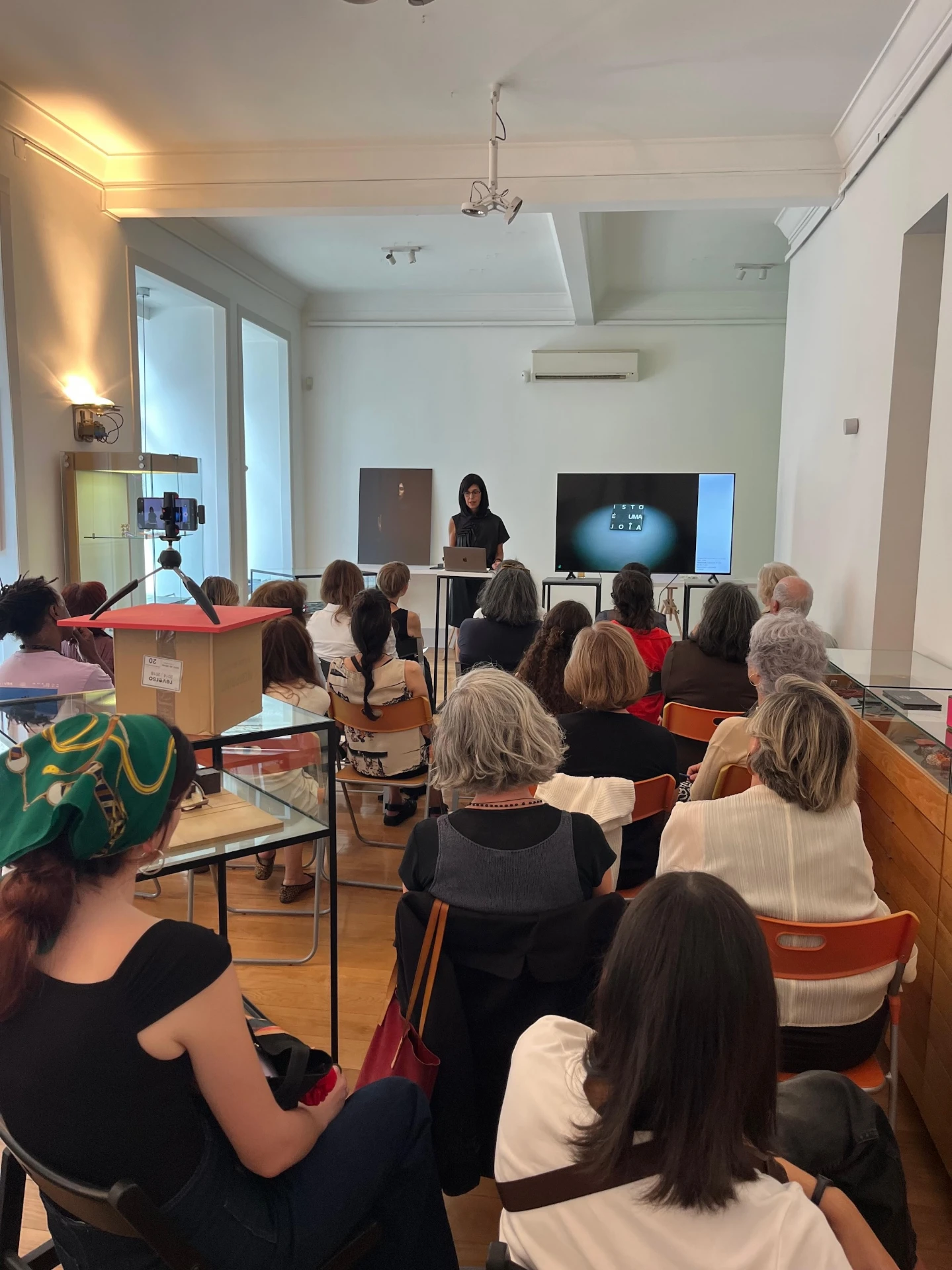
The talks are open to everyone, the audience for the conference has mostly been other artists with the exception of some collectors. The talks give a great opportunity for arts and jewelry students to learn and to get inspired. Free education is hard to come by in Portugal, and with these talks Reverso and artists certainly offer it. The talks are recorded and edited and are available on youtube on Reverso gallery’s channel but not everything is recorded - the discussions that take place after the talks do not make it to the videos. Reverso has filled the time between exhibitions with Trajectories; the gallery has become an auditorium with six rows of seats and could host up to 50 listeners. It’s a niche, it happens in a gallery and not in a museum, the initiative is strong and the local history of contemporary jewelry built, step by step, exhibition by exhibition, artist by artist, gallery by gallery. “Galleries are here to educate and explain the value of things to the public,” says Crespo. “It is also important for artists to have a place to exhibit, show and sell their good work, otherwise they will start to create cheap and easy things just to earn money,” said Crespo. The next artists to present their work are Ana Albuquerque (March) and Teresa Milheiro (April).
ADVERTISING
Previous
agenda
16 Feb 2026
Call for Applications until March 15 - Cosmophilosophy for the Arts: Rethinking production
By Umbigo
Next
article
16 Feb 2026
FPM #6 | contrast: 1949–2024 — Photography in the PLMJ Foundation´s Collection: Aesthetic Distance in Photography
By Ayşenur Tanrıverdi
Related Posts
article
16 FEB 2026
Trajectories, at Reverso Gallery
By Kaia Ansip
article
19 NOV 2025
Under the planetary influences: Halo – Rings of Saturn at Tereza Seabra gallery
By Kaia Ansip
article
17 APR 2025
Munich Jewellery Week, the tradition that keeps growing
By Kaia Ansip
article
04 JUL 2024
Teresa Milheiro’s retrospective “1984”: Rebellion on the battlefield of the body
By Kaia Ansip