article
Vivian Maier – Anthology at the Centro Português de Fotografia
When writing about an anthological exhibition on the American photographer Vivian Maier (1926-2009), it is impossible not to mention her curious biography. Having worked as a nanny for more than four decades of her life, in various cities such as New York, California, and Chicago, her immense photographic work was only discovered in 2007, when it was purchased by chance at an auction, after years locked away in storage cabinets.
Vivian Maier's artistic production consists of "more than 120,000 negatives, Super 8mm and 16mm films, various recordings, diverse photographs and countless undeveloped films"[1]. It is as if she demonstrates an insatiable desire to capture the banality of everyday life, during her walks alone through the city, or accompanied by the children she cared for. The gesture of a boy hiding a shoe, a newspaper boy sleeping, a maid cleaning a window, a policeman firmly gripping the hands of a corpulent elderly woman, or a group of children playing. And above all, the portraits! Which reveal the astonishment, the discomfort and the sharp gazes of those portrayed. The strangeness and the grotesque. And her awe before the city, frequently comparable to the work of photographers such as Lisette Model, Diane Arbus, or Leon Levinstein. However, in the words of Anne Morin, curator of the exhibition, about the photographer's work: "she narrated the beauty of ordinary things, seeking the imperceptible gaps and elusive inflections of reality in the banality of everyday life"[2].
Through her photographs, Maier tells us stories of anonymous people, of passersby she encountered on the streets and their idiosyncrasies, making them the main characters in a narrative to come. Establishing a boundary between her and what she captures, we sense her presence without, however, taking part in the action. As the exhibition curator points out: "Indeed, distance is the key word in his work and must be emphasized, as it represents the basis of his modus operandi"[3]. In fact, throughout the exhibition we can understand this way of working, evident, for example, in the photograph in which we see a policeman around a dead man and all the apparatus around him, or in an excerpt from one of his Super 8mm films: Murder in Chicago of a mother and her baby [...] (1972). Disturbing, documentary images, disruptive snapshots of everyday life.
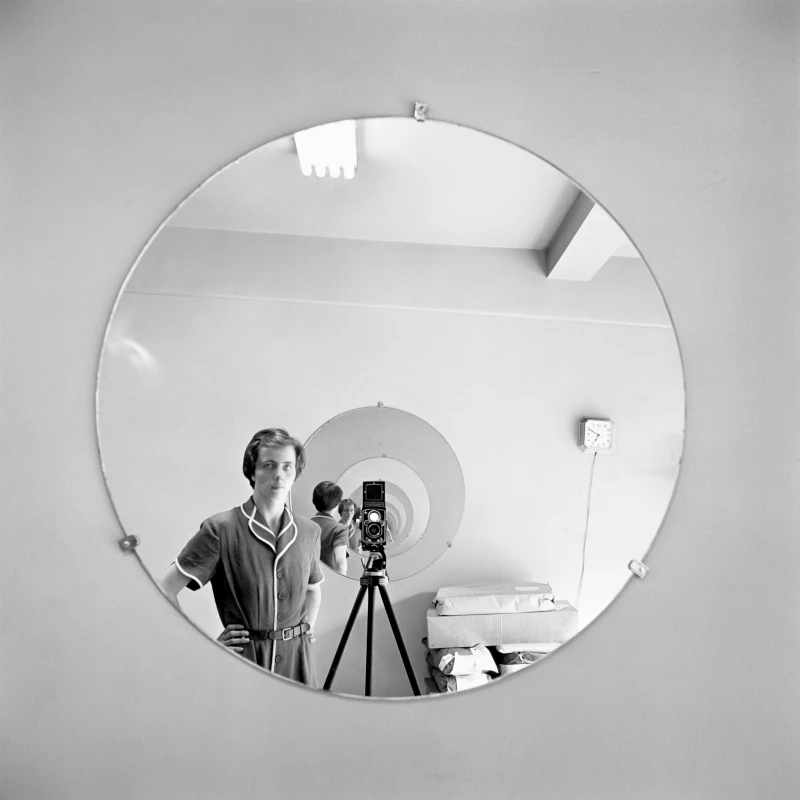
However, the distance in Maier’s artistic production takes on another dimension in her portraits and self-portraits. She often photographs herself in front of mirrors, shop windows, or circumflex reflective surfaces. Always with her cameras, which she has acquired over the years, among which we highlight her Rolleiflex, and which can be seen in the exhibition thanks to the CPF collection[4]. It is also common to photograph her reflection with the face of another person. And to capture her shadow alongside a group of passersby, animals, or in various situations and caricatured elements. Curiously, in this set of images, the photographer presents the same sharp gaze that we often see in her subjects. And a mysterious smile that challenges us.
On display throughout the exhibition rooms of the Centro Português de Fotografia, the former headquarters of the Porto Penitentiary and Court of Justice, whose trapezoidal floor plan provides a unique journey, the exhibition is composed of seven parts: Street Scenes, Childhood, Formalism, Portraits, Self-Portraits, Color Photographs and Super 8 Films. Each one emphasizes a different theme, technique, aesthetic or medium.
Vivian Maier – Anthology is open until August 30, 2026.
ADVERTISING
Previous
article

08 Jun 2026
Língua Turva: The Aesthetic Unconscious
By Ayşenur Tanrıverdi
Next
article
12 Jun 2026
Tabique, by Rita Gaspar Vieira
By Maria Inês Augusto
Related Posts
article
09 JUN 2026
Vivian Maier – Anthology at the Centro Português de Fotografia
By Ana Martins
article
30 DEC 2024
Solombra: Luísa Jacinto at Galeria Quadrado Azul, in Porto
By Ana Martins
article
26 DEC 2024
Endless sun by Hugo de Almeida Pinho – Part I: the cinematic sunrise at gnration
By Ana Martins
article
02 DEC 2024
António Carneiro: O Voo da Águia at Museu do Porto – Ateliê António Carneiro
By Ana Martins