article
The structure of memory: Cabodá, by Marcia Pastore
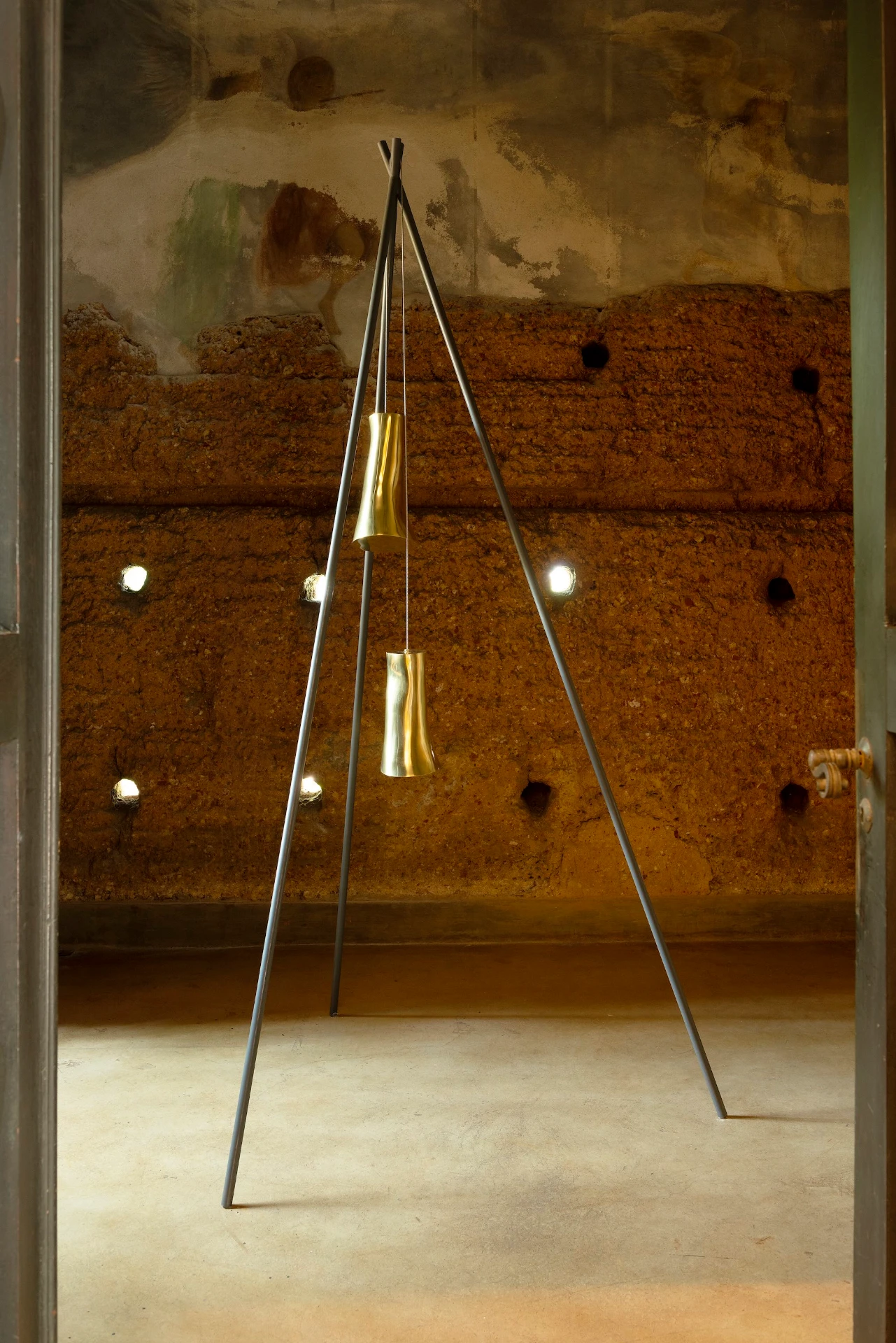
"The poetics of the work lie in the choice of materials and the use of their characteristics. ‘I let the material speak for itself,’ Pastore emphasizes. This is how we observe the long, thin reinforcing bars gaining the lightness and flexibility of lines as they rise from the ground and pierce the back wall of the building."
“You are dust, and to dust you shall return. (...) Human beings, in whatever state they may be, were certainly dust and will return to dust. Therefore, they are dust. Because everything that lives in this life is not what it is, but what it was, and what it will be.” - António Vieira (Sermão da Quarta Feira de Cinzas. Rome, 1672. Tradução livre)
Like all works of art that are effective in their purposes, Cabodá, by Marcia Pastore, has many and profound possibilities for interpretation. The most concise and faithful to the poetics of the work is that of the artist herself, who has full command of the properties and characteristics of the elements she uses to construct her works, as well as the subtlety to point out only hints, without revealing all the expressive power that she has mobilized and that the viewer is invited to explore and grasp in their own way of seeing and according to the map of their own life story.
The adventure lies in this: expanding perceptions based on eloquent clues, which leave the path open to amalgams of personal experiences. Therefore, there are as many possible interpretations as there are sensitive gazes that land upon them. To use a concept very dear to Lygia Pape, they are "magnetized spaces" that attract and fascinate. The strength of Cabodá comes from what is an apparent non finito, gradually revealing the solid framework of concepts and their execution as triggers of perceptions stemming from both reason and emotion, always in partnership with the intrinsic properties of the materials used. "It's a dialogue, not an imposition," emphasizes Pastore.
Occupying the Capela do Morumbi as a place to unfold and investigate the expressive possibilities of a site-specific work is also quite a challenge. The space is imbued with protagonism. The rammed earth walls lead the reading of the proposed ensemble to a time and a method of construction made of essentials. It means piling up the contingent, the clay, and giving it the vertical permanence of the wall. Although the vertical existence of the human is always contingent.
Cabodá, the artist observes, is the name given to the wooden beams that are part of the rammed earth construction process and leave their mark in the holes. “The holes are a presence through absence. They preserve the place where the cabodá was.” This construction method was brought to Portugal by the Arabs (Moors) from the Middle East and North Africa and became popular in colonial Brazil, starting from the island of Madeira and the Brazilian Northeast.
High on the back wall of the Chapel, there is a single round window, an oculus that brings in the presiding light, inviting the gaze to be elevated. It is to this light coming from outside, or to the fragment of infinity to which it refers, that Pastore's installation addresses itself, both constructively and metaphorically. Light as a memory of what has been, but still underpinning and guiding the flexible iron rods that rise from the ground in gentle curves until they plunge into the holes and seek the other side of the trajectory.
It is this initial and subtle impact that reveals a curious predominance of line and graphic expression in the installation. But drawing, a classic category of visual arts, does not exist there in its usual forms, nor was it resolved with lines before being physically constructed in real space. Pastore does not draw her projects: she chooses the materials and their characteristics, both physical and visual, that she is interested in bringing together and articulating to obtain the poetics of her work. This is quite unusual, even within the realm of conceptual art, to which her work may also refer, where there is almost always a sketch, even an essential one, to demarcate intentions and directions for the work under construction.
The iron wires and their supports visually realize the "traces" of this graphic design. "This entire installation obeys the structuring principle of a seesaw: for one segment to be in the air, the other needs to be on the ground," the artist points out. The exchange of forces, the dialogue between the material and its reverberation in concept, alternates between what was and what will be. A dialogue that the Portuguese Baroque writer António Vieira (1608-1697) called in one of his most famous sermons, "dust raised and dust fallen." Life and death. Or, if you prefer, existence and memory.
The poetics of the work lie in the choice of materials and the use of their characteristics. "I let the material speak for itself," Pastore emphasizes. This is how we observe the long, thin reinforcing bars gaining the lightness and flexibility of lines as they rise from the ground and pierce the back wall of the building.
Along this path, the iron wires carry, through the holes and as if on a journey through time, the bricks used today for the same procedure previously performed by rammed earth: to erect walls, to delimit spaces.
As the brick passes through the old hole of the cobblestone path, it gains strong compressions at its precise angles and a certain organic quality of life shaping life, of a yesterday configuring today. The dialogue is produced by the exchange of forces, by the measurement of powers. A dialogue that continues to flow despite one being inside and the other outside the Chapel's environment. They are bodies and existences that remain linked by the memory left by the strong tension of coexistence. Life conceived as the matrix of art.
The exhibition Cabodá can be visited at the Capela do Morumbi - Museu da Cidade de São Paulo until May 31, 2026.
BIOGRAPHY
Angélica de Moraes is a visual arts critic, cultural journalist and independent curator. She lives and works in São Paulo (SP, Brazil) since 1986. She has been covering national and international arts events (Kassel, Venice, Yokohama, Madrid, New York) for over two decades for newspapers and art magazines. She has curated exhibitions for the São Paulo Museum of Art (Regina Silveira, 1996), Paço Imperial Rio de Janeiro (Alex Flemming, 2006) and Santander Cultural (Porto Alegre), among others. Angélica has contributed to several books, including "Regina Silveira: Cartografias da Sombra" (1986), "Crítica de Arte no Brasil" (2006), "Alex Flemming" (2012) and "O Valor da Obra de Arte" (2014). He was a member (2008-2009) of the Brazilian team of researchers for the Documents of 20th Century Latin American and Latino Art project. The Digital Archive and Publications Project was developed by the International Centre for the Arts of the Americas (ICAA), Museum of Fine Arts, (Houston, Texas, USA) in partnership with the Faculty of Architecture and Urbanism (FAU-USP) of the University of São Paulo, under the coordination in Brazil of historian Anna Maria Belluzzo.
ADVERTISING
Previous
article
13 Mar 2026
By a thread: Helena Lapas at Monitor
By Dela Christin Miessen
Next
article

16 Mar 2026
Espaço Intermédio, by Cristina Ataíde
By Tomás Saraiva