article
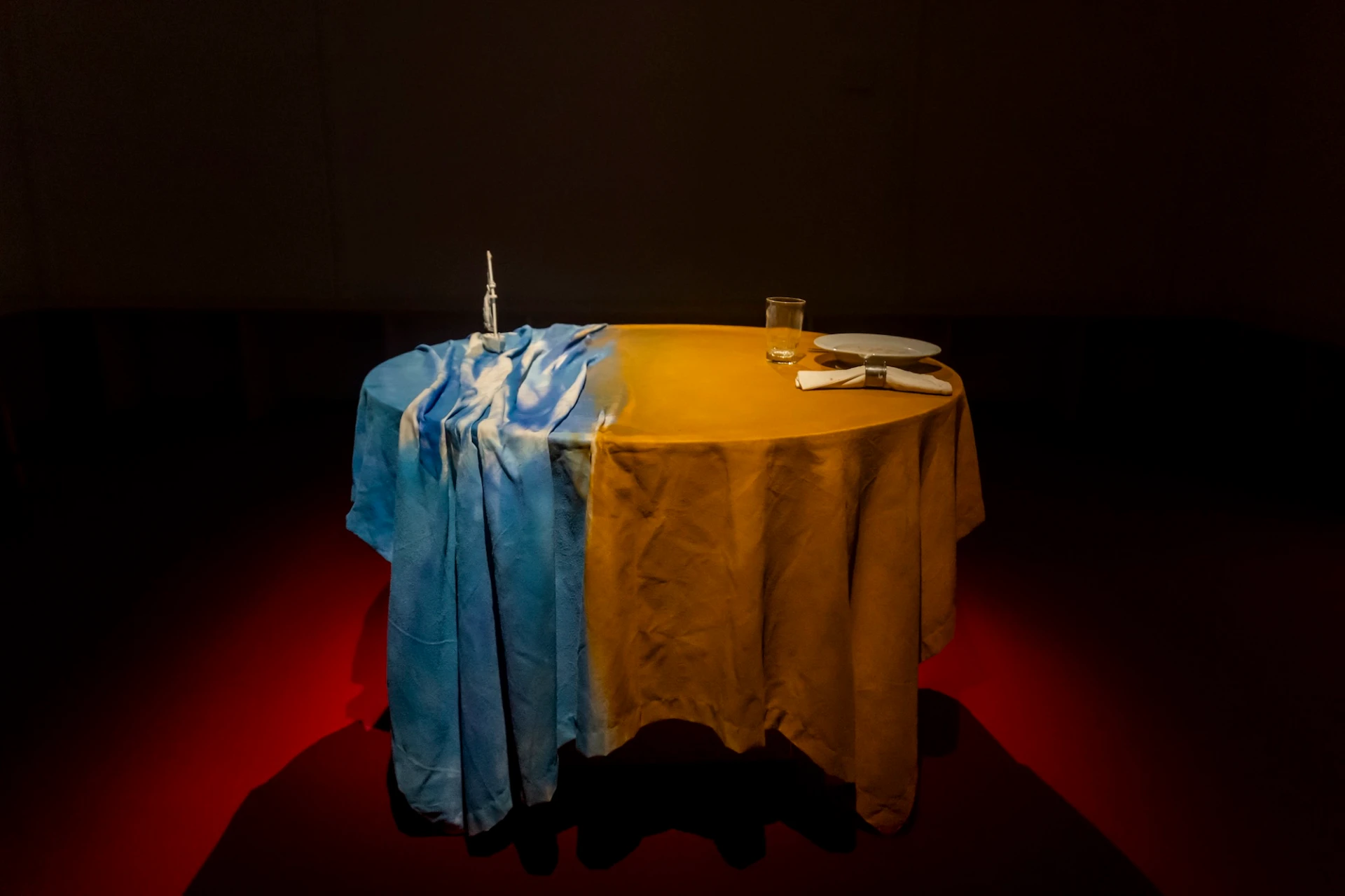
Mesa-Paisagem (1973), by Ana Vieira, at Brotéria
A table, just a table, a plate, two pieces of cutlery, a glass.
The tablecloth, torn to one side, appears painted on the surface, in blue and white, like a canvas of a painting, detached from its support. The plate is half full of a handful of white sand from the beach.
On one side (of the table) a meal, with a cloth napkin; on the other, the fabric, placed on the table, pulled taut, displays white pleats, as if it were a dress, on a blue background, evoking a long sea, which plunges to the ground (a waterfall?).
A round table, overlooking the sea, and a rocking boat, at the mercy of a tide of white foam. (a cliff?)
Ana Vieira's installation, Mesa-Paisagem (1973), currently on display at the Brotéria gallery, evokes an open window onto a landscape, a memory, a dream.
Ana Vieira often drew upon her childhood memories to create and affirm her works. The simultaneity between exteriority and interiority, the voids, the shadows, the absences – also present in the work of Lourdes de Castro – and childhood memories are common elements in the artist's work.
In an interview conducted by Hans Ulrich Obrist, the artist highlights other artists who also constituted important references and influences on her work. Noronha da Costa was one of these artists, especially in his use of space as an open field for artistic experimentation1.
The artist belonged to the category of Portuguese artists who, in the 1970s, courageously and extensively distanced themselves from conventional and academic painting. Ana Vieira, according to Obrist's attentive gaze, would thus be an artist who positioned herself in the place and concept of: beyond painting.
Ana Vieira was also captivated by Michelangelo Pistoletto when she saw the work Mirrored Paintings, from 1962, printed in the pages of the architecture magazine Domus. In this work, the viewer became an integral part of the piece. For this reason, the artist was interested in the relationship that Pistoletto established between the viewer, the work, and life.
In Mesa-Paisagem, the viewer becomes the protagonist of the work. They participate dynamically, not only in Ana Vieira's memories of the beach, but also in their own memories. They are compelled to wander around the table in search of meaning and, in an active discovery, to immerse themselves in the artist's landscape, to become part of it. The work thus distances itself from the externalized spectator of the work and from academic painting itself.
Another of Ana Vieira's references is the relationship between the house and travel, the latter clearly materialized in the small white boat that rests on the Mesa-Paisagem. The artist, once again, represents, or evokes, some passages of her life, especially from her childhood, in which her trips from the Azores to the mainland were very frequent.
The transience between interior space (house) and exterior space is also prefigured in the series of slide shows, Janelas, from 1978. Beyond the voyeuristic dimension that is evident, the opposition that the artist establishes in her work becomes clear, according to Maria Filomena Molder, “between the inside and the outside: (until one can enter the box, finally abandoned to itself and converted into a path)”2.
Vieira is also torrent, transience, movement, liberation, memories and ruins.
The artist gave up on objects, as Molder said.
Finally, La Salette Tavares, in her text Ambiente Objeto3, describes Ana Vieira like never before: “Ana Vieira is an inventor of space. Wherever her hands land, our eyes unfold ambiguities, hidden intelligences, the magic of the opaque transparent, of the labyrinth, limpid for the game of readings at risk of becoming others themselves. Fabricating space is a gift that accompanies us from early childhood. (…) Space is the presence not only of what is seen, of the face that is shown to us, it is the whole of each partial appearance plus the rest. Total existence with the face we do not see, but that we know is there.
Perhaps that is why Ana Vieira is remembered, at the moment, as the artist of inaccessible images. As Delfim Sardo would say: Ana Vieira makes images to place anything beyond the reach of vision (…) so that they insinuate themselves into our minds, form a space”4.
A exposição Ana Vieira, Mesa-Paisagem, 1973, Madeira, tecido, pintura a spray sobre tecido e objetos, 94 x 110 cm ø can be visited at Brotéria from April 7 to May 16, 2026.
1 In an interview conducted by curator Hans Ulrich Obrist on November 13, 2011.
2 Ibidem
3 Catálogo Ana Vieira, Porto, Fundação de Serralves, 1998, pp. 21-27 Maria Filomena Molder, Matérias Sensíveis, Lisboa, Relógio d’Água, 1999, pp. 197-203.
Catálogo Ana Vieira: Muros de Abrigo / Shelter Walls, Ponta Delgada (Açores), Museu Carlos Machado, Fundação Calouste Gulbenkian, 2010, pp. 211-213 (org. Paulo Pires do Vale).
4 Colóquio-Artes, n .º 22 , 2 .ª série/17.º ano, Abril de 1975, pp. 24 -28
5 Expresso, Revista Única, 13-12-20 08, Delfim Sardo, Olhar o Vento, Obras da Colecção BESart contadas por Delfim Sardo, Lisboa, Babel, 2010.
BIOGRAPHY
Carla Carbone was born in Lisbon, 1971. She studied Drawing in Ar.co and Design of Equipment at the Faculty of Fine Arts in Lisbon. Completed his Masters in Visual Arts Teaching. She writes about Design since 1999, first in the newspaper O Independente, then in editions like Anuário de Design, arq.a magazine, DIF, Parq. She also participates in editions such as FRAME, Diário Digital, Wrongwrong, and in the collection of Portuguese designers, edited by the newspaper Público. She collaborated with illustrations for Fanzine Flanzine and Gerador magazine.
ADVERTISING
Previous
interview
-lds3q.jpg)
08 May 2026
Reading Images: Interview with Willem de Rooij
By Tomás Camillis
Next
article
10 May 2026
Sarab, by Mohammed Ahmed Ibrahim: The Stripped Form
By Ayşenur Tanrıverdi
Related Posts
article
23 SEP 2026
Realismo Ilhéu: Marcelino Santos at the Museu do Neo-Realismo
By Carla Carbone
article
10 AUG 2026
Second Cycle of Exhibitions at the Arpad Szenes – Vieira da Silva Foundation
By Carla Carbone
article
06 AUG 2026
Autocolante. Iconografia da Liberdade, at MUDE
By Carla Carbone
article
09 MAY 2026
Mesa-Paisagem (1973), by Ana Vieira, at Brotéria
By Carla Carbone