article
Burle Marx: in a garden of painted plants
"In A Place to Be: The Burle Marx Legacy, the garden is transformed into a representation of the garden, and the sensory experience is reconfigured through archival research. Aware of this “limitation,” Nuria Enguita, artistic director of MAC/CCB, and curator Marta Mestre offer a cross-disciplinary approach by linking the landscape painter’s archive with the work of five contemporary Portuguese artists."
Displaying the work of a landscape architect in a museum has a paradoxical dimension that is not unique to this discipline. It can even be extended to most professional archives presented in a museum setting. Perhaps that is why it is worth recalling Rosalind Krauss’s observation[1] applied to photography, according to which the meaning of an image is not limited to the image itself but arises from a discursive system that frames it and renders it intelligible. The museum is one of this system's agents and is far from being a neutral entity; it is a legitimizing device: it defines what is recognized and “transforms the document into a work of art”.
In Roberto Burle Marx’s (1909–1994) case—whose professional practice is a living entity that speaks to processes with their own temporalities, encompassing growth, transformation, composition, and decomposition (cycles)—transposing them to an exhibition space inevitably involves mediation. The work, therefore—the gardens—loses its social experience and phenomenology as a habitable and sensory place (it may be true that a garden is physically impossible to replicate in an interior space) and is instead evoked through a documentary collection: drawings, preparatory studies, and photographs. And all of this would be true, were it not for the fact that we know Burle Marx was, above all, a modernist, who rejected established formulas and broke with conventional academic norms. He introduced endemic Brazilian plants into public space design, but also organic and abstract forms, drawn from his interest in and practice of the plastic arts—yes, plastic, not just visual, because we’re talking about the body and gesture in space. We recognize that his sketches could be displayed in any “white cube,” side by side with his paintings, and with those of others—here they might be those of Nadir Afonso, or even Pancho Guedes—and they would be something else entirely, even though they would never lose the trace of Brazilian modernism, equally imprinted in the work of Lúcio Costa and Oscar Niemeyer, with whom he collaborated.
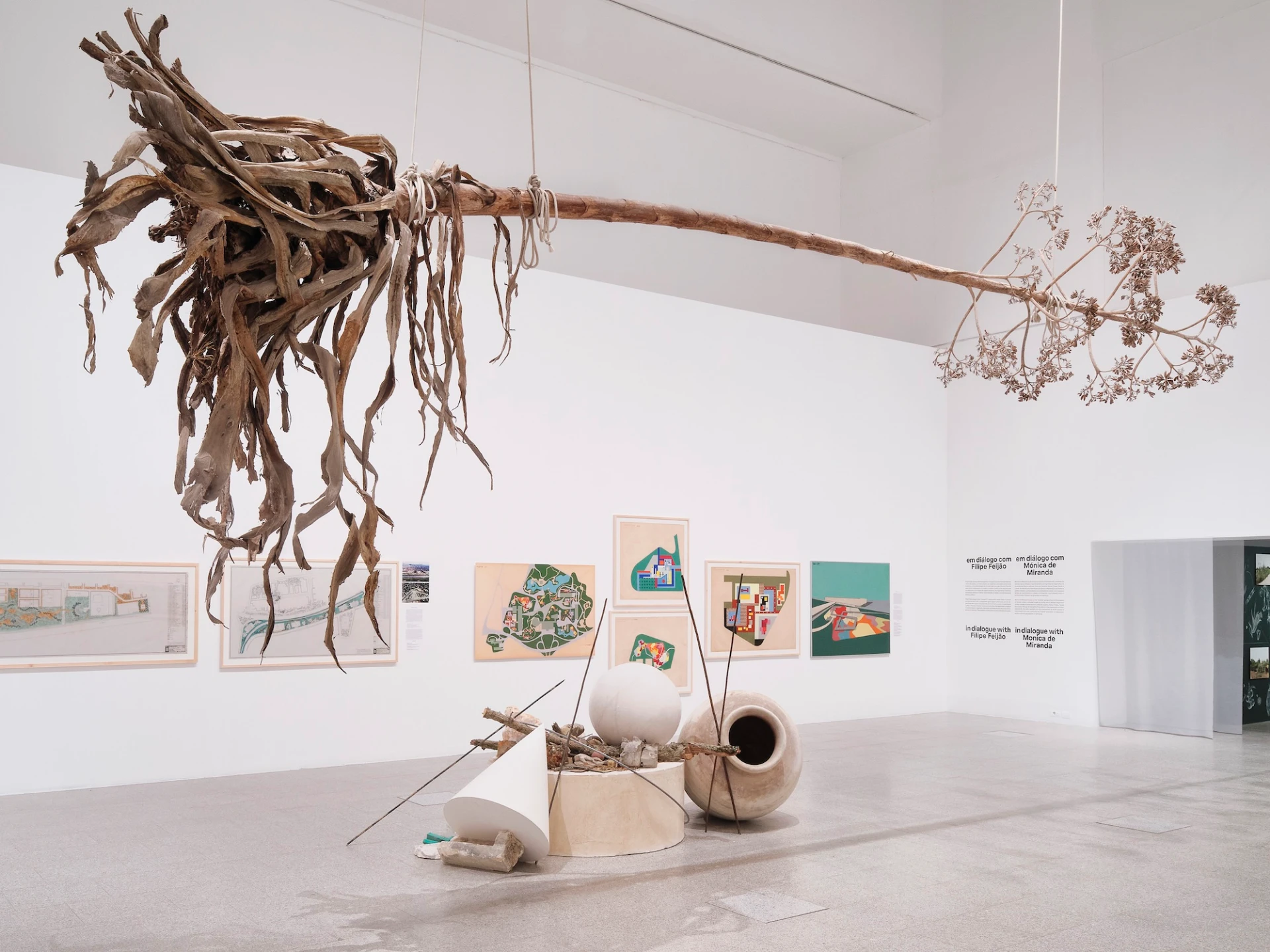
In A Place to Be: The Burle Marx Legacy, the garden is transformed into a representation of the garden, and the sensory experience is reconfigured through archival research. Aware of this “limitation,” Nuria Enguita, artistic director of MAC/CCB, and curator Marta Mestre offer a cross-disciplinary approach by linking the landscape painter’s archive with the work of five contemporary Portuguese artists.[2] This establishes a dialogue with works by Fernanda Fragateiro, Filipe Feijão, Juan Araujo, Mónica de Miranda, and Lourdes Castro, broadening the interpretive framework to include the Portuguese context. Across five themes, following the room layout—city building, aesthetic and ethical commitment, modern design, environmental activism, and botanical heritage —a multi-faceted artist is deconstructed, chapter by chapter. These section titles are, to a large extent, also traits of Burle Marx’s personality: democratic, artist, modern, activist, and botanist.
Our tour begins with the Jardim das Ondas. Designed by Fernanda Fragateiro and João Gomes da Silva (Global Arquitetura Paisagista) for Expo ’98, this studio also designed Ribeira das Naus, as well as the surroundings of the Terminal de Cruzeiros—a project by Carrilho da Graça—both in Lisbon, and the garden at the Serralves Museum. It consists of a set of small models that replicate the topography or bathymetry of the waves. Also noteworthy is the atlas by Mónica de Miranda, an artist who has dedicated much of her research to the African diaspora, identity, and landscape, with a presence in Lisbon and its circles, which are usually absent from these stages (Tales of Lisbon and South Circular, 2019). Jardins Invisíveis is a documentary series[3] about community gardens in the capital's suburbs. To many, these are urban wastelands; to others, they are tales of immigration, acts of resistance, subsistence, and ecology. Lastly, we fly to the island of Madeira, to Lourdes Castro’s island garden. A set of 20 drawings from the series Sombras à volta de um centro is impeccably displayed in a structure of two semicircles[4] discontinuous, reminiscent of the filtered light from Japanese screens, stabilized by slabs of pink lioz—a stone that recurs in the other installations throughout the exhibition, and, of course, on the CCB’s façade.
At a time when climate emergency is redefining the way we think about—or approach—cities, whether through the importance of green spaces, ecosystems preservation, sanctuary creation, planning of retention basins, or reflection on coastal development, the figure of Burle Marx is surprisingly contemporary. He is, in his design, his thinking, his landscaping, or his activism.
However, since we miss the “smell of wet dirt” and the light filtering through the treetops, we accepted Ivo Meco’s invitation (which is part of the parallel program Jardins: Lugares de Olhar, taking place on Saturday, March 21, at 11:00 a.m.) and climbed up to the Olive Garden, from where one can see the Japanese Garden or the Praça do Império Garden, or, further ahead, the Tropical Botanical Garden; we thought of the Garden of Eden, the Hanging Gardens of Babylon, and how political and social gardens are, as well as acts and symbols of power.
A Place to Be: The Burle Marx Legacy is on view through April 5 at MAC/CCB, highlighting two initiatives in the public program: Jardins, Lugares de Olhar, a guided tour of the gardens surrounding the museum led by Ivo Meco on the spring equinox, and Alarve, a performance by João dos Santos Martins.
[1] KRAUSS, Rosalind. Discursive Spaces in Photography: Landscape/View. Art Journal. Vol. 42, No. 4, (1982), pp. 311–319.
[2] This model was imported from the exhibition in Brazil, following a collaboration between the Burle Marx Institute and the Museum of Modern Art in Rio de Janeiro, as Marta Mestre explained during the guided tour.
[3] A project that follows on from Jardim Crioulo, created for the GreenHouse project (2024), which officially represented Portugal at the 60th Venice Biennale.
[4] Semicircles that also echo those of the Casino Park Hotel, the only project attributed to Oscar Niemeyer in Portugal, designed in close collaboration with Viana de Lima (with interiors by Daciano da Costa)—“Corbusian architects” for whose work the garden is an extension of the architecture; in this specific case, the garden embodies the tropical and Macaronesian landscape.
BIOGRAPHY
Architect (FA-UL, 2014) and independent curator (postgraduate at FCSH-UNL, 2021). In 2018, he founded the curatorial collective Sul e Sueste, a joint platform between art and architecture, territory and landscape. As a curator, he has regularly collaborated with a number of institutions, municipalities and independent spaces, including ‘Space, Time, Matter’ (group exhibition at the Madre Deus Convent in Verderena, Barreiro, 2020), ‘How to find the centre of a circle’ with artist Emma Hornsby (INSTITUTO, 2019) and ‘Fleeting Carpets and Other Symbiotic Objects’ with artist Tiago Rocha Costa (A.M.A.C., 2020). He was recently co-curator with architect Ana Paisano of the exhibition ‘Cartografia do horizonte: do Território aos Lugares’ for the Museu da Cidade in Almada (2023). He regularly writes reviews and essays for magazines, publications, books and exhibitions. He is co-author of the book ‘Gaio-Rosário: leitura do lugar’ (CM Moita, 2020), ‘À soleira do infinito. Cacela velha: arquitectura, paisagem, significado’ (author's edition with the support of the Direção Regional da Cultural do Algarve, 2023) and “Geografias Urbanas” (under publication). His professional activity revolves around the various branches of architecture.
ADVERTISING
Previous
article
19 Mar 2026
A Oferta, by Jaime Welsh
By José Pardal Pina
Next
article
23 Mar 2026
May I Help You? Posso Ajudar?, at MAC/CCB
By João Pedro Soares
Related Posts
article
19 MAR 2026
Burle Marx: in a garden of painted plants
By Frederico Vicente
article
16 JAN 2026
Eva Gaspar at Salto: Until death does us part again
By Frederico Vicente
article
30 OCT 2025
João Penalva in retrospect: the heteronomy of a singular artist
By Frederico Vicente
article
28 OCT 2025
Rui Chafes: nineteen axes to believe in fire
By Frederico Vicente