Article
Clinical Distance to Intimacy: "Tecnologias da Intimidade" at Mono Gallery
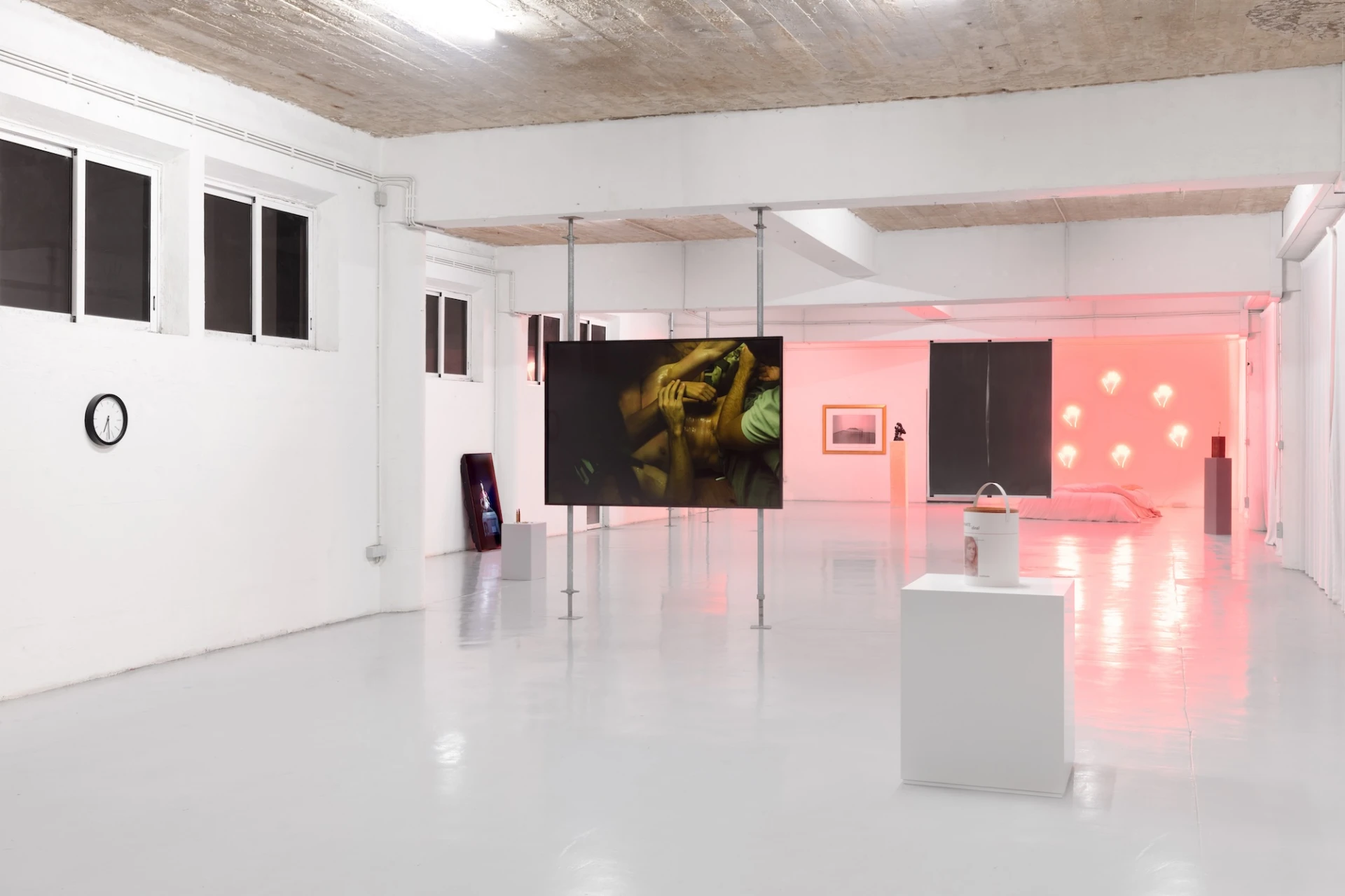
Tecnologias da Intimidade (Technologies of Intimacy), a group exhibition presented at Mono Gallery, brings physical contact and sensory scenes. In fact, each seems to have been torn from a David Lynch scene, blending seamlessly with the gallery’s raw, unembellished garage atmosphere.
The exhibition’s curator, Ana Cristina Cachola, states that “It is in fiction that intimacy becomes visible, often in the form of excess.”1 We can always draw on libidinal imagery as a particularly effective means of strengthening memory. Intimacy, which drives us to retreat into a dark room to make love, separates the body from the outside world with a delicate membrane. This membrane envelops the body in a fictional sense of invulnerability, covering it with an armour so thin that it is almost intangible. What is at stake here is an invisible “garment”, a fabric woven from the libido. This fabric allows us to escape the surrounding violence while simultaneously shielding us from disgust.
Pleasure has never been entirely a matter of happiness. Bodily fluids, dirt, discharges, scattered thoughts, pills, silicone objects entering and leaving the body, and the remnants of sexual pleasure bring us into contact with the material reality of life. These are precisely the dimensions of bodily experience that conventional systems tend to exclude or overlook.
In Fernão Cruz’s work “Dói Tanto” (Me duele tanto), in which we mentally complete the unfinished sentence, the emotional pain of someone's absence becomes entangled with physical suffering. “I am in pain” is not a clinical finding, yet it intimates that physical suffering cannot be disentangled from eroticism.
In Louis-Ferdinand Céline’s novel Journey to the End of the Night, the female body is presented as a paradoxical space in which life and decay coexist. While Céline’s clinical gaze and Georges Bataille’s erotic and metaphysical explorations differ in their approaches, both seek to expose the presence of death within the living. Tecnologias da Intimidade brings these two perspectives together, placing clinical distance and erotic and metaphysical depth on the same plane.
In Ana Pérez-Quiroga’s black-and-white photographic work Je déteste être grasse, mange-moi s’il vous plaît! (I Hate Being Fat, Please Eat Me!), we encounter a female body positioned on a dining table. The woman’s demand does not arise from any hope of recovery or transformation. “Eat me” is a demand for annihilation: destroy me. Through this demand, the woman humiliates the viewer, confronting them with their own hungry, soulless gaze.
The body is unruly. Unpredictable. Full of flaws and the openings that accompany them. Moments of intimacy resemble a microcosm, almost entirely insulated from the outside world. In Marcos Duvágo’s "Os Convites nos Olhos Embriagados", intertwined, sweaty bodies are caught in an ecstatic state of erotic abandon. These scenes evoke a sense of things being done hastily and haphazardly.
The Marquis de Sade’s observation in Philosophy in the Bedroom that “the best way to become familiar with death is to associate it with an immoral idea” grants seduction the same naturalness and legitimacy as death itself.
Throughout history, seduction has been burdened with an ill-fated destiny. It has consistently been regarded as an evil strategy, or even as one employed by the world itself. It has always been a ruse of worldly existence. Today, as evil and aggression acquire increasing currency, the fact that seduction remains in the shadows may seem paradoxical.
In Seduction, Baudrillard writes: “Psychobiological technology -all the information prostheses and electronic networks we use to regulate ourselves- offers us a strange bioelectronic mirror. Each of us, like a digital Narcissus, slides along the death drive and exhausts themselves within their own image.” As we increasingly regulate our own bodies and pleasures, the slow, Narcissus-like effects of narcosis may begin to take hold. In Francisco Trêpa’s A Beak in My Throat, we can discern an eager embrace between pathological narcissism and death. We find ourselves threatened by psychosis. Cloning is the most extreme form of seduction: passing from the Same to the Same, without passing through the Other.The rhythm of life carries the full weight of erotic ambiguity. Isabel Cordovil’s monument makes this idea visible through an ordinary object.
Monument to My Colgate Action Max White: A Very Decent Toothbrush in Shitty Times.
Sometimes, the point is really to erect a monument to a toothbrush that has emerged from shitty times. We take care of the body, an organism in constant need of care. Regardless of how difficult or dismal the times may be, this body continues to demand feeding, emptying, cleansing and purification. It is a body for whose continued existence we are held “responsible”.
Similarly, in Mané Pacheco’s Soft War, as empty bullet casings are transformed into lipsticks, we see new weapons being invented along these lines of flight as a means of resisting the state’s powerful arsenal: I can escape; throughout my escape, I am searching for a weapon. I recognise it in myself.
Hilda de Paulo’s work “A Amante Ideal” (The Ideal Lover) marks a sharp turning point in thought. As Michel Foucault suggests in The Birth of the Clinic, ‘sexuality is also the outcome of a process of production involving discourse, language and desire.’ The term ‘liofilizado’ (lyophilised) in the work exposes the sardonic dimension of this logic of production: the substance -the lover- is frozen and dehydrated through vacuum processing, transformed into a product that can be reconstituted as a solution whenever needed. The lover thus becomes a product that can be stored, reproduced and made ready for use whenever required.
Tecnologias da Intimidade sheds light on forms of intimacy situated within the blind spot of desire. It considers both the recognition of the numerous and complex conditions that must converge for the acts of pleasure to be properly enacted and the formation of a discourse of “truth” that individuals develop in relation to themselves.
The exhibition is on view at Mono Gallery until 21 November.
Participating artists: Alice Geirinhas, Ana Pérez-Quiroga, Ana Rebordão, Bárbara Bulhão, Bárbara Pisco, Cláudia Cruz Guerreiro, Cristina Ataíde, Fábio Colaço, Fernão Cruz, Francisco Trêpa, Hilda de Paulo, Hugo Cantegrel, Isabel Cordovil, Mané Pacheco, Marcos Duvágo and Xavier Almeida.
1 From the exhibition text.
BIOGRAPHY
Ayşenur Tanrıverdi is an Istanbul-based writer, living in Lisbon since September 2022. She studied at Istanbul University and is the author of two published works of literary fiction. A regular contributor to Cumhuriyet, a major Turkish newspaper, where she focuses on Portuguese culture. Her essays and critical texts on theatre, literature, and contemporary art have also been featured in various art magazines.
ADVERTISING
Previous
Article

18 Nov 2026
Guardiões do Mira: about the exhibition "Nuvens correndo num rio / Quem sabe onde vão parar?"
By Mariana Varela
Related Posts
Article
19 NOV 2026
Clinical Distance to Intimacy: "Tecnologias da Intimidade" at Mono Gallery
By Ayşenur Tanrıverdi
Article

09 OCT 2026
Geographies of Memory: A Stone in the Middle of the Road
By Ayşenur Tanrıverdi
Article
18 JUN 2026
Olho de Vidro, by Pedro Barassi: The Gravity of the Gaze
By Ayşenur Tanrıverdi
Article
15 JUN 2026
Notes on ARCO Lisboa 2026
By Ayşenur Tanrıverdi