article
Phantom Body: Spectrality as a Reading Device
“Perhaps it is precisely in this ability to perpetuate, through the montage, the questions posed by the works themselves that the greatest strength of Corpo (Body) lies. The curatorial choices do not subordinate the works to a concept; rather, they create the conditions for them to establish relationships with each other that broaden their field of meaning without compromising the singularity of each one.”
Among the multiple ways of thinking about the ghost – from philosophy to Freudian psychoanalysis – perhaps it is the Shakespearean universe that best crystallizes its paradoxical condition. Far from being merely a supernatural element, the "ghost" is, in this context, essentially a spectral apparition that returns to disturb the present, insisting on occupying a place that escapes stability and forcing the characters to confront what remains unresolved. Perhaps that is why the ghost remains a particularly fertile figure for thinking about contemporaneity and everything that, despite being apparently extinct, continues to exert influence on the present.
I believe it's a common experience for many Leiria residents to have, at some point in their lives, felt a chill when looking at the old chalet commissioned by Roberto Chartres de Azevedo in 1894. With its romantic architecture, permanently closed windows, and pink walls that betrayed the passage of time, Villa Portela remained there, atop the hill – facing the building that now houses the Leiria City Hall – without any life emanating from its interior, evoking an imagery akin to that of haunted houses in literature and film.
It was the year 2016 when the project to revitalize and convert the building into an Arts Center was announced, which would only be inaugurated in 2025.
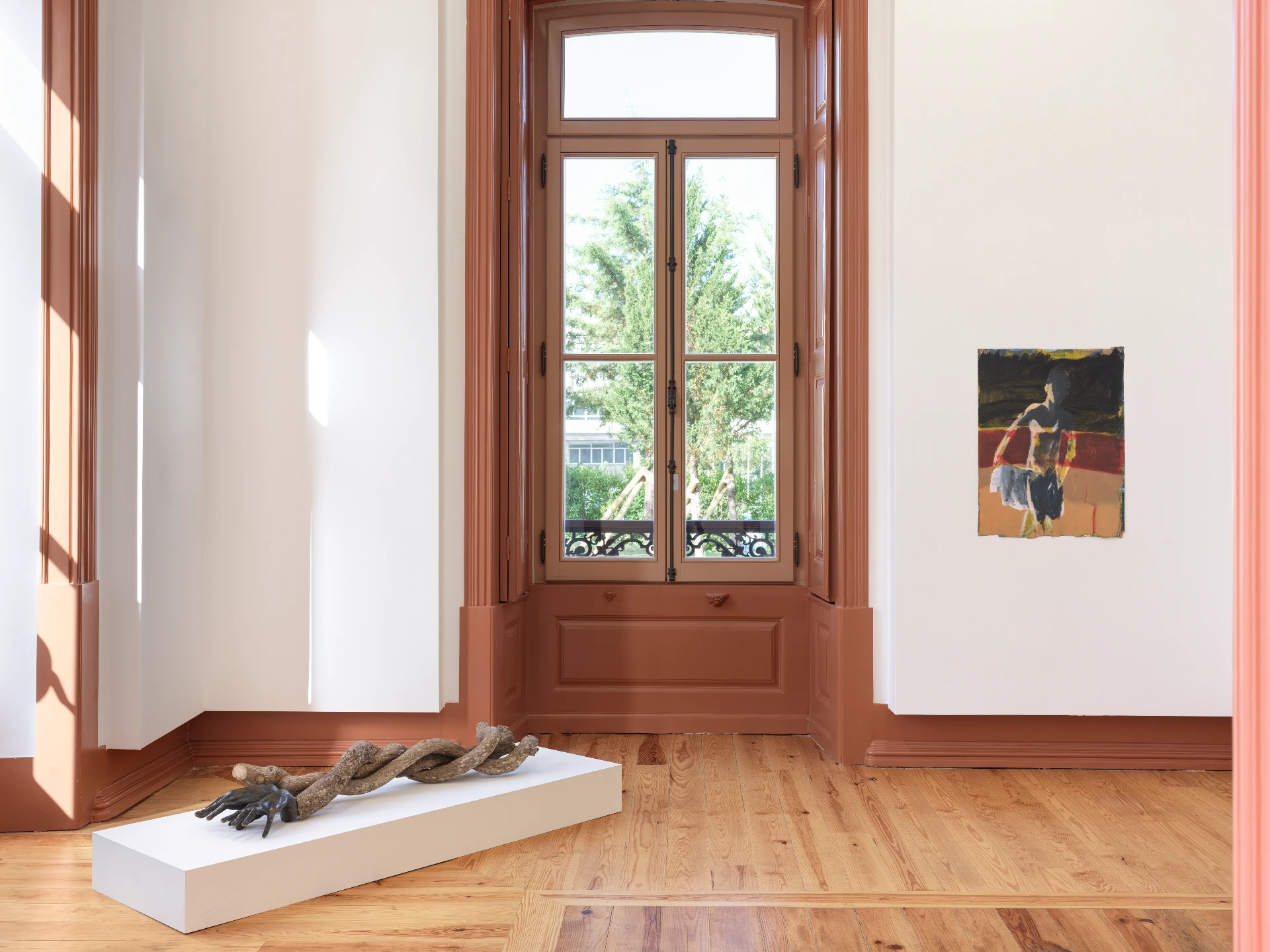
It is precisely in this context that the choice of Corpo Fantasma (Phantom Body) as the title for the second exhibition at the Villa Portela Arts Center, bringing together works from the State's Contemporary Collection, becomes particularly significant. Regardless of the curator Marta Espiridão's intentions, it becomes difficult to dissociate this title from the history of the building itself, also marked by a condition that approaches the realm of the phantasmagorical.
This condition, however, is not limited to the memory of the building, extending into the very experience of the visit. The interior also seems to preserve the memory of what it once was when, upon climbing the spiral staircase, the original wood of the chalet's steps can be heard creaking underfoot.
The curatorial effectiveness in how the exhibition narrative engages with this latent memory is immediately apparent. Here, the ghost nears the spectator's body, which is also a wandering body. Free to roam the space without a predetermined route, the visitor to the exhibition also becomes a wandering presence, summoned to construct their own path among works, rooms, and associations.
It is precisely in this movement that the title begins to reveal its true scope. At first, Corpo Fantasma (Phantom Body) seems to announce an encounter with representations of the conventional figure of the ghost – that liminal being often covered by a white sheet. In fact, Fato GICAPde Túlia Saldanha (Túlia Saldanha's Fato GICAP) (1976), suspended in one of the first rooms, seems to point to just that: it is an anonymous, faceless entity, hanging from the ceiling, whose hypothetical body is only hinted at under colorful rags. The piece itself, however, constitutes the vestige of a performance and, therefore, of a past action. Fato GICAP seems, therefore, to respond, in the first instance, to the expectation created by the title only to, soon after, dismantle and complicate it through its multiple layers of meaning and history. From this moment on, the exhibition moves away from the literal representation of the ghost to develop a broader notion of spectrality, seeing it less as a supernatural manifestation than as a condition of human experience. This shift allows us to understand the exhibition's trajectory not as a succession of representations of the ghost, but as a progressive investigation of the concept's multiple meanings.
It is precisely in this light that one can read Re Récamier (2020), by Rosa Carvalho, Untitled (from the Silueta Series) (1975), by Ana Mendieta, or Sombras projetadas de Marie e José Manuel Simões (Projected shadows of Marie and José Manuel Simões) (1964), by Lourdes Castro. In all of them, the spectral condition materializes – or dematerializes, in this case – through the vestige: recesses, silhouettes, and outlines of shadows function as marks of vanished bodies whose presence continues, however, to inscribe itself in memory, making absence the condition that summons the body.
While in previous works the body persists through its external traces, in André Romão's Seiva (Jungle) (2023), this persistence shifts to within the bodily experience itself. The reflection on absence is thus prolonged, evoking the idea of the "phantom limb" as that which the body continues to feel, remember, or project even in the absence of the amputated object.
It is also from the idea of a body that continues to exist beyond its immediate materiality that the exhibition naturally leads to a reflection on the construction of the subject. Amputation can, in this sense, be understood as a gesture of adapting the "self" to a larger, social and normative set, referring to the processes by which the subject constructs, negotiates or transforms its own identity. Therefore, it is worth highlighting the choice of works such as Soufflé (2007), by Sarah Lucas, and Untitled (Facial Hair Transplant) (1972), by Ana Mendieta, summoned by the curator as examples of the "specters of identity and the haunting of gender categories" (1). More than illustrating this problem, both highlight identity as an unstable construction, permanently subject to displacements and reconfigurations.
Finally, the curatorial approach in the installation of Maria José Palla's Autorretratos, Polaroids (Self-Portraits, Polaroids) (1970) proves particularly successful, where the very arrangement of the works seems to materially extend both the issues raised by the exhibition and the artist's gesture. It is a set of Polaroids in which Palla appears repeatedly as the self-represented author in an apparent delirious state: at times fully present, but as if absent from herself; at others, on the threshold between physical presence and disappearance, to the point where her own body becomes invisible, giving way to the architectures she inhabits. It is precisely this tension between presence and absence that the installation prolongs in the exhibition space. Some Polaroids appear fully revealed; others remain partially hidden in their respective paper wrappings; still others are totally absent, being evoked only by their corresponding envelope. It is significant that this interplay between showing and hiding occurs through the Polaroid itself, whose technique is based on a gradual process of image revelation. The installation thus echoes this material condition, transforming the revelation into a gesture that is simultaneously technical and curatorial. Spectrality, therefore, ceases to be merely an issue evoked by the works and becomes a condition of the image itself.
Perhaps it is precisely in this ability to perpetuate, through the montage, the questions posed by the works themselves that the greatest strength of Corpo (Body) lies. The curatorial choices do not subordinate the works to a concept; rather, they create the conditions for them to establish relationships with each other that broaden their field of meaning without compromising the singularity of each one.
Far from simply invoking supernatural imagery, the ghost reveals itself here, similar to the Shakespearean specter, less as a figure than as a field of relationships in permanent negotiation that the viewer is invited to navigate.
Corpo Fantasma will be showing until August 30th at the Villa Portela Arts Center in Leiria.
1 . Espiridião, Marta. Curatorial Text "Corpo Fantasma", 2026.
ADVERTISING
Previous
article
06 Aug 2026
Autocolante. Iconografia da Liberdade, at MUDE
By Carla Carbone
Next
article
10 Aug 2026
Second Cycle of Exhibitions at the Arpad Szenes – Vieira da Silva Foundation
By Carla Carbone