article
Second Cycle of Exhibitions at the Arpad Szenes – Vieira da Silva Foundation
“We think of light and, indeed, of particles, in a given visual field, and it is tempting, and almost impossible, not to bring to mind the rectilinear and expansive paintings of Vieira da Silva, currently present in the Second Exhibition Cycle of the Arpad Szenes Foundation – Vieira da Silva, fulfilling, these works, a role (but not only) of linking and agglutinating the different exhibition nuclei currently on display at the foundation.”
In 1979, the magazine October published one of the greatest articles of all time: Grids, by Rosalind Krauss1.
In the aforementioned article, the art historian and critic made clear what remained hidden in the realm of art, but which was fundamental and shaped a modern aesthetic: the use of the grid.
Krauss began by situating the use of the grid structure, which gained greater prominence in the artistic phenomenon from pictorial cubism onwards, even before the Second World War. But, more importantly, he understood the assertion that there existed, among artists, an ambition to achieve silence, accompanied by a growing “hostility towards literature, narrative, and discourse”2.
Discourse was progressively replaced by visuality, by the formalist dominance of art3. And nothing is better than the grid to dismantle this discourse4.
Gradually, the grid, or network, despite the historian recognizing its generative potential, took over the critical and more widespread process of art, resisting its development5.
Krauss defined it, in its functionality, on the one hand, as being spatial, "flattened, geometricized, ordered"; on the other, temporal, as it focuses on the present, denying the past, its sequentiality and the objectified relationship with reality (perspective).
According to the author, the structure itself was not absent from past works, from the 19th century, or even, albeit remotely, from the Renaissance, and she based her theory on the optics and mechanical physiology of the eye6.
Rosalind Krauss's analysis of 19th-century treatises and studies on optics and the physiology of the eye is very interesting. In them, Krauss observed that (these treatises) were illustrated with grids, "because they were a way of demonstrating the interaction of specific particles along a continuous field, and that this field was analyzed according to a modular and repetitive grid structure."
We think of light and, indeed, of particles, in a given visual field, and it is tempting, and almost impossible, not to bring to mind the rectilinear and expansive paintings of Vieira da Silva, currently present in the Second Exhibition Cycle of the Arpad Szenes Foundation – Vieira da Silva, fulfilling, these works, a role (but not only) of linking and agglutinating the different exhibition nuclei currently on display at the foundation.
The work of Vieira da Silva, selected for this exhibition and present in the Spatial Structures section, unequivocally reveals the principle of the grid or network (examples: Les dégres, 1964, La Basilique, 1967, Au fur et à mesure, 1965, Voyage d’hîver, 1961, New Amsterdam I and II, 1970, or Esplanade, 1967) through intersecting lines in a generally unstable space, intercepted by shimmering planes and colors, ambivalent regarding the representation of depth and "unifying perspective," and in a labyrinthine interplay of solids and voids.
In the artist's paintings, we recognize the use of the distant memory of space (as in the case of her own studio, transformed into an imaginary, non-physical place) or starting point for her paintings, even though the artist remained absent or unable to work in her studio in Paris.
Atelier, Lisbonne, 1935, and Atelier, 1940, are examples of works evocative of shadows and phantasmagoria.
In the first, a studio occupied by two nets, or screens (the reticulated effect), is revealed, as well as curved linear elements that Sara & André have masterfully appropriated and translated into the gallery space of the Museum, through an installation composed of tubular and rectilinear elements that cover the beginning of the Exhibition Cycle room, currently on display.
Vieira da Silva's painting punctuates and connects the different thematic cores of the exhibition. Its quadrilateral structure, in an invisible way, structures and envelops the body of works present in the Museum, by the different artists.
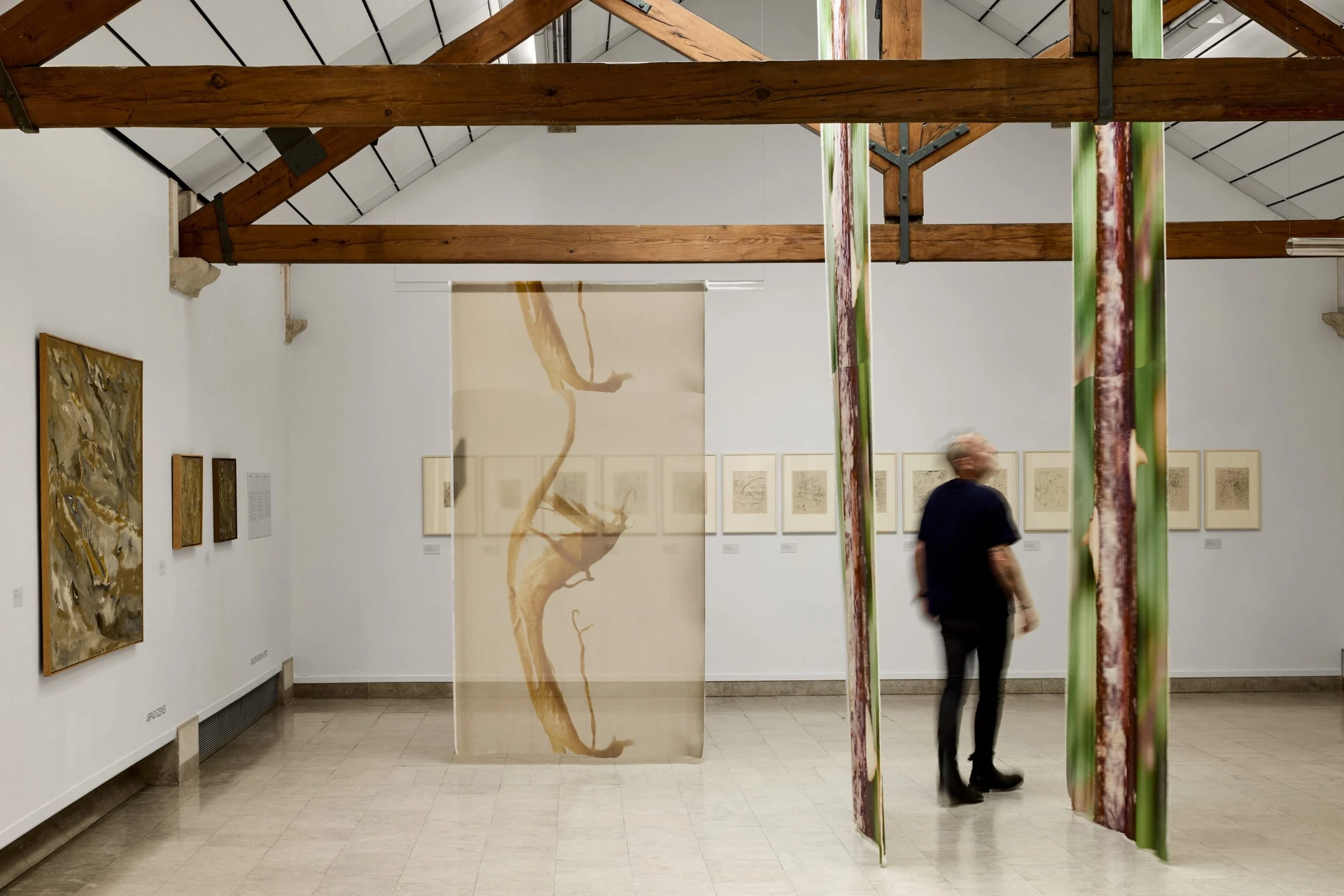
Noronha Feio incorporates silk screens, suspended in acrylic tubes, printed with photographic images, enlargements of tree fragments, plant stems, or other references (photographs of the city of Budapest, macros of undefined patterns, nets and fences) and, being slightly transparent, these screens appear juxtaposed to one another, dissolving around the painter's works, and fixed along a wall of the gallery. The suspended surfaces of Noronha Feio undulate as the visitor passes by, which gives the whole a certain volatility, contributing to the lightness and intermittency of the exhibition space, later alluding to the vibratory iridescence of Vieira da Silva's works, and the series exhibited in the core "The life of plants, L'inclémence lointaine and other works" (revealing the attention the artist gave to the pulsation, life, and variability of plants).
These oppositions, confrontations, and decontextualizations in Noronha Feio's work, evidenced in the "Arborescences" section, are common in his artistic practice. They traverse different artistic areas and media through the collection of images and the intersection of diverse realities and meanings, highlighting the arbitrariness of everyday events, translated (and manipulated) into the artistic field. The artist's motifs appear at different points in the exhibition and demonstrate vague, open, and imprecise abstract plots or elements, leaving the observer the possibility and freedom to make their own choices, connections, and interpretations of the images.
The works of Arpad Szenes, for example, Le bosquet, from 1956, and La vallée, continue the theme of nature in the museum's exhibition space.
In several rooms of the museum, an exhibition of João Paulo Feliciano's work is on display, clearly showing the connections and articulations with the work of Vieira da Silva. This is especially true in the early stages of Feliciano's artistic life, where the artist's work was a strong influence.
Throughout the artist's exhibition, one can see paintings that display geometric and reticulated quadrilateral structures. These always involve a play of opposing references (meshes, patterns, networks, architectural spaces, natural elements) and juxtaposition of contrasting colors.
The duo Mariana Caló and Francisco Queimadela offer visitors an installation, Multiplicador de visões e preces Multiplier of Visions and Prayers, from 2026, comprised of diptychs of painted silk, oil paintings on canvas, and projections of drawings in light. The silhouettes, in their solid and empty spaces, recall the shadows and translucent fabrics of Lourdes Castro.
Until September 13th, at the Arpad Szenes – Vieira da Silva Foundation.
1 Grids Author(s): Rosalind Krauss Source: October, Vol. 9 (Summer, 1979), pp. 50-64 Published by: The MIT Press
2 Ibidem
3 Ibidem
4 Ibidem
5 Ibidem
6 Ibidem
BIOGRAPHY
Carla Carbone was born in Lisbon, 1971. She studied Drawing in Ar.co and Design of Equipment at the Faculty of Fine Arts in Lisbon. Completed his Masters in Visual Arts Teaching. She writes about Design since 1999, first in the newspaper O Independente, then in editions like Anuário de Design, arq.a magazine, DIF, Parq. She also participates in editions such as FRAME, Diário Digital, Wrongwrong, and in the collection of Portuguese designers, edited by the newspaper Público. She collaborated with illustrations for Fanzine Flanzine and Gerador magazine.
ADVERTISING
Previous
article
10 Aug 2026
Phantom Body: Spectrality as a Reading Device
By Luísa Ferreira
Next
article
11 Aug 2026
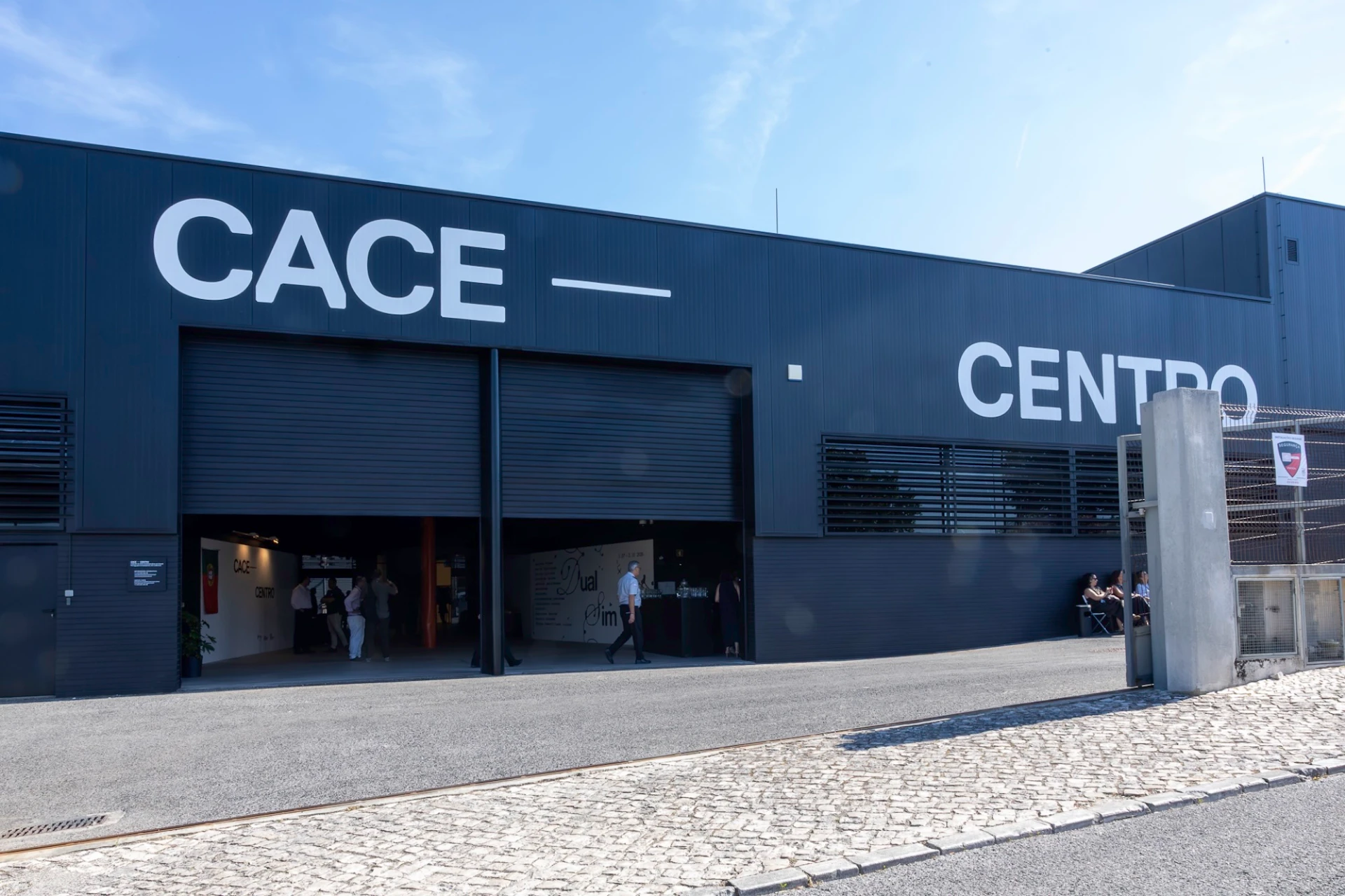
Dual Sim at CACE-CENTRO: what a collection produces
By Laurinda Branquinho
Related Posts
article
23 SEP 2026
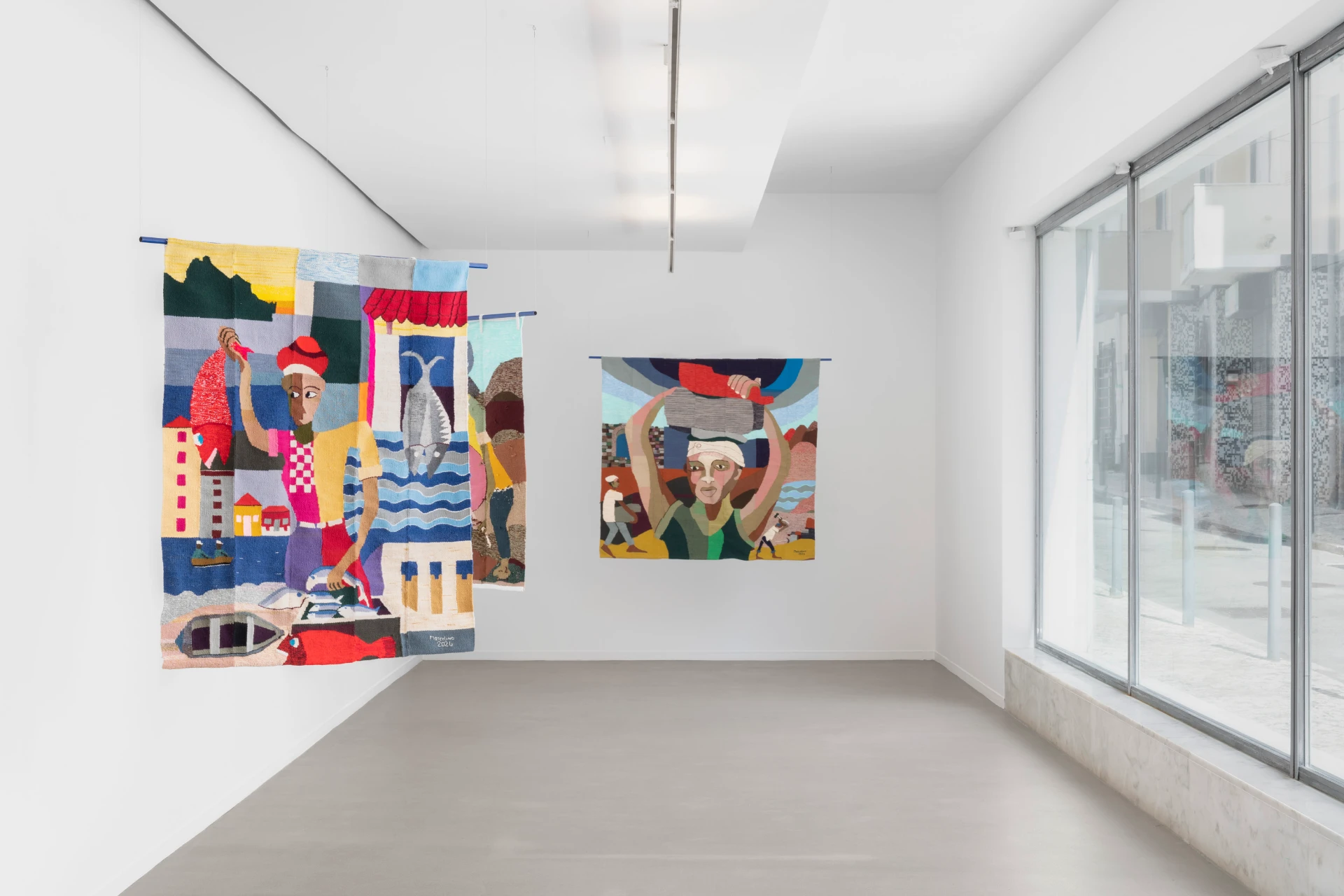
Realismo Ilhéu: Marcelino Santos at the Museu do Neo-Realismo
By Carla Carbone
article
10 AUG 2026
Second Cycle of Exhibitions at the Arpad Szenes – Vieira da Silva Foundation
By Carla Carbone
article
06 AUG 2026
Autocolante. Iconografia da Liberdade, at MUDE
By Carla Carbone
article
09 MAY 2026
Mesa-Paisagem (1973), by Ana Vieira, at Brotéria
By Carla Carbone