article
Diante do Tempo (Moment III), at Appleton
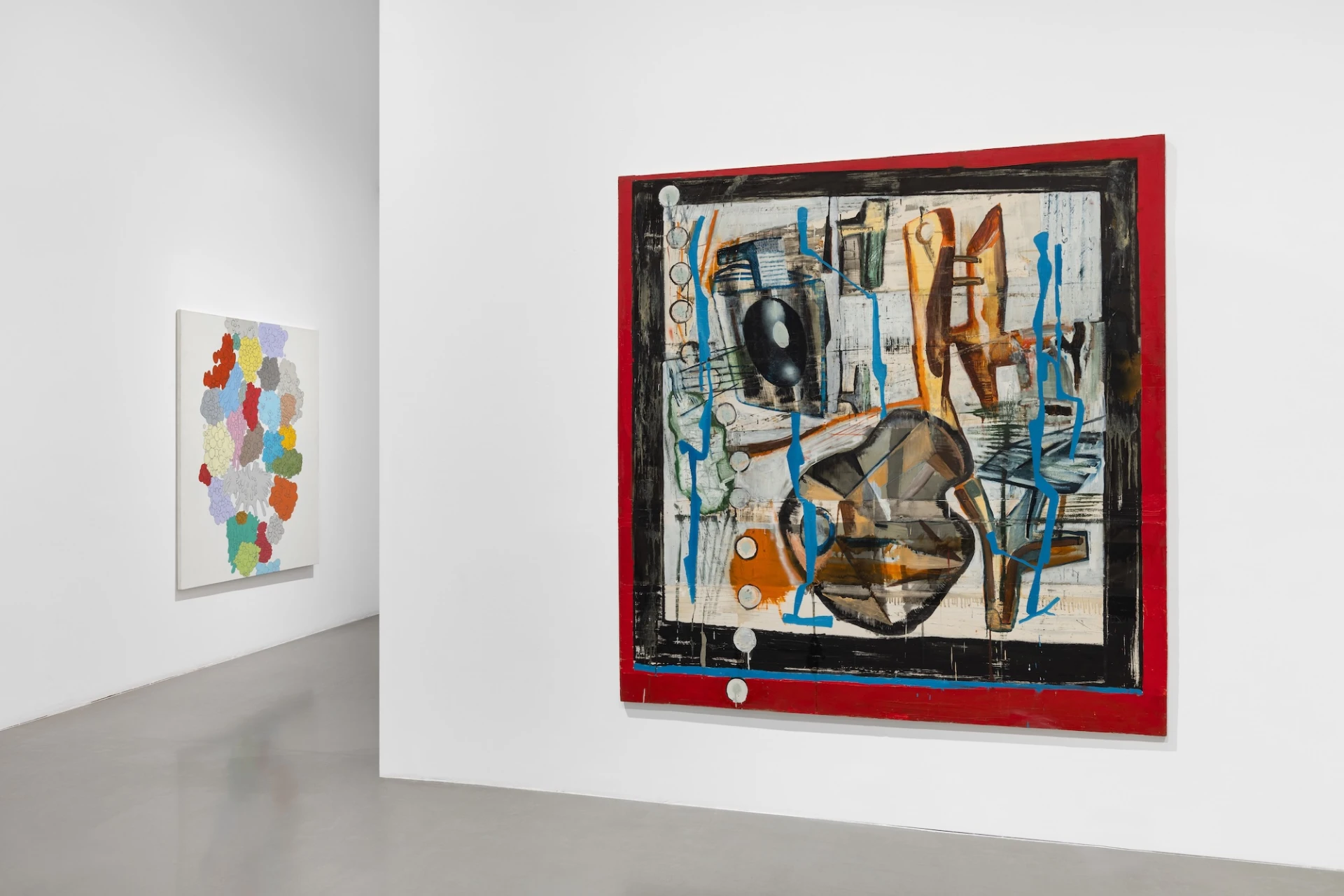
The third phase of the exhibition Diante do Tempo presented at Appleton Square and [BOX], constitutes a fundamental step in the conceptual consolidation of the exhibition project. This phase asserts itself as an unfolding that extends previously formulated assumptions while simultaneously re-inscribing them within a new spatial and curatorial context, allowing for a rearticulation of the issues at stake. The move to Appleton introduces new conditions for reading and experiencing the exhibition, in which different languages, scales, and modes of inscription are placed in relation, intensifying the experimental field that permeates the proposal.
As an expanded exhibition project Diante do Tempois built upon a reflection on the passage of time in art, on heritage, politics, and the temporal dimension inscribed in the very materiality of the works. Time is understood here as a living matter, traversed by discontinuities, returns, and layers of memory, subject to processes of interruption, reactivation, and reconfiguration that produce meaning in the present. Throughout its different phases, the project opens itself to a multiplicity of practices, generations, and languages, promoting confluences, but also frictions and confrontations.
According to Vera Appleton, this project involved a different approach than what usually guides the association's programming, since it was designed for touring, requiring adaptation to different exhibition contexts. Part of the exhibition, now taking place in the Lisbon gallery during a period of change, assumes a particular and special character. The show, which was designed from the identity and "genetics" of Appleton, gains, after its expansion, a new expression at its base – the mother house, as Vera refers to it – highlighting its own dynamics.
It is within this context that the integration of Appleton Recess #4 also proves particularly significant. Conceived from its inception as a meeting space between artistic practices of different generations and fields of research, this cycle operates as a curatorial device that intensifies the relational logic of the broader project. In an interview with Umbigo, on the occasion of the gallery's eighteenth anniversary and the opening of Diante do Tempo in Elvas, Vera Appleton emphasized that the invitation to Ana Anacleto and Bruno Marchand stemmed from the desire to promote a deliberate curatorial shift, capable of introducing an external perspective that did not reiterate existing assumptions, but reconfigured them based on other methodologies and sensibilities. This openness asserts itself as a structural gesture, allowing the exhibition to be constructed from distinct ways of thinking about and presenting artistic practice.
In the context of this edition, what unites the presented works is a shared attention to language as unstable matter, subject to processes of fragmentation, displacement, and transformation. The presence of Ana Hatherly, through works such as Hand made (2000) and Labirinto urbano (a) (1999), introduces a field of investigation in which writing asserts itself simultaneously as visual form, gesture, and material trace. The linearity of reading is systematically interrupted, exposing the sign as an unstable—even precarious—entity. The works call for an exercise in deciphering in which the accumulation of gestures and traces becomes constitutive of the experience.
This problematization of language resonates with the practice of Pedro Diniz Reis, whose works explore the articulation between sound, image, and perception through abstract and diagrammatic procedures. Works such as Alphabet (Japanese), Alphabet (Russian), and Alphabet (Greek) (2005–2006) are developed based on formal systems and methodologies of spatio-temporal organization or data collection, bulding environments that demand prolonged attention. Repetition and variation here function as structuring principles, giving rise to an immersive experience that asserts itself more as a process in continuous activation than as a finished form.
Sara Graça's intervention introduces another type of tension into the exhibition as a whole. Through a single work—commissioned specifically for this encounter—the artist presents a composition that seems to possess its own code, capable of simultaneously dialoguing with the space and the gestures of the other works, transforming its presence into a point of opening within the exhibition itself.
The dialogue between these practices is thus constructed from subtle tensions and zones of contact, where the dissolution of representational weight, attention to materiality, and the refusal of conclusive forms operate as elements of approximation. The exhibition space is configured as a field of continuous negotiation, in which the works mutually affect each other. A particularly illustrative example of this articulation appears in Labirinto urbano (b), by Pedro Diniz Reis, where listening to Sérgio Nascimento's composition directs the viewer's gaze towards Ana Hatherly's work. The gesture of listening while observing introduces an overlapping of perceptual regimes, activating a cross-reading that intensifies the experience and reinforces the relational dimension.
On the lower floor, the presence of Osso Exótico accentuates this logic by shifting the axis of experience to the realm of listening and bodily action. The work assumes an autonomous presence, introducing a cyclical temporality that activates space as a place of occurrence. Through video and sustained sounds, a dramaturgy is constructed, marked by minimalist gestures and an expanded time, characteristic of the group's practice. The possibility of considering this work as a performance experienced in the unique context of the Elvas cistern, and its reinscription in a distinct space, highlights the potential of itinerancy and variation as a process of adaptation and reconfiguration, opening the work to new interpretations.
In this exhibition, there is a relationship between artwork, gesture, listening, and perception that explores the porous nature of time, its traces, its layers, the way it infiltrates, expands, and contaminates gestures, materials, ways of seeing and feeling. In the movements it propels, it reminds us that meaning is formed from experience, not classification, from the recovery of memories that remain to be revisited, rewritten, and rethought, in this or other places. And language. Always language.
The exhibition can be visited until February 14, 2026.
BIOGRAPHY
Maria Inês Augusto, 34, has a degree in Art History. She worked at the Museum of Contemporary Art (MNAC) in the Educational Services department as a trainee and for 9 years at the Palácio do Correio Velho as an appraiser and cataloguer of works of art and collecting. She took part in the Postgraduate Programme in Art Markets at the Faculty of Social Sciences and Humanities of Universidade Nova de Lisboa as a guest lecturer for several editions and collaborated with BoCA - Bienal de Artes Contemporâneas in 2023. She is currently working on an Art Advisory and curatorial project, collaborating with Teatro do Vestido in production assistance and has been producing different types of text.
ADVERTISING
Previous
article

27 Jan 2026
Between Word and Silence, at MACAM
By Ana Filipa Almeida
Next
article
28 Jan 2026
Praised Labor: Ana Jotta at messieurs-dames
By Diogo E S Dietl
Related Posts
article
25 JUN 2026
Scrolls, at Buraco: The Two Sides of the Same Coin
By Maria Inês Augusto
article
12 JUN 2026
Tabique, by Rita Gaspar Vieira
By Maria Inês Augusto
article
12 MAY 2026
Phantom Tales, by Pedro Zhang
By Maria Inês Augusto
article
10 MAR 2026
Deviation as structure: four decades of painting by Pedro Casqueiro
By Maria Inês Augusto