article
Poems of Tomorrow and Folklore (Part 2) at Francisco Fino Gallery
Poems of Tomorrow, João Motta Guedes' first solo exhibition at Galeria Francisco Fino, stands between promise and fracture, between the gesture that announces protection, care, and escape, and the awareness that this same gesture, from the outset, carries its own impossibility. In turn, in Pedro Barateiro's exhibition Folklore (Part 2), the past is summoned as an active construction. The works presented are part of an artistic practice that has long questioned the symbolic, political and cultural systems that shape contemporary experience.
Poems of Tomorrow, João Motta Guedes' first solo exhibition at Galeria Francisco Fino, stands between promise and fracture, between the gesture that announces protection, care, and escape, and the awareness that this same gesture, from the outset, carries its own impossibility.
Before proceeding, it seems pertinent to clarify that poetry—in its broadest, most expansive sense—does not appear here as a complement. Poetry is a method, a structure of thought. It is a means by which the world is questioned. Motta Guedes has been exploring, with sensitive rigor, the tensions that constitute the human condition—freedom and violence, vulnerability and desire, promise and despair. Anchored in demanding material research, his project practice reveals a reflection that is both intimate and collective.
With a background in Law, the artist relies on tools of analysis, language, and responsibility, moving through the field of empathy, consequence, and individuality, where thinking also means assuming implications. His work offers no answers. It is incessant in its search. It asks what we are doing here, what path to follow, and how to inhabit the emotions that guide and disorient us. It humanizes by recognizing fragility as a condition; it empowers by summoning sensitivity as a force; it acts by persistently seeking to guarantee the dignity of others. It explores the possibilities of various paths and the experience of falling as a necessary movement to start again. It confronts reality without giving up on dreams. It persists between the lucidity of limits and the insistence of hypotheses, of various hypotheses. Between utopia and the awareness of attempting—always attempting.
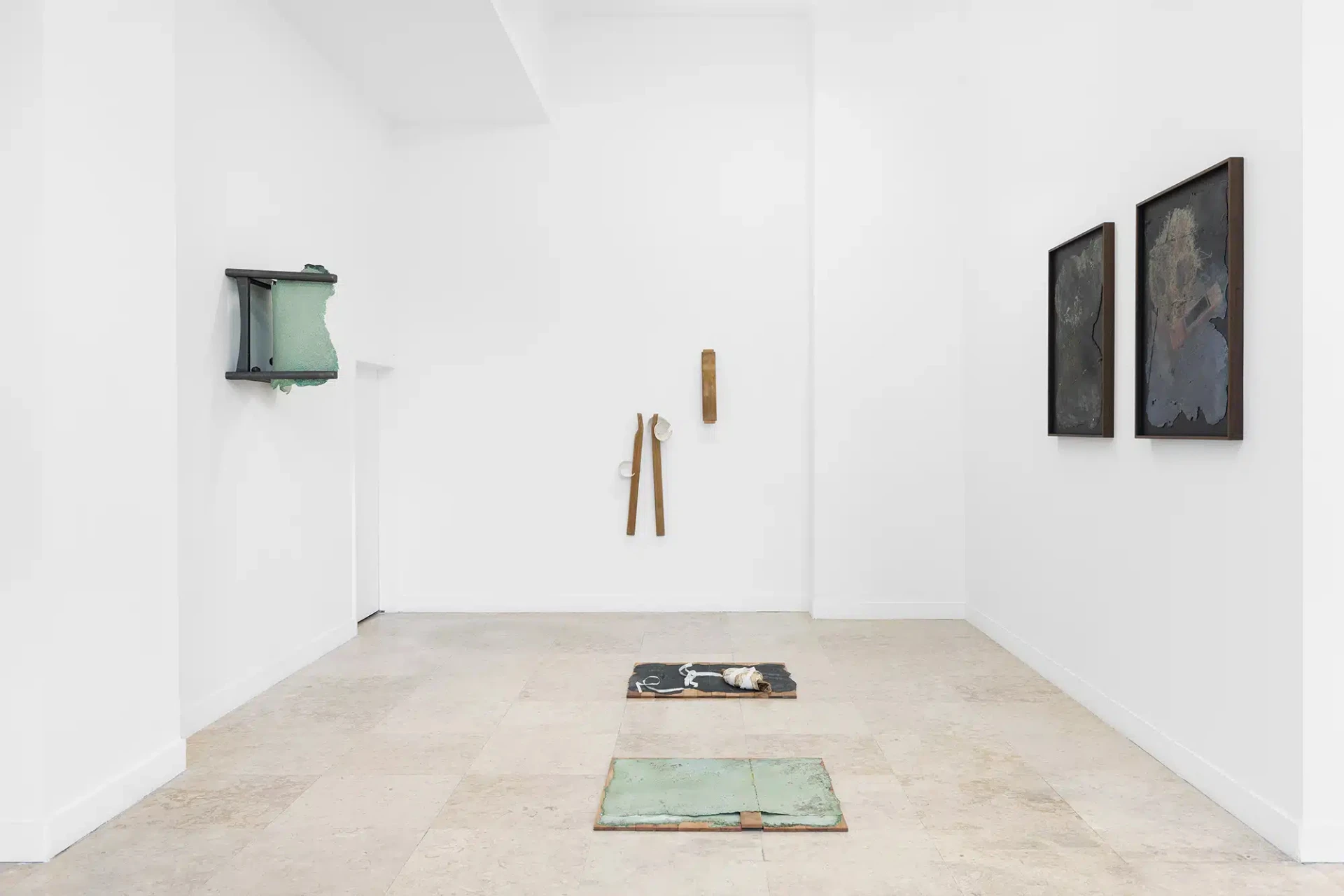
To me, Poems of Tomorrow is like a poetic archive of promises—João Motta Guedes' promises, maybe even all of our promises. It's a place where sculpture and installation unfold time into a continuum of expectations, frustrations, and possibilities, exposing the future as an open space for projection and risk. A labyrinth that announces the possibility of multiple paths, of possible choices (The only way out is through, 2026); an impossible staircase (A measure of salvation, 2026); a door that leads nowhere (Edge of infinity, 2026); clothing that promises protection—I like to think bulletproof—made of shattered glass (Promise you will protect me I, II, and III, 2026); care (Bringing the flowers to you, (sunflower), 2025); the pause (Taking a break from all your worries, 2025)... each work evokes movement and, simultaneously, a suspension of it. The device promises ascension but does not lead there; the structure that suggests an exit returns us to the starting point; the staircase, tensioned by barbed wire, transforms the idea of progress into an interrupted gesture. There is no arrival. Only becoming, an incessant process of subjectivation and questioning. A promise of the possibility of transition seems to insinuate itself precisely in the works, the suggestion that there is a possible passage, displacement, transformation. However, the gesture that announces this crossing does not guarantee it. The works become, rather, points of friction between the desire to go beyond and the inevitability of remaining here. Between being-beyond and being-in-the-present. They propose that what could be an opening becomes an interval. There is a refusal of assured destiny.
Even the chosen materials contribute to this tension. Their very materiality carries an active contradiction. Transparency, refraction, fragility... qualities that suggest lightness and protection, prove ambiguous. What appears to shield exposes; what seems to protect threatens to shatter. This semblance of defense becomes a metaphor for what we invent in order to survive in the world: beliefs, systems, narratives, promises of support. It is resistance threatening to become fragmentation; security revealing cracks. As a promise, in the Derridian sense, the exhibition opens up to a future that it does not control, radically uncertain, yet to be fulfilled.[1] There is, in these works—for example, Somewhere we may meet again (2026)—a co-implication between those who promise and those who believe. These require a kind of ethics of reception: a willingness to accept that the promise does not guarantee fulfillment and recognition that poetry, here, launches us into one of many possible futures. An open, poetic, dreamlike, free future. A future made, perhaps, of love.
The research conducted by the artist, which becomes quite clear here, embodies a lucid hope. There is an awareness that the letter may not arrive, that the climb may end at an impossible summit, that the door may open onto the same place. Even so, the promise persists as an invitation: to imagine other ways of being and doing, other ways of inhabiting the fractures, other ways of recognizing the other. On display is a set of works that compels us to think, feel, and experience vulnerability as a constitutive condition of being human. To accept sensitivity as relational power, as a possibility for encounter. And, in this recognition, perhaps the idea of a more just society, of a shared consciousness of care, will insinuate itself. João Motta Guedes reminds us how important it is to keep failing... so that tomorrow we can fail better.
In Pedro Barateiro's exhibition, the past is summoned as an active construction. Folklore (Part 2), also on display at the Francisco Fino Gallery, goes beyond a nostalgic evocation of tradition to offer a critical investigation of the mechanisms that produce it. The works on display are part of an artistic practice that has long questioned the symbolic, political, and cultural systems that shape contemporary experience.
Over the last few decades, the artist has developed a cross-disciplinary body of work that spans drawing, painting, sculpture, installation, performance, video, and writing. His work is organized as a device for thought, exploring the tensions between language, power, and imagination, constructing environments that operate as spaces for collective questioning. Here, this investigation starts from the very etymology of the term: folk — people; lore — knowledge. Folklore thus designates both the knowledge of the people and the set of narratives that structure collective identities. Barateiro is particularly interested in the dynamic dimension of this field, a territory in constant dispute, where memories, symbols, and discourses are reorganized, reinterpreted, and transformed, revealing that tradition is not fixed but always renegotiated. Here, the conceptual starting point is based on the representation of D. Estefânia's tiara (Folklore, 2026). This historical and symbolic object functions as a question mark, as a catalyst for questions about legitimacy, power, and representation. In representing it in the space of contemporary art, the artist investigates the political and emotional imaginaries that the jewel sustains. The tiara's depiction, also used as the cover of a Duvida Press publication, establishes a reading axis that articulates the various elements of the exhibition space. Among them is the BNU table, designed by Daciano da Costa for the Banco Nacional Ultramarino, which introduces an additional layer of interpretation. This design object, created for colonial administrative contexts, becomes here a silent document of specific economic and geopolitical structures.
The presentation of 39 book covers from Duvida Press, arranged in poster format, adds another critical dimension. Acting as an imaginary library, these covers—which cover fiction, theory, and essays—question authorship, legitimacy, and the circulation of knowledge. By integrating them into the exhibition space, the artist transforms each publication into an active device for reflection, making the act of exhibiting a sensitive experience of contact with the past and reconfiguration of the present. Here, memory and narrative are inscribed in a material and conceptual way, demonstrating that what we inherit is not fixed, but constantly rearticulated.
This juxtaposition of elements—royal jewelry, modernist design, and editorial materials—creates a field of tension between power, aesthetics, and memory, challenging the perception of each object as isolated or even neutral. Barateiro explores these elements' temporal and symbolic layers, establishing relationships between objects created in different periods in an attempt to blur the traditional hierarchy of value and, perhaps, the authority that each piece embodies. In his search for means that reveal historical aspects, narratives, testimonies, in short, he aims to bring another time that still informs ours, through its presence and fetishization.[2]It builds an intersection between ideas and temporalities, bringing forth meaningful relationships (or exposing where that meaning breaks down).
In Folklore (Part 2), Barateiro seems to want us to remember that tradition is always an act of construction and that what we call identity is, in fact, the result of choices, forgetfulness, and displacement. What future is possible when we fail to see that the past is an active agent in producing meaning and in constructing the narratives that define us?
[1] I am referring to Jacques Derrida's way of thinking about promises. Not as a commitment that may or may not be fulfilled, but as a structure open to the future. For Derrida, a promise is an act that creates a relationship with something that does not yet exist.
[2] In the exhibition room sheet.
BIOGRAPHY
Maria Inês Augusto, 34, has a degree in Art History. She worked at the Museum of Contemporary Art (MNAC) in the Educational Services department as a trainee and for 9 years at the Palácio do Correio Velho as an appraiser and cataloguer of works of art and collecting. She took part in the Postgraduate Programme in Art Markets at the Faculty of Social Sciences and Humanities of Universidade Nova de Lisboa as a guest lecturer for several editions and collaborated with BoCA - Bienal de Artes Contemporâneas in 2023. She is currently working on an Art Advisory and curatorial project, collaborating with Teatro do Vestido in production assistance and has been producing different types of text.
ADVERTISING
Previous
article
18 Feb 2026
Anne Imhof: Fun ist ein Stahlbad, at Serralves
By Katya Savchenko
Next
article
20 Feb 2026
João Paulo Feliciano, at Cristina Guerra Gallery: The Autonomy of Objects
By Ayşenur Tanrıverdi
Related Posts
article
29 SEP 2026
Multiple Eyes, to unlearn how to see
By Maria Inês Augusto
article
25 JUN 2026
Scrolls, at Buraco: The Two Sides of the Same Coin
By Maria Inês Augusto
article
12 JUN 2026
Tabique, by Rita Gaspar Vieira
By Maria Inês Augusto
article
12 MAY 2026
Phantom Tales, by Pedro Zhang
By Maria Inês Augusto