article
João Paulo Feliciano, at Cristina Guerra Gallery: The Autonomy of Objects
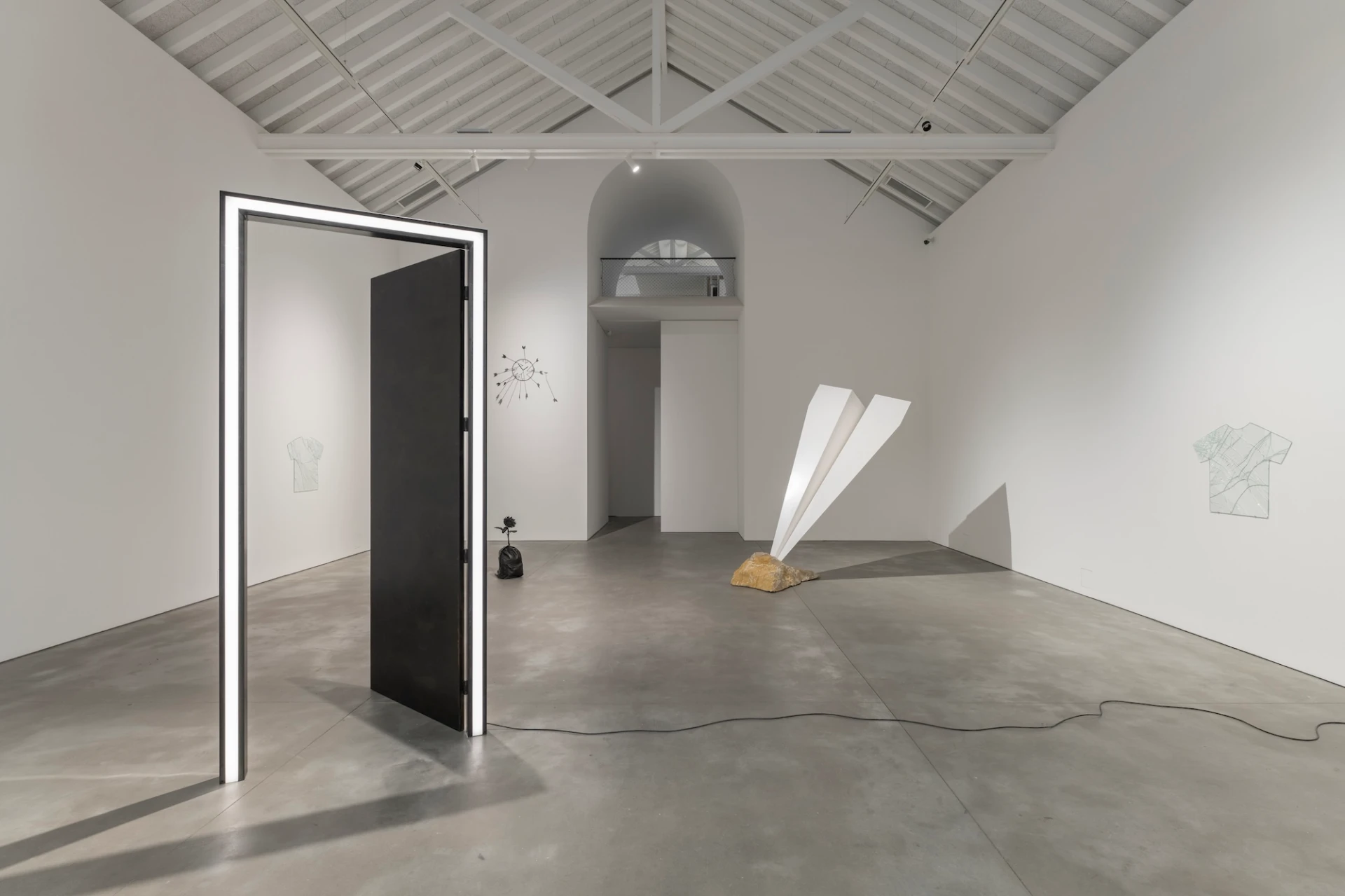
In a world where things are yet unnamed, I sense a sublime freedom. We fall in love before we know the word love; we encounter pleasure in childhood, before society labels it. João Paulo Feliciano’s exhibition exists in this world: it has no title, and the works are untitled (with a single exception). A pureness where meaning does not disrupt the intuition of creativity. Jacques Rancière argues that “this little word ‘understand’ halts the movement of reason and destroys its confidence.” In an undefined world, the mind is ever more open to learning and fearless when it comes to thinking.
When thought is liberated, objects begin to assert their own autonomy. Feliciano’s creative process does not move toward a sense of completion or decay, but rather invites an open-ended incompleteness. The works come together like short stories with no fixed center, open to new associations with every glance, preventing the viewer’s gaze from settling and remaining perpetually unpredictable.
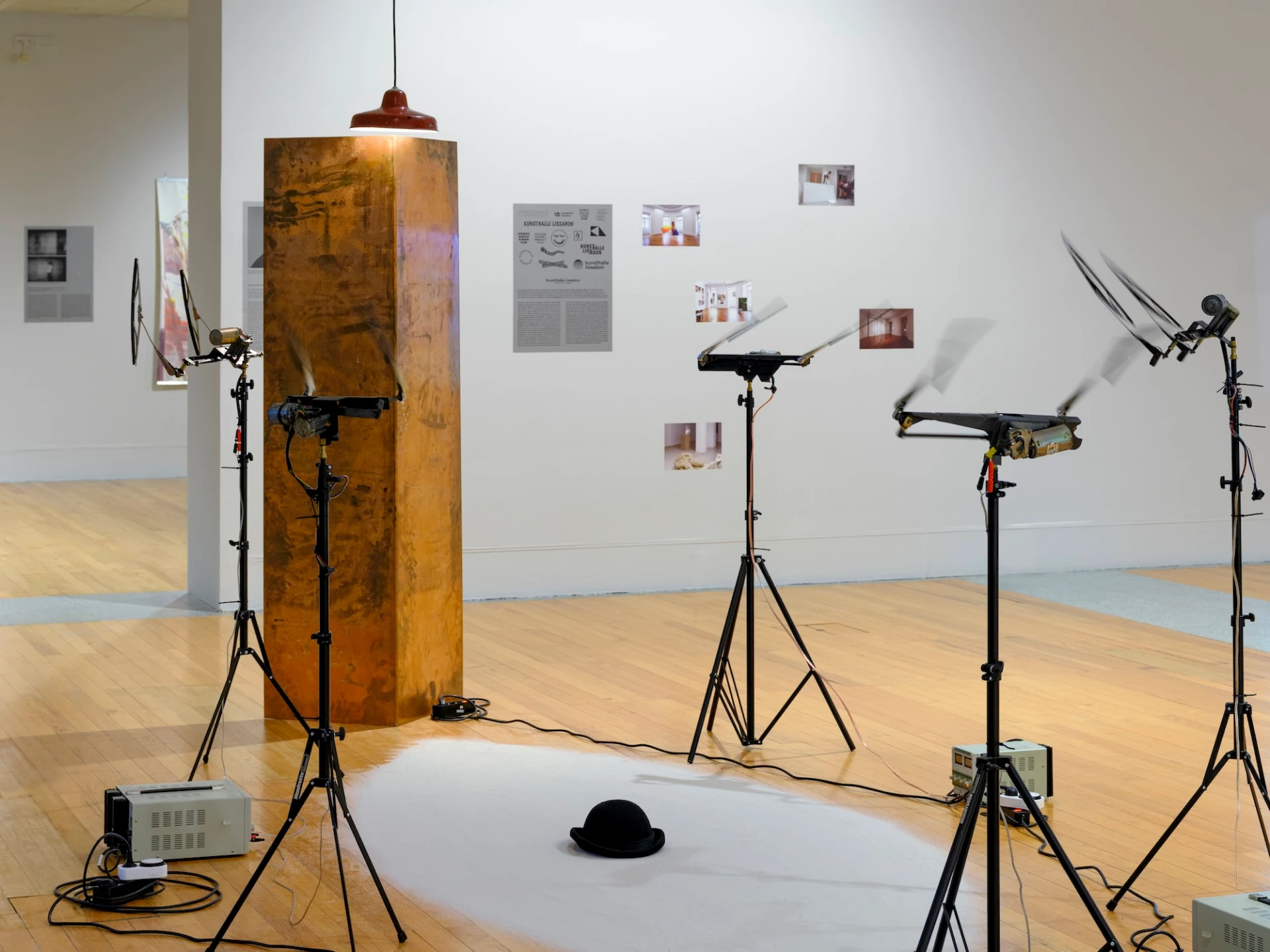
The “functional-malfunctions” of found materials -whose operations are now limited or obsolete- become integral to Feliciano’s artistic process. It is hard not to agree with art critic Arthur Danto, who described aging as the well-intentioned collaboration of time and grime. Feliciano reveals to the viewer the wear, jams, creaks, and breakdowns that emerge between social systems and object-machines. Up close, the mechanical components lose their function; from a distance, the gears and motors resume operation, revealing their distinctive qualities.
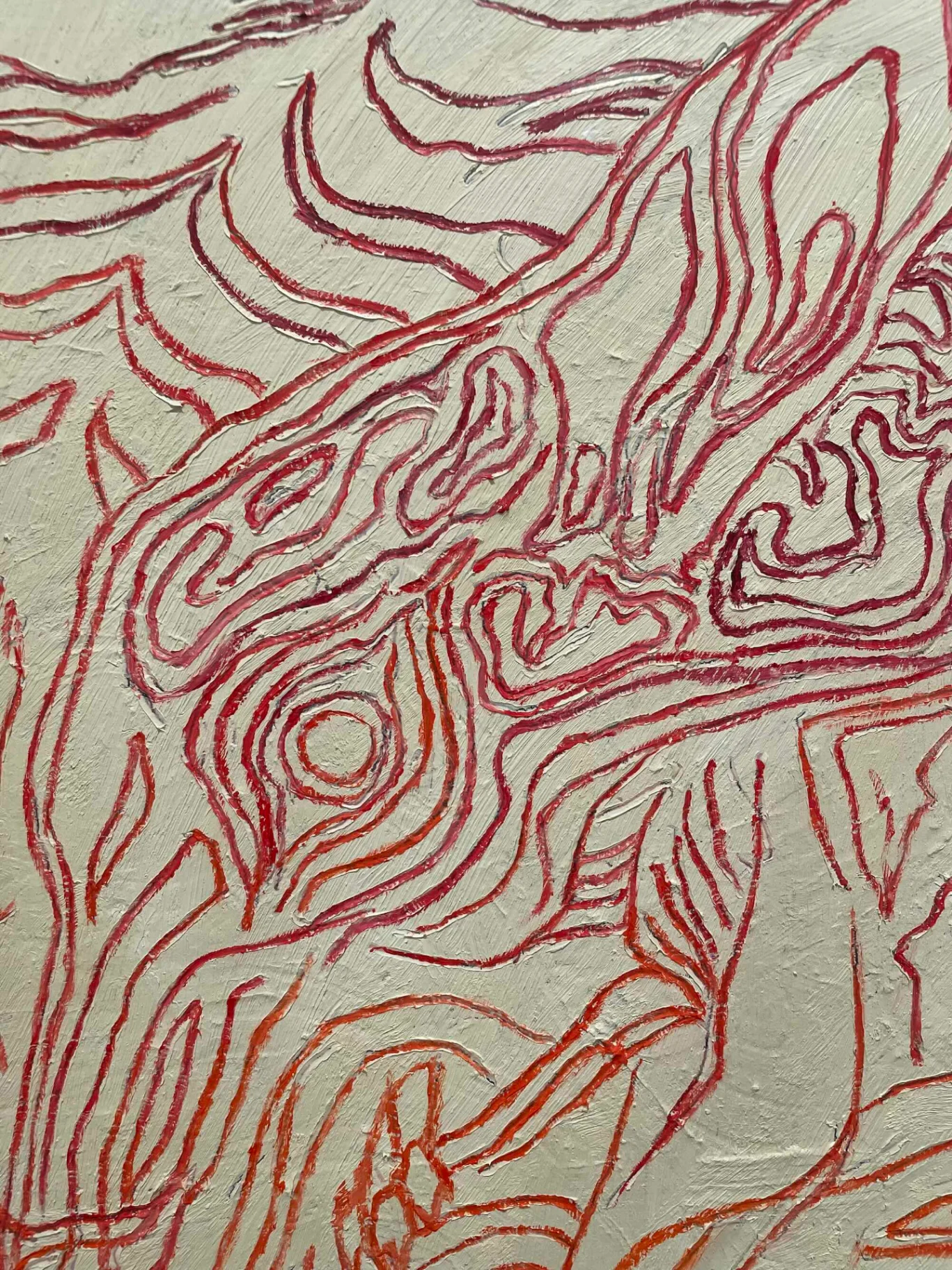
In the works of certain writers - Sebald, Mario Vargas Llosa, or Lawrence, for example- one can hear a distinctive voice. In João Paulo Feliciano’s exhibition, a linguistic voice can be perceived even without encountering words, creating a melodic atmosphere on a verbal level. The theoretical connection Feliciano establishes with music, stemming from his education, emerges almost like an electric current. The “seepage” of this melodic image through the cracks in his works signals something quietly brewing within, especially emphasized in red tones, yet subtly, never overtly.
“Under the skin, the body is an over-heated factory, and outside, the invalid shines, glows, from every burst pore.” - Antonin Artaud
The day I visited the exhibition was one of those aimless wandering like a hobo through the city. I was in a second-hand bookstore selling old architectural engravings. I have always loved engravings: the way ink flows through grooves carved into plates with precise technique, revealing a singular aesthetic unity. As I absentmindedly scanned the papers for hours among the shelves, I realized that, until that moment, I had not truly been aware of what I was looking at. My body and mind seemed to be detached by mutual agreement. Leaving the bookstore and entering Cristina Guerra Gallery, I witnessed the technical coldness I had felt while observing the engravings merge into an aesthetic context. It was sudden, like being startled by a sound or a strike, or like waking from a dream.
The diversity of João Paulo Feliciano’s works from the past five years allows the viewer to adopt a gaze detached from time, much like the one I experienced in the bookstore. In truth, I no longer take as much pleasure in using the word “experience” since, in recent years, seeing everything in life as an “experience” has, in a sense, trivialized it. It may be more accurate to say “perceiving” or “attuning.”
The simplicity and naturalness of the materials in his works - charcoal, watercolor, stickers, glass, cardboard, plastic, metal pieces, and magnets - allow him to construct new meanings from everyday objects that could easily become experimental tools at home, seemingly harmless and quiet. This reflects a childlike courage that shapes the artist's protected creative world.
The exhibition invites numerous questions about the relationship between object and artwork. I am reminded of a brief dialogue from H.G. Wells’ 1895 science fiction novel The Time Machine:
“Can a cube that cannot sustain its existence truly exist?”
Filby fell into thought. “Clearly,” continued the Time Traveler, “a real object must extend in four directions: length, width, thickness, and — continuity.”
The works included in the exhibition, once desired but now rendered functionless in the modern world, such as video disks, found fans, calculators, the obsolete keyholes of old wooden boxes, and rusted gaps, do they still possess a form of continuity today, or are they now equivalent to the abstract existence of a line of zero thickness?
A world where mechanisms still breathe in short gasps, emit smoke, and creak with their springs, striving to keep pace with an orderly system… Yet following the objects is not the point; the aim is to witness the grandeur it once sustained. Here, wood, metal, paint, glass, and found objects remain alive, still breathing, carrying the quiet joy of possessing a spirit, and reaching the vastness of life through art.
The word that comes to mind for João Paulo Feliciano is “bricoleur”: someone who works with their hands, creating with the materials at hand. Lévi-Strauss emphasized that scientific thinking often involves bricolage, creating a work from available materials or using mixed media. Nobel laureate biologist François Jacob took this idea further with the concept of “evolutionary tinkering” explaining that evolution operates like a repairman experimenting with various uncertain materials to produce functional objects. According to the philosophy of evolutionary tinkering, none of the materials initially serve a defined purpose, and each can be used in multiple ways. Following the trial-and-error logic, “evolution does not produce novelty from scratch.”
Just as shoots sprout from the earth, a receiving antenna can emerge within a painting. The object becomes a thing, and the thing becomes an object. The self and the non-self (moi et non-moi), the outside and the inside, merge into one. Nature or city, a green garden or an old garage, they exist as a production process where elements interconnect.
The only work in the exhibition that has a title is Jumbo – Jumbo.
The Sony Jumbotron is a video screen that uses large-screen television technology. Essentially a display device, hundreds of tubes like this are required to form a complete Jumbotron screen. Each module contains eight small squares made up of red, green, and blue sections, with edges that block unwanted light. The work faces an empty swimming pool, which is uncannily illuminated in the darkness of night. The projection seems less concerned with showing anything than with hiding, filling the space with an unsettling presence.
I like the untamed, wild nature of contemporary art and its possibilities that even technology cannot compete with. René Magritte’s words about painting always make me happy: “there is little relation between an object and what represents it.” In fact, it is precisely this distance that preserves the true creative impulse.
The language Feliciano establishes through his practice arises more from passion than from necessity. Within the artistic system he constructs, no definitive judgments are made regarding temporality or permanence. The works are free within their own image and can embody a different quality for each visitor, each day.
João Paulo Feliciano demonstrates that beauty is not confined to proportion, brilliance, or clarity; it may reside in wholeness and even contain the possibility of its own contradiction.
BIOGRAPHY
Ayşenur Tanrıverdi is an Istanbul-based writer, living in Lisbon since September 2022. She studied at Istanbul University and is the author of two published works of literary fiction. A regular contributor to Cumhuriyet, a major Turkish newspaper, where she focuses on Portuguese culture. Her essays and critical texts on theatre, literature, and contemporary art have also been featured in various art magazines.
ADVERTISING
Previous
article
19 Feb 2026
Poems of Tomorrow and Folklore (Part 2) at Francisco Fino Gallery
By Maria Inês Augusto
Next
article
20 Feb 2026
Avenida 211 at MAC/CCB – When will there be another 'occupation' action?
By Benedita Salema Roby
Related Posts
article
18 JUN 2026
Olho de Vidro, by Pedro Barassi: The Gravity of the Gaze
By Ayşenur Tanrıverdi
article
15 JUN 2026
Notes on ARCO Lisboa 2026
By Ayşenur Tanrıverdi
article

08 JUN 2026
Língua Turva: The Aesthetic Unconscious
By Ayşenur Tanrıverdi
article
02 JUN 2026
On Wandering Among Beings: "Entre Seres" by Susanne Themlitz
By Ayşenur Tanrıverdi