article
itede, itepe, by Dorota Jurczak, at Rialto6
It is against a backdrop of pastel pink that envelops the entire exhibition space at Rialto6 that the Polish artist Dorota Jurczak presents her third solo exhibition in Portugal, itede, itepe, once again curated by Miguel Wandschneider.
I confess, I didn't know the artist and had never visited Rialto6. A beginner's mistake, perhaps. However, I believe that, often, the absence of expectations is an advantage in this kind of thing. Expectations that were, from the very first moment, surpassed by the warm welcome I received when I arrived at Maria and Armando Cabral's space. It seems to me that the way they welcome us is the subject of an increasingly relevant discussion, especially in gallery spaces – although Rialto6 doesn't consider itself a gallery per se – which are anchored in an intimacy between the representatives of the space and the visitors, unlike larger institutions. This last point should also be, or ought to be, the subject of a huge debate.
But moving on. After climbing the stairs that lead to the exhibition, I came across three slender silhouettes in a bluish-patina bronze, Balasina, Gieniek, and Tadeusz (all from 2020), who introduced me to the world of Dorota Jurczak. With confidence, I approached them, gazing at them attentively, as they surely gazed at me. They were all very well-dressed, from their high collars matching the patterns of their sweaters, floral or polka-dotted, to their straight, styled hair that enhanced the enigmatic nature of their expressions, as well as a friendliness that, despite everything, didn't seem strange to me. It wasn't a serious game, quite the opposite. They are figures that raise an eyebrow. Still, a certain kind of affection arose there.
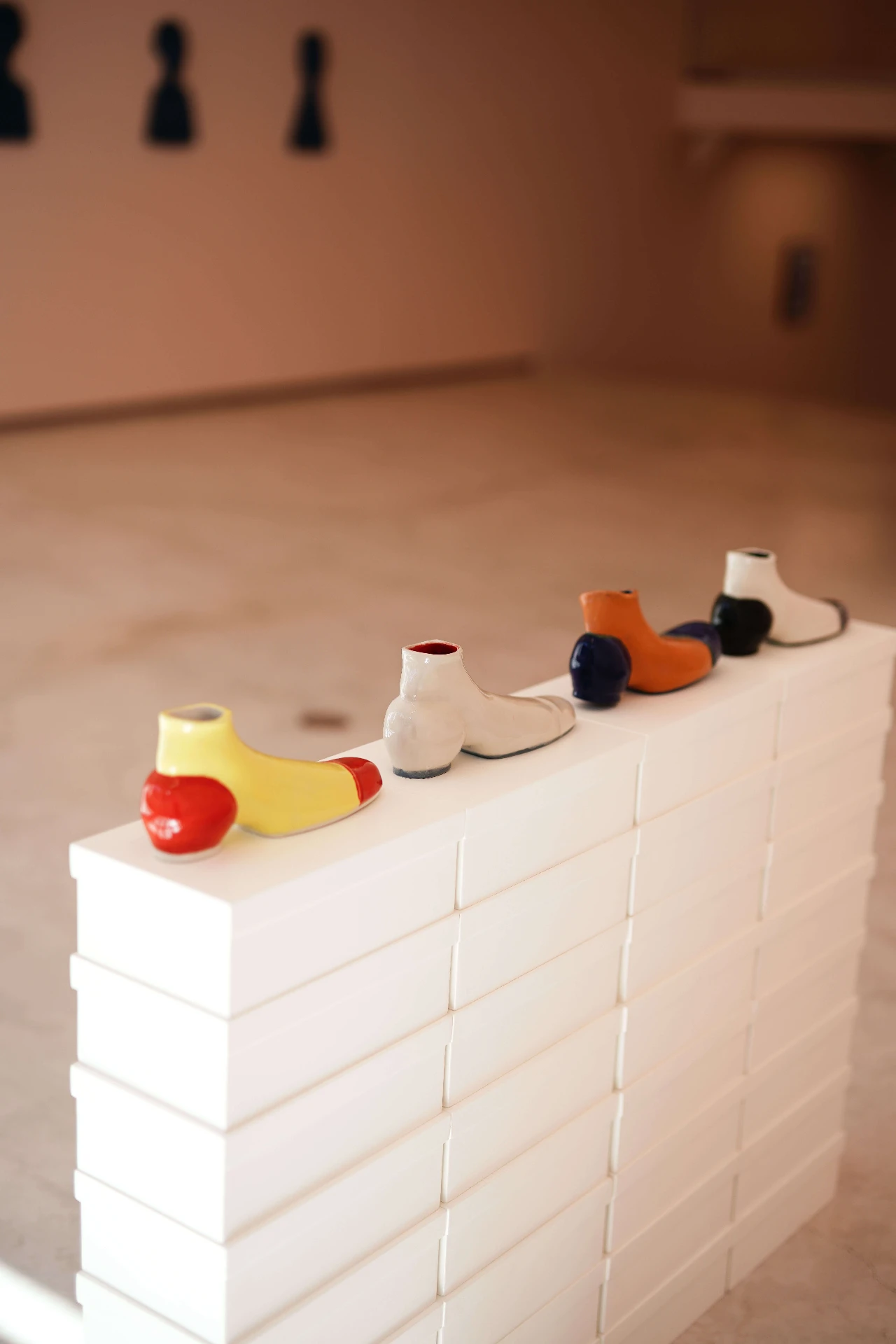
To the left of this group, under the light streaming through the magnificent window, is a set of painted MDF shoeboxes, with their respective glazed ceramic examples on top (shoewall, 2020), each with its own color scheme and elongated elegance, similar to those depicted in the prints—a charm that could neutralize a cockroach in the corner of the room. Next to them are two prints, Nuna, Nusia i Blumka (2023) and Dakota (2025), the first in five colors, the second in chine-collé, a printmaking technique in which a thinner paper—usually of Asian origin—is glued onto a stronger support using a press. This allows for the minute details that make Dorota's prints stand out. Most notably in her printmaking work presented here, across the various technical aspects in which the artist specializes, the scenarios she creates—starting from domestic scenes or moments of a funky, pajama-clad daily life in the company of seemingly somewhat wacky four-legged friends—bear strong alignments with the practice of illustration, satisfactorily challenging the core of so-called contemporary art.
Turning to the opposite side, the bifurcation of the space can lead us either upwards or downwards. Upwards, a rod. Or, in other words, a group of three small towers with pig heads, which comically remind us of the seriousness and imposing nature of Egyptian statuary, facing another engraving. In stoneware, Meander, Żonkil, and Landryna (all from 2026) slightly broke the lightness I was feeling, yet without clashing with the world I was perceiving there. Everything remains calm and tranquil. Downstairs, again an engraving (Dakota, 2025) and two other figures, Szumka and Kropka (both from 2024), in a more androgynous aspect than the other group of figures, but perhaps a little more at ease given the bare torso of one of them… I felt that this was the home of all these beings who, at the same time, were telling me that this was also mine…
The world that Dorota Jurczak has created is, in fact, distinct. It is, above all, a concise and effective reality in its entirety, without needing to anchor itself to any narrative line to cement itself. According to the very few online texts about Dorota Jurczak, the artist's work incorporates notions of Polish folklore, bordering on the macabre and somber, relying on a terrifying figuration. However, I don't feel completely in agreement with these lines. In itede, itepe, etc., etc., in Polish, I felt, above all, a familiar, domestic well-being – I dare say. The characters that Dorota has brought here, over the last 5 years of production, seemed to have recognized me there, showed me their presence, and respected my peace. Perhaps the advantage of only now looking at Dorota's work lies here. I felt carefree enough to sit on the stairs of the exhibition space writing these words. I don't know if the comfort will come from the pastel pink that covers the entire exhibition or from the play of color that endows it with a certain strength. In fact, after having sought out the artist's work, this exhibition is probably the one that least evokes those somewhat somber feelings. From the prints to the sculptural work in this exhibition, the bizarre, which is also one of the driving forces of Dorota's work, wasn't as strongly felt here. Still, perhaps I discovered a little bit of my own world here. In that sense, it's an exhibition that deserves attention, of importance in the contemporary artistic context, especially in the Portuguese scene. The fact that Dorota's visual production doesn't fit into these contexts is a matter of great interest. I conclude, therefore, that it's a curatorially insightful note on the part of Miguel Wandschneider, which, it's worth pointing out, also aligns with his beautiful selection of books for the Livraria da Rialto6, which opened at the same time as this exhibition. Certainly, something we are invited to do, when faced with Dorota Jurczak's work, is to discover our world, or our reality, through the openness of her artistic work.
The exhibition is on view at Rialto6 until May 30.
1 Miguel Wandschneider, when he was in charge of programming at Culturgest, had already curated two exhibitions of Dorota Jurczak in 2016, in Lisbon and Porto.
BIOGRAPHY
Tomás Saraiva (b. 2002) has a degree in Art and Heritage Sciences from the Faculty of Fine Arts in Lisbon and is studying for a master's degree in Curatorial Studies at the College of Arts of the University of Coimbra. Between painting and curating, he combines the artistic thinking he has been developing with his curatorial values, either solo or as a group. She has held and participated in several exhibitions at national and international level.
ADVERTISING
Previous
article
12 May 2026
Phantom Tales, by Pedro Zhang
By Maria Inês Augusto
Next
agenda
14 May 2026
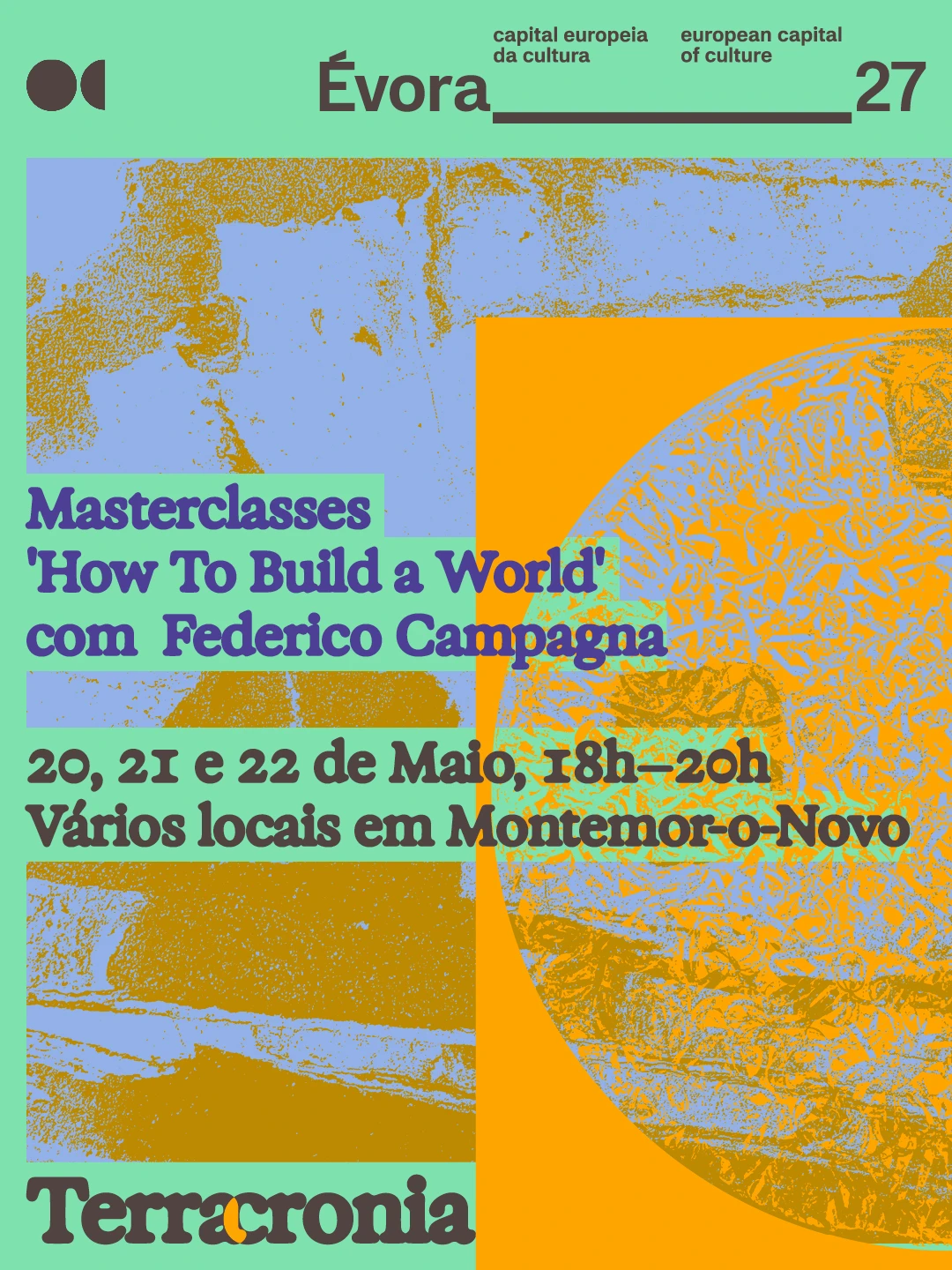
TERRACRONIA - How To Build a World: Masterclass with Federico Campagna in Montemor-o-Novo
By Umbigo
Related Posts
article
03 SEP 2026
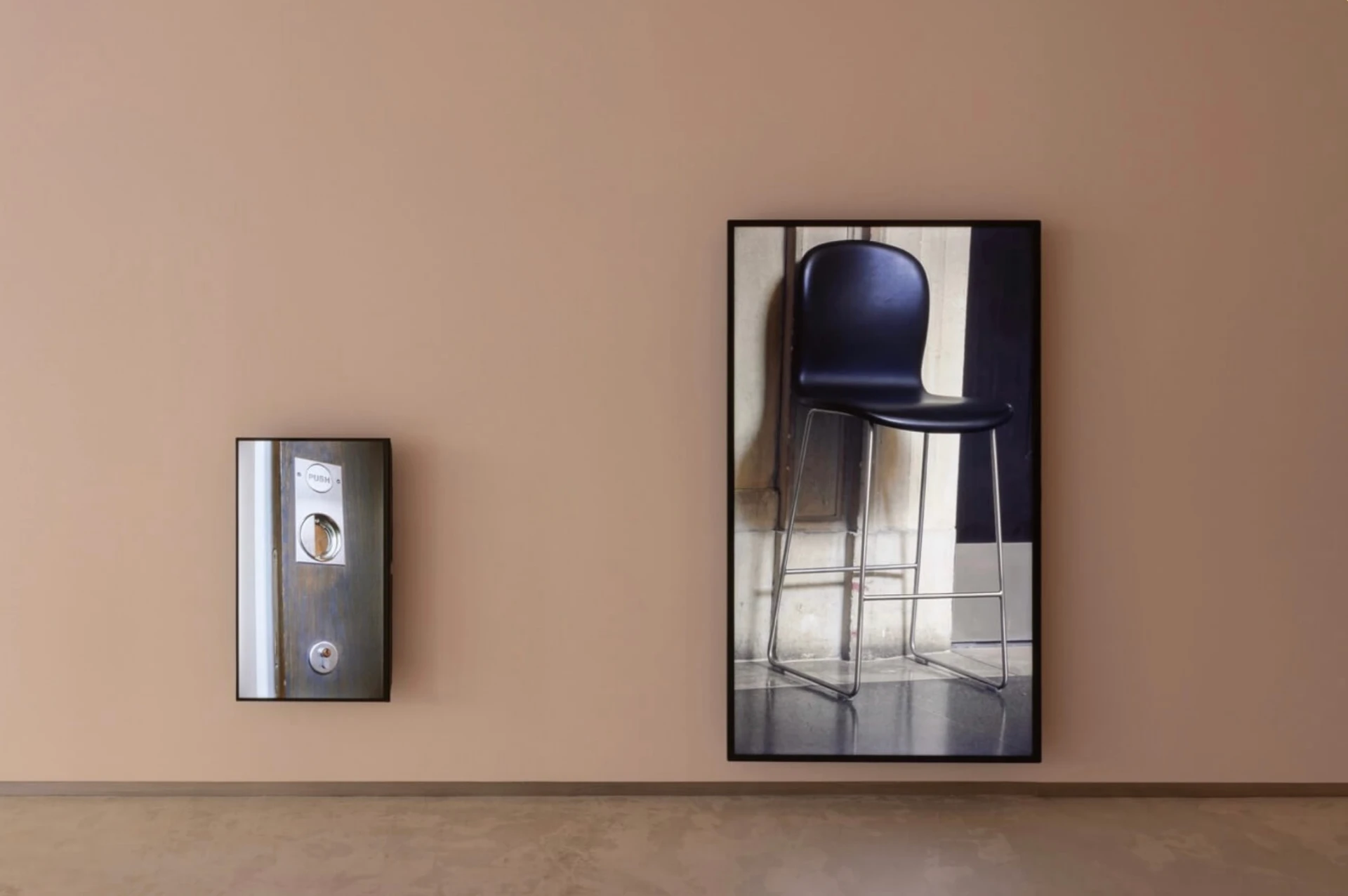
Radical Gestures, by Tatiana Macedo, at Rialto6
By Tomás Saraiva
article
13 AUG 2026
Reaching the fata morgana, by Inês Mendes Leal, at the Boavista Gallery
By Tomás Saraiva
article
13 MAY 2026
itede, itepe, by Dorota Jurczak, at Rialto6
By Tomás Saraiva
article

16 MAR 2026
Espaço Intermédio, by Cristina Ataíde
By Tomás Saraiva