article
After Hours, by Monica Coelho, at Fundação Carmona e Costa
In an inconspicuous building behind Avenida das Forças Armadas, the Fundação Carmona e Costa occupies two rooms on the same 6th floor. To the left, a door opens onto the small collection of Chinese porcelain assembled by its founder; to the right, from September 12 through November 14, visitors can discover Fora de Horas (After Hours), an exhibition by Portuguese artist Monica Coelho, curated by Manuel Costa Cabral. The young artist has created an exhibition built around time, waiting, and that which seems to exist after hours.
"And that one, in a shade of blue that barely exists, a blue that isn’t real. A blue that is pure memory of somewhere."
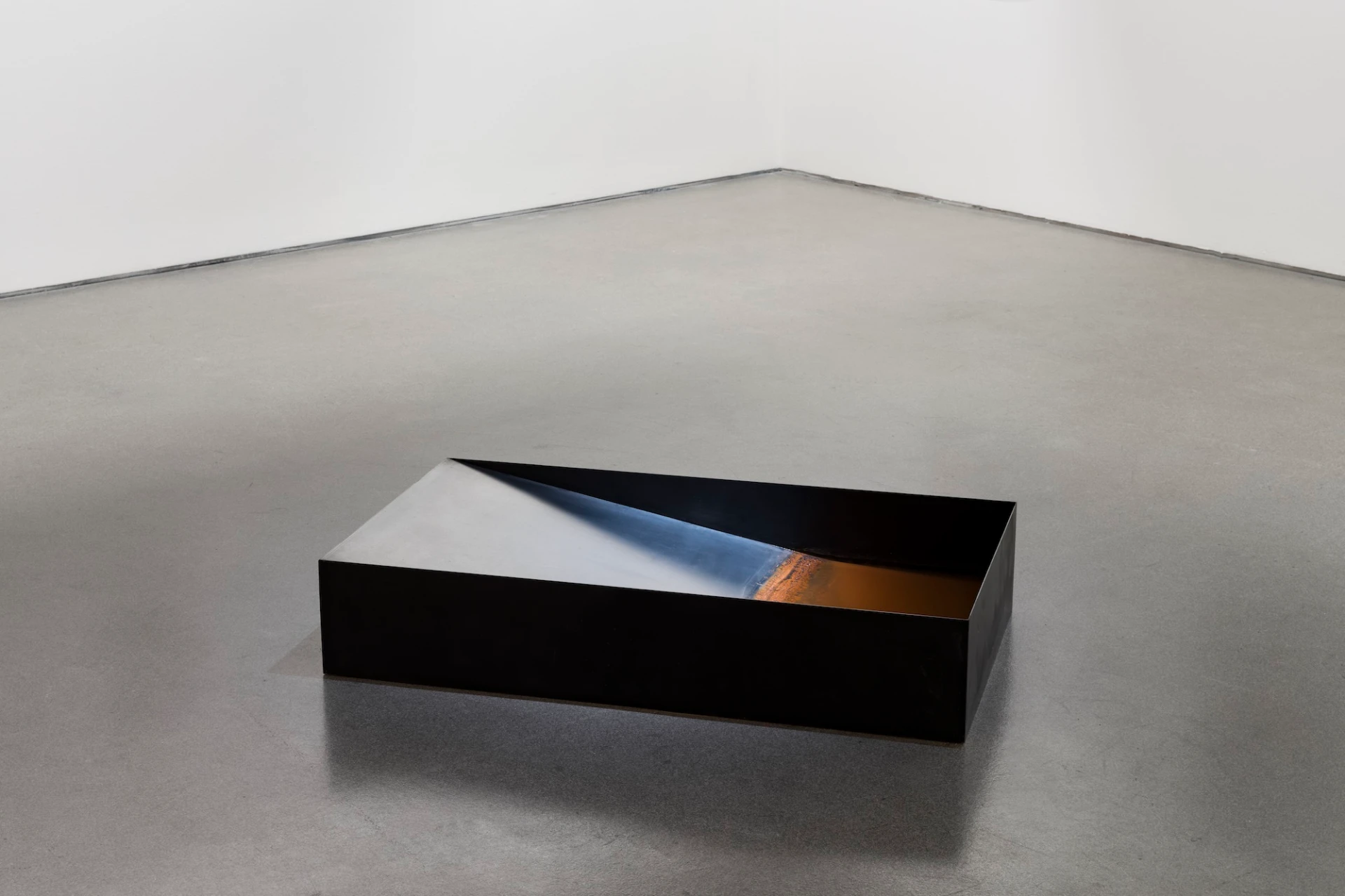
The exhibition balances figuration and abstraction: steel caught between blue and rust. Although red occasionally finds its way in—a color rarely seen in nature—the melancholic, elusive quality of time and the rust that settles on the hulls of boats define the exhibition’s atmosphere. Looking more closely at the works, we encounter a practice spanning sculpture and drawing, with time running through both as subject and raw material.
Conveying atmosphere is no easy feat, to say the least. While the works contain meanings of their own, it is worth noting the creation of a poetic environment permeated by emptiness and the passage of time, both as material and as subject. The exhibition handout contributes to this effect: rather than explaining the exhibition, Monica Coelho poetically introduces each room, as though it were a play. Each space weaves together and reveals a momentum that informs and foreshadows what comes next.
Just inside the entrance, we are greeted by a group of chairs, fiercely yet delicately forged in steel. They stand motionless against a blue backdrop, waiting for no one. They serve no purpose as seats; their function has been emptied out. Only the outlines of the chairs remain, forged in steel, imposing a strange, unsettling condition upon both them and us. Through the deliberate removal of the chair’s essential parts, a sense of emptiness takes hold almost instinctively. The scene could belong to a play by Samuel Beckett, even as a certain melancholy permeates the exhibition.
A long strip of paper runs alongside the chairs, bearing the minutes Monica spent waiting in 2024—in waiting rooms, hospitals, government offices, and agencies. The times, carefully gathered and handwritten, lay bare the passage of time, like the familiar ticking of a clock marking what is yet to come and what has already passed, as the hours trickle away like water. In this first room of the exhibition, waiting emerges not merely as an aesthetic device, but as a practice and an experience of attention: to wait, to collect the experience of waiting, and to transform it into an inventory of hours spent in vain.
Barthes wrote that waiting is the condition of the lover. The lover’s anguish lies in having their sense of time captured by the comings and goings of the beloved. Their defining identity becomes that of one who waits. To see them or not to see them becomes the new way of measuring time. We perceive time as we perceive the movement of boats, both within and beyond ourselves.
For time makes itself most visible through the movement of things: we see it in the ageing face, in the growth of children. We feel it in rust and ruins, in the slow passage of things, in the growth of plants. Immersed as we are in time, time and loss draw close as ideas, should we allow them to. And while we may gather time, gather the day, and expand our experience of being alive, it is equally clear that time, like a river, flows on, always carrying something away with it.
What remains is the subject of the second room, which connects to the third in an opposing gesture. The room of shadows presents drawings of the empty chairs in a process-oriented approach, revealing the process, the idea, and the gradual making of what we encountered earlier. Guide-line Series, a 2019 work, sees Monica play with the notions of blueprint and making through cyanotype drawings. This camera-less photographic printing technique, widely used in botany, also operates here as a concept: its distinctive blue result depends on sunlight and time.
It is a process that cannot be entirely controlled. In the exhibition, it appears as a record, a memory, and evidence of the process that took shape in the previous room. Yet it also reveals itself as a method: the blue that evokes a certain nostalgia is produced by leaving the drawings in the sun to develop over time. A doorway takes shape at the far end of the room; but, like the empty chairs, it too offers no passage.
The room of shadows prepares us for the next space, which offers the inverse movement: rather than revealing the process of the object’s delicate forging, it shows us what undoes it—time materialized as the memory of movement: rust. In this silent exhibition, there are no clattering gears, only rust as a pictorial medium. We see it paint and permeate almost every drawing in the room, seeping into and contaminating nearly everything. The drawings take on reddish and orange hues, while rust itself, as a material, asserts its presence at the center of the room: raw material, color, and atmosphere, reminding us that things, too, decay.
In an unapologetically poetic gesture, Monica introduces the final room, where glass jars are arranged on a blue table. Filled with a certain uselessness, they seem unable to fulfil their intended purpose: they are, unmistakably, objects of art. Stripped of any function, they revel in their own lack of utility. They present themselves as transparency and emptiness; as deviation; as form; as interiority made exterior.
When considering this notion of exteriorized interiority, it is worth examining the role played by emptiness, both in the artisanal molding of glass and in its very aesthetic. From a manufacturing perspective, the jars are made by glassblowing: their form is born of breath. Each jar preserves the trace of a breath, continually metabolized through its exchange with the air of the world. Unlike other artefacts, their shape has not been imposed from the outside, as with a carved stone, but pushed outward from within, by the air that compelled them to open.
Delicately yet fiercely forged with air, these objects continually externalize their interiority, a quality inherent to the very nature of glass. Divested of their function, they become strangely poetic, in a way that recalls a poem by Daniel Faria: "Men who are like places ill-situated/Men who are like ransacked houses/Like places absent from maps/Like stones removed from the ground/Men who are like/Irreparable damage/Men who are like living survivors/Men who are like displaced places/Out of place."
Air is often thought of as that which is absent, its invisibility intertwined with its omnipotence: we do not see it because we see through it. Time is made of a similar substance. Within this interval, shaped by breath and the rhythm of the world, Monica composes a poetic exhibition that not only brings together works spanning several years, but also takes shape as a narrative, a thematic thread, an artistic preoccupation. Waiting and time are put to work as artefact and method, raw material and experiential principle: ultimately, as a faint trace that allows movement, yet also as an emptiness permeating its rhythms.
The exhibition is open until November 14.
ADVERTISING
Previous
agenda
20 Oct 2026
The Folklore Project, 22 October at the PLMJ Foundation
By Umbigo