article
ARQUEOLOGIA REMIX: On Time and Its Uncertainty
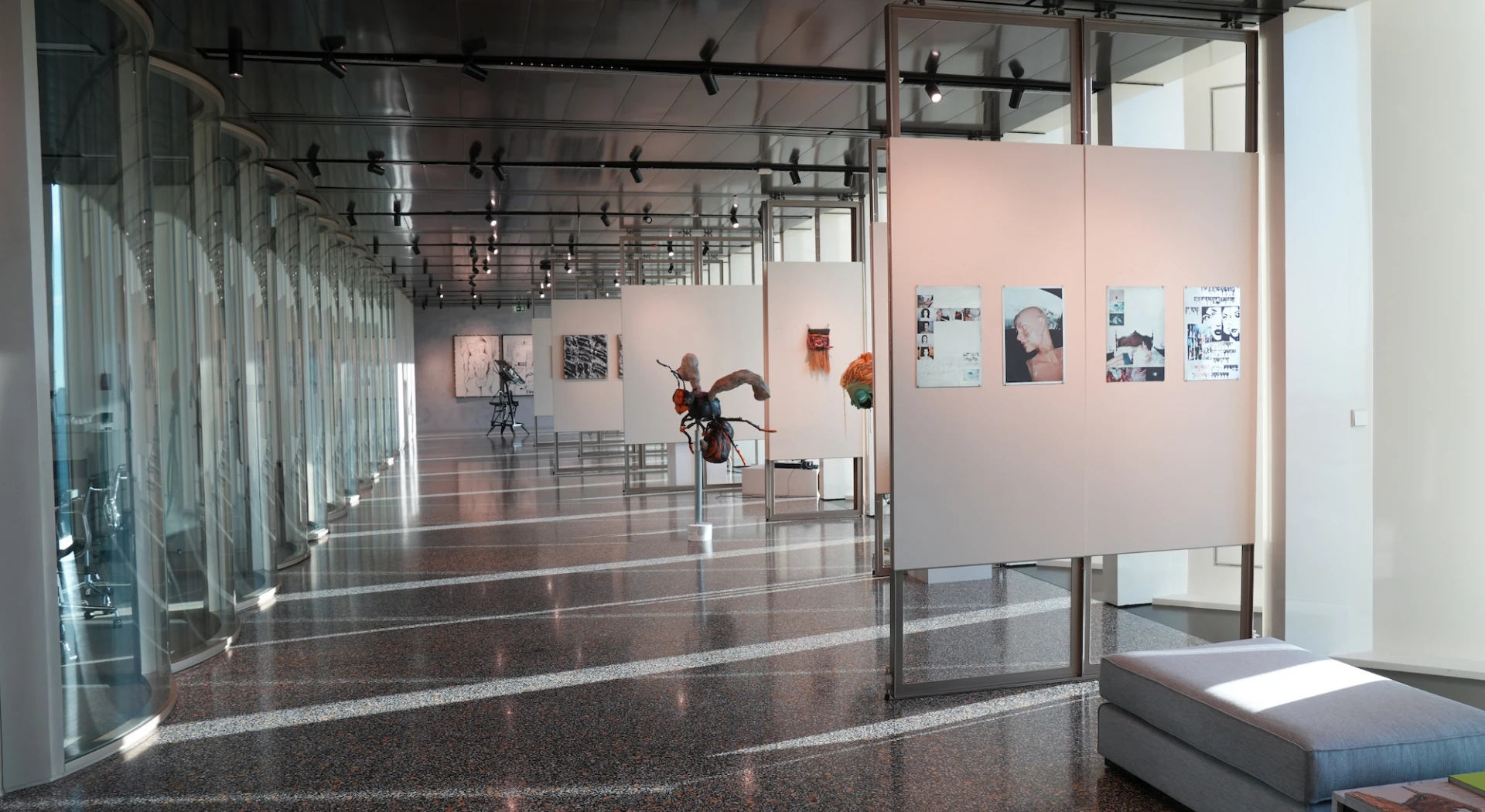
“Curated by Filipa da Rocha Nunes and featuring works by Xiao Zhiyu, Luís Rocha, Lyz Parayzo, and Joana Lourenço, Arqueologia Remix (Archeology Remix) goes far beyond a simple illustration of the two concepts as apparent opposites, rather encouraging an understanding of them as constructive proposals for the common challenge of inhabiting time. Among the collected works, it becomes clear that at no point are we dealing with an intact past or a singular present, for every attempt at preservation implies a reorganization, and every act of creation carries with it traces of other temporalities.”
It is an insurmountable impossibility to inhabit the present, as if its fundamental indefiniteness were punishing us with an eternal flight, a constant blurring that becomes clear only when it slips away from us and, ultimately, reshapes itself into history. We always fictionalize the present either too soon or too late; it never reveals itself in its own time. It is evident that this relationship of impossibility stems from our own temporal condition. The fiction of the present is nothing more than the anticipation and representation of a fabricated reflection—or, in other words, a chronic anxiety inherited at birth, a genetic self-preservation instinct. Perhaps it is precisely from this temporal condition that some of the most persistent gestures in our history arise—from excavating, archiving, copying, and transforming, to creating and destroying. These gestures are more than mere operations on objects or images; ultimately, they emerge as ways of navigating time and negotiating our relationship with what precedes us and what does not yet exist.
Although it is not immediately apparent, it is within this conceptual landscape that the exhibition Arqueologia Remix (Archeology Remix), on display at Galeria Cristina Guerra, is situated and acquires an almost ontological resonance. Curated by Filipa da Rocha Nunes and featuring works by Xiao Zhiyu, Luís Rocha, Lyz Parayzo, and Joana Lourenço, Arqueologia Remix (Archeology Remix) goes far beyond a simple illustration of the two concepts as apparent opposites, rather encouraging an understanding of them as constructive proposals for the common challenge of inhabiting time. Among the collected works, it becomes clear that at no point are we dealing with an intact past or a singular present, for every attempt at preservation implies a reorganization, and every act of creation carries with it traces of other temporalities.
What is raised here proves even more pertinent at a historical moment when the ceaseless proliferation of images and the continuous circulation of information seem to erode the stability of memory and experience. The very idea of archaeology becomes uncertain at a time when the past itself proves unstable. When it engulfs us, the meaning of “remix” becomes diluted. It is therefore futile to consider this issue solely within the confines of the exhibition space. Here, archaeology and the remix signify much more than artistic methodologies or thematic spheres represented in various forms across the defined territory of contemporary art; rather, they serve a purpose that predates that—they respond to our temporal condition (which Heidegger named with poignant fatalism) and reveal themselves as proposals for understanding and inhabiting time in a world where origin has long ceased to function as an absolute foundation.
To exist is to temporalize oneself. Or rather: it is existence itself that gives time its meaning. Temporalization thus manifests not as the insertion of Being into some arbitrary chronological line, but as the continuous unveiling of time as it flows through it. For no archaeological act restores an intact past—to excavate is to always interpret, reorganize, and re-inscribe traces into a new constellation of meaning—and because no remix starts from an absolute present—every recomposition works with forms, images, narratives, and memories that persist, albeit transformed, in the fabric of the present—it becomes evident that temporal experience is never organized as a linear succession of moments, but as an incessant interweaving of what we inherit and what we project.
Whether it is Joana Lourenço's Anthropological Bunker (2025), with its documentary feel, or Xiao Zhiyu's visual semi-fictions, the works brought together in Arqueologia Remix reveal how materials cease to function as testimonies to a lost time and instead present themselves as active fragments, capable of producing new relationships and new interpretations of time. The past does not stretch out as a stable and fixed primordial landscape, but as material available for countless reconfigurations of the sensible; the present, in turn, ceases to appear as an autonomous starting point: rather, it emerges as a place where different temporalities coexist in mutual interplay.
If, still following Heidegger, to exist means navigating an inherited historicity, then all culture must be understood as a practice of temporalization. Far more than mere operations performed on objects, archiving, preserving, restoring, and, ultimately, remixing reveal themselves as ways of understanding our presence in a world that we neither receive intact nor can we pass on in its entirety. Archaeology and remixing thus manifest themselves as two modalities of the same cultural survival gesture: the ceaseless effort to shape the temporal experience that constitutes us.
Looking back once more, if the past ceases to exist as a reality crystallized by some divine law and instead becomes a construct continually reconfigured by our own earthly actions, then archaeology no longer consists of recovering an origin, but of discovering the conditions that weave cultural discourses. (It seems inevitable—and almost ironically fitting—to return to Foucault when we speak of archaeology.) Archaeological remains do not preserve the past. They organize it, delimit it, and (re)produce how it can be recognized and, ultimately, understood. Archaeology reveals itself to be a gesture of montage—a remix before the remix—which, inebriated with love for the past, always stumbles in its reproduction.
The remix is always a product of archaeology, whether this is a distant archaeology or a close look at the immediate past. It is therefore not unreasonable to infer that we live surrounded by reconfigurations, reproductions, and repetitions of an ever-expanding archaeology. It is worth remembering that these movements are by no means mere replication, or that, at the very least, behind this apparent replication they instead make possible the emergence of a difference (Deleuze, 2000): each repetition displaces what is repeated, re-inscribing it into a new fabric of understanding. The remix has screwed up the original, but at no point has it replaced it; rather, it demonstrates that any original survives only through the successive transformations that bring it up to date. Archaeology, too—as the first remix—participates in this logic, for every new reading of the remains inevitably alters what we understand as the past.
Contemporaneity took this condition to its limit. In an era saturated with images, reproductions, and digital archives, the referent—in this case, the past (or its vestige)—gradually loses its foundational role, rendering preservation and reconfiguration indistinguishable. The landscape that once stretched beneath its cartographic representation is now lost to us (Borges, J. L., 2020). In turn, nostalgia—that formless sentiment that overwhelms us without asking permission as we traverse the labyrinth of hostile mobiles by Lyz Parayzo (2024) and the pre-objective reductions by Luís Rocha (2025–2026), until we descend the stairs toward the bunker from which the nostalgic cloud seems to emanate —no longer points to a distant origin or a lost landscape, but rather focuses on the very uncertainty of the landscape itself, transforming the past into an uncertain reality, one in a state of constant reconstruction. It is thus, immersed in such uncertainty, that Arqueologia Remix demonstrates to us that whatever gesture is employed, both constitute inseparable reactions to the same chronic anxiety—subtle yet insistent—in the face of our temporal condition.
Inhabiting time has never been a peaceful task. We are condemned to exist between that which dissolves and that which is still seeking form. The anxiety that characterizes the present may stem not only from the acceleration of the world, but from the growing impossibility of clearly distinguishing between memory and invention, origin and reconstruction, permanence and change. Even so, it is precisely in this uncertainty that creation finds its place. Never has creation meant starting from scratch, just as remembering has never meant merely returning to what once was. Each creative gesture extends other gestures; each image carries other images within it; each moment opens a window onto other moments. Creation does not interrupt continuity; on the contrary, it renders it visible, reaffirming that Being is constituted less by the stability of its forms than by the incessant need to reorganize them. Arqueologia Remix invites us to recognize the rhythm: not that of nostalgia for a lost origin, nor that of the promise of absolute novelty, but the continuous movement through which we become what we are, ceaselessly rediscovering the temporal matter that constitutes us.
Curated by Filipa da Rocha Nunes, Arqueologia Remix is on view at Galeria Cristina Guerra until September 26, 2026.
BIOGRAPHY
Guilherme Sota is a multidisciplinary artist, music producer and co-founder of the Vertigo collective. He holds a degree in Painting from the Faculty of Fine Arts at the University of Porto and is currently completing a Master’s degree in Art Criticism and Curatorship at the Faculty of Fine Arts in Lisbon. His artistic practice spans various fields, including painting, sound, installation and writing, through which he explores themes related to ontology, sexuality and iconography. Since 2020, his work has been shown in group and solo exhibitions, notably ‘Do Ser e do Seu Desvelar’ at ÁRVORE Cooperativa, Porto (2025), ‘Microcosmos’ (2026), at Espaço Cultural Mercês, Lisbon, “Na Fenda da Forma” at CC Penedo da Saudade, Coimbra (2025), as well as in various exhibitions organised by his collective. He received the “Jovens Criadores na Árvore” award (2025), amongst others, and was selected for the “CreArt 3.0 AiR” artist residency in Kaunas, Lithuania (2025), amongst others. Alongside his artistic practice, he writes for Umbigo magazine, is responsible for curating and producing the Vertigo events, hosts a monthly programme on the Brazilian radio station Function!, and regularly produces musical projects.
ADVERTISING
Previous
article
26 Aug 2026
Museu das Expectativas, by Pedro Gomes: What is a museum?
By Ana Isabel Soares
Next
article
01 Sep 2026
THIS IS (NOT) A CHURCH: Can a church be a place for encounter?
By Maria Inês Mendes