article
Museu das Expectativas, by Pedro Gomes: What is a museum?
Between October and December of last year, curated by Sérgio Fazenda Rodrigues, the Kindred Spirit gallery in Lisbon presented the exhibition Museu das Microagressões (Museum of Microaggressions), the first of three phases in which the presentations of this work by Pedro Gomes are structured. The third, which will conclude the trilogy, is presented under the title Museu Pessoal (Personal Museum); the second is the one that can now be visited in Tavira, at the Ermida de São Roque – Tavira Municipal Museum.
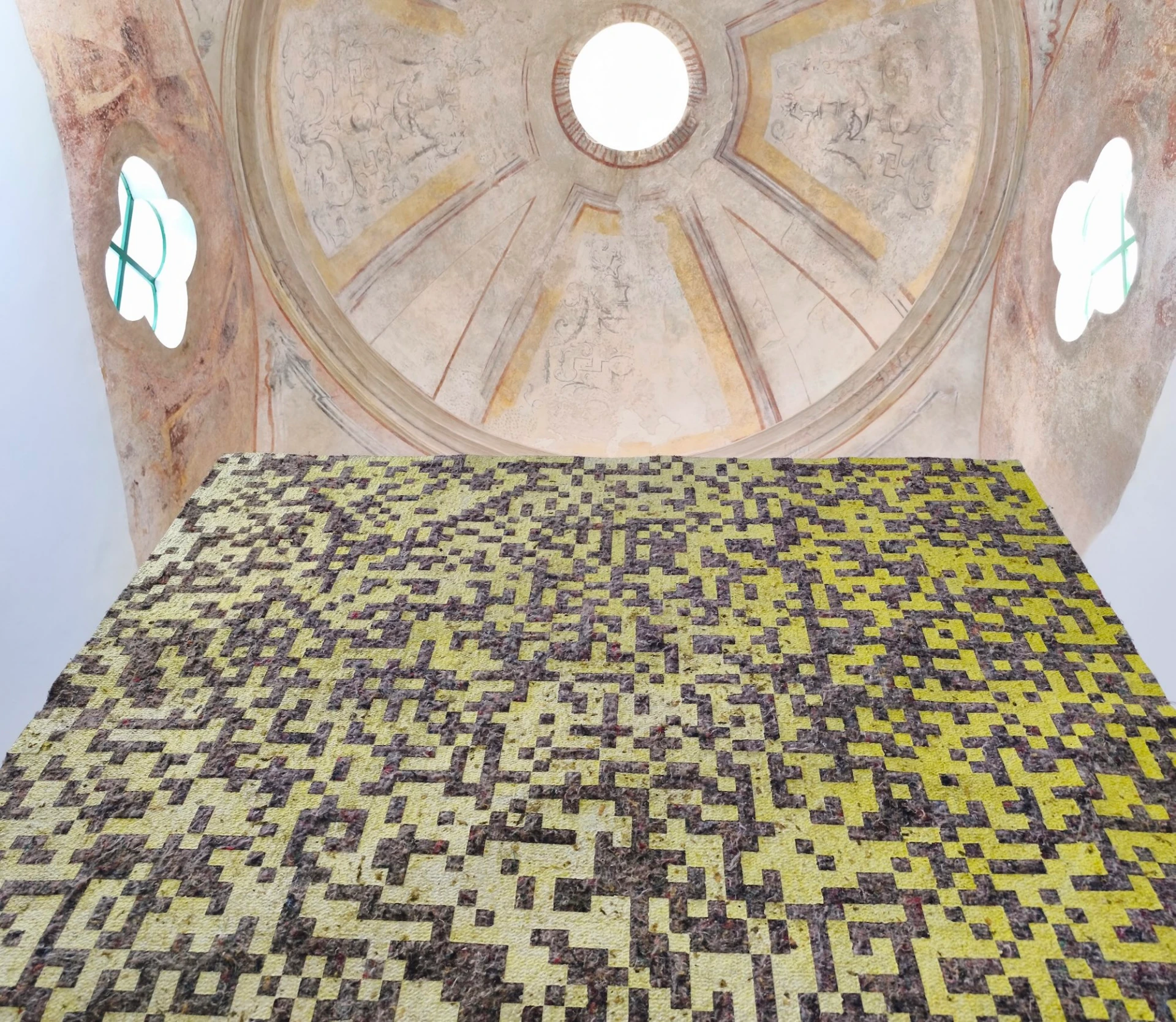
In the exhibition text, the curator of the second phase of the presentation, João Silvério, emphasizes the significant way in which the arrangement of the work's elements integrates them into the space of the Ermida, evoking the "presence of religious liturgy." More than twenty easels, arranged in various positions, compel the visitor to traverse the nave, as if the space of the deconsecrated hermitage multiplied with each passage. One might expect that each easel, with its respective two distinct faces, represents an individual attending a religious ritual? Perhaps, but such an interpretation would not do justice to the labyrinthine atmosphere to which the exhibition invites. The "museum of expectations" transforms them into museifiable pieces: what inhabits the exhibition can be a set of expectations on a kind of intermediate platform, awaiting or demanding a reorganization. It is the visitor who, out of necessity, seeks to operate this rearrangement: to do so, they must precisely relinquish expectations, observe each piece again, and seek, in each one and in the whole, the thread of the arrangement. In the Ermida of Tavira, museum and temple converge to house the pieces that constitute a work of art, and the ritual they inspire transforms the space into a place whose architecture and codes of conduct guide the visitor through a pre-structured experience: a world of expectations that are, after all, what is on display. Visiting it is, in this sense, a kind of performance that the visitor fulfills and in which they construct their own exhibition: one row of easels hides the next; each easel does not support just one "painting," and to perceive both sides, a shift is necessary that reconfigures what has just been seen.
This Museu das Expectativas is a unique work, even though it is made up of several distinct and autonomous elements. They all share some characteristics, whether of support, materials or format, but it is precisely in these traits that each one generates an individuality that sets it apart from the whole – the interest lies in seeing how this singular and momentary extraction does not affect the total body (which, incidentally, the containment of the hermitage helps to consolidate).
Since Museu das Microagressões, Pedro Gomes’s (b. 1972) idea has been to problematize the concept of a museum, or of an "institutional system for presenting content" (to use Fazenda Rodrigues's expression). What is exhibited in a museum is never entirely separable from the way it is exhibited. Selecting, classifying, ordering, and framing objects suggests, from the outset, an interpretation: that of the curator, that of the artist, that of the visitors, all dynamically implicated. In Pedro Gomes's exhibition, possibility ceases to be a mere museological principle and becomes the very substance of the work.
Whether through the construction of the easels, reminiscent of Carlo Scarpa's reimagining of museum design—designing modern easels, bases, and pedestals for classic pieces and artifacts in traditional museums—or through the use of leftover fabric, tablecloth patterns, ties, or other objects related to a kitsch aesthetic (Fazenda Rodrigues speaks of the "Camp approach to a kitsch universe"), Gomes revisits environments from his childhood. But, in the same way that the traditional idea of a museum seeks to reconstruct eras and cultures through fragments, here too the 1970s and 1980s are glimpsed only between spaces, in framed cutouts in thick and almost inscrutable matter, shimmering in flashes of texture, visuality, and even smells.
The materiality of each piece in the complex work that constitutes this "Museum" reveals the artist's dedication to its composition: the fabrication of the "canvases," for which different types of waste were chosen, the selection of fabrics that function as "paints," the colors drawn on these backgrounds, and, not by chance, the measurements of the easels and the position each occupies in the room. The choice of these "smaller" materials is all the more significant as they come to occupy the place where the anticipated traditional museological code (the "expectation") would lead one to expect objects legitimized as "art." Indeed, in the exhibition's presentation, the Municipal Museum describes it as an installation that simulates "the interior of a Fine Arts museum, in which everyday fabrics, poor materials, and waste appear where canvases would be expected." Expectation is therefore not just a theme: it is engendered as a formal mechanism, constitutive of what has been installed and is displayed. Pedro Gomes presents each piece as a necessary sign for recognizing a "museum"—the measurements of each easel, the double "canvases," the arrangement, the distance between the elements, the dynamics of the framing. And, in the next step, he subtracts from the visit any museological stability that these signs might promise.
Carlo Scarpa designed each easel not only to frame the pieces, but also to condition the visitors' attitude towards them, forcing them to position themselves according to the height and inclination of the pedestal, or easel. I remember the surprise – that is, the demolition of any expectation I carried with me – when I found, in the Regional Museum of Palermo, in the Palazzo Abatellis, the lapis lazuli mantle of the Virgin Antonello da Messina, the demure hand and the gaze that seemed to want to delay the Annunciation: the sensations exacerbated by the enormous white background in which the relatively small image was fixed, as if floating. The hand that painted it was Antonello's, but Scarpa was also there. Pedro Gomes seems to ask a similar question, in a particularly intriguing way: when one enters a museum, how much of what one sees is the museified artifact? And how much is part of the device that directs our gaze?
The exhibition is open until September 26, 2026.
BIOGRAPHY
Ana Isabel Soares (b. 1970) has a PhD in Literary Theory (Lisbon, 2003), and has been teaching in the Algarve University (Faro, Portugal) since 1996. She was one of the founders of AIM – Portuguese Association of Moving Image Researchers. Her interests are in literature, visual arts, and cinema. She writes, translates, and publishes in Portuguese and international publications. She is a full member of CIAC – Research Centre for Arts and Communication.
ADVERTISING
Previous
article
25 Aug 2026
Mixed media on paper #12: Masks unintended to mask
By Luísa Salvador
Next
article
27 Aug 2026
ARQUEOLOGIA REMIX: On Time and Its Uncertainty
By Guilherme Sota
Related Posts
article
14 SEP 2026
Space and time: lugar-depois, at Museu Zer0
By Ana Isabel Soares
article

09 SEP 2026
The Elusiveness of Time: on the exhibition ‘Uma Árvore’ by Daniel Moreira and Rita Castro Neves at the Palácio da Galeria in Tavira
By Ana Isabel Soares
article
26 AUG 2026
Museu das Expectativas, by Pedro Gomes: What is a museum?
By Ana Isabel Soares
article
19 JUN 2026
Passenger Side: Drift, movement
By Ana Isabel Soares