article
The space of the artwork: Bruno Zhu at CAM
“In Belas Artes, Bruno Zhu questions the status of the museum in contemporary times. He proposes an artistic curatorial approach where he assimilates works from others in order to, through a series of general guidelines, explore a plethora of themes—some of them: the hierarchy of artistic genres and the privilege of the work as a spatial focus, the absence of prior meaning and the blurring of truth, masculinity and mercantilism, art as illusion, etc.”
Chartres Cathedral is like the friezes of the Parthenon, and the horses of Lascaux are like an African mask or the Christ of a Byzantine mosaic. They are the plastic core of a culture, forms being fabricated from the very bowels of the place and finally manifested in an artistic style that, being a general conquest, belongs to no one. The artist understood that his practice was not free, being able to experiment as far as the style allowed. More than an original genius, he was an imagistic operator—his first duty was to reveal public truth outside the shadow of his individualism. In this stable system where everything vibrated with metaphysical meaning, an Egyptian artist who altered the forms of hieroglyphs not only contradicted the gods but also condemned the pharaoh to eternal wandering.
And how strange it is to contemplate, even today, so many of these works in a blank space, divorced from their original context. Perhaps we have never overcome the vehemence of this rupture, for we still feel a faint phantasmagoria in the halls of our museums. From this restless enchantment, generations of artists have been formed—the modern artist is, in large part, its child: the creative indulgence with which he wanders among an ocean of distinct objects is the result of a culture that, detached from its own origins, promoted the aesthetic adage of art for art's sake. To the modern artist, the origin or native meaning of the African mask matters little. Its value is measured according to the strength of its visual impact. The work communicates with us as an aesthetic object, emptied of everything that is not perceived in its form.
But it is a mistake to judge modern art as isolated or gratuitous. There is also immense power in this perspective, which grants the object countless possibilities. For the work as an end-in-itself is a reflection of a society that values freedom above all else—relieved of the burden of their functions, both work and artist find themselves in a suspended space where they can exercise other perspectives, questioning conventions and suggesting alternatives. In an emptied society, modern art accepted the challenge of fabricating (more than conveying) meaning to existence. The modern artist is a heroic anomaly.
Although tragic, the very resourcefulness that underpinned modernity also prevented it from constructing styles. Modern art seemed doomed to archaism. New styles emerged and quickly faded, never achieving their classical equilibrium: a set of techniques in harmony. Archaism is a vital force in search of the solidity that has eluded us for centuries. But perhaps it is good to accept the unstable, to embrace doubt: wouldn't this be the great lesson? If the classical transcends the individual in favor of the human, the modern artist is also classical—but in a different way: devoid of systems, techniques, or shortcuts, he confronts the silence of the work, which is also the unattainable. He confronts it weakened, though perhaps more sensibly. He tries to find the perfect distance from the thing, without constraining or isolating it. The solitude of the work lies in having been made by someone who cannot contemplate it, and being contemplated by someone who could not make it. Thus, it remains inexhaustible. The work does not occupy, but rather builds the space to be occupied by us, and the discourses we extract from it cannot replace it. Before it, we annul our individuality to slip into something infinite. Perhaps this is why so many contemporary philosophers prefer literature to philosophy: for the work is like us, at its core there is an indeterminate content awaiting partial realizations.
The modern museum is only possible in a culture that replaces religion with science—wouldn't its white cubes be laboratories where hypotheses are tested and relationships studied? In this sense, there is a paradoxical similarity between scientific thought and aesthetic experience. But artistic truths are not verifiable. In the absence of an objective method to organize knowledge, this constant comparison of images might lead us both to current relativism and to self-destructive criticism. The end of art has been proclaimed for decades—the final exhaustion of the aesthetic regime is a consequence of the emptying of the object: the work loses any claim to intrinsic value, becoming the representative of general discourses. The work that was an end-in-itself becomes a means-to-another-thing. But if the precept of art is the influence of the work on us, then the end of the object is also the end of the subject, who, by disregarding the autonomy of things, also comes to understand himself as the mere receptacle of discourses. Just like the works themselves, we become shadows of concepts. And if art for art's sake is the fruit of a democratic modernity that values individual freedom, could the work as discourse be seen as the fruit of an authoritarian and mercantile society?
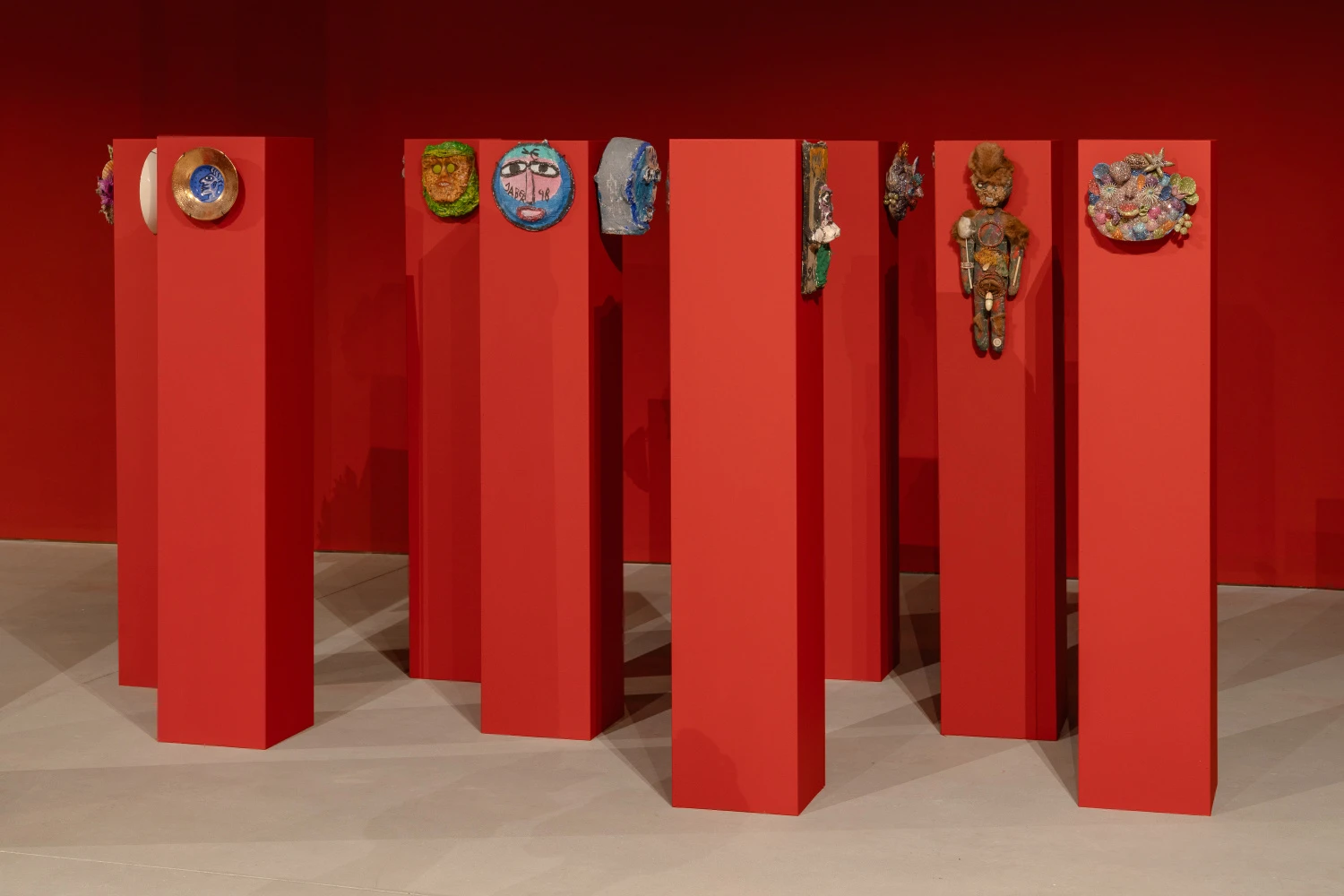
But how real is this supposed aesthetic autonomy, in fact? Is the museum truly separate from all circumstances, even knowing that both spectators and curators carry their entire world within them, in their gaze? And if everything is relational, in dialogue with the context, how can we situate the work within systems of meaning that do not limit it? In Belas Artes, Bruno Zhu questions the status of the museum in contemporary times. He proposes an artistic curatorial approach where he assimilates works from others in order to, through a series of general guidelines, explore a plethora of themes—some of them: the hierarchy of artistic genres and the privilege of the work as a spatial focus, the absence of prior meaning and the blurring of truth, masculinity and mercantilism, art as illusion, etc. Even so, the approaches adopted do not always delve deeply into the themes — the exhibition ends up becoming an exercise in contemporary horizontalism: multiplicity, simultaneity, and hybridity hinder critical density because they prioritize the volume of information over a committed, vertical examination of each element.
Therefore, it is inevitable to slip into gratuitousness—the operations are visually impactful, which ends up attracting more attention than the works themselves, and it is not always possible to discern the themes indicated in each room. Is Zhu adopting an ironic, radicalized perspective of the museum as an authoritarian space that allows the imposition of artistic status on things without justifying their foundations? If so, the critical difficulty of analyzing this exhibition becomes the same as that faced by all (many) current artists who adopt irony in their practices—how to separate the performance from the proposal? Is there something here, behind the play of reflections?
The exhibition operates according to what Fredric Jameson calls postmodernity—in commenting on the Bonaventure Hotel, he highlights above all its lack of orientation: by replacing the real with the simulacrum, the postmodern hyperspace inhibits our capacity to situate ourselves existentially in the world. Zhu also promotes wandering, not signaling entrances and exits, multiplying doors, inverting axes, altering exhibition positions. The operations of each room subvert the regulatory axes of the previous one. Altering the axes is transforming the context, also altering the parameters through which things are judged. Although an interesting exercise, it is perhaps executed in a somewhat deterministic way, reducing the thing to the context: the duty of the work is to represent the parameters of the room, which are supposedly guided by a subversion of the themes addressed.
The flexibility of circuits does not extend to our encounter with the works, which are merely the means. Thus, it can be said that the installation conveys standardized discourses where the indistinction of the work is replaced by art as a closed representation. And, therefore, autonomy is also denied to us—we do not encounter ourselves: we always see Zhu. We have been spared the intellectual effort: it is impossible to complete the hermeneutical gesture, because if any interpretation presupposes an interpreter, here the works have already been interpreted—what we have are illustrations of certain discourses. We are in a closed system that, in essence, represents the death of the spectator.
The Dadaist subversion of references was a method of immense impact at the beginning of the last century, validating itself in relation to both modern criticism of traditional art and the absurdities perpetuated in public life at the time. It was a "conscious" destruction that, like Duchamp's urinal-fountain axiom, allowed the work a breath of fresh air. It was also soon surpassed by a more constructive Surrealism, although contemporary art has revisited Dadaist methods countless times—almost never with the same impact (are we experiencing an assemblage of archaisms?). For our circumstances are different: much has already been said, for example, about the inevitable relationships between such contemporary art and late capitalism, which, without much commitment to origins or autonomies, makes use of any reference that serves the immediate impact that will influence us to accept certain discourses. Such utilitarianism clearly contradicts both the freedom of the work and the viewer—the disbelief in the autonomy of things creates a void that is quickly filled by external agents. In the current artistic landscape, even a work that intends to be controversial must also justify itself through a certain utilitarianism, its criticism being accepted only if it promotes simple interpretations of current themes. The appearance of criticism becomes preferable to criticism itself.
BIOGRAPHY
Tomas Camillis is an author and researcher based in Lisbon, working on fiction and on essays in the interplay between art, philosophy and literature. He has a master's degree in Art Theory by PUC-RJ. In recent years he has participated in researches, taught courses in cultural institutes, helped organize conferences and published in specialized magazines. He currently collaborates with the MAC/CCB Educational Service and Umbigo magazine.
ADVERTISING
Previous
agenda
20 May 2026
BEAST IFF returns to Porto from 3 to 7 June
By Umbigo
Next
article
22 May 2026
New exhibition cycle at CIAJG
By Mafalda Teixeira
Related Posts
article
25 AUG 2026
Foreign Monuments: Grada Kilomba at Fundação Albuquerque
By Tomás Camillis
article
18 AUG 2026
The distant work: Ana Vieira at Galeria Vera Cortês
By Tomás Camillis
article
30 JUL 2026
Excess and Silence
By Tomás Camillis
article
08 JUL 2026
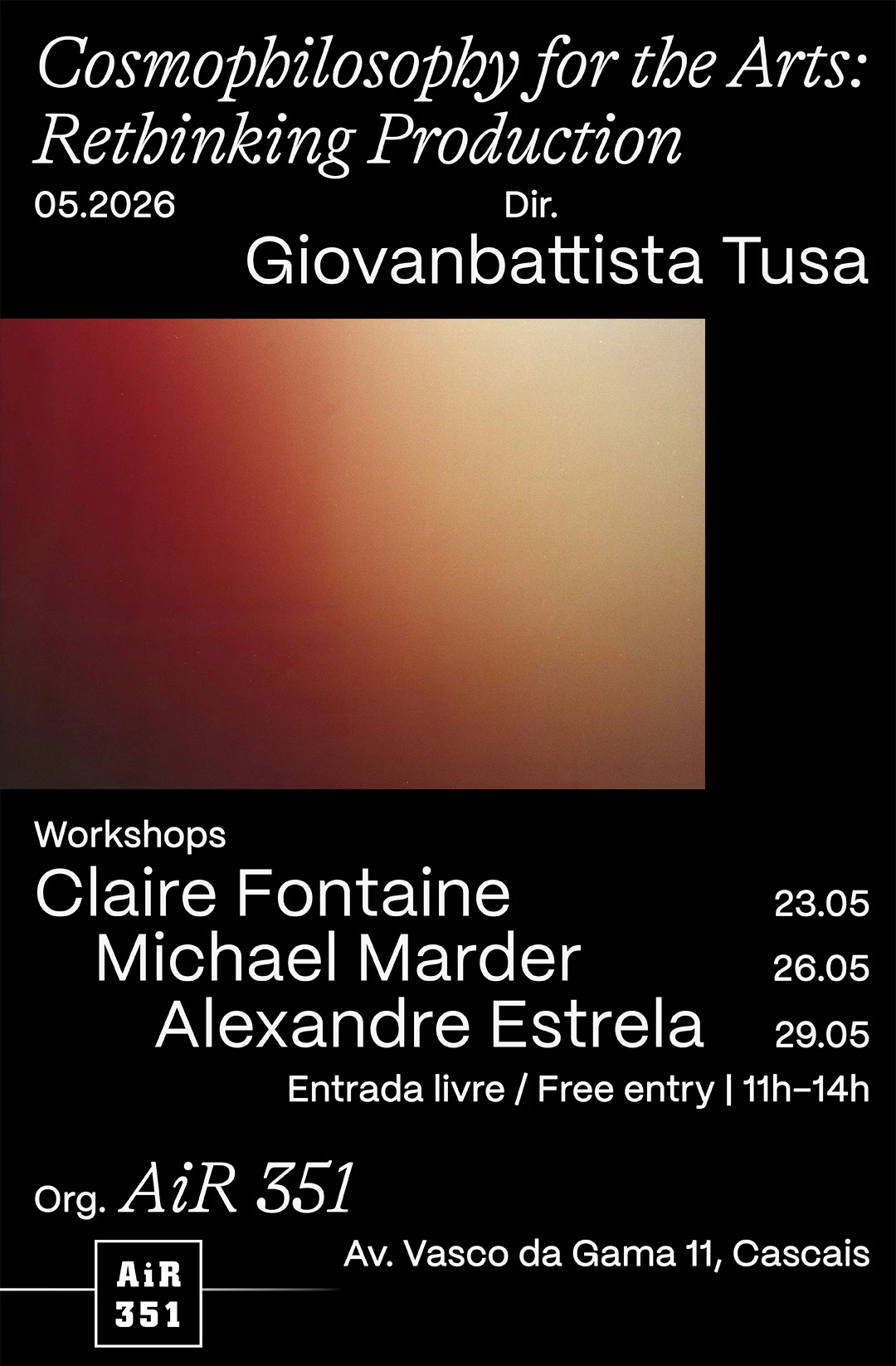
TOWARDS TERRA INCOGNITA: Interview with Giovanbattista Tusa
By Tomás Camillis