article
Rosa Barba. Drawing Vocabularies, at CAM - Gulbenkian
“Through a play of time and occasion, the work suggests the production of an ephemeral event within an unstable and temporal set of elements. An image, an event, formed through a series of encounters, relational rhythms, and processes.”
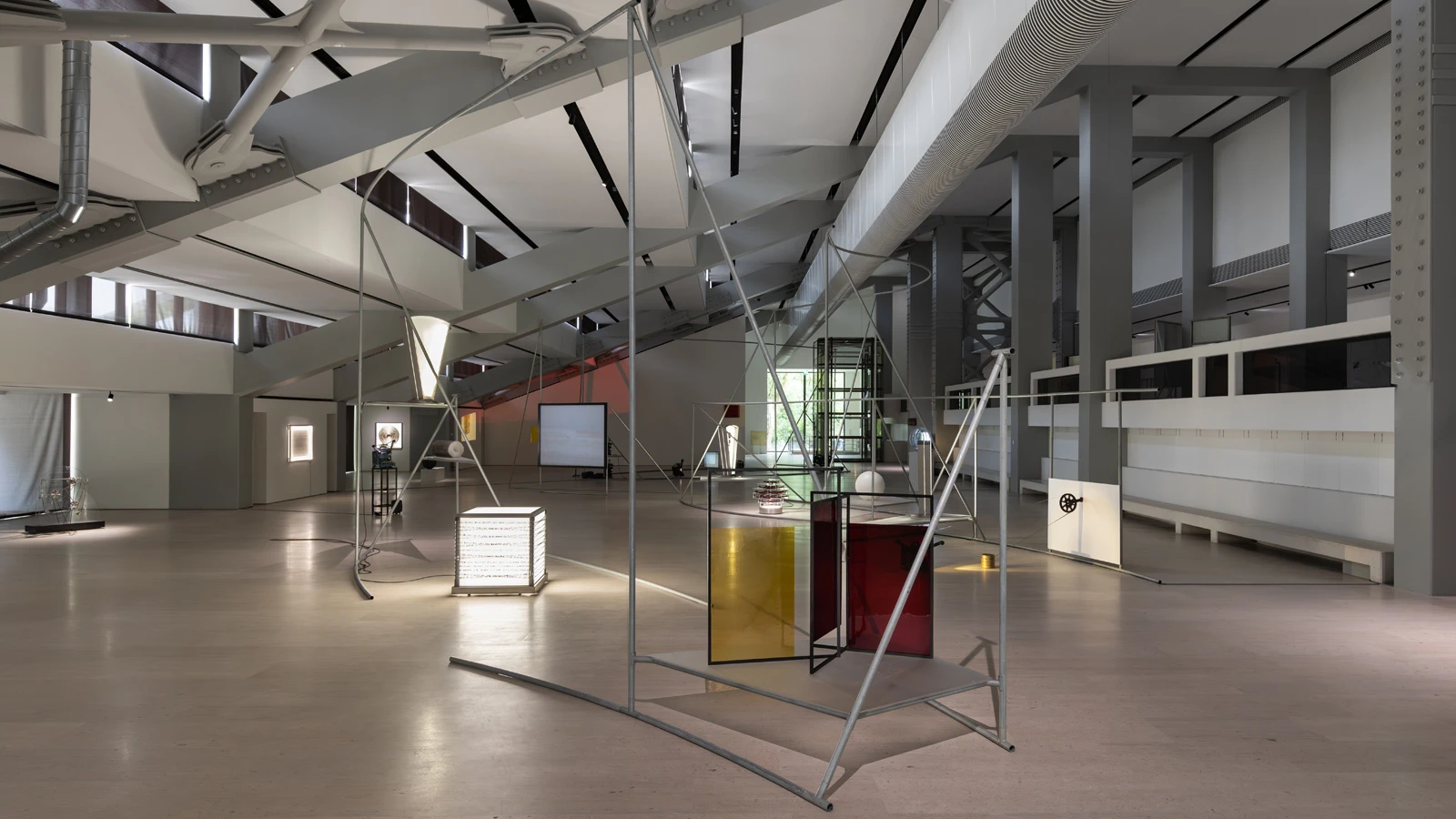
Probably one of the most emblematic artists in the contemporary European context, Rosa Barba, an Italian-German visual artist, is at the CAM - Gulbenkian from May 16th to September 28th. With an original body of work that maintains historical resonances with Kinetic Art, Barba presents a constellation of 22 artworks that resonate with each other and construct an exhibition totality within a scenario of anarchy of cinematographic forms.
The exhibition intertwines cinema and sculpture, bringing with it questions involving memory and film, architecture and montage, temporality and language. Thus, for four months, the recently renovated building, designed by Japanese architect Kengo Kuma, hosts an exhibition in which light, image, and filmic devices are orchestrated in a symphony of combinatorial elements, mathematical rhythms, and kinetic sculptures.
Adding to this symphony of works is Myth and Mercury, a 22-minute film produced in 35mm exclusively for the exhibition at CAM. The film starts from Antonio Gramsci's prison writings and moves between geological and historical temporalities of the Mediterranean, exploring connections between the energetic and physical forms of neutrinos and resistance; as well as between the past and future of the Mediterranean landscape. The film, with its experimental and non-linear editing, resonates with the entire anarchic work of the Italian artist's cinematic experience. It also integrates the most important elements of her conceptual research, such as neutrinos and light particles, which constitute the main protagonist in the materiality of her cinema.
**
Barba's exhibition is structured around a transition between the anarchy of cinematic structure and a reflection on cinema as a way of bringing into presence that is absent or distant, drawing a parallel with astronomy. This anarchy reorganizes the viewer's experience, placing them before the machines that operate the light projections: sculptures that condense a simultaneously formal and conceptual aspect of his work.
The exhibition presents encounters between different film machines, displayed and reconfigured according to the exhibition space of the CAM. The exhibition is populated by sound devices and kinetic sculptures, which construct and deconstruct cinematographic aesthetics towards an explosion of the vocabulary of its elements. In this sense, each work can be seen individually, even though the exhibition also unfolds as a whole.
Let's consider, for example, the beautiful Spacelength Thought (2012) – a modified, computer-programmed typewriter that records text onto an unexposed strip of 16mm film. As the film is fed into a projector, it displays one letter at a time against the wall, following the rhythm of the film. The letters appear as fragmented parts of a whole text that lies on the floor and can be walked through by the visitor. The sculpture, which provides support and condition, traverses the text and projects it, letter by letter, onto the wall.
An exercise in fragmentation, but also an exercise in reconfiguring the infinite into the minimal, Barba ends up reformulating some burning issues of the contemporary context related to technology and language in a context of automation and acceleration. Adding the most fundamental element of cinema as a field of work and as a sculptural field, cinema appears as a privileged medium to bring time and temporality to the center of the works, operationalizing rhythm, delay, speed, and distance as fundamental aspects of the work. However, it maintains the centrality of the device as a translating and creative operation.
A little further on, we find Language Infinity Sphere (2018). The work is a steel sphere impregnated with hundreds of fused letters, producing what could be seen as the chaotic and probabilistic set that resides in the carnivorous skeleton of language. It is Babel-like, but it also refers to the idea of Aleph present in Jorge Luis Borges's story: a magical point that contains all other points in the universe simultaneously. In this work, language also appears as the infinite probability of word formation, a set that is simultaneously mathematical and alive, of the conditions of possibility for bringing to life that which subsists in our experience.
At the intersection of the word as probability and as visual code, Barba also suggests poetry as a method of sensitively reorganizing the word outside the logical order of meaning and the linear skeleton. With works such as Isolation of Information (Roller) (2015) or A Shark Well Governed (2017), the artist allows us to perceive the word not only as the cosmos of meaning that binds us, but also as a code endowed with a vibratory, tactile capacity, capable of sensitively reshaping the material through appearance and disappearance, through approximation and distancing from other words. The fact that they are sensitively forged in steel also lends the work the suggestion that words, too, are imprinted with us, in the flesh of events and occurrences.
But probability, movement, and combinatorial elements also appear in a more organized way in the exhibition, and the work In Play (Hopscotch) (2024) may be the most emblematic. The work, which moves continuously and, at a specific moment, forms an image, refers to historical works of kinetic art, leading us beyond cinema and projection and reaching what can be seen as the production of reality itself.
Through a play of time and occasion, the work suggests the production of an ephemeral event within an unstable and temporal set of elements. An image, an event, formed through a series of encounters, relational rhythms, and processes. Although determined by a mathematical structure that organizes them—unlike life, which can be less determined—the work leaves open the suggestion that the elements forming the image, the event, and reality itself are formed through the same matter: time. And all these meanings intertwine and suggest each other in the artwork.
**
But beyond the individually observable works, the exhibition is symphonic precisely because of the relationships formed between them: the entire exhibition unfolds as a performance, as an event. Other works clarify this principle, such as Solar Flux Recording (2025): two pieces communicate with each other, producing different events each time they meet. The automatism implied in the devices also invokes the agency of these machines as moving and relational bodies, in which the spectator participates in a pre-determined symphony. In this context, the projection of light, time, and color seems to be operated by machines that are also like autonomous steel hummingbirds – themselves a fundamental part of what they exhibit, projecting light and image into the exhibition space.
In this sense, Barba's careful treatment of the film cameras is evident; as they pass through his hands, they become sculptures. It would be cliché to speak of beauty, but the works are truly endowed with such balance, suggestion, and lightness that it would also be impossible not to touch on this formal aspect of his works.
Furthermore, whether in works that primarily use cellulose – such as Thick Harmonies (2026), As Fixed In Flux (2025), or Off Splintered Time (2021) – or in works where the film machine itself is decomposed – it is important to note not only the anarchic gesture of decomposing and recomposing the pieces, but also, and above all, the reconfiguration of the spectator within the cinematic experience. The subject appears here not as a passive recipient of images, but as an entity embedded within this engineering, operating within the context that produces the images. This reconfiguration is produced by the gesture of revealing the device that forms the work, highlighting the material forms that produce the image.
**
Thus, in Rosa Barba's work, cinema, astronomy, and memory converge not as separate fields, but as variations on the same question: how does presence emerge through absence, and how do the apparatuses of vision shape what can be seen, felt, or even thought? In what ways can we refine and transform our ways of experiencing time, language, and vision? If the telescope, cinema, photography, and image projection fundamentally share the capacity to bring into presence that which is absent, Barba not only shifts the meaning of the image from representation to duration, but also reveals and calls us to a reconfiguration of aesthetic experience: through her sculptural treatment of filmic machinery—at once matter and metaphor—she rescues the wonder of the assembly and disassembly of our ways of seeing.
Rosa Barba. Drawing Vocabularies is on show at CAM - Centro de Arte Moderna, Gulbenkian, until September 28.
BIOGRAPHY
Mariana Varela (b. 1991) is a poet and sociologist. She has published "Enigmas de Jaguar e Jasmim" (2019) and "Rotativa" (2022), both edited by Urutau. She edited the mini literary magazine "Frente!" and currently edits the literary magazine "Letra Lenta". A graduate of the University of São Paulo, with a master's degree in sociology from Universidade Nova de Lisboa, she is currently pursuing a PhD in philosophy at the same institution. She writes articles on the intersection of aesthetics and philosophy.
ADVERTISING
Previous
article
 [A] Rodrigo Cass, [L] Brotéria-h6ebz.jpg)
03 Aug 2026
Is there such a thing in nature as a perfect square?
By Inês Folgôa Moreira
Next
article
06 Aug 2026
Autocolante. Iconografia da Liberdade, at MUDE
By Carla Carbone
Related Posts
article
03 AUG 2026
Rosa Barba. Drawing Vocabularies, at CAM - Gulbenkian
By Mariana Varela
article
23 JUN 2026
TERRACRONIA - Masterclass with Federico Campagna in Montemor-o-Novo
By Mariana Varela
article
25 FEB 2026
Color and gesture - a primordial noise of the world: Fernando Mello Brum at 3+1 Arte Contemporânea
By Mariana Varela