article
Sacred Heart, at Fundação Eugénio de Almeida
“By praying to all the angels and saints, one will find the path to ecstasy.”
What makes a heart as large as the one that opens the exhibition Sagrado Sacred Heart. Works from the collection of the Archdiocese of Évora and the Treger Saint Silvestre Collection —so impossibly red, so impossibly fiery—beat so strongly?
What has become of this heart of Christ, now pinned to a wall, at the mercy of those who no longer recognize anything in it?
Distant, skeptical, passive spectators of a culture we are gradually ceasing to recognize, in this heart we see everything that no longer exists: mercy, love, mourning, death, suffering, even beauty.
One could say that God has lost His grandeur; that He has become a strange concept, worn down by the accelerationist, hypermodern cynicism from which this text, too, is born—and how could it be otherwise?
But God remains immense, albeit alone.
God's heart—the one that beats for everyone and can be felt within us at the very moment when the whirlwind of life sweeps us away—is both the symbol and the place where human emotion finds expression and comes face to face with the virtues of doctrine, the austerity of faith, and the beauty of goodness.
Separated from the body, its arteries severed, deprived of its lungs’ support and its bones’ and muscles’ protection, the heart stood as a representation of God and His infinite love for humankind. The divine heart is the whole in a single organ, needing neither face nor body, for in God, the particular is enough to be infinite.
It is of the heart of Christ—and always of the heart of Christ—that Saint Gertrude’s visions speak. In one of her ecstasies, Gertrude claims to have heard the beating of Christ’s heart when she pressed herself against one of the five sacred wounds. The heart was beating, pouring out blood like an inexhaustible fountain, and bearing witness to an eternity that would not end with death and that would forever remain pulsating and gushing, even in the winter of humanity.
And when Our Lady of Sorrows reveals herself with her chest open, her heart pierced by cross-shaped blades, it is impossible not to feel a tightness in the chest cavity, in that red muscle—an empathy for the pain, loss, and anguish of a mother who left her son on the cross. No other feeling could be deeper. Everything about her seems to be suffering. Yet here, too, in this open wound exposed to the elements, there is a love, a passion, a devotion to something so ineffable, so absolute and inexplicable that it can only be an expression of an inner contemplation that is difficult to explain, show, or put into words. In that moment, Mary’s torn heart is the heart of the divine incarnate in Christ, full of flames and love, even as her Son surrendered to the cross.
The hagiography found in Sacred Heart illustrates all of this in the tears of the saints, in the expression of a life force stifled by arrows, in the drawings of artists committed to psychiatric institutions, in the blessings of the angels, in the prostration of the martyrs, and so on. The dialogues between the Treger Saint Silvestre Collection and the collection of the Archdiocese of Évora bridge and bring together different time periods. Today’s artists share the same passionate, boundless, and ecstatic fervor as the artists of the past, as well as the same fears and beliefs; they are stenographers of their times, sculptors of their sorrows, performers of an inner tragedy that they seek to empty or channel through art.
By praying to all the angels and saints, one will find the path to ecstasy.
And what begins with a wooden heart later unfolds into a record of what Georges Bataille called inner experience. Ultimately, Sacred Heart focuses on this experience, discovering the mystical in the artists’ gaze and in the features of the saints sculpted by anonymous hands. In other words, we wander accompanied by the spirits that shaped the limits of knowledge; we embark on “a journey to the limits of human possibility,” without preestablished goals, seeking unknown horizons in the folds of darkness. Only then can we infer from there the answer to that question which no one seeks to answer anymore, entangled as we are in a numbing materialism: what does it mean to be?
Sacred Heart is both necessary and unusual: necessary, because it recalls the values and experiences that shape our culture; unusual, because it emerges in a time devoid of references—or filled with empty ones. All the choreography of bodies and faces, all the fascinating curations created by artists who have contributed to the exploration of so-called Art Brut, exist within this paradox that in no way negates itself, but rather adds depth to the experience of being. The exhibition compels a suspended intelligence, insofar as, as Bataille says, “the advance of human intelligence had as a side effect the diminution of the possible in a realm that seemed foreign to intelligence: that of inner experience.” (Bataille, 2021: 22) Furthermore: “The development of intelligence has led to a drying up of life, which, in turn, has diminished intelligence.”
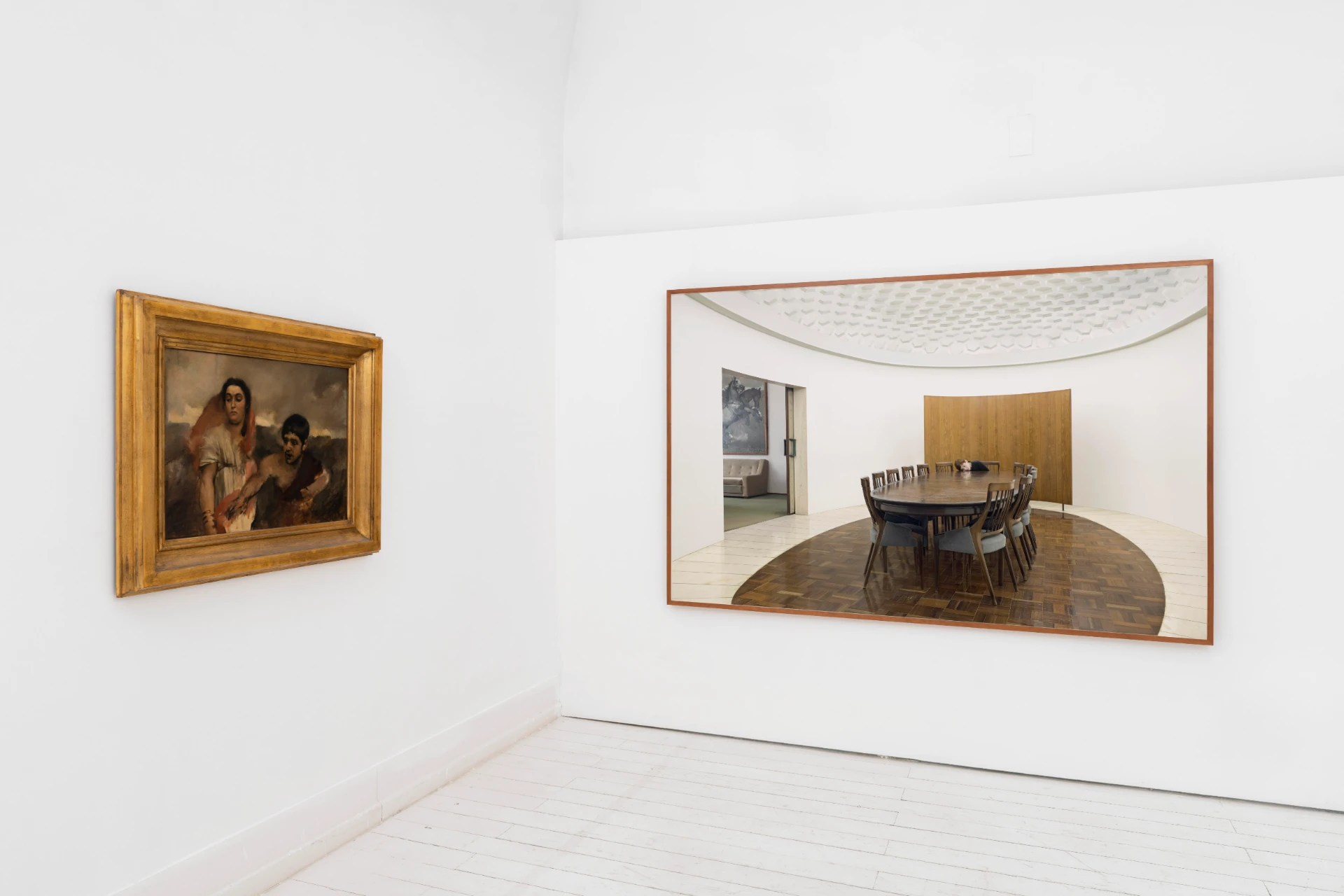
Óscar Morales's vibrant colors and Giovanni Podestà's high-relief sculptures echo the symbols of the past, of the most fundamental Western culture: the uncertainties of a punishing God and the hope of a generous one; the torments of a life of suffering and redemption in the heavens; the despair of life and the consolation of eternity. Although they exist on different planes, with purposes (if any) that are also distinct, the works of these artists—who are part of the so-called Art Brut movement—document the cultural legacies of the West. Treachery and sin have the same face in the medieval imagination. The serpent slithering across Barbara Demlczuk’s back is the same serpent defeated by the Immaculate Conception.
According to the philosopher, “we only attain states of ecstasy or rapture by dramatizing existence in general” (Bataille, 2021: 25). What seems like madness is, in fact, life taken to the extreme, and the heart is the purest representation of this sudden ignition of being. It is the heart that conveys the fusional state between God and the subject, and it is the heart that holds the cartography for the trance.
From another perspective, the tears of the saints—of St. John of the Cross (Spanish, if there were any doubt), of St. Ursula, of St. Jerome, of St. Teresa of Ávila (Spanish, too, if there were any doubt), of St. Sebastian. That is to say, none of the sculptures at the Sacred Heart seem to be weeping, but all the saints weep, because weeping is the confirmation of life’s pain, rarely of death. Emil Cioran says, at the sharp peak of paradoxes and contradictions, of fever and the torrent of inner tears, that “it is not knowledge that brings us closer to the saints, but the awakening of the tears that sleep deep within us” (Cioran, 2022:21). Our tears—those of us who still know how to weep—meet the tears of the saints and the artists of Art Brut. Collectively, we form a river, a cascade of suffering, anguish, and loneliness. It is these tears—this “hermeneutics of tears,” as Cioran would further say—that console us and propel us toward the most eccentric extremes of logic. “Holiness has pain as its method, and its goal is God. Since it is neither practical nor comfortable, men have relegated it to the realm of the fantastic and worship it from a distance.” Will we be able to take away some of the pain from these saints and these artists so that the burden becomes less heavy? But in doing so, we would lose the absolute rigor of the tears. That would be unthinkable. After all, all saints suffer from this “delusion of grandeur,” these whims “masked by humility, restlessness concealed by charity.” However, there is the possibility that it was only in this way that these saints bridged the gap between heaven and earth, crossed the “aridity of consciousness” (ibid.), the desert of the world, to soar to the heights and, in this way, come to know humanity.
One could say of these artists featured in the exhibition that they, too, were saints—albeit for brief moments. Madness—later termed psychosis—is a gateway to the divine and to nothingness. Perhaps it was there, in those fleeting aesthetic moments—quickly suppressed by anesthetic treatments—that the mad artists discovered the system of life. Anesthesia is the drug of the present: “The anaesthesia of postindustrial societies translates, therefore, into an apathy toward anything that cannot be the object of an exchange, symbolic or otherwise” (Bonnet, 2020). And all these artists did was refuse anesthesia and test the limits of existence. Such audacity is impossible to experience except through an art that denies and controls the intensity of life, fear, suffering, and passions. The incomprehensible is dismissed as pathological. What appears unintelligible is interpreted and treated according to psychopharmacological methodology. Everything that deviates from the norm, everything that cannot be expressed in the transactional, objective, and productivist language of modernity, must be analyzed, dissected, and remedied through medicine. States cannot accept madness, the divine touch, asceticism, or the fall of souls. All of this would be far too exoteric.
The room where the dead Lord rests at the Eugénio de Almeida Foundation, with Vasilij Romanenkov’s characters and his epic of human cycles, is a simulation of death… and no one wants to see death. It is a condition of modern life to freeze life in a single moment, which fragments into smaller moments, in a presentism that is now, immediate, and instantaneous. The gratification of the infinitesimal present does not allow for the future of life, which is death. “The Hedonistic and Epicurean traditions, in which pleasure is the pivot-point of existence, designated the present moment as the ultimate site of joy.” (Bonnet, 2020).
Our ancestors cultivated death. Christianity cultivated death. To inhabit this room is to deny our hypermodern condition. We are torn from our natural state—from our acceleration—to understand a reality we wish not to acknowledge, not to believe, thinking that cryogenic sleep, a concatenation of computational and biological memories, will immortalize us in the damnation of life. We want to experience infinity, without admitting death and the tears of death. We want to fill the void with stimuli and more stimuli, to intensify the immediate. “The hyperpresent is narcotic, in that it induces a forgetting of self. It imposes an incomplete vision of the world in which the instant and the everyday play the role of a refuge, and where repetition and the marking of time function as rituals for exorcising the fear of death.” (Bonnet, 2020).
But those who do not taste salt poured from their eyes, those who do not touch the cold face of death, will never attain the fever of consciousness, the ecstasy of lost love, the cosmic touch of nothingness, of the void, of the absolute. We extract from ourselves the most vital organ—the brain. The heart—that one—so impossibly red, so impossibly fiery—may stop, for it will have nothing left to love, hate, weep for, or yearn for.
Sacred Heart. Works from the Collection of the Archdiocese of Évora and the Treger Saint Silvestre Collection is on at Fundação Eugénio de Almeida in Évora through February 28, 2027. The exhibition is curated by Joaquim Oliveira Caetano.
References:
Cioran, Emil (2022). Tears and Saints. Coimbra: Edições 70. | Bataille, Georges (2020). Inner Experience. Coimbra: Edições 70. | J. Bonnet, François (2020). After Death. Falmouth: Urbanomic.
BIOGRAPHY
José Pardal Pina has been the associate editor of Umbigo since 2018. He has an Integrated Master's in Architecture from Instituto Superior Técnico, Universidade de Lisboa, and a Post-Graduation in Curatorship from Faculdade de Ciências Sociais e Humanas, Universidade Nova de Lisboa. Curator of the Dialogues (2018-2024) and Landscapes (2025-) projects in Umbigo.
ADVERTISING
Previous
article
14 Jul 2026
To Whom It May Concern, at Carpintarias de São Lázaro
By Maria Inês Mendes
Next
article
15 Jul 2026
Gibellina - Capitale Italiana dell'Arte Contemporanea 2026
By Josseline Black
Related Posts
article
15 JUL 2026
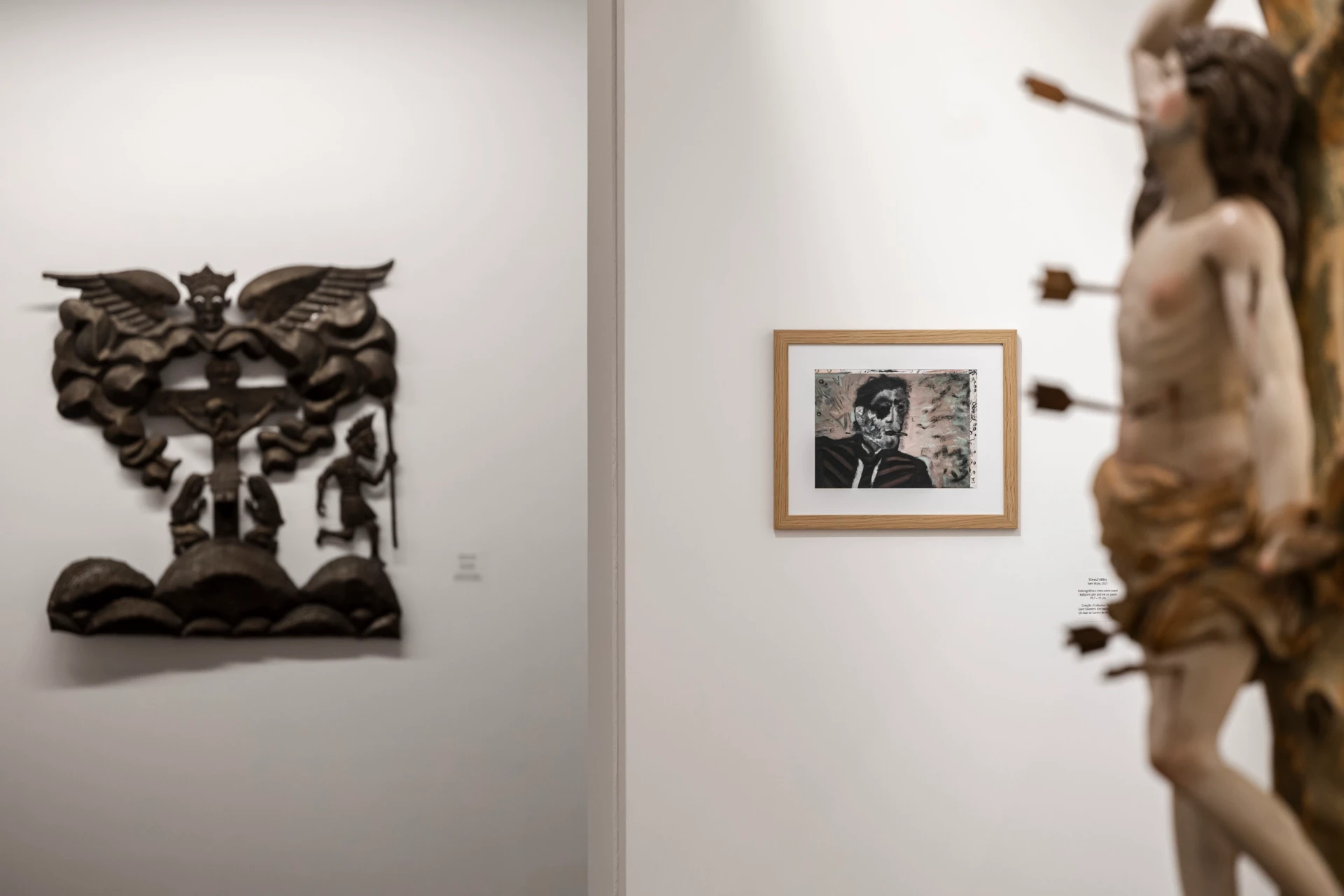
Sacred Heart, at Fundação Eugénio de Almeida
By José Pardal Pina
article
01 JUL 2026
landscapes change places… at the Fundação Eugénio de Almeida
By José Pardal Pina
article
19 MAR 2026
A Oferta, by Jaime Welsh
By José Pardal Pina
article
02 FEB 2026
Húmus, at the Atelier-Museu Júlio Pomar
By José Pardal Pina