article
'50 years of memory, creativity and resistance' at CNAD - National Centre for Art, Crafts and Design, in Cape Verde
"In July, the month in which we commemorate the independence of Cape Verde, the National Centre for Art, Crafts and Design – CNAD, an institution founded on the bedrock of the Cooperativa Resistência, honoured 50 years of a movement unique in Cape Verde, in both its philosophy and its work. Its unifying and archiving concept brought together and raised awareness of the country’s arts and crafts, leading to the reinterpretation of different forms, techniques and materials."
Resistence (noun)
The act or result of resisting, of refusing to yield or succumb. The refusal to submit to the will of another; opposition [...] A tendency to endure difficulties [...] The quality of a body that counteracts the action of another body.
Cape Verde achieved independence in 1975, reinforcing its cultural identity through the arts by inaugurating a new way of thinking: the need to retrieve pieces dispersed throughout the archipelago, collecting and celebrating them as genuinely authentic remnants of the cultural identity of the Cape Verdean people. In 1976, the climate was perfect for establishing Cooperativa Resistência, which, as its very name suggests, stood tall in embodying the defining feature of a people: resistance.
In July, the month in which we commemorate the independence of Cape Verde, the National Centre for Art, Crafts and Design – CNAD, an institution founded on the bedrock of the Cooperativa Resistência, honoured 50 years of a movement unique in Cape Verde, in both its philosophy and its work. Its unifying and archiving concept brought together and raised awareness of the country’s arts and crafts, leading to the reinterpretation of different forms, techniques and materials.
The exhibition presents itself as an irreverent act.
Given that the exhibition occurs on the fiftieth anniversary of the Cooperativa Resistência, the inclusion of elements resulting from the collective’s research, as well as works made during that period, would be the natural choice.
The conceptual and interactive exhibition welcomes visitors with a black backdrop: a large black curtain that defines the first section of the exhibition, resembling the long, sequenced scenic backdrops running across theatre stages, as if holding different moments of a play within them.
In this instance, the first moment is static and preliminary, counterbalancing two long textile elements, positioned vertically, signifying two distinct weaving techniques and symbolically referencing two different identities found across the archipelago: the windward islands with their calabedoche and the downwind islands with their pano de terra, or ground cloth, the traditional Cape Verdean woven cloth. Although arranged vertically, they protrude from the white wall on a structure resembling an easel or a stylised loom, implying the continuity of a story still being written, a tangle still being woven. The composition resembles, at first sight, two high-backed seats, two armchairs or platforms on which rests the reality of a country forged from diversity.
There is a manuscript by Manuel Figueira on the side, whose first sentence is highlighted: “It was on January 20, 1975”. This short text sees Manuel Figueira describe an exhibition he held at the former trade union, now the CNAD museum, drawing particular attention to a significant revelation he had during that period, prompted by two events: the first, a garment and a woven sash from Santo Antão; and the second António Carreira's book Panaria Cabo-verdiano Guineense. The end of the manuscript reads: "These revelations greatly contributed to the emergence, a year later, of what we called the ‘Cooperativa Resistência’.”
Walking through the heavy black curtain – and peering underneath it, in my short stature –, I recalled the (heavy) black flag of famine as a ubiquitous landmark in the history of Cape Verde, the ‘resistance’ of a people and the influence of Capt. Ambrósio, who, following my reading of Manuel’s manuscript, stood out more clearly in my memory.
We then stepped into a new compartment. Inside, we found ourselves in another dimension, this time plunged into darkness. Pitch blackness filled the space. Surrounded by curtains, just like those I mentioned earlier that follow one another on stage, keeping distinct moments of a play separate. However, as we shall see, the performative dimension grows stronger as the exhibition reaches its completion, with the visitor taking centre stage.
This section features a video edit by Grace Ribeiro, titled No antigo consulado inglês (início dos anos 80), using original footage captured by the collective at the time. It shows the importance of weaving to the country's arts and crafts and, by extension, to the collective’s work, ranging from the collection of raw materials for processing – whether for warping and/or dyeing – to the reinterpretation of forms, weaving, and artistic creation. The title refers to the place where the Cooperativa was initially established and to one of the city’s most iconic historic buildings, demolished in the last decade. It recalled the debris used in Manuel Figueira’s work Ex-consulado Inglês, with memory scraps mixed with bits of material and the typical dust stirred up on the common windy days in Mindelo.
I was now pushing through a new curtain; the moment was entirely new. Projected onto the screen, I could see the ground cloth; but it was not static. It was the ground cloth itself, but its image was dynamic, constantly changing, becoming increasingly stylised, and then disintegrating. It was the present being played out; the digital medium brought about this reinterpretation, offering different possibilities for that element and inspiring new ways of looking, seeing, experiencing and exploring. This projection transformed the ground cloth into pano diGiterra, a work by the Portuguese artist Luis Grifu.
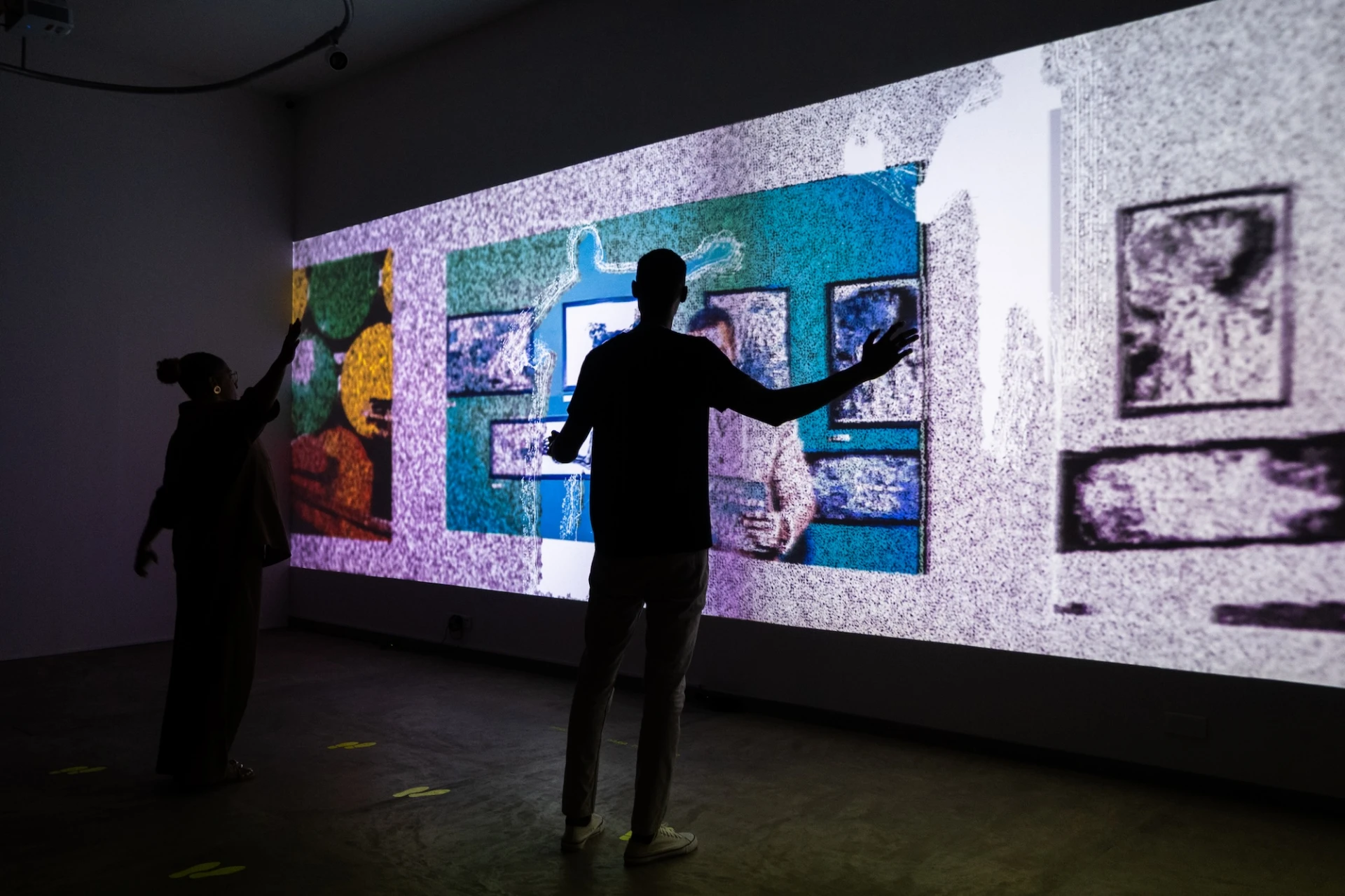
Another new curtain. It was clear to me that this was the third act. This succession of curtains took shape, in fact, in my mind as three distinct moments, or three acts, in this case. It was the crowning moment of the piece; I walked into a larger space, where the continuous projection stretched across 8 metres and a sequence of images brought to mind what I know of Cooperative Resistência. I tried to decipher what seemed less obvious to me. I drew closer, stepped back, drew closer again. I was at the centre of the image. Quite literally, my image — my outline, my silhouette — was being mirrored in the projection, becoming part of that entanglement, which was now not only made up of wires; it consisted of many other things which, more or less evident, now took my presence into account. Also, the remixed audio, where different references to Cape Verde – such as the sound of the São João drums – converged, reacted to my own presence; once my body took its place within the projected image, I heard Manuel Figueira – echoing from the exhibition’s introduction, with his manuscript. The echo of the past could be heard clearly, contrasting with the musical remix filling the background and flooding the entire exhibition space, filling every little area, every moment.
I continued to see my image reflected in the projection before me, a silhouette with vague boundaries, such as the outline of a raindrop on water, simultaneously repeating itself in the reflected video. It was the future. We were in a different space/time, grounded only by Manuel’s voice.
Traços de Resistência was the name of that moment, devised by Luís Grifu, where the traces of resistance intrinsic to the Cape Verdean people intertwined with the cooperative's woven threads, mirroring the surroundings, the material and life itself.
The exhibition 50 Years of Memory, Creation and Resistance, presented by CNAD - National Center for Art, Crafts and Design, celebrates half a century of the history of Cooperativa Resistência (founded in 1976), which was the embryonic nucleus and the first cultural institution created after the country's independence. The exhibition can be visited at the Galeria Bela Duarte, located in Mindelo, on the island of São Vicente, in Cape Verde.
ADVERTISING
Previous
article
29 Oct 2026
Perdurar como Paradoxo, at Fundação MEO
By Carla Carbone