article
Perdurar como Paradoxo, at Fundação MEO
“Demarcating itself from the traditional curatorial logic of mere passive contemplation of the works, this approach also transcends the chronological boundaries of the works, even though the selection exhibited spans two distinct decades – the 1990s and 2000s – of the 20th century. In this way, Perdurar como Paradoxo dethrones and challenges the linearity of the curatorial narrative, also revealing the diversity of works of art present in the Contemporary Art Collection of the MEO Foundation.”
The practice of art curation today is fraught with numerous challenges, including integrating different art forms within a single exhibition, such as painting, sculpture, installation, and other fluid forms of more recent artistic creation. One of the lines arising from these challenges, in the exhibition Perdurar como Paradoxo (Enduring as Paradox) is the criterion of juxtaposing and establishing, between works by artists, oppositions and "dissimilarities" on the one hand, and reverberations and familiarities on the other. In short, the aim is to establish a unifying element, often pictorial, that expands and dilates in accordance with the exhibition space.
This is the case with the work Smoke Get in Your Eyes (2000), by Rosa Almeida. A tangle of delicate, undulating transparent films, originating from cigarette packs, emerges within a frame, perforated by the heat of cigarette butts. It echoes Arte Povera, and perhaps the delicate gentleness of Mariza Merz, as well as the works she created in the silence of her home and in the shadow of the spotlight, while accompanying the artistic career of her husband, Mário Merz. Rosa Almeida's work also finds an echo in another work in the exhibition, titled Burnt Paper by the artist Maria José Oliveira. Maria José Oliveira's work, created in 2000, allows us to effectively associate a whole body of work by the various artists presented in the exhibition.
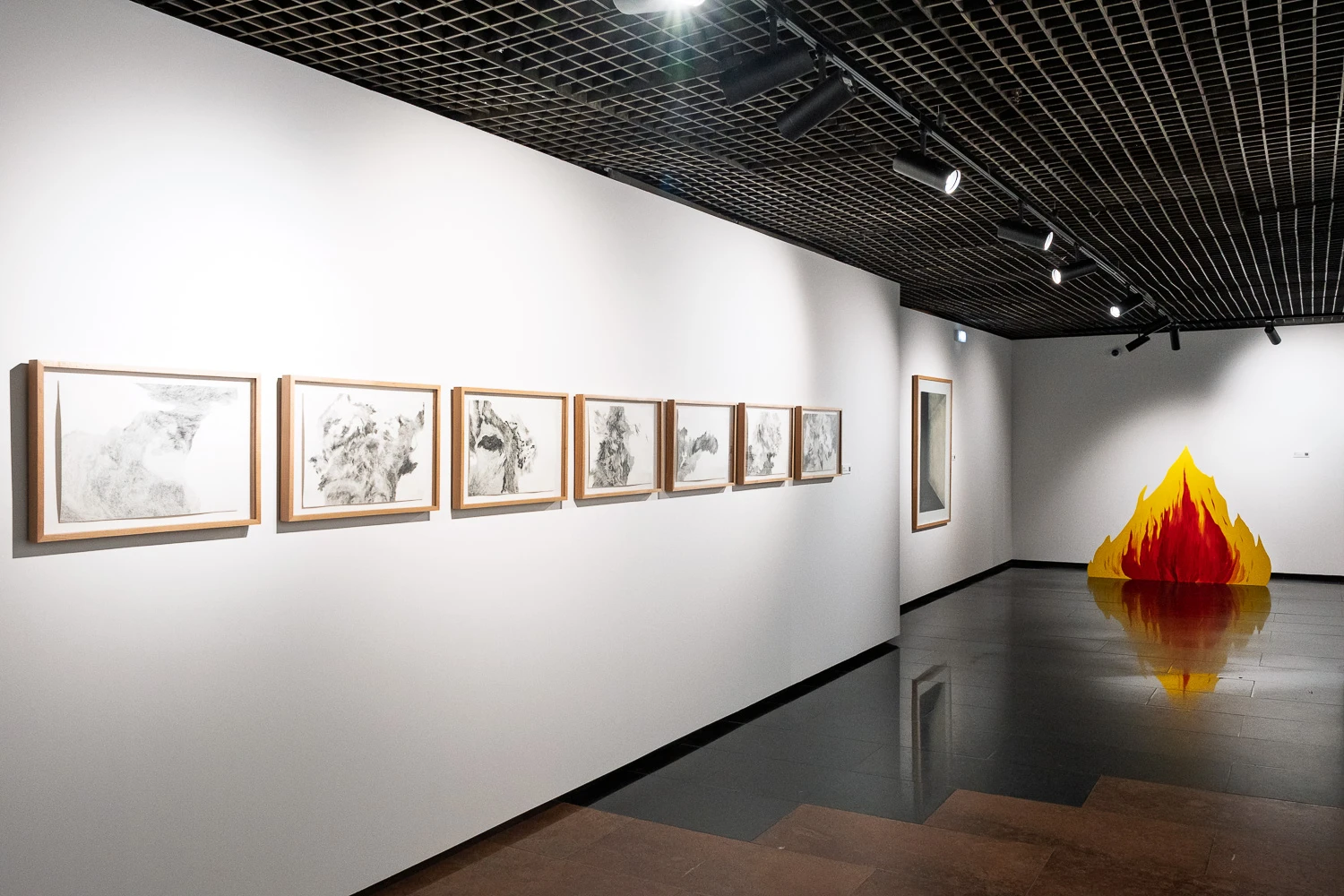
Other similarities are evident between the work Untitled by Fernando Brito, a colourful cruise ship constructed entirely from Lego pieces, and the flamboyant piece Fire (2023) by Ragnar Kjartansson. This work communicates with the outside world when, immediately at the beginning of the exhibition, we examine it, facing the entrance to the exhibition space.
In the first room, we observe a set of drawings by Martinha Maia (2004), positioned in a row, that demonstrate the obstinate repetition of small strokes in India ink. Like furrows inflicted on the white surface of the paper, they invite the visitor to an intriguing investigation into the meaning of the artist's gesture, ultimately concretised by an avid fluidity of cartographic writing and a fleeting recognition of figures, sometimes abstract, sometimes figurative. Works such as "Erros 44" (Mechanical) (1995), by Eduardo Batarda, and the untitled work from the series Ten Orphic Drawings (1997), directed by Maria Tomás, establish a pictorial link throughout the entire collection.
In today's curatorial practices, the criteria are multiple; it is not enough to establish a static exhibition of works of art, or a mere fixation of them in physical terms, but also to trace a reflective path, a critical stance on art, and an encouragement of the articulation and comparison of works of art. Demarcating itself from the traditional curatorial logic of mere passive contemplation of the works, this approach also transcends the chronological boundaries of the works, even though the selection exhibited spans two distinct decades – the 1990s and 2000s – of the 20th century. In this way, Perdurar como Paradoxo dethrones and challenges the linearity of the curatorial narrative, also revealing the diversity of works of art present in the Contemporary Art Collection of the MEO Foundation.
The fact that the exhibition includes a body of work by artists from various generations, with distinct languages, contributes both to the enrichment of the exhibition, currently on display at the MEO Foundation Space, and to the construction of a living History of Portuguese Art, responding to the current challenges of art historiography, as well as the demands of contemporary curatorship.
The mixing of artistic media and supports in this exhibition, as well as the immateriality of the work, can be found in Miguel Soares's digital work ARCHIBUNK3R Associates (2000), as well as in Alexandre Estrela's installation Lazy Eye, created in 1998.
The artist, as has been the norm throughout his artistic career, invites us to an immersive, synesthetic experience of art, where the viewer is challenged, in a perceptual sense, to unravel, layer by layer, the codes and stimuli evoked by the various luminous or physical elements that compose his installations. In Lazy Eye, the artist explores the kinesia of the eye and the saccadic movements it exhibits as the brain seeks to identify new volumes and forms. As Terry Smith tells us: the current curator is not limited to the physicality of space, but to a whole corollary of knowledge that is densified in the past and, simultaneously, extends into the future.
The exhibition Perdurar como Paradoxo also presents works of art grounded in discursivity and "statement." We see works by artists in which the idea, the word, and the phrase are widely represented and evocative of Kosuth's conceptualism, Kruger's claims, and the poetics of Baldessari and Lawrence Weiner.
On a wooden panel covered in formica, Cristina Mateus delivers phrases such as "I have nothing more to say" or "I'm tired, I'm very tired," directing the use of these statements towards the sphere of interiority and human emotion.
Finally, in an interweaving of works that are solidly and coherently articulated, we can also find works by Maria Tomás, Luís Palma, Eduardo Nery, Marta Moreira, Pedro Casqueiro, Pedro Cabrita Reis, and the Black is Black series by Pedro Proença.
The exhibition can be visited until November 13, 2026.
BIOGRAPHY
Carla Carbone was born in Lisbon, 1971. She studied Drawing in Ar.co and Design of Equipment at the Faculty of Fine Arts in Lisbon. Completed his Masters in Visual Arts Teaching. She writes about Design since 1999, first in the newspaper O Independente, then in editions like Anuário de Design, arq.a magazine, DIF, Parq. She also participates in editions such as FRAME, Diário Digital, Wrongwrong, and in the collection of Portuguese designers, edited by the newspaper Público. She collaborated with illustrations for Fanzine Flanzine and Gerador magazine.
ADVERTISING
Previous
article

28 Oct 2026
Where did we come from and where are we going? And what does Portugal have to do with it?- Two exhibitions curated by Sérgio Fazenda Rodrigues in Berlin
By Julia Flamingo
Related Posts
article
29 OCT 2026
Perdurar como Paradoxo, at Fundação MEO
By Carla Carbone
article
23 SEP 2026
Realismo Ilhéu: Marcelino Santos at the Museu do Neo-Realismo
By Carla Carbone
article
10 AUG 2026
Second Cycle of Exhibitions at the Arpad Szenes – Vieira da Silva Foundation
By Carla Carbone
article
06 AUG 2026
Autocolante. Iconografia da Liberdade, at MUDE
By Carla Carbone