article
Passenger Side: Drift, movement
Passenger Side, an exhibition on view at Associação 289 in Faro and curated by Tiago Candeias, brings together works by Inês Brites, José Taborda, Renato Chorão, Regina Silva, and Valéria Martins. The exhibition is structured around the idea of displacement – not only as a drifting sensation during travel or physical movement (evident, for instance, within the two rooms of 289, where the coolness of the brick floor welcomes visitors’ footsteps), but also as an inner journey, traversed in contemplation, guided by the artists’ creations and creative proposals. More than a self-contained space, the passenger’s place is understood as a partial view of the world – it is a side, whose counterpoint is that of the one who guides the journey.
The passenger takes part in the journey, but does not seem to determine the destination. Their status as a traveler depends on the presence of the other, of others – the artworks, the artists. But who is the passenger? The curator, Tiago Candeias, positions himself first and foremost as a conceptual explorer of the exhibition: in the program, with Michel Onfray as his starting point, Candeias explores what he understands by “journey.” He is a passenger who gathers information before boarding–not so much about the places he intends to visit, but rather about the mindset he wishes to adopt upon embarking on the journey. It is a powerful metaphor for reflecting on what the pathways of art are today: subjectivities marked by the instability and fragmentation of what one encounters, yet seeking, in some way, to master the tools of these journeys–which are known in advance to be uncontrollable. This is precisely what Onfray suggests: that the journey begins before the actual movement–it begins in suspension, curiosity, and anticipation, in a voluntary abandonment of familiar references. Tiago Candeias proposes that “family is the first map,” and it is through the work of Valéria Martins–located to the left as one enters the second room–that a path begins to take shape. In the video Agora a Sério | Now for real, the camera fires, as if it were the gun the father teaches her to handle, and captures moments of a family trip that is revisited as moving images. Seated next to the shotgun, in the passenger seat, the artist faces this renewed instrument for capturing life and resumes the journey as an observer. Is it the intimate cartography she is recovering–is it this map that guides her? Childhood images and household settings suggest an archaeology of origin, the excavation of which reveals the family as a place where potential affections and traumas reside. Life’s journey begins in spaces one does not choose, but which one continues to inhabit even after they have disappeared.
The curation avoids the literal notion of travel and points toward divergent, sometimes inverted directions: in the piece Retrovisor by José Taborda – perhaps the one in which the visitor feels most invited to embark – one encounters the challenge of a gaze that multiplies and dissolves, requiring neither a road nor the car for which the mirror (a device that frames games of memory and perception) serves as a metonymy. The rearview mirror compels one to look back in a way that is never head-on, and to shifts that transform the landscape into atmospheres, fragments, and interrupted – or obsolete – gestures. Even when incomplete, or merely symbolized, the car reasserts itself in Banco de carro, also by Taborda – only to reject comfort, to avoid the invitation: the seat is locked, and the passenger finds herself perplexed: how to make the journey?
Each intervention or piece in the exhibition – or each creator – is a waypoint on a free-form itinerary: and each visit is a sequence of approaches, interruptions, and resonances that are suspended and then resumed.
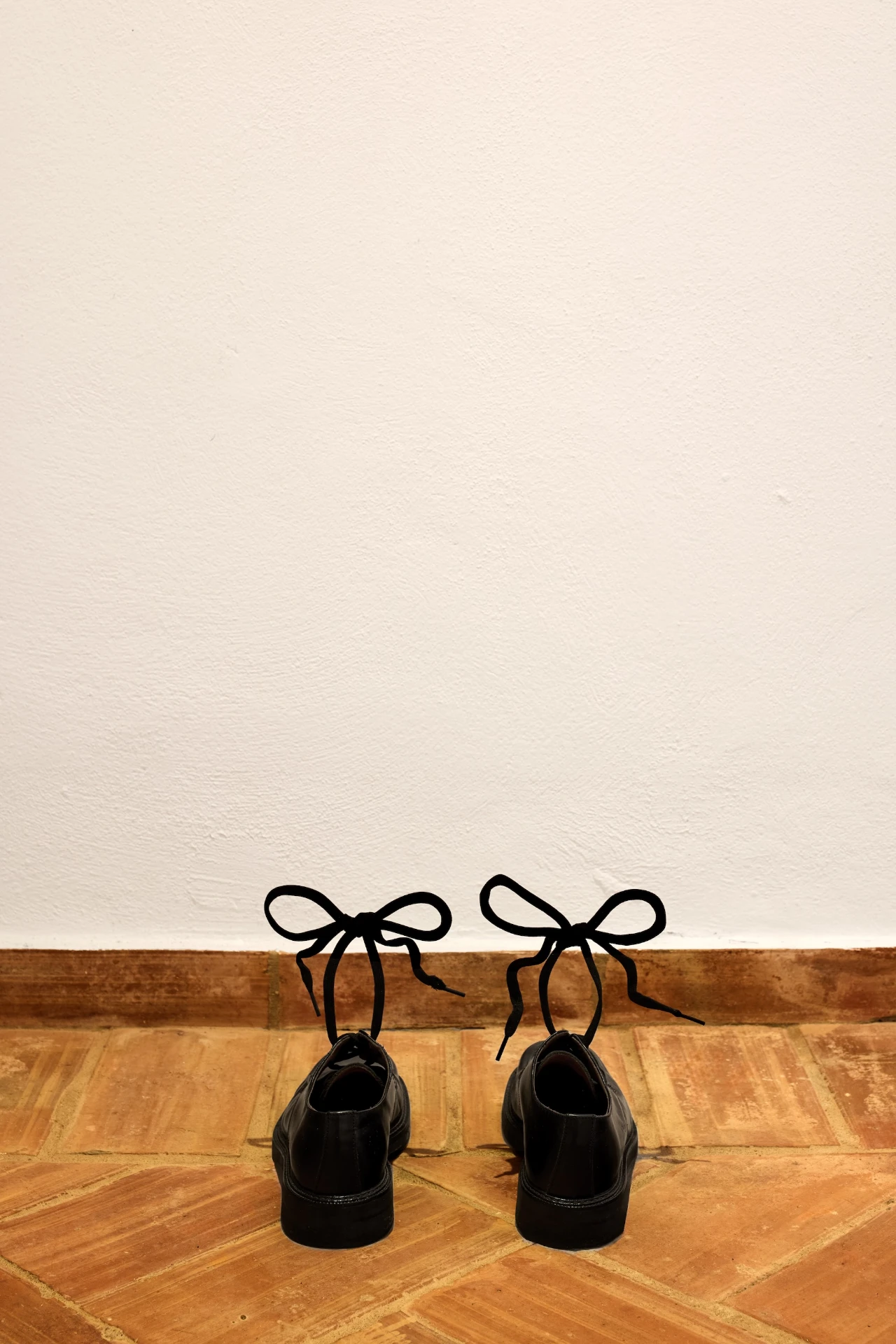
Perhaps these are familiar resonances that the Madeiran artist Regina Silva inscribes with stickers on a handled acrylic panel (the door of a 1997 Volkswagen Polo?), lines that depict cartoons, black-and-white memories of a childhood whose journey she wishes to restart – or perpetuate – through line and transparencies? There are three pieces by Regina Silva in the exhibition: in addition to this sort of door that stands in the way of the gaze, perpendicular to the wall and the floor (a position the artist revisits from earlier works), suspended in a space she has neither closed off nor opened up, the shoelaces from Misstep – a misstep that immobilizes them in the corner of the first room–magically suspend themselves in the air, once again a mark of movement captured in the impossibility that confines the watercolor and self-adhesive vinyl of Punch yourself in the face (the most recent work on display) to the two frames. The caricatured violence of the title directs the visitor’s attention back to herself, to a form of self-sabotage – a frustration so common to journeys one wishes to undertake from closed, internalized contexts.
Inês Brites’ two works suggest a brief, silent shift within the exhibition itself: be extra careful with heartfires (hold) and Falta de comunicação | Miscommunication (both from 2023) engage in a dialogue with one another and, in doing so, create an explorable space – from a basin filled with cloths in the center of the room to other cloths leaning against the two corner walls – the visitor wonders how they moved from one to the other, what materials and colors flow from the wax, cotton, and pigment into those objects of intermittent existence. However, the tension of these questions encounters the obstacle of “miscommunication” when the visitor, guided by curiosity, approaches and discovers a telephone (another inoperative, obsolete object) inside the basin. Communication implies movement, but movement does not guarantee successful communication, and the two pieces persist in drawing closer and pulling apart in this ever-tentative dialogue.
Renato Chorão’s three pieces insist on the possibility of a dialogue that continues to demand movement between different places. On the same wall, or from one wall to another, there are visual elements that stand out and isolate themselves: Um lenço molhado no lençol da cama do meu quarto (2024) is a white heart that travels from the piece i love you um ano depois (2022) – an inkjet-printed image of a wall inscribed with love declarations interrupted by the voids of multiple white hearts (the heart from 2024 could have been cut out, in another medium, from the 2022 image). The curator describes the most recent piece as a “crumpled handkerchief that can serve just as well to dry tears as for any other act of shared intimacy in bed as a personal and intimate space,” suggesting an ambiguity in which the format does not assert any sentimentality, but rather affirms “the place where these experiences dwell” – it is space that these pieces speak of, the place they occupy, the journey they demand of the visitor, whether in the gaze of the moment or in the memories evoked that revisit territories of relationships and intimacies. The urban graffiti i love you… may, after all, contain many people’s emotional archive, for the insistence of the inscription declaring that love on a dilapidated wall reveals the city as a surface for affective inscription, a space where ephemerality desperately seeks to be recorded as permanence. But it is precisely this difficulty–or this impossibility of permanence – that IOS16 suggests: a mirrored surface shaped like a small star; the piece reproduces the front view of a cell phone–engaging in a dialogue with the “communication failure” of the phone seemingly hidden within Inês Brites’s piece.
If, at the end of the 17th century, the writer Xavier de Maistre suggested traveling around one’s own room, and if, a few decades later, Almeida Garrett rejected that immobility and, in an ironic gesture, wrote a book about his travels through his homeland, Ana Cláudia Santos begins the first short story in her book A Morsa (2026) as follows: “I’ve been spending much of my free time reclining on the couch, with my laptop on my lap, traveling on Google Street View. Some people do this to visit our little world, mapped in its entirety online.” The mobile device offers the possibility of traveling without leaving one’s seat–but what journey is offered by that suspended phone, constantly updating and out of one´s hand’s reach, which could otherwise allow one to explore its interactive surface? All journeys are made up of possibilities and impossibilities, and a passenger is nothing more than someone who is carried along and must adapt to what the vehicle, the driver, or the road imposes upon them. In this curatorial project, Tiago Candeias entrusts his fate as a passenger to five artists; yet the means of transportation or communication that these artists impose on their passenger lead instead to dead ends of doubt–suspended questions whose answers can only be formulated as shared drifts experienced equally by drivers and passengers alike.
The exhibition is on view until June 27 at Associação 289 in Faro.
BIOGRAPHY
Ana Isabel Soares (b. 1970) has a PhD in Literary Theory (Lisbon, 2003), and has been teaching in the Algarve University (Faro, Portugal) since 1996. She was one of the founders of AIM – Portuguese Association of Moving Image Researchers. Her interests are in literature, visual arts, and cinema. She writes, translates, and publishes in Portuguese and international publications. She is a full member of CIAC – Research Centre for Arts and Communication.
ADVERTISING
Previous
article
18 Jun 2026
Olho de Vidro, by Pedro Barassi: The Gravity of the Gaze
By Ayşenur Tanrıverdi
Next
agenda
22 Jun 2026
UmbigoLAB Call: Art residency UmbigoLAB @ Casa de Mateus Foundation 2026
By Umbigo
Related Posts
article
14 SEP 2026
Space and time: lugar-depois, at Museu Zer0
By Ana Isabel Soares
article

09 SEP 2026
The Elusiveness of Time: on the exhibition ‘Uma Árvore’ by Daniel Moreira and Rita Castro Neves at the Palácio da Galeria in Tavira
By Ana Isabel Soares
article
26 AUG 2026
Museu das Expectativas, by Pedro Gomes: What is a museum?
By Ana Isabel Soares
article
19 JUN 2026
Passenger Side: Drift, movement
By Ana Isabel Soares