article
complexo brasil, at the Calouste Gulbenkian Foundation
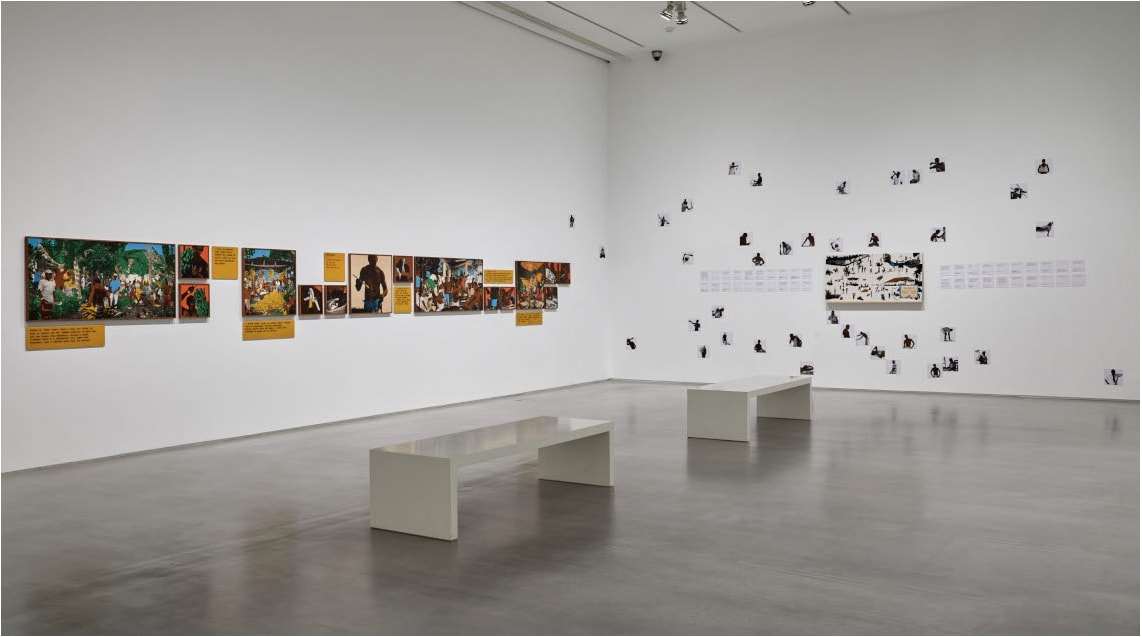
“Curated by José Miguel Wisnik, Milena Britto, and Guilherme Wisnik, the complexo brasil brings together works of art, historical archives, and audiovisual installations produced for the occasion, which features extensive parallel programming and a catalog with five essays. In a non-linear temporality, the exhibition unfolds in interconnected sections, weaving dialogues between generations of artists and movements in Brazilian art, as well as fissures and dichotomies that mark the construction of Brazil and its relationship with Portugal.”
In the lobby of the main building of the Calouste Gulbenkian Foundation are the colors of the Brazilian flag. As a prologue to the exhibition complexo brasil, the choice of literalness provokes an ambiguous sensation. Emmanuel Nassar's A Bandeira (2011), deconstructed and reorganized, introduces the idea of a new reading – another way of seeing – opening space for fundamental perspectives. Jaider Esbell's Carta ao velho mundo (2018-2019) begins the exhibition.
The enormous panel – a four-hundred-page book on the history of European art, reinterpreted and overlaid with contemporary Indigenous art – raises the fundamental question: who has always narrated history? The emphasis on Indigenous art and cosmogony in this initial phase brings, alongside ritual objects and contemporary works, a video recording of the Tupinambá Cloak (1500), whose return from Denmark to Brazil in 2024 is a historical landmark and evokes the ancestry, memory, and strength of the Tupinambá people, inscribing the presence and resistance of the original peoples. In contrast, the painting Índio Tarairiu (Tapuia) (1641), by Albert Eckhout, addresses the ethnological-colonial perspective on those who inhabited the territory long before it was called Brazil. It is noteworthy that ancestral artifacts from various ethnic groups – who persist in an intense struggle for survival, land demarcation, and forest preservation – remain in the possession of European museums.
Curated by José Miguel Wisnik, Milena Britto, and Guilherme Wisnik, the complexo brasil brings together works of art, historical archives, and audiovisual installations produced for the occasion, which features extensive parallel programming and a catalog with five essays. In a non-linear temporality, the exhibition unfolds in interconnected sections, weaving dialogues between generations of artists and movements in Brazilian art, as well as fissures and dichotomies that mark the construction of Brazil and its relationship with Portugal.
Counterpoints inherent to a history marked by violence and resistance run through the exhibition. Alongside graphic records of the predatory and extractive occupation of the Amazon, Quintal (2020), by Uýra Sodoma, converses with Entidades (2021), by Jaider Esbell, which grandly occupy the Gulbenkian garden. From the abundant nature delineated by Burle Marx in Mata Atlântica (1991), we move to Distopia Amazônica (2012-2021), by Lalo de Almeida. Face to face, the engravings of Debret – which capture a colonial and slave-owning Brazil of the 19th century – meet the series Atualização Traumática de Debret, by Gê Viana, in which the artist reinterprets the same scenes.
There is a reclaiming of spaces – both institutional and within the very regimes of representation – and narratives of identities that, throughout history and even today, face continuous attempts at erasure by colonial logic and its practices of cultural, political, and epistemological domination. By shifting the hegemonic gaze, experiences, memories, and knowledge are rewritten from their own perspectives, encompassing their diversities and subjectivities.
Só vou no Leblon a negócios (2016), by Arjan Martins, is a large-format painting. Suspended, it extends across the gallery floor. The artist changes the map's geography; at the center is not Europe, but the Atlantic Ocean—the route between the African and American continents, which more than ten million people were forced to cross. The sculptures IWIN OLÁ ATI EYE LOKE - Majestosos ancestral da árvore com um pássaro no alto - OMOLU (1978) and IWIN IGI N’LA - Grande espírito da árvore (1979), by Mestre Didi, relate vertically and in color to Arjan Martins' painting, reflecting how, in the face of colonial imposition, Afro-Brazilian religions became a space for creation, autonomy, and identity affirmation.
In the resonance of spirituality, the encounter with the Manto da Apresentação, by Bispo do Rosário, and the Igreja Nossa Senhora do Rosário dos Pretos (2023), by Elian Almeida. The Catholic influence and religious syncretism. Displayed in a large glass case, we are immersed in the magnitude of the mantle, a chessboard of symbols and names mirrored on its reverse, while, in Elian Almeida's painting, the gold of the historic church of the black brotherhoods shines, a symbol of resistance and reinterpretation of Catholic rituals from African roots.
In the background, movements that directly engage with European artistic avant-gardes, such as Brazilian modernism and neoconcretism, are evident. In Nuno Ramos's installation Cruz Negra (2025), Malevich's cross is gradually erased, completely transforming itself by the end of the exhibition. In this melting pot – of a Brazil that is indigenous, African, and European – the country's potential for transformation and reinvention is reaffirmed, where the constituent forces are multiple.
The space is used in a completely different way on the lower floor. Upon descending the stairs, the public is greeted by a projection of O peixe (2016), by Jonathas de Andrade. Interspersed with three installations are the final immersive video rooms that complement the exhibition. A multisensory environment plays with the contrast of sensations, with the presence of the body, and invites the viewer into Brazil.
The fragility of the moment in which the Brazilian complex is inaugurated in one of Portugal's largest art institutions makes it even more urgent. In the current socio-political context, marked by hate speech and intolerance, the value and emotion of an exhibition like this is paramount, especially for Brazilians who, like me, live here. I returned several times to fully grasp the size and depth of the exhibition, and on each occasion, I couldn't hold back tears. This vast and emblematic journey through Brazilian culture reveals, among many layers, an opportunity to broaden awareness of Brazil by invoking a reclaiming of its own history.
The exhibition complexo brasil is on display at the Calouste Gulbenkian Foundation until February 17, 2026.
BIOGRAPHY
Ana Grebler (Belo Horizonte - Brazil) is an artist, curator and writer. Graduated in Fine Arts at the State University of Minas Gerais (UEMG) and postgraduate in Art Curatorship at Nova University of Lisbon (FCSH). Participated in group shows in Brazil and organized the exhibitions Canil (2024), Deslize (2023) and O horizonte é o meio (2022), in Lisbon. Contributes with Umbigo Magazine with essays, reviews and interviews, and works on the platform's international partnerships. At the intersection of practices, reflects on contemporary visual culture, creating dialogues and imaginaries between spaces and artistic processes. Currently lives and works in Lisbon.
ADVERTISING
Previous
article
 [A] Alexandra Bircken, [L] Culturgest-lehev.jpeg)
14 Jan 2026
Second Skins, Hybrid bodies: Alexandra Bircken at Culturgest
By Orsola Vannocci Bonsi
Next
agenda
16 Jan 2026
Anniversary of Art, on 17 January, at CAM
By Umbigo
Related Posts
article
15 JAN 2026
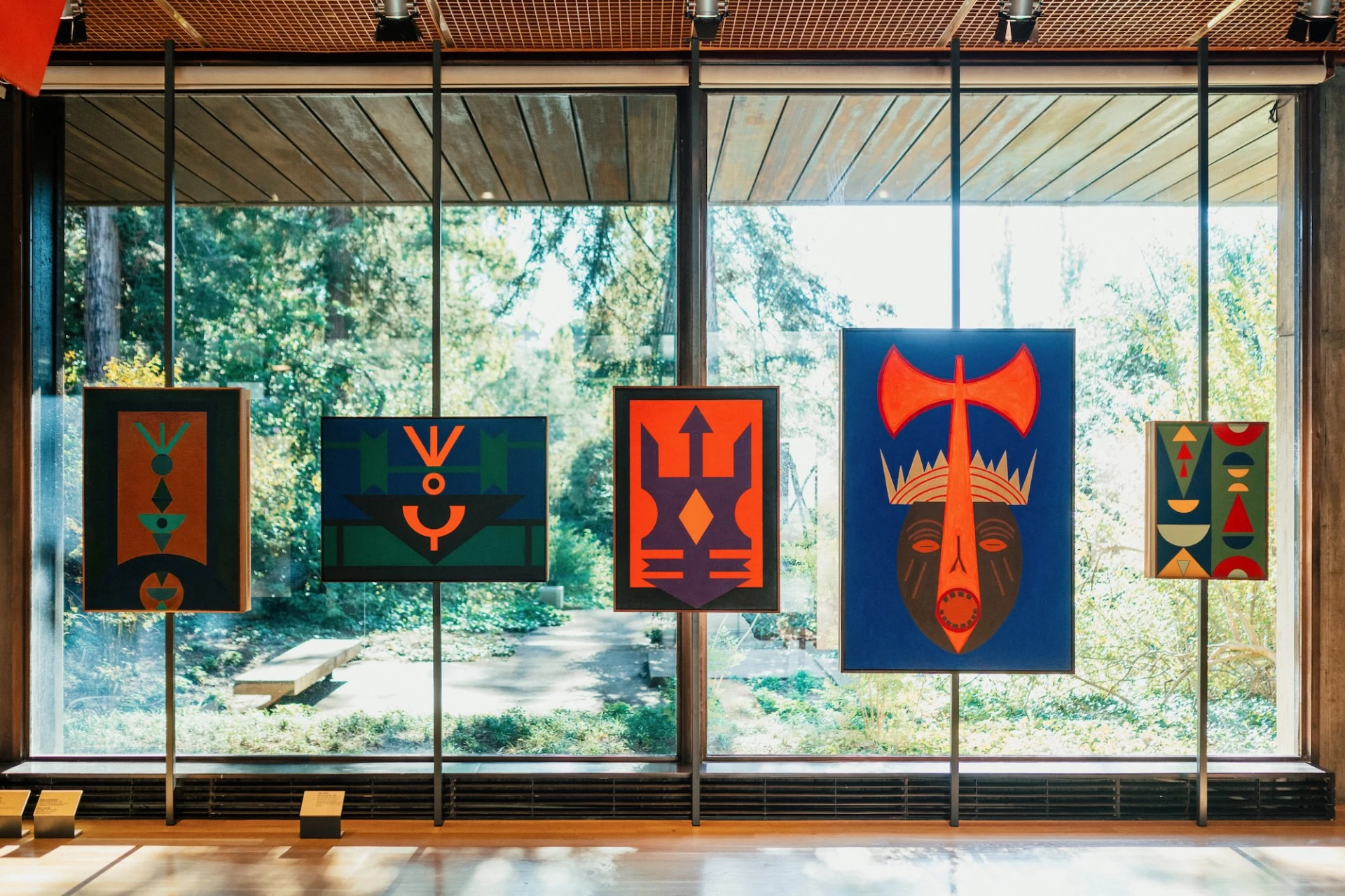
complexo brasil, at the Calouste Gulbenkian Foundation
By Ana Grebler
article
08 OCT 2024
Apertura Madrid Gallery Weekend 2024
By Ana Grebler
article
28 JUN 2024
Walk&Talk 2011-2022: what you don’t know is worth discovering – Interview with Jesse James and Miguel Mesquita
By Ana Grebler
article
29 SEP 2023
Apertura Madrid Gallery Weekend 2023
By Ana Grebler