article
Intervalo, by Eduardo Matos: the first step in a station that has already passed
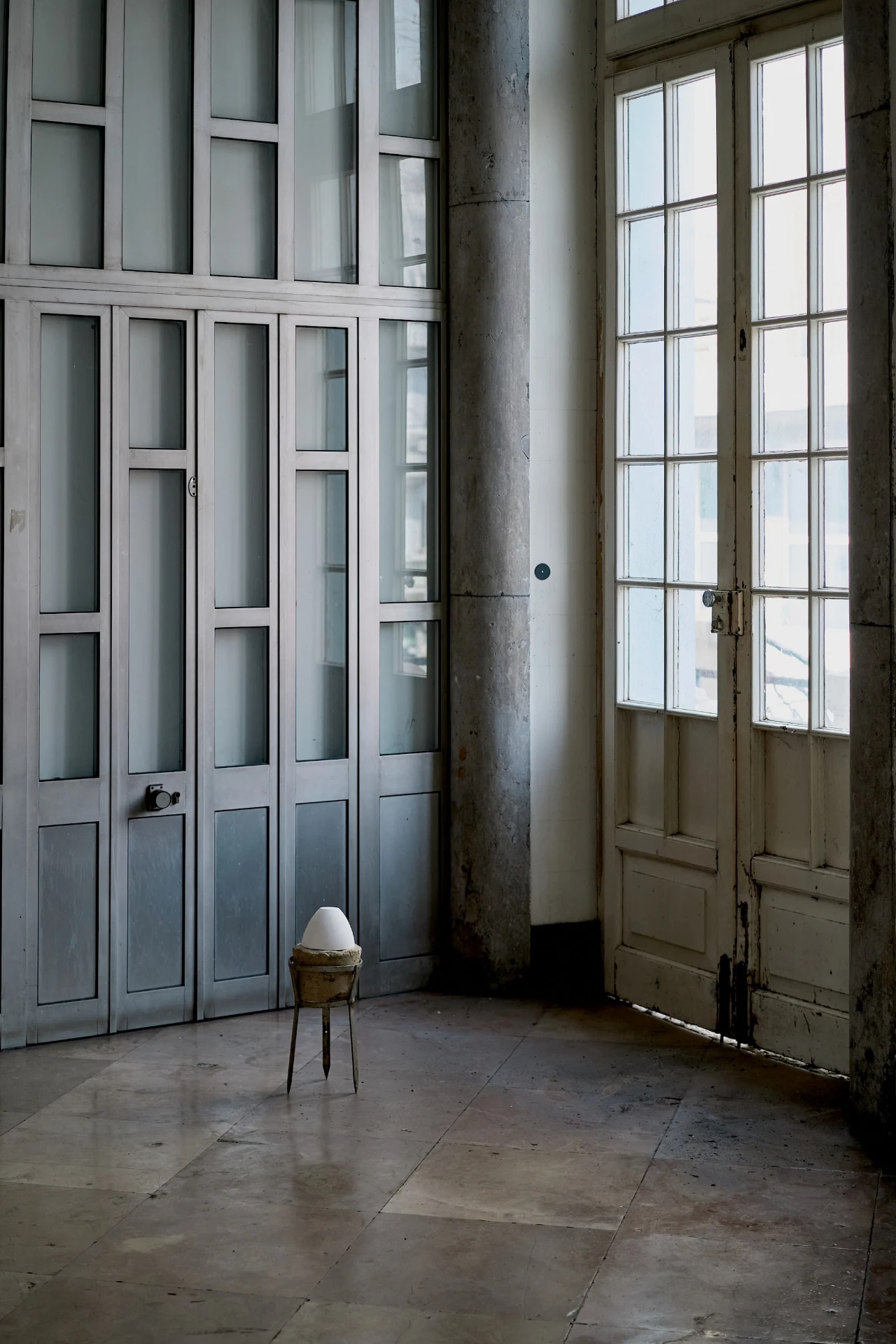
"The interior of the Estação Nova train station is now the site of Eduardo Matos's latest exhibition, systematically focused on observing a deactivated, disconnected space in a region progressively marginalized by the degradation of access to the city. Curated by Jorge Simões and produced by the Centro de Artes Visuais, the artist occupies the facade area with the axis oriented to the southeast, intertwining the artistic process and signs of life in a continuous exchange between both sides, in a space displaced by the movement of things, unfinished, "a starting point," in his words, elaborated around the letters that make up the parenthesis that the title opens — intervalo (interval)."
There was a time when everything repeated itself like a stream of water, under the enormous clock hands that stood still for long periods, accumulating a portrait of the passing days. It has been just over a year since that exit was closed, after about a century running along the same coordinates, with the end of the railway connection to downtown Coimbra.
The interior of the Estação Nova train station is now the site of Eduardo Matos's latest exhibition, systematically focused on observing a deactivated, disconnected space in a region progressively marginalized by the degradation of access to the city. Curated by Jorge Simões and produced by the Centro de Artes Visuais, the artist occupies the facade area with the axis oriented to the southeast, intertwining the artistic process and signs of life in a continuous exchange between both sides, in a space displaced by the movement of things, unfinished, "a starting point," in his words, elaborated around the letters that make up the parenthesis that the title opens — intervalo (interval).
The central atrium, flanked by two circles intersected by other forms, comprises parts of bodies bent by the weight of their homogeneous matter. The sculptures, made of clay extracted from the river, are unique and raw. They are mouths sculpted by time or proverbial marks already highlighted by the puppeteers, rising from a layer of phluvia on supports of varying heights, organized by a colorful cadence, contrasting with the ironwork of the station. The freshwater species pass, from their materiality, into soft pigments, recovering, beyond the staircase, the diversions of the shoal of fish. Evidence of certain aspects of what once was is evident in the preserved urban dystopia, as if its walls had been demolished, amidst rumors of a return to the deluge.
Unveiling the center of one of the old waiting rooms is the exhibition's eponymous video, developed over eight years, filling it with various cave-like formation features. The device's limitations and materiality corrupt the understanding of the lost objects, which, forgotten in their use, cease to meet the expectations attributed to them. We encounter them from the collector's point of view, images that suspend contact, that function as electroacoustic signals and sonic possibilities, imbued with a distance in the perception of these instruments, of an imagined listening.
Molded between two sculptural pieces, the path trodden from the depths is finally reconstituted in the identification with the findings of the disturbed places of enunciation, from where roots were formed. The work of observation and documentary projection of the form of fiction is fueled by the numerous notebooks filled with bestiaries, more than phantasmagoria, for the sketches of a stained-glass composition.
On the opposite side, a disc rotates above the blue of the tables arranged at right angles, seemingly supporting a temple with various offerings, including a wooden cushion, a kind of prototype for a transported spaceship, and beneath this plane, suspended, three sedimentary formations. The composition Three-eyed fish (2008–2020) takes its name from one of the drawings exhibited there, a record of a mutation in the form of a parietal eye, of such refined detail that it resembles a primitive vertebrate inhibited by light in the face of the severe impacts on marine biodiversity and the health of the planet.
The intrusions of objects as replicas contaminate the space through alliteration, which is constructed in a connection that is both telluric and universal, like a vestigial organ with a bilateral and symmetrical skeletal system, similar to that structure from which it is still possible to hear the trains. The exhibition branches out into adjacent areas, in the artist's notes camouflaged among the informational notes and signage of the evacuated information posts. Added to this performative dimension is the presentation of Eduardo Matos's sound project with André Cepeda, in collaboration with Jonathan Uliel Saldanha, on the closing day.
The emphasis on the function of an image reproduction machine extends to intrusive objects and deepens in their implicit enumeration, in studies of the problems raised by the passage of light, tests of gradients or metallic vapors, elemental analyses of the ore, without, however, ensuring a collection free of impurities. An interrupted breathing pattern on the surface reveals the meditative gesture of autobiographical approach to the distant. One imagines, as in Poe's poem, the sigh of Cicero: O, Tempora! O, Mores!
The narrative diluted within this interior space draws a parallel with the contemporary derivation of the "place of memory" idealized by the historian Pierre Nora in the work Les lieux de mémoire (1984–1992), based on the subjectivity that produces it, as a space or event, in the sense of what is developed, essentially, by the affective intersection of collective memory, outside of a historiographical constitution that impassively situates it.
Intervalo reveals an abyss about what is denied to us, an outcome that had been expected, to which elegies were dedicated by those who saw it as a starting point, a necessity for fulfillment. From a territory in transition, traversed through the exhibition device, to an expression of intensity that unfolds it as a legacy and a part of an infinite time, a sequence is drawn, linked by a slow gaze upon the nature that reflects it.
Intervalo, by Eduardo Matos, is open from July 21st to September 13th, at Estação Nova, in Coimbra. More information and the complete program can be found at www.veraoa2tempos.pt.
BIOGRAPHY
Master's student in Curatorial Studies at the University of Coimbra, where she graduated in Art Studies with a specialisation in Film Studies and a minor in Philosophy. Postgraduate degree in Cinema and Audiovisual Studies from the Escola Superior Artística do Porto. Committed to experimental arts with a focus on multimedia artistic projects and the relationship between sound and moving images, themes explored in cultural programming, sound production and voice-over work in radio practice linked to Rádio Universidade de Coimbra.
ADVERTISING
Previous
article
13 Aug 2026
Reaching the fata morgana, by Inês Mendes Leal, at the Boavista Gallery
By Tomás Saraiva
Next
article
18 Aug 2026
The distant work: Ana Vieira at Galeria Vera Cortês
By Tomás Camillis