article
Sweet Dreams, at OSTRA practice
"While Sweet Dreams features very different artistic practices that might have been brought together through an exercise in "what if" rather than an accurately constructed narrative, they nevertheless seem to have a great deal in common, including an interest in building and revisiting archives (understood here in the broadest possible sense), as well as a careful attention to immediate material reality that allows room for accidents and chance encounters."
As a teenager, in a rather stereotypical fashion, I loved to decorate the walls in my room with posters of pop stars, photographs of myself, my family and friends, and museum postcards I used to collect. One postcard that ended up beside my bed (which I thus spent a great deal of time looking at) featured Samuel Beckett's famous quote, “Ever tried. Ever failed. No matter. Try again. Fail again. Fail better.” At the time, I was blissfully unaware of the ways this phrase would be absorbed into the capitalist belief system, in which failure is seen merely as an annoying but instructive hiccup on the way to success. Instead, I was intrigued by the agency that failure itself can carry – by its ambiguous nature as something that can hold both disappointment and beauty, and allow meaning to emerge from the unforeseen.
In a way, the group exhibition at OSTRA practice, Sweet Dreams, came into being through a moment of such “failure”. In the beginning, Bartolomeu Santos, artist and founder of OSTRA, planned for Jennifer Bennett, Tim Cierpiszewski, Colin Ginks, and Rodrigo Rosa each to have a solo exhibition in the space. This plan never materialised and transformed into a new proposition envisioned by Bartolomeu and supported by the artists – to bring their four practices into dialogue, while trying to keep some of the original ideas they had for the solo shows. The word chosen to underpin the exhibition was, however, not failure, but dreams – another way of describing something imagined but not fully realised. According to Bartolomeu, he was especially drawn to the capacity of dreams to linger: “I mean, how do you destroy a dream? If you're already dreaming, you can never destroy it because it's still on your mind and there are always bits of the dream that still exists.”
Rather than something experienced during sleep, a dream here refers to a thought that is consciously envisioned, perhaps born in daydreaming. In her text on artistic research and the relationship between knowledge and art, curator and art historian Chus Martínez revisits Gaston Bachelard’s thinking on daydreaming1. Here, this practice is understood as a mode that enables thought to oscillate between different logics while remaining radically open to what does not yet exist, thus being a constitutive space that makes room for thinking beyond this world and building new ones. For Martínez, art operates in this very domain of productive uncertainty, marked by “a constant exchange between different systems that vacillate between the abstract and the concrete”2, with daydreaming becoming one of its essential operations.
While Sweet Dreams features very different artistic practices that might have been brought together through an exercise in "what if" rather than an accurately constructed narrative, they nevertheless seem to have a great deal in common, including an interest in building and revisiting archives (understood here in the broadest possible sense), as well as a careful attention to immediate material reality that allows room for accidents and chance encounters.
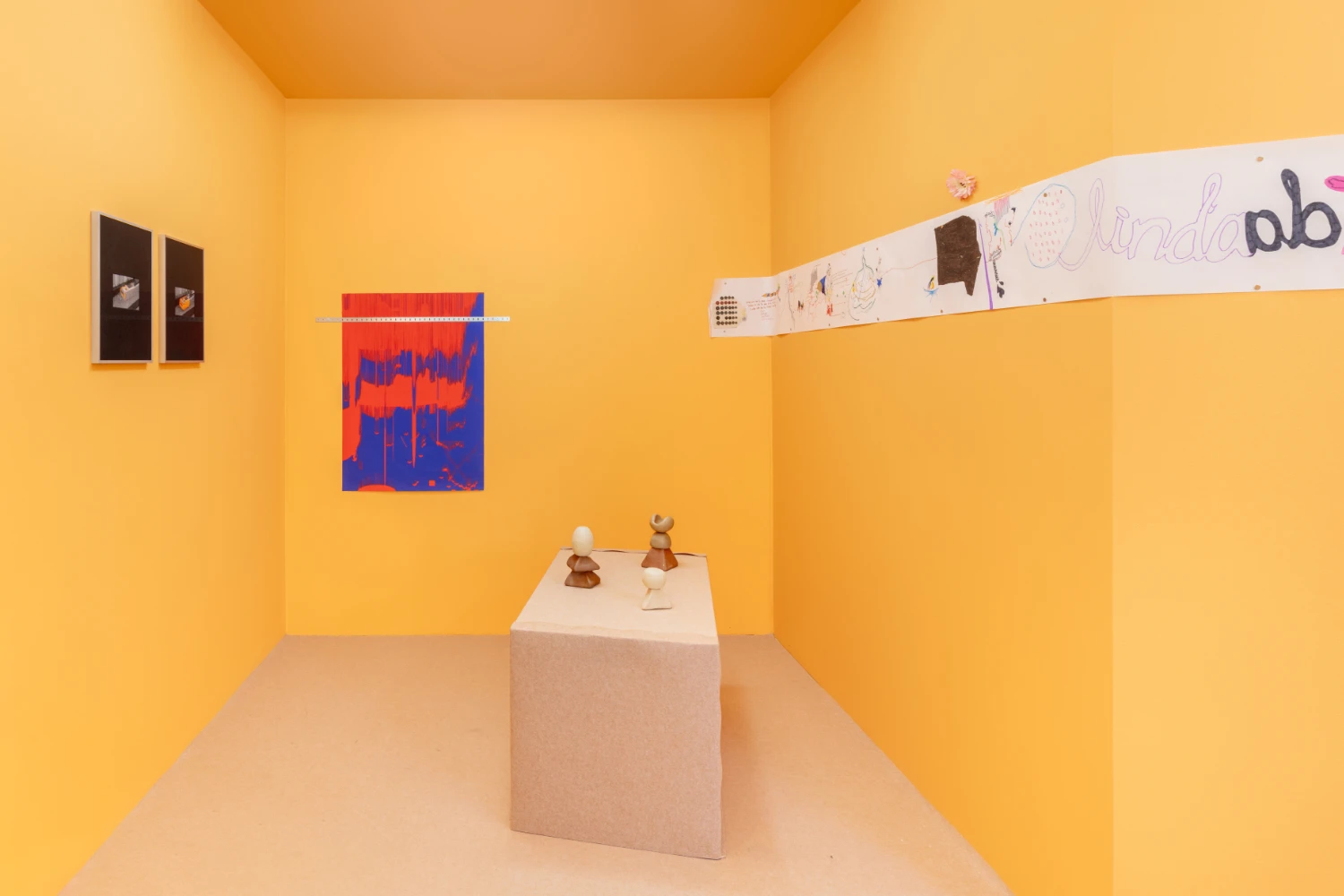
Jennifer Bennett’s objects from her Fragile Balance Games series (2025–2026) embody the artist’s exploration of clay and its diversity as a material. For Bennett, no two clays are alike, as each reflects the unique soil composition of its place of origin. The playful sculptures featured in Sweet Dreams are made from unfired clay found in the Penacova region, where the artist currently lives. These objects are also, as Bennett herself calls them, shape-shifters that are never static, as their elements can be easily reassembled into new random forms.
Tim Cierpiszewski’s artistic inquiry concerns itself with image production and unfolds through his work with digitally generated image archives, which serve as the source material for his paintings and installations. At the same time, his work is always site-responsive: he engages with the exhibition space conceptually, as well as practically. For instance, as part of the research for his new work Untitled (2025), created for the exhibition at OSTRA, a new measured survey of the space had to be carried out, and a reference to this process intervened with the surface of the artwork itself.
Rodrigo Rosa’s photographic diptych Untitled (2026) presents two close-ups of urban industrial structures – pareidolic concrete blocks marked by splashes of orange. These images originated from a random encounter that took place five years ago. As the artist recalls, at the time he was focused on the colour orange in his paintings so these objects naturally caught his attention. Within Sweet Dreams Rodrigo Rosa approaches these images anew. Being rediscovered by the artist while he was revisiting his archive within a broader attempt to recontextualize it, they now appear situated within his ongoing research of the ways human presence leaves traces in the urban landscape.
Colin Ginks’s projects draw on a personal archive of memories and experiences that fuel his multidisciplinary practice. For the exhibition at OSTRA, he created a four-metre-long site-specific mural on paper incorporating found objects, drawing, collage, and text into a non-linear yet interwoven narrative. Responding to the exhibition concept, he embraced daydreaming as an artistic process, allowing his imagination to “run” and seeing “where it took [him]”, encountering darkness, poetry, and ambiguous symbolism along the way. Ginks describes his practice as driven by a desire to break with the expected and the familiar, a principle that manifests itself both in the foundations of his practice and in immediate artistic decisions, such as a flower escaping the paper roll and extending onto the wall above.
The approach to working with the space in Sweet Dreams was not exempt from the spirit of uncertainty and chance running through the exhibition concept and the individual artistic proposals. In order to choose the wall colour, Bartolomeu Santos invited each participant to share their preference. Rather than selecting a single colour or assigning a different shade to each wall, he discretely mixed all of them into one and painted the entire space with the resulting blend. This experiment yielded a pleasant deep yellow, but could have equally resulted in a less eye-pleasing colour. Would it then have been considered a failure? Possibly, but maybe no matter – whether harmonious or discordant, the gesture would stand equally as a productive experiment and a testament to the leap of faith essential to (day)dreaming, to practising the common, and to the creation of a shared space within a group exhibition.
1 Chus Martínez, The Complex Answer: On Art as a Nonbinary Intelligence (London: Sternberg Press, 2023), pp. 69–70.
2 Ibid., p. 69.
BIOGRAPHY
Katya Savchenko is a curator, professor, and cultural producer based in Moscow, Russia. She graduated from the Moscow Higher School of Economics in 2011 and completed her Master's degree in Arts Management and Cultural Policy at Goldsmiths University in London in 2014. Currently, she works as a junior research curator at the Garage Museum of Contemporary Art in Moscow. Along with Valentin Diaconov, she is a mentor for the Garage 2021/2022 scholarship program, supporting emerging artists. Katya Savchenko is also the coordinator and professor of Arts Management in the Master's program in Curatorial Practices in Contemporary Art at the Moscow Higher School of Economics. In 2014-2015, she was head of production for the 6th Moscow International Biennial of Contemporary Art, How to Gather, curated by Bart de Baere, Defne Ayas, and Nicolaus Schafhausen. In 2017, she was an award-winning artist-in-residence at Tensta konsthall in Stockholm, as part of the EUNIC program supporting emerging Russian curators. Katya Savchenko has also collaborated as an independent curator with the Osnova Gallery in Moscow and the Futuro Gallery in Nizhny Novgorod.
ADVERTISING
Previous
article

29 Jul 2026
Shortlist for the FLAD Drawing Award 2026
By Umbigo
Next
article
30 Jul 2026
Excess and Silence
By Tomás Camillis
Related Posts
article
 11.53-mk8cv.jpeg)
15 SEP 2026
One Million Points of Light: Alfredo Jaar at Galeria Francisco Fino
By Katya Savchenko
article
29 JUL 2026
Sweet Dreams, at OSTRA practice
By Katya Savchenko
article
10 JUL 2026
João Penalva at Culturgest: Characters and Players
By Katya Savchenko
article
![Notas de Rodapé [Footnotes], at Jahn und Jahn](https://umbigo.s3.us-east-1.amazonaws.com/public/space/rodapé 1 -y0ecj.jpeg)
04 MAR 2026
Notas de Rodapé [Footnotes], at Jahn und Jahn
By Katya Savchenko