article
Writing the Crystalline Field of Collectivity: The Second Shadow at ICA Milano
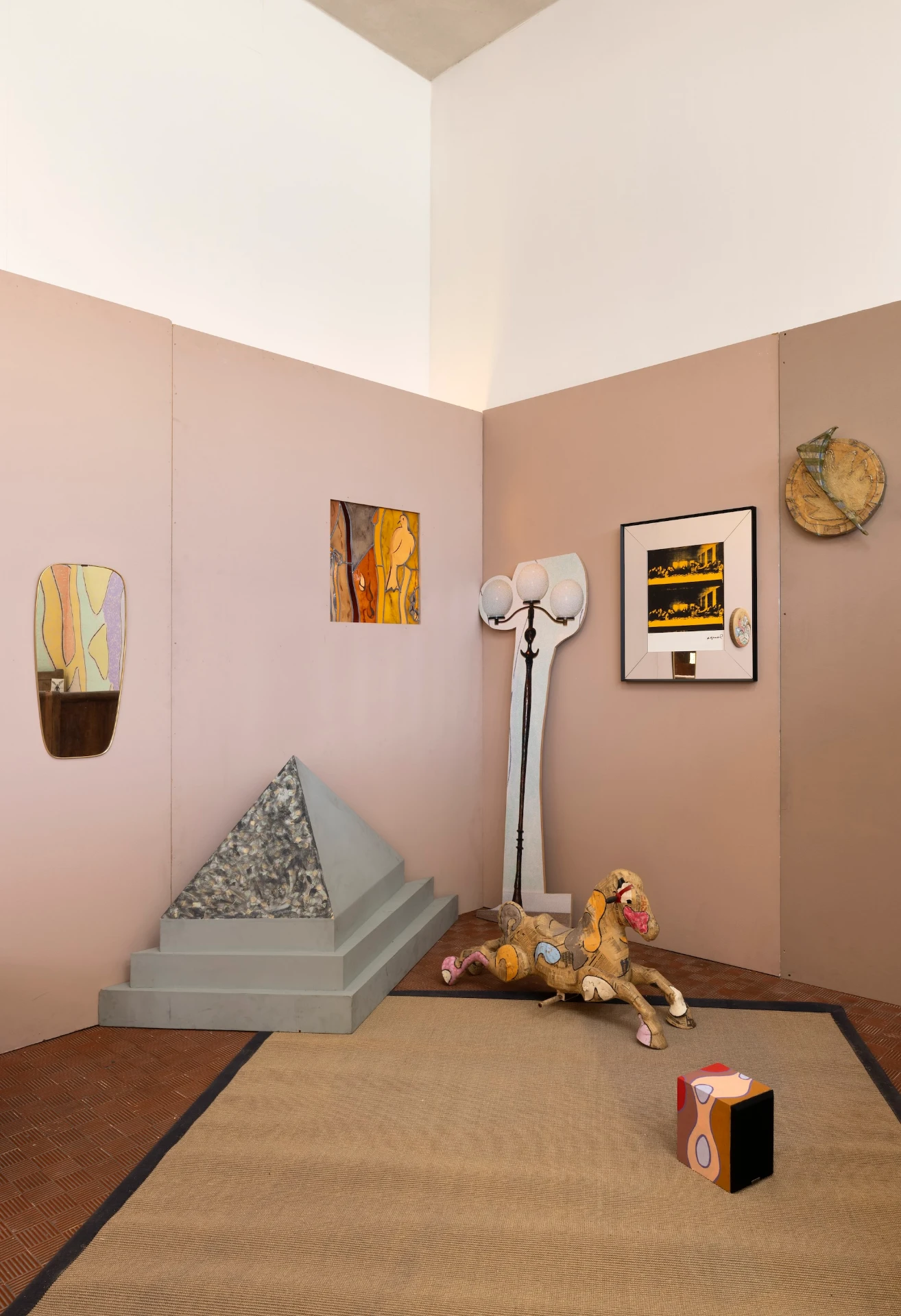
What might it mean to map “The Space of Literature” onto The Second Shadow: Dozie Kanu / Mirroring: Marc Camille Chaimowicz / Shared Echoes and Kindred Spirits not as an external interpretive framework, but as an immanent condition of its spatial and temporal organization? What Maurice Blanchot theorizes as “l’espace littéraire”—a domain structured by withdrawal, indeterminacy, and perpetual recommencement—finds here a material and curatorial analogue. Simultaneously, this Blanchotian space may be rearticulated through the concept of a crystalline field of collectivity, wherein discrete elements coexist as interdependent facets, generating meaning through reflection and refraction rather than synthesis. The exhibition thus unfolds at the intersection of these two epistemological and spatial paradigms: the space of literature and the crystalline field.
The iterative structure developed by Marc Camille Chaimowicz—repeated across multiple instantiations, each incorporating new participants while retaining scripted vestiges of prior configurations—foregrounds recursion as a primary organizational principle. The room conceived by the artist has a recipe and operates through return, variation, and displacement. Its installation at the ICA is the ninth time. In this sense, it aligns closely with Blanchot’s assertion that a literary work does not originate in a singular moment but continually reopens its own beginning. Blanchot’s formulation is instructive here:
“By the end, the reader is able to make out some important questions… This gratifying process, however, leads to where one thought it began… as though one were just now… ready to begin approaching it.”
This dynamic is materially instantiated through Chaimowicz’s longstanding engagement with theatre and domesticity. The exhibition constructs interiors that function simultaneously as lived environments and staged settings. Objects—tablecloths, curtains, and lighting—operate both as domestic furnishings and as theatrical props. This duality produces a condition of theatrical domesticity, in which everyday space is rendered performative and performativity is internalized as a mode of habitation. The viewer is thereby positioned not as a detached observer, but as a participant within a continuously unfolding scene of meaning. Crucially, this recursive staging may also be understood as a durational writing practice. Each iteration of the exhibition constitutes a new inscription within an ongoing process, such that the curatorial gesture itself assumes the form of temporal composition—an extended act of rewriting in space.
The exhibition’s material and perceptual economy is further grounded in Georges Perec’s concept of the infra-ordinary. Rather than privileging spectacle, the exhibition foregrounds minor, often overlooked gestures: a tablecloth that becomes a dress, a dress that operates as a performative surface, fresh flowers marking temporality both decay and newness, Kanu’s beloved ecords activated by a museum guard, a workers’ library situated as a latent resource, facsimiles of lamps, many lights on the ground, daylight, the light of the eye refracting meaning.
These elements function as micro-structural units through which the exhibition’s spatial logic is articulated. Perec’s well-known observation—“To live is to pass from one space to another, while doing your very best not to bump yourself.”—acquires methodological significance in this context. Movement through the exhibition becomes a practice of calibrated attention, a navigation of thresholds in which meaning emerges incrementally and relationally. The infra-ordinary thus operates not as background, but as the very condition of legibility.
The dispersed nature of these elements finds coherence through the conceptual framework of Gershom Scholem, whose writings emphasize the role of hidden correspondences in the production of meaning. Within the exhibition, such correspondences manifest as a constellation of relations linking historical, aesthetic, and spatial references: Warhol’s Last Supper (1987) in dialogue with its Milanese context, echoes of Jean Cocteau’s apostolic imagery, and the inclusion of artists such as Trisha Donnelly and Cinzia Ruggeri.
Within Dozie Kanu’s spatial framework, this constellation acquires a distinctly social dimension. His decision to incorporate a multiplicity of artists—alongside performative elements, archival materials, and a workers’ library—constitutes a deliberate displacement of singular authorship. The exhibition space becomes a site of co-writing, in which meaning is generated through the interaction of heterogeneous contributions. Importantly, this co-writing is not only spatial but durational. Kanu’s inclusion of multiple voices extends the exhibition temporally, transforming it into a processual text—a manuscript continuously revised through participation, encounter, and iteration. In parallel with Chaimowicz’s recursive installations, Kanu’s curatorial gesture can thus be understood as a complementary writing practice, one that inscribes collectivity into the very fabric of the exhibition.
The transition from infra-ordinary to infra-imaginary is articulated through the poetics of Pablo Neruda. In “Apogee of Celery,” the mundane is rendered as a site of internal proliferation: “From an innocent center never dinted by sound, from the waxes’ perfection, the linear lightnings break clear…”
This passage offers a model for understanding the exhibition’s material operations. Objects—flowers, textiles, architectural fragments—function as depth structures, containing an excess that cannot be fully actualized within the visible field. The infra-ordinary thus opens onto the infra-imaginary, a domain in which material surfaces are continuously inflected by latent interiorities.
Within Kanu’s environment, the suspended stair-dress emerges as a paradigmatic object. Detached from the body and hovering between garment and architectural form, it embodies a condition of functional indeterminacy. Its suspension signals not absence as negation, but displacement as a generative principle, redistributing meaning across the relational field.
This logic extends to subjectivity itself. As Octavia E. Butler shares:“There is nothing new under the sun, but there are new suns.”
The exhibition operates through this paradox of repetition and difference. New “suns” are created—within an ongoing field of relations. Subjectivity, in this context, is neither fixed nor dissolved, but continuously reconfigured through encounter. The convergence of these theoretical and material frameworks is most precisely articulated through the notion of a crystalline field of collectivity. Unlike organic or totalizing models, the crystal is defined by the coexistence of discrete yet interdependent facets. Within this field, contributions from Kanu, Chaimowicz, and Cocteau operate as a facet; each relation as a reflective interface; each encounter as a reconfiguration of the haptic.
Blanchot’s withdrawal corresponds to the crystal’s opacity; Scholem’s correspondences to its internal symmetries; Perec’s infra-ordinary to its material grain; Neruda’s poetics to its inner luminosity; and Butler’s transformation to its refractive capacity. The space of literature and the crystalline field thus converge: both are structured by multiplicity, indeterminacy, and the necessity of ongoing approach. Alejandra Pizarnik articulates the tension between solitude and creation:
“you’ve built your home
you’ve fledged your birds
you’ve beaten the wind
with your bones
you’ve finished alone
what no one began”
Within the context of this exhibition, however, solitude is neither abolished nor absolute. It is refracted through collectivity. Each participant remains singular, yet each is implicated in a shared process of inscription. Thus, the line may be heard as a refractive variation: you’ve finished together what no one began.
With the care of Rita Selvaggio, Kanu and Chaimowicz, are included within a durational, crystalline space in which writing is extended into spatial practice and space itself assumes the characteristics of writing. To inhabit this space is to engage simultaneously in reading and writing: to move, as Perec suggests, between spaces with attention; to approach, as Blanchot insists, without closure; to trace correspondences, as Scholem reveals; to perceive depth, as Neruda articulates; to inhabit transformation, as Butler proposes; and to sustain singularity within relation, as Pizarnik affirms.
What emerges with Second Shadow: Dozie Kanu / Mirroring: Marc Camille Chaimowicz / Shared Echoes and Kindred Spirits is mirroring, but is further a field of ongoing articulations in which the whole is perpetually refracted and deferred, and in which the subject, constituted through relation, is dispersed into multiplicity while remaining irreducibly singular. Here, the crystalline is not to be understood as static or ornamental, but as kaleidoscopic: a space of light, color, and experimentation that opens onto playful encounter, through which the exhibition affirms joy as a shared and generative condition of its relational, sensorial, and spatial life.
The exhibition can be visited at ICA Milano until May 23, 2026.
Bibliography:
Blanchot, M. (1982). The space of literature (A. Smock, Trans.). University of Nebraska Press.
Butler, O. E. (1993). Parable of the sower. Four Walls Eight Windows.
Neruda, P. (1991). Residence on Earth and other poems (D. Eisenberg, Trans.). New Directions.
Perec, G. (1997). Species of spaces and other pieces (J. Sturrock, Trans.). Penguin Classics.
Pizarnik, A. (2016). Extracting the stone of madness: Poems 1962–1972 (Y. Elias-Bursac, Trans.). New Directions.
Scholem, G. (1995). Major trends in Jewish mysticism. Schocken Books.
BIOGRAPHY
Josseline Black is a contemporary curator, writer, and researcher. She holds an M.A. in time-based media from the Kunst Universität Linz and a B.A. in Anthropology (specialization Cotsen Institute of Archaeology) from the University of California Los Angeles. She operated for five years as in-house curator of the international artistic residency program at the Atelierhaus Salzamt (Austria) wherein she had the privilege of working closely with a number of brilliant artists. Included in her duties within the institution she allocated and directed the Salzamt hosting of the E.U. CreArt mobility for artists program. As a writer, she has reviewed exhibitions and co-edited texts for Museu Nacional de Arte Contemporânea do Chiado, Portugal, Madre Museum Naples, the Museums Quartier Vienna, MUMOK, Guimarães Gallery, Gallery Michaela Stock. She is regular theoretical contributor to the Contemporary Art Magazine Droste Effect. In addition, she has published with Interartive Malta, OnMaps Tirana, Albania, and L.A.C.E (Los Angeles Contemporary Exhibitions). In tandem to her curatorial practice and writing, she has for the past decade used choreography as a research tool inquiring into the ontology of the performing body with a focus on embodied cartographies of public memory and space. She has held research residencies at the East Ugandan Arts Trust, the Centrum Kultury w Lublinie, the University of Arts Tirana Albania, and the Upper Austrian Architectural Forum. It is her privilege to continue developing her approach to curatorship which derives from an anthropological reading of art production and an ethnological dialectic in working with cultural content generated by art makers. Currently, she is developing the methodology which supports the foundation of a performance-based trans-disciplinary platform for a spectral critique on art production.
ADVERTISING
Previous
article
14 May 2026
La Chantin, by Cisco Merel: the shell we are
By Orsola Vannocci Bonsi
Next
article
18 May 2026
God and the Devil in the Land of the Biennial
By Matteo Bergamini
Related Posts
article
15 JUL 2026
Gibellina - Capitale Italiana dell'Arte Contemporanea 2026
By Josseline Black
article
29 JUN 2026
The Theatre of Care at Galleria Federico Vavassori
By Josseline Black
article
15 MAY 2026
Writing the Crystalline Field of Collectivity: The Second Shadow at ICA Milano
By Josseline Black
article
10 FEB 2026
The sweetness of invisible friction: Homework 4 at Galeria Madragoa
By Josseline Black