article
10 out of 10 at the PLMJ Foundation: The Practice of the Word
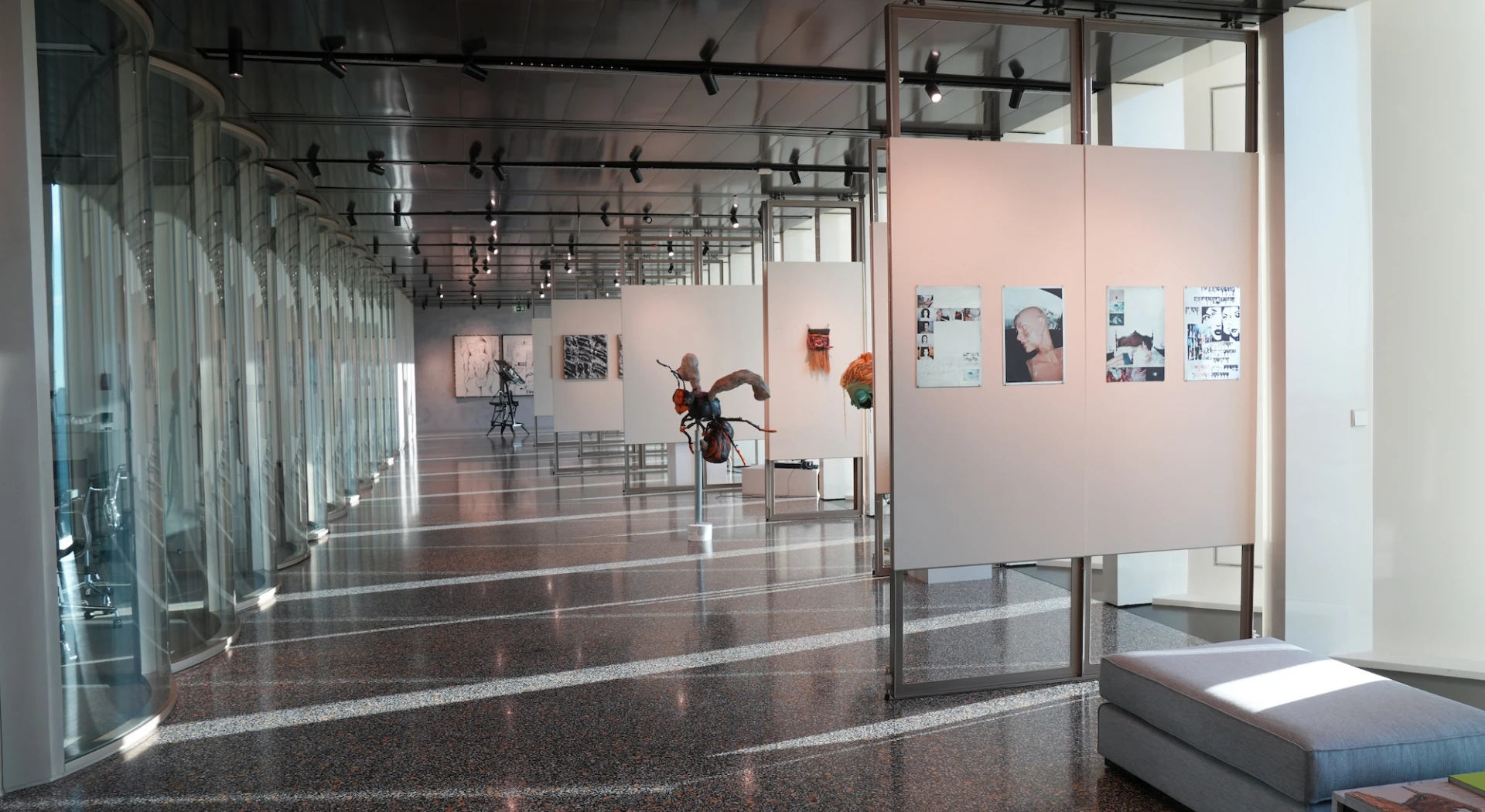
Curated by Carolina Piçarra and in direct response to the documentary 10 Young Portuguese Artists, Through the Lens of Lourenço Mello, the exhibition brings us closer to ten artistic practices in constant development, implicitly suggesting, through the numerous and varied techniques, media, and issues explored, the possibility that the artwork is not, in fact, only the object on which the contemplative gaze rests, but also, and before that, the continuous flow through which it becomes possible.
It is a sad, age-old tradition that there has been no distinction between the work of art and the object that gives it form—an object where, for too long, the primary meaning of creation has been deposited, and before which, before any other movement, the viewer's gaze has surrendered to contemplation. However, contemporary times have brought us, and insist on cultivating, a reactive practice in the face of time and the traditions that so naively seek to preserve it. In the incessant ferment of the present, this almost dichotomous correspondence between object and work has become less evident. There has been a progressive shift in attention away from the crystallised work. Investigation, experimentation, time, doubt, and method have also become elements worthy of contemplation. The exhibition 10 out of 10, currently on display at the PLMJ Foundation, seems to emerge precisely as a symptom of this shift. Curated by Carolina Piçarra and in direct response to the documentary 10 Young Portuguese Artists, Through the Lens of Lourenço Mello, the exhibition brings us closer to ten artistic practices in constant development, implicitly suggesting, through the numerous and varied techniques, media, and issues explored, the possibility that the artwork is not, in fact, only the object on which the contemplative gaze rests, but also, and before that, the continuous flow through which it becomes possible.
Thinking about the work from the perspective of its process does not, at any point, mean replacing the object with its genesis, as if the former lost its importance. Rather, it means recognising that creation is rarely fixed in a single moment, that each work carries with it the deviations and reformulations that remain inscribed in its final form without ever being exhausted by it. Both Lourenço Mello's documentary and the exhibition make explicit this often invisible dimension of artistic practice. Without seeking to explain the works or indicate an interpretative path, they reveal that each work results from its own time, from a singular investigation, and from a continuous relationship with the context that housed its creation. 10 out of 10 reflects this notion of the work in continuous construction, an inevitably unfinished work, a workflow, a becoming-work. A work that not only exists between states, but is itself a movement that will never stabilise. The work-flow that emerges never exists as a finished object; rather, it exists as a provisional configuration within a long process that remains open." Dimensions such as the studio, conversation, research, or error then cease to be mere antecedents to creation and become integral to the very experience of the work: what is exhibited is not only a result, but a way of thinking, a duration, and a practice that extend beyond what we see.
If each artistic practice constitutes a unique journey, then the lack of need for formal or thematic unity becomes perceptible in the diversity that runs through 10 out of 10. The exhibition is organised not around any conceptual axis, but rather as a field of coexistence, a common territory in which different languages come together without losing their specificity. Its meaning does not reside in the comparison established between the works, but in the possibility of recognising that each one responds, in its own way, to the same gesture of continuous creation. Before seeking to exhibit a set of works, 10 out of 10 exhibits the common becoming-work. If today the work tends to exceed the limits of the object, the exhibition can no longer be understood merely as a simple set of works gathered within the four walls of the exhibition space. The proximity between distinct practices does not produce, nor necessarily seek, to lead to a common narrative; on the contrary, it produces a field of relationships where affinities, contrasts, and tensions remain open; it cultivates a profoundly fertile ground, where the inherent openness of the work becomes clear in its constant ferment. The artwork's essential plurality and its exponential multiplication emerge as crucial dimensions of the artistic object. Unity, if it exists, thus ceases to result from a shared identity and instead emerges temporarily in the ephemeral relationships that each practice establishes with the others, as if the exhibition itself functioned less as a closed discourse and more as a medium where different discourses reformulate themselves and allow themselves to be reformulated by one another.
Perhaps a work never truly ends. Each interception, each exhibition, and each new context re-inscribes it in a movement that prolongs its existence far beyond the initial form that made it visible. 10 out of 10 demonstrates precisely that creation does not simply happen the moment the work emerges. Still, rather than that, as a result of its opening, it continues to unfold indefinitely in the relationships, discourses, and contexts that intersect with it. The work, therefore, ceases to be a point of arrival and asserts itself as a verb—a gesture with no rest in sight.
The exhibition can be visited at the PLMJ Foundation in Lisbon until October 30, 2026.
BIOGRAPHY
Guilherme Sota is a multidisciplinary artist, music producer and co-founder of the Vertigo collective. He holds a degree in Painting from the Faculty of Fine Arts at the University of Porto and is currently completing a Master’s degree in Art Criticism and Curatorship at the Faculty of Fine Arts in Lisbon. His artistic practice spans various fields, including painting, sound, installation and writing, through which he explores themes related to ontology, sexuality and iconography. Since 2020, his work has been shown in group and solo exhibitions, notably ‘Do Ser e do Seu Desvelar’ at ÁRVORE Cooperativa, Porto (2025), ‘Microcosmos’ (2026), at Espaço Cultural Mercês, Lisbon, “Na Fenda da Forma” at CC Penedo da Saudade, Coimbra (2025), as well as in various exhibitions organised by his collective. He received the “Jovens Criadores na Árvore” award (2025), amongst others, and was selected for the “CreArt 3.0 AiR” artist residency in Kaunas, Lithuania (2025), amongst others. Alongside his artistic practice, he writes for Umbigo magazine, is responsible for curating and producing the Vertigo events, hosts a monthly programme on the Brazilian radio station Function!, and regularly produces musical projects.
ADVERTISING
Previous
article
29 Sep 2026
Multiple Eyes, to unlearn how to see
By Maria Inês Augusto