article
Multiple Eyes, to unlearn how to see
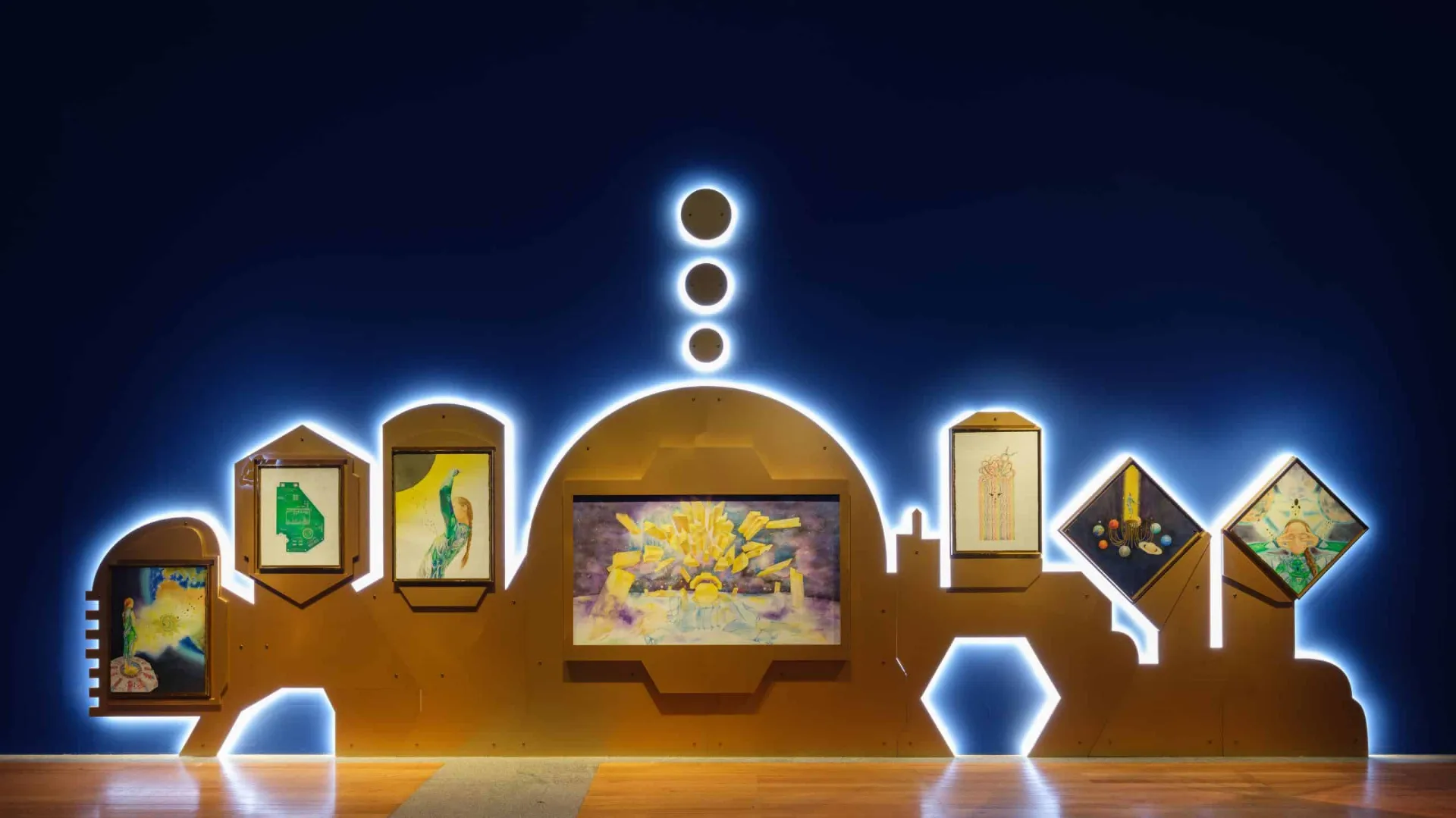
Multiple Eyes, an exhibition at MAC/CCB curated by Nuria Enguita and Rafael Barber Cortell, introduces three artists from different geographical backgrounds and different generations — Patricia Domínguez, Ines Doujak and Lubaina Himid. Their artistic practices are bound together by a common rejection of any single, definitive way of looking at the world. They propose, through the different rooms, exercising a new perspective, a thought-provoking challenge, a call that pushes us to break away from the traditional categories through which modernity has shaped our understanding of reality: human and animal, nature and culture, health and illness, spirituality, centre and periphery. Their approach to ethnoecology is somewhat harsh, somewhat cosmic, grotesque and raw, and achieved through a process of healing, allowing them to delve deeply into identity, categories and belonging.
Running counter to the notion of an objective and universal perspective, their research encourages a pluralistic understanding, steeped in indigenous knowledge, non-Western cosmologies, ancestral spiritualities, and physical experiences, reminding us that no system of knowledge is ever absolute. Together, these works spread through the exhibition halls like a contagion, slowly dissolving the boundaries of modern thought. Using different languages and media, they study the ecology of relationships by exploring diverse cultural ways of understanding the living world. This is not merely an ecology of survival — although it also encompasses an ecology of survival (?) — but rather a field of memories, violence and care, wherein humans, animals, plants, technologies and spirits all coexist in a sort of open negotiation. Patricia Domínguez, Ines Doujak, and Lubaina Himid serve as cultural mediators in this scenario. They draw on scientific archives, colonial histories, ritual practices, iconographies, and technological tools to reassemble relationships among different types of knowledge. The pieces become critical tools, ready to disrupt our ways of knowing and seeing, challenging us to lose sight of our perspectives so that we may see more broadly and inclusively. This critique is primarily directed at the modern urge to label everything, noting that naming something is never a neutral act. It means establishing boundaries, defining identities and figuring out who belongs and who falls outside the norm. This exhibition tackles this by pulling apart these categories and offering new ways of being and thinking, in which identity remains relational and even unstable.
Ines Doujak’s practice is best grasped through the discipline of ethnoecology, as it explores the taxonomies by which bodies are organised. She uses collages and other media to forge hybrid figures whose identities defy any easy categorisation. This meditation on the politics of the body and the scientific and social mechanisms of categorisation is made particularly evident in the series Ghost Population (2015). The collages originate from 19th-century medical atlases dealing with skin diseases — collections of images designed to catalogue what the body should not be, or appear to be. Doujak breaks down these images and then reassembles them following a counterintuitive logic. Rather than scientific separation, they give rise to unexpected encounters between human bodies, roots, feathers, shells and plant organisms. Disease becomes less a deviation from the norm and instead appears as a manifestation of nature itself, laying bare the categories of ‘healthy’ and ‘pathological’ as cultural constructs.
This concern with hybridity invites us to consider the figure of the monster not as a symbol of anomaly, but as a way of highlighting — and even exposing — the violence behind normative categories, as if monstrosity itself were inherent to the very systems responsible for classifying them. These grotesque figures deliberately reject clear-cut identities to expose the artificial nature of such boundaries. The posters in the Wanted series also address this topic. By borrowing the graphic style commonly used in police bulletins and AIDS awareness campaigns, Doujak stresses that disease is never merely a biological phenomenon. Epidemics also lead to patterns of stigmatisation, exclusion and persecution. The instantly recognisable graphic vocabulary makes visible the way in which certain species — and even populations — are cast as a public threat.
The constant presence of rats, pigs, insects and other creatures deemed repulsive reinforces Julia Kristeva’s notion of the abject1. This revulsion ultimately reveals more about the psychological and cultural mechanisms through which we project onto animals all that we refuse to acknowledge in ourselves than it does about the animals themselves. Animality becomes a symbolic storage container for our human anxieties, fears and traumas. The artist’s Animal Trials (2026) explores how, in the 13th and 20th centuries, animals were dragged before the courts in Western Europe, accused of crimes such as destroying crops or committing acts of violence, and were even granted lawyers, formal trials and sentences. Doujak recaptures this incident through a puppet-and-shadow theatre housed in a tent adorned with a patchwork of photographs from her archival collection of abused horses. The fable undermines legal anthropocentrism and reveals that the very mechanisms of criminalisation applied to animals still operate on marginalised human groups, who are often regarded as pests, unproductive, or disposable.
The monumental sculpture Walking Cemetery (2023) carries this grotesque narrative one step further. A three-metre-tall female figure cradles a child in her arms. Clearly referencing Goya’s Saturn Devouring His Son, the narrative moves towards colonial history and the enslaved female bodies, often robbed of the chance to be mothers. The monumentality normally reserved for heroes is well suited to making visible those who have historically been excluded from public memory. Landscape Painting (2021–2026) directly challenges the authority of scientific classifications. After inheriting the seed collection compiled by the gardener Leo and losing much of it in a fire, Doujak converts this setback into a reflection on the fallibility of systems, renaming hundreds of plants after revolutionary women and non-binary people. This reclassification ceases to function as a means of appropriation and becomes a practice of symbolic reparation and resistance.
If, throughout the exhibition, Doujak challenges us to confront deeply uncomfortable territory, then Patricia Domínguez, on the other hand, takes us into a sphere that is simultaneously healing and critical. The Chilean artist engages in a creative practice which combines ethnobotany, ethnoecology, Andean spirituality and a critique of contemporary extractivism. Her visual universe combines stones, medicinal plants, particle accelerators, digital devices, references to quantum physics and indigenous cosmologies, rejecting the hierarchy between science and spirituality. She is primarily interested in how observation shapes what is observed. Technology, nature and the cosmos are shown to coexist on the same plane as ways of understanding the world that complement one another.
I recall Ideas to Postpone the End of the World, a book that brings together texts from lectures and interviews with Ailton Krenak, in which he states that we have become increasingly estranged from this organism of which we are a part, the Earth, and have begun to think of it as one thing. We are another: the Earth and humanity (...) everything is nature. The cosmos is nature. This idea of a separation between human beings and the natural world is also echoed in Domínguez’s artistic practice. In La Balada de las Sirenas Secas (2020), water simultaneously serves as a creative principle and an object of political conflict. The artist confronts and protests the privatisation of water resources, which has permitted agricultural companies to monopolise water for large-scale avocado monocultures, thereby depriving entire communities and animals of this essential resource. The representation of an Avocado God — an ironic deity of modern capitalism —, women struggling to get back this common good, and a figure resembling a modern-day mermaid, a sort of spiritual water spirit, together create a ritual that draws us into a political resistance, condemning the transformation of nature into a commodity – a theme on which Krenak likewise insists, warning against the very notion of sustainability promoted by the system responsible for environmental devastation: we need to reconsider the myth of sustainability, coined by corporations to justify their destruction of our concept of nature. This reminds us of the urgent need to foster an alternative way of understanding the land, in which caring for nature means acknowledging that we are part of it, and that the violence committed against ecosystems is equally inflicted upon the bodies that depend on them.
A Planet for Abu (2025), designed in collaboration with artisans from Rajasthan and woven over two years using traditional Mughal carpet-weaving methods, includes animals, drones, portals, horses, black holes, plants and hybrid creatures straight out of the artist’s imagination, coming alive in a universe where all these entities and figures coexist without any hierarchy. The possibility of lying down on the piece makes it a ritual space for rest, dreaming and collective imagination. The suspended sculpture alongside the installation adds to this almost shamanic atmosphere, combining the sacred with the technological without pitting them against one another.
Lubaina Himid formally departs from these strategies but shares the same willingness to reclaim overlooked narratives. A leading figure in Black British Art, she works across painting, installation, theatre and collage to call into question the colonial mechanisms of representation.
Works such as Cosmic Coral (2024) — in which two masked figures are portrayed as if suspended in an apparently banal dialogue, with one showing the other a sketch of a red coral, a symbol profoundly associated with Afro-Caribbean cultures and the Atlantic trade, which simultaneously served as an amulet, a barter good and a form of spiritual resistance during the era of slavery —, small gestures acquire special power, mattering more than sheer technical virtuosity; Himid uses them to build a relational energy that flows through the entire painting. This and other works possess a theatrical dimension which I believe is fully expressed in the installation A Fashionable Marriage (1988). Appropriating William Hogarth’s Marriage A-la-Mode series, Himid converts an 18th-century satire into a critique of Margaret Thatcher’s United Kingdom. Reagan, art critics, art dealers, cultural patrons and Thatcher herself feature as re-enacted characters in political theatrics. In contrast, the only truly mobile figure is the Black artist at the centre of the composition, bursting through centuries of invisibility. To some degree, the installation rewrites narratives of power, exposing how much the artistic canon itself constitutes a mechanism of classification and power.
As I went through the entire exhibition, it became clear to me that these three artists are united by a common purpose: to target the very classificatory mindset that sustains different forms of violence. Nature does not exist outside of humanity, nor is there an isolated subject capable of looking at the world from a neutral standpoint. Multiple Eyes offers other ways of inhabiting the world. It advocates a process of unlearning that encourages us to accept that categories such as species, gender, race, illness, nature, or culture are historical and political constructs, opening us to other cosmologies and forms of knowledge. It urges us to shed the illusion of a single perspective and accept that the world has never truly been contained within the categories through which we have learnt to organise it.
As Ailton Krenak writes, still in Ideas to Postpone the End of the World 2: if we can lend attention to any vision that avoids the blindness we are currently experiencing across the globe, then perhaps it could open our minds to some form of cooperation between peoples, not to save others, but to save ourselves.
The exhibition is open until October 25, 2026.
1 Julia Kristeva explores the concept of the abject in her work Powers of Horror: An Essay on Abjection (1980; English translation from 1982), describing it as anything that threatens the boundaries between the self and the other, disrupting identity and the symbolic structure through an experience of disgust and unease.
2 Krenak, A. (2025). Ideas to Postpone the End of the World. Antígona. Ailton Krenak (1953) is a Brazilian writer, philosopher, environmentalist and indigenous activist, member of the Krenak people. He is a leading voice in the fight for the rights of indigenous peoples and the protection of nature. His work has long been concerned with the relationship between humanity and the environment, questioning developmental models that drive the exploitation of natural resources.
BIOGRAPHY
Maria Inês Augusto, 34, has a degree in Art History. She worked at the Museum of Contemporary Art (MNAC) in the Educational Services department as a trainee and for 9 years at the Palácio do Correio Velho as an appraiser and cataloguer of works of art and collecting. She took part in the Postgraduate Programme in Art Markets at the Faculty of Social Sciences and Humanities of Universidade Nova de Lisboa as a guest lecturer for several editions and collaborated with BoCA - Bienal de Artes Contemporâneas in 2023. She is currently working on an Art Advisory and curatorial project, collaborating with Teatro do Vestido in production assistance and has been producing different types of text.
ADVERTISING
Previous
interview
25 Sep 2026
Interview with Isadora Alves, author of the Umbigo.space cover
By João Pedro Soares
Related Posts
article
29 SEP 2026
Multiple Eyes, to unlearn how to see
By Maria Inês Augusto
article
25 JUN 2026
Scrolls, at Buraco: The Two Sides of the Same Coin
By Maria Inês Augusto
article
12 JUN 2026
Tabique, by Rita Gaspar Vieira
By Maria Inês Augusto
article
12 MAY 2026
Phantom Tales, by Pedro Zhang
By Maria Inês Augusto