Article
ArtCut - Triennial of Art of the Catholic Universities: Homecoming
“Exercises in Empathy unfolds across eight cities and three continents, with around a hundred artists and fourteen curators. In Lisbon, with Homecoming as its theme, it treats home not as a fixed place but as an ongoing practice of construction. Curated by Filipa Oliveira, João Sarmento SJ and Nuno Crespo, it spreads across three venues: the Universidade Católica Portuguesa, the Museu Nacional de Arte Contemporânea (MNAC) and Brotéria. Each one reads homecoming differently, from the physical structure of a house at the university, to home as a body, memory and imagination at the MNAC, and home as the community and nature we belong to at Brotéria.”
“To those who no longer have a homeland, writing becomes home” (Adorno, 2020)
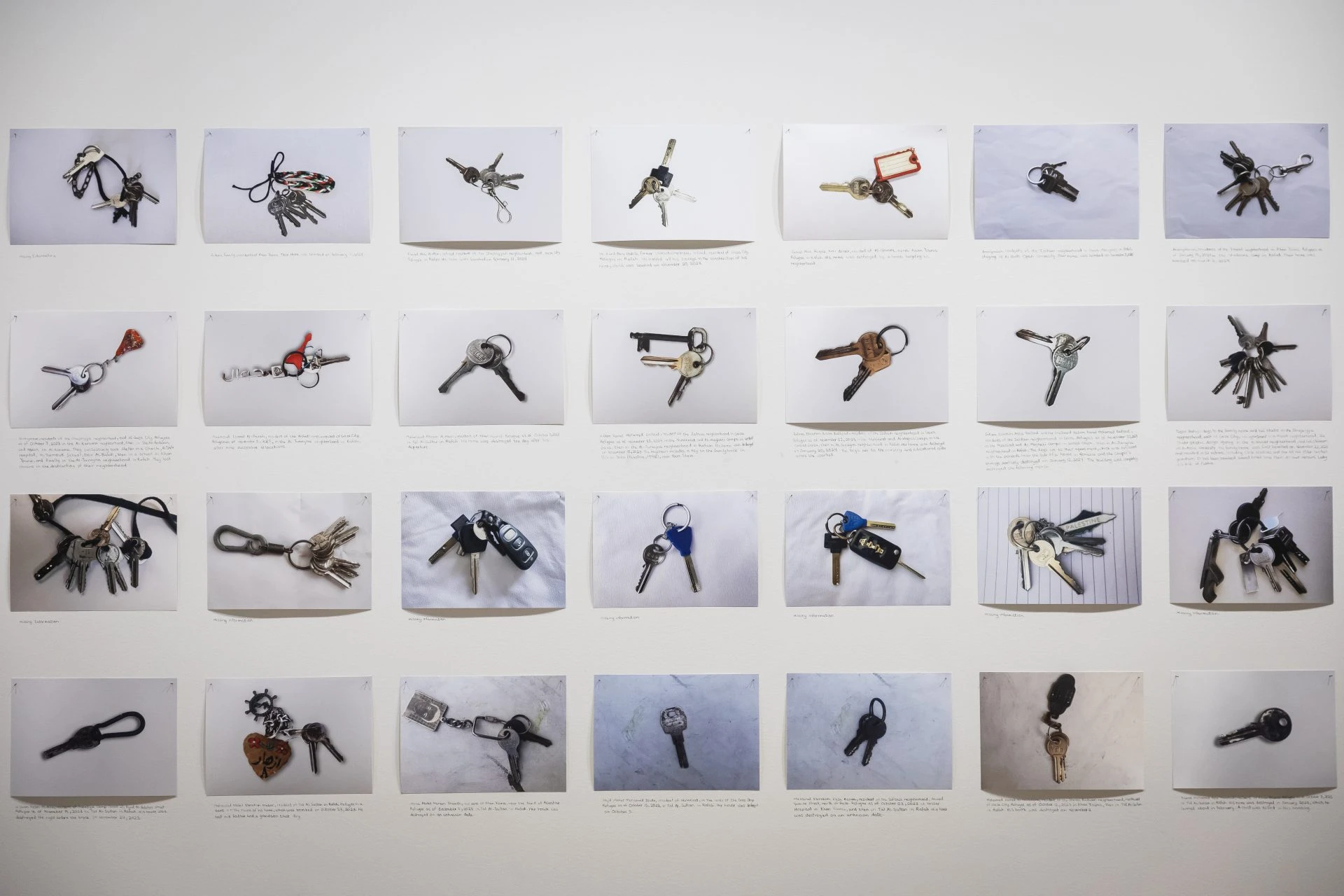
I stand in front of the close-up photographs of keys and can hear the rattling of the keys in the last Lisbon protests for a right to have a home. Taysir Batniji’s Just in Case is part of the first Catholic Universities Art Triennale (ART CUT ‘26) titled Exercises in Empathy. “The very international architecture of the project is already, in itself, an exercise in institutional empathy, an invitation to inhabit a shared listening to goodness, truth, and beauty.” (Tolentino de Mendonça, 2026)1
Exercises in Empathy unfolds across eight cities and three continents, with around a hundred artists and fourteen curators. In Lisbon, with Homecoming as its theme, it treats home not as a fixed place but as an ongoing practice of construction. Curated by Filipa Oliveira, João Sarmento SJ and Nuno Crespo, it spreads across three venues: the Universidade Católica Portuguesa, the Museu Nacional de Arte Contemporânea (MNAC) and Brotéria. Each one reads homecoming differently, from the physical structure of a house at the university, to home as a body, memory and imagination at the MNAC, and home as the community and nature we belong to at Brotéria. They read it as memory and forgetting, refuge and confinement, and name three kinds: “home-memory, home-desire, home-wound.” So, what is a home when it’s not a house? What does home mean when you have lost your house?
We humans like to do the math. Some of us calculate the time when another wildfire will swallow up our homes and watch how the flames come creeping closer every year. “The planet, that ticking bomb, becomes our suicide vest to wear.” (Temelkuran, 2026). Similar to the curators of the Triennale, in her book Nation of Strangers, Ece Temelkuran, a Turkish writer living in exile, tries to redefine “home” through human connection and mutual solidarity rather than fixed geography. Following her thought, some of us lose our homes without moving. It happens on an ordinary afternoon in your living room – wait, no, not a living room, since few of us can afford the extra room – where a news broadcast gives yet another update about the insanity of our countries. “Fascists, growing in number, claiming our homes to be only theirs”, and public space along with them. We are getting suspicious there might not be enough future left to fix the past (Temelkuran 2026). And yet, or even because of this, we continue to build small communities that will protect our hearts. “We weave intricate connections with people to have an emotional roof over our heads”. 2
Taysir Batniji’s photographic work Just in Case goes beyond statistics of destroyed homes and displaced individuals. Since 1948, the key is a symbol of hope, when over 700,000 Palestinians lost their homes overnight and still locked their doors, hoping to return one day3. Under the photograph, handwritten in pencil, Batniji added the name of the owner, place of the house, and date (if known) of destruction of the once-home.
Some keys are rusty, some keys are new, some keys have practical carabiner hooks, some keys have silly key rings, some wear aesthetic dangling colorful pearls as accessories. Some keys come alone, some keys come with others. They remind me of my keychain, a gift from my mum with sentimental value that I lost on my first day of school. Or the sound my friend makes when she approaches with her 10 keyrings, so one hears her approach (“homecoming”) from a distance. They remind me of the numerous times I lost my keys or locked myself out, needing someone to save me, to open the door, to cut their key for me. Memories of someone who has never really lost a home, who has a safe country to “come home to”. If I ever wanted to make the choice to return, it would be there, in reach. I, for myself, having left my home by choice rather than by necessity.
The title Just in case adds something domestic, banal, modest. Just in case, take your keys, you never know; we might come back. Just in case, take all belongings dear to you; you might never come back. Just in case, tell the people you love that you love them.
Simultaneously, in autumn 2026, the Acampada takes shape in Portugal. In Lisbon, hundreds of people mount their tents in protest. Demonstrators make visible an experience that policy language reduces to inflation figures. Following Breytenbach, quoted in Temelkuran’s book: “The voice cannot exist when it is not heard”. If a voice depends on a listener, then protest is less an expression of grievance than a demand to be heard. Exercises in Empathy extends this demand and gives the viewer the chance to either complete or withhold that act of listening. In 2024, Gerador reported that 5975 people sleep on the streets, 4798 people don’t have a home and are sheltered in centers, rooms, or “pensions”4. Since then, housing prices have surged to – once again – historic highs, with a 16.5% increase in housing costs, while average income grew by only 5.1% (INE 20265).
Quoting the curators, we carry fragments of every home we have inhabited, and “perhaps we will never truly return home.” Returning to the exhibition, noticing the story of return might be one of the oldest stories we tell. European literature begins with one: Odysseus, the soldier who spends years crossing seas and his own fears for the sake of homecoming. The Greeks even had a word for this kind of story, nostos, the journey home. In the Odyssey, it ends well: The door opens, Penelope awaits him. It doesn’t always end like that. Think of Portugal after 1974-75, when the empire collapsed, and the writer António Lobo Antunes asked how one could return home if there is no home (Capeloa Gil, 2026)1. Or the people from former colonies for whom the old metropolis was an empty, half-hostile house: a home that has become unheimlich, uncanny. Wars, borders and economies keep producing people who go back to find that “back” no longer exists. So when the Triennale chooses Homecoming for the Lisbon location, it isn’t picking a cosy subject. It is picking one of the oldest and most unfinished questions we have. And it does so under the title Exercises in Empathy, which admits that we cannot live another person’s return. All we can do is try to imagine it.
How lucky we are to still have keys to rattle, keys that still fit into a lock.
*
ART CUT 2026 is the first Triennial of Art of the Catholic Universities, an international initiative promoted by the Dicastery for Culture and Education of the Holy See and led by Cardinal José Tolentino de Mendonça.
In Lisbon, the exhibition is divided into three venues – the Catholic University of Portugal, Brotéria, and the National Museum of Contemporary Art – and brings together more than 30 national and international artists, including Abel Salazar, Aires Mateus, Amadeo de Souza Cardoso, Ana Jotta, Ana Vieira, Andreia Santana, Augusto Alves da Silva, Carlos Bunga, Cristián Salineros F., Daniel Blaufuks, Délio Jasse, Dimakatso Mathopa, Eduardo Viana, Emiliano Di Cavalcanti, Francesca Woodman, Gordon Matta-Clark, Heidi Bucher, Helena Almeida, Irineu Destourelles, João Abel Manta, João Pedro Vale + Nuno Alexandre Ferreira, Jorge Pinheiro, Julião Sarmento, Lara Almarcegui, Manuela Bronze, Maria Beatriz, Maria Helena Vieira da Silva, Martha Rosler, Mona Hatoum, Nicolás Paris, Patrícia Garrido, Pedro Costa, Petrit Halilaj, Rafa Bqueer, Rebecca Horn, René Tavares, Rolando Sá Nogueira, Taysir Batniji, Vanderlei Lopes and William Eggleston. The triennale will end in late 2027 with a "synthesis" exhibition at the Holy See Pavilion in Venice.
2 Ece Temelkuran, Nation of Strangers, 2026
5INE 2026: Instituto Nacional de Estatística, accessed on October 20th 2026 through https://www.idealista.pt/en/news/property-for-sale-in-portugal/2026/10/01/77780-house-sales-in-portugal-fall-again-as-price-growth-loses-momentum
BIOGRAPHY
Dela Christin Miessen is a researcher, writer and editor. She is part of Aberta Studio in Lisbon and the co-founder of Echoes Residency for socially engaged art practices.
ADVERTISING
Previous
Article
10 Nov 2026
Could the Venice Biennale kill?
By José Pardal Pina
Related Posts
Article
11 NOV 2026
ArtCut - Triennial of Art of the Catholic Universities: Homecoming
By Dela Christin Miessen
Article
13 MAR 2026
By a thread: Helena Lapas at Monitor
By Dela Christin Miessen
Article
11 MAR 2026
António Olaio at the NO·NO Gallery: On (not) Falling
By Dela Christin Miessen
Article
23 DEC 2025
O céu, sol, chuva, chuva, chuva: Luísa Correia Pereira at the Panteão Nacional
By Dela Christin Miessen