article
Annie Leibovitz's apples and faces in Wonderland, at the MOP Foundation
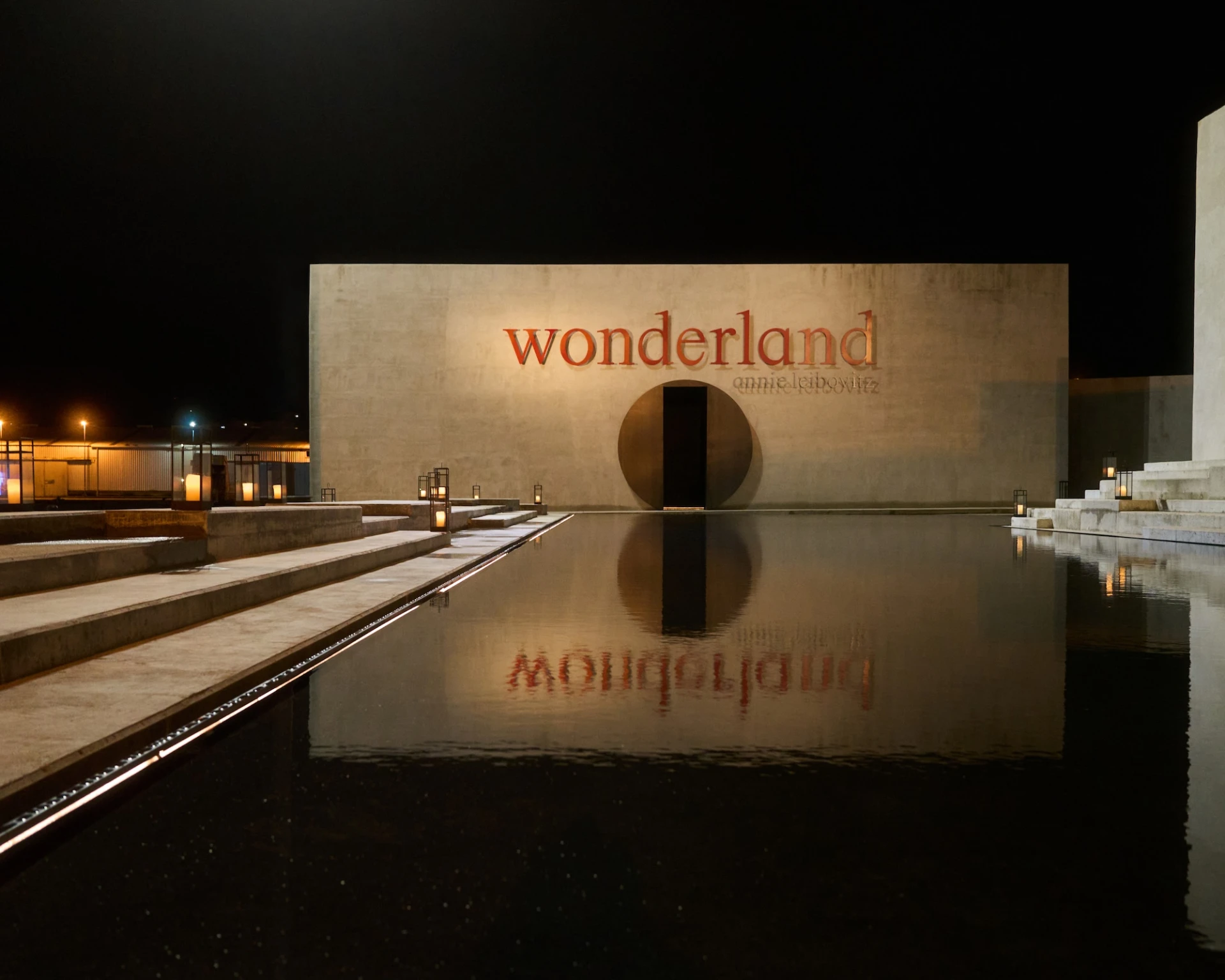
The morning is well on. The sea seems still in the golden chill on a sunny winter's day in Coruña. At the Marta Ortega Pérez Foundation, we await Annie Leibovitz, the 76-year-old photographer born in Connecticut, USA, who will give a guided tour of Wonderland, her latest exhibition.
The throng of journalists, eager to receive Leibovitz, sets the tone for the exhibition of a spectacular, baroque, luxurious body of work, both in its treatment of the images and in the iconographic grandeur that characterizes them. However, the exhibition criteria generate a tension, partly irresolvable, and therefore intriguing, with the photographic style of this work. If the photography is luxurious, due to its undeniable technical virtuosity, the foundation's rooms unfold as if it were, after all, an exhibition of the studio, the place where certain alchemical phenomena of artistic creation occur, the space of the unfinished work, normally invisible to the viewer's eye. The gesture is bold and cannot be considered a form of curatorial negligence, although it is our duty to mention that acrylic display cases, in most cases where this exhibition option is chosen, compromise the full viewing of the photographs. Was Leibovitz's intention to return to the viewer their own reflected image? Revealing, ultimately, the questioning, retreating effect that art has on its admirers? Did such a way of exhibiting obey the desire to refer to the fundamental plane of the act of looking at an image: namely, that of situating ourselves at a distance from ourselves, simultaneously declaring our place in the world, this time consciously singularized? These are questions that remain in the air, equally contributing to a differentiated reflection on Wonderland.
The exhibition's focus, naturally in keeping with the foundation's agenda, is Leibovitz's fashion photography—many of the photographs on display were taken for magazines such as Vogue and Vanity Fair—although the first work exhibited is a large panel composed of hundreds of black and white photographs that the American photographer took during a 1975 tour of the London band Rolling Stones. This is an early way of looking, in which the photographer, in a more spontaneous manner—impossibly involved in pre-photographic setup, playing with the electrifying contingency of concerts and the playful suspension of the backstage—had not yet transformed reality into the style that would become her own, characterized by monumentalization on every scale. In other words, regardless of the final size of the photograph, all the works exhibited in Wonderland are presented in a grandiloquent, monumental tone, investing the images with a timeless dimension coinciding with a mythological potential. The attentive viewer will be challenged by the temptation of the narrative, while simultaneously being captivated by the visual intoxication of the images. In effect, the work is divided into two fundamental moments: one that projects itself into the future of transmission through narrative, and another that can only relate to the unique experience the viewer has of and with photographs. It is curious how some images generate astonishment, showing celebrated personalities from the world of arts and culture, whose images we are accustomed to, appearing here in a different light, playing a role different from the one we have placed them in, distanced as we are from these figures by a distance that necessarily fosters fiction. Thus, through the scenic montage of narratives, of fabulous pictorial tableaux, Annie Leibovitz exposes us to the fundamental human tendency to arrange this or that figure according to a certain grammar, sometimes more rigid than we would like to suppose. The grammar of moral narratives. Let us not forget the inherent terror of these popular and fantastical tales, which we, in a hasty or perverse way, call children's stories—from Hans Christian Andersen to Lewis Carroll. Now, fashion and photography coincide in the purpose of experimenting with skins that, while not new, existing in the world to be extracted, all depending on a more self-absorbed than judgmental gaze, surprise us by leading to familiar places and forms, but never before attempted. The mythologizing plane of childhood, as an immense parade of diverse skins, allies itself with the ethical imperative of taking one figure or another, and assuming it as a result of our willingness to look, as well as not invariably recognizing ourselves as a founding territory, but rather a shifting border between one costume and another, between one fantastical story and another, between the flesh-and-blood doll and the spectral woman, man, or child.
Wonderland, as the title itself indicates, is the entrance to a place without a defined perimeter. It is the place before it is territory. It is, therefore, the unfinished as the first raw material of art and, paradoxically, of the desire to fit into another skin. It is much more an exhibition about the awareness of being in the presence of figures, to which to add the term the other is already a tyrannical way of saying I. Photography—as an artistic form of reinvention of the self, a way of narrowing distances or treating them by attending to such a distance, without distorting it—serves an aesthetic and ethical premise, evident in this exhibition: namely, the awareness that there is no truly free, creative way of saying other by preceding it with a definite article.
We questioned Leibovitz about the combination of the absurd and the dreamlike as a guiding aesthetic principle in her photographs, and the consequent impression of distance, as if her images reached us from a distant time, sometimes giving the feeling that what is ruinous is the present reality we inhabit, and not presumed photographic fragments from the past. We summarized our question by asking the photographer to clarify the importance of mythology in her work. The answer curiously reconciled History and stories, that is, the narrated reality and the narratives that compose that reality: "I love History and I love stories," affirming that she carries within herself an encyclopedia. Her work, therefore, situates the place of impossible innocence, of the sum of learnings to be combined and integrated in a more or less creative way. Perhaps the great success of an artist is, in the end, to refuse to yield to the inscription of a conjunction between the terms History and stories, assuming them as parts of a continuum irreducible to dialectics.
If the photographs, outside of any frame, pinned with thumbtacks, seem to inscribe the exhibition as a draft of the exhibition, such a way of exhibiting emerges more as a potentiator of tensions than as an evident curatorial criterion. The minimization of the solemn tone of the images, without it being clear whether this is an ironic principle of montage, results in an appeal to the viewer to participate in the exhibition without explaining it, to read the images without seeking fabulous teachings or morals in them. Perhaps great monuments are, after all, great dilemmas. We do not choose to lie in the shadow of a symbol. The shadow of a symbol is a place of terror. The cold stone against the hot flesh, that is a beautiful story, provisional and deformable, that is, plastic, eligible, casting a shadow on the sun, without rest, in a beautiful harbor, with that beauty of inhospitable places, to which we know we cannot belong, in which we will always be passing through. Facing the sea or the river. Sweet or salty. Who will know? Whoever dares to taste the apple, even before it leaves the tree.
The exhibition Wonderland, by Annie Leibovitz, can be visited at the Marta Ortega Pérez Foundation (MOP Foundation) until May 1, 2026.
BIOGRAPHY
Master's degree in Portuguese Studies from Universidade Nova de Lisboa, with a thesis on Nuno Bragança. She is currently writing a doctoral thesis on Agustina Bessa-Luís and Manoel de Oliveira and melancholy. FCT scholarship holder, she has contributed to anthologies and has published poetry and essays in national and international magazines. She has published two books of poetry: “E o Coração de Soslaio a Todo o Custo” (2025) and “Penhasco” (2025). She is co-editor of Lote magazine. She writes literary criticism for the Observador newspaper.
ADVERTISING
Previous
article
22 Jan 2026
Portuguese Experimental Cinema: The Artist’s Cinema
By Maria Inês Mendes
Next
article

27 Jan 2026
Between Word and Silence, at MACAM
By Ana Filipa Almeida
Related Posts
article
21 JUL 2026
On Desisto – o que não vejo imagino (I give up – what I can’t see I imagine), by Nuno Sousa Vieira
By Maria Brás Ferreira
article
18 MAY 2026
Depois de Para Sempre, at Pavilhão Julião Sarmento
By Maria Brás Ferreira
article
17 APR 2026
About "antes de subir à tona", by Cristina Robalo: to set the stage for a shipwreck, to know how to love the otherside of a portrait
By Maria Brás Ferreira
article
27 JAN 2026
Annie Leibovitz's apples and faces in Wonderland, at the MOP Foundation
By Maria Brás Ferreira