article
Autocolante. Iconografia da Liberdade, at MUDE
“Requiring little financial investment, these small, portable adhesive devices also simplify their own multiplicity and reproducibility. With just a domestic printer, it is possible to produce a considerable impact within the context in which they circulate. The message can be endlessly repeated, slipping through and spreading rapidly, in defiance of, and parallel to, prevailing laws and moral conventions.”
Our earliest encounter with stickers may have come through childhood football albums, whenever we purchased collectible cards identifying the stars of each championship, those with odd, uncanny facts on biology, or the bizarre record-breaking phenomena of the Guinness Book. These formats gradually became part of everyday life, growing up alongside us. Later came student-union election campaigns, in which List A or List B would surface with stickers in assorted sizes and configurations. Even when washed out, they always delighted the students, who spread them everywhere. But the most compelling examples of these adhesive items came through politics, whether from trade unions or from several ideological factions. Nor should we ignore international causes, particularly environmental campaigns and the serious opposition to atomic warfare.
We find within this humble format the qualities that have kept the sticker active within artistic, graphic, social and ideological practice for so many years.
Being highly effective instruments of visual communication, stickers spread with remarkable speed. Their lightness and narrow size allow them to be carried and placed almost anywhere. Portability, exchange and small size allow them to be concealed discreetly in pockets or simply held in our hands. They can be attached to surfaces almost silently, such is the ease with which they adhere to the supports chosen by those spreading them (lapels rucksacks, laptops, vehicles, bicycles, handrails, urban walls, lampposts, signs, windows, mobile phones, etc). From the small size arose the concept of micro-activism. On the one hand, stickers become objects of proximity, intimacy, personalization, ownership and identity; on the other, they are vessels for rallying cries (activism), spreading and fastening themselves to unlikely places, appearing in full public view, or having a fleeting existence, since they may be removed and appropriated, destroyed or torn apart by others.
Even as condensed vehicles of information, stickers also fulfil far more banal and commonplace roles. They operate as markers, brand identity emblems and forms of advertising.
Their most rapid proliferation has occurred within politics, particularly during election periods or in campaigns organised around the concerns of small communities. Stickers have the distinctive capacity to reinforce membership of a group whose participants share the same ideological principles.
Requiring little financial investment, these small, portable adhesive devices also simplify their own multiplicity and reproducibility. With just a domestic printer, it is possible to produce a considerable impact within the context in which they circulate. The message can be endlessly repeated, slipping through and spreading rapidly, in defiance of, and parallel to, prevailing laws and moral conventions.
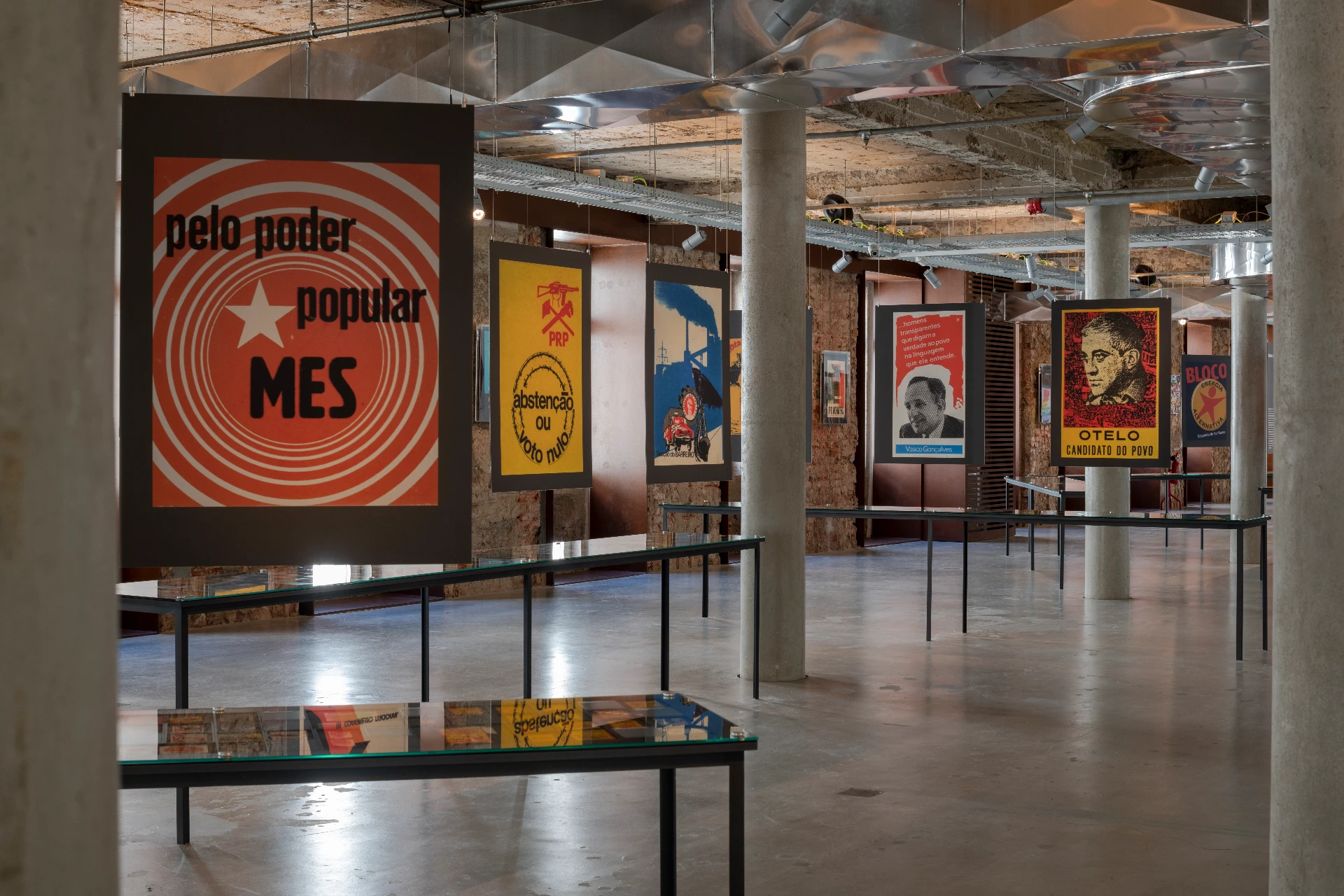
Currently on view at MUDE, the exhibition Autocolante: Iconografia da Liberdade covers a period of fifty years and reveals the remarkable range of applications made possible by this down-to-earth tool. Less noticeable than a poster or stencil, the sticker also requires considerably less physical effort to be spread. Organised by MUDE and Ephemera (latter holds the archive), the exhibition brings together a remarkable collection of stickers. Most carry no attribution to an individual author, despite the technical sophistication of their accomplishment (printing processes, the use of colour, etc.), as they reflect different political and social factions and fulfil multiple purposes, including electoral campaigning, political propaganda and awareness-raising around social causes.
Selected for the MUDE exhibition, the collection contains the political and historical period of repression preceding the Portuguese Carnation Revolution, the years immediately following 25 April (including the extensive production of stickers for the revolution itself and the PREC), and the countless political and social demonstrations that have taken place since. Emerging causes, including environmentalism and human rights, are also present; these, alongside political slogans, are among the most permanent themes across time, retaining their relevance in the present day.
Curating this extensive exhibition is the historian José Pacheco Pereira, biographer of Álvaro Cunhal, as well as the founder of the Ephemera archive and a public figure involved in Portuguese political life since 1960.
Among the forerunners of the modern sticker identified by Pacheco Pereira is the philatelic vignette, itself an instrument of propaganda. According to the curator, both the vignette and rudimentary forms of the sticker were used for clandestine propaganda during the Second World War1, and their subsequent distribution and widespread adoption in Portugal would be encouraged by the arrival of cheaper printing techniques2.
Different forms of political and propagandistic use are further explained by the curator: “as a complimentary item during election campaigns, together with other gifts that ascertain a symbolic trade-off with the potential voter; as a form of political identity, visibly worn on clothing, sometimes on the body itself, or attached to everyday objects such as briefcases; for placement in public locations, where it functions as a miniature poster that is easier to attach to lampposts, letterboxes, doors and the walls of houses, among other surfaces; as a means of raising funds through its sale; and, in association with the latter, as a collectable object”3.
Structuring the exhibition are the following sections: The sticker and its family, Stickers before 25 April, The explosion of 25 April, 25 April across Fifty Years (1974–2026), The First elections (1975–1976); Political Parties, Faces, Presidential, National and Legislative Elections, Local Elections, Rallying Cries, Satire, Press, Looking at stickers from the rest of the world, Trade unionism, Causes I, and Causes II.
Several thematic groups are displayed towards the end of the exhibition. Particularly striking are the stickers with the faces of well-known names such as Marx, Lenin, Che Guevara and Mao. Portuguese personalities of the Revolution are also included, including Vasco Gonçalves and Otelo Saraiva de Carvalho, alongside political leaders such as Mário Soares, Salgado Zenha, Freitas do Amaral and Álvaro Cunhal. Equally prominent are emblematic and familiar slogans still heard today, including “O Povo Unido Jamais Será Vencido” (“The People United Will Never Be Defeated”), as well as sentences that remain embedded in the national collective memory, such as “Soares é Fixe” (“Soares Is Cool”) and rallying cries including “Não Há Plano B” (“There Is No Plan B”).
Although most of the illustrators and designers responsible for the stickers in the exhibition are anonymous, identifiable authorship appears within the Satire section. We have Portuguese illustrators such as Pedro Carvalho, Luís Lázaro, Luís Miguel Castro, Luís Pinto, Manuel Vieira, Mário Caeiro and Vasco Colombo, among others.
Posters flank the exhibition throughout its course, carefully arranged together with the chronology of the stickers. Road signs and other signage are also displayed, their surfaces completely and fully covered with stickers of different origins and purposes.
Autocolante: Iconografia da Liberdade can be seen at MUDE - Museu do Design e da Moda until August 30.
1 PEREIRA, J. P. (2026) Autocolantes e Propaganda Política. Exhibition sheet
Autocolante, Iconografia da Liberdade, MUDE, Ephemera, RTP, page 6 to 9.
2 Ibidem
3 Ibidem
BIOGRAPHY
Carla Carbone was born in Lisbon, 1971. She studied Drawing in Ar.co and Design of Equipment at the Faculty of Fine Arts in Lisbon. Completed his Masters in Visual Arts Teaching. She writes about Design since 1999, first in the newspaper O Independente, then in editions like Anuário de Design, arq.a magazine, DIF, Parq. She also participates in editions such as FRAME, Diário Digital, Wrongwrong, and in the collection of Portuguese designers, edited by the newspaper Público. She collaborated with illustrations for Fanzine Flanzine and Gerador magazine.
ADVERTISING
Previous
article
03 Aug 2026
Rosa Barba. Drawing Vocabularies, at CAM - Gulbenkian
By Mariana Varela
Next
article
10 Aug 2026
Phantom Body: Spectrality as a Reading Device
By Luísa Ferreira
Related Posts
article
10 AUG 2026
Second Cycle of Exhibitions at the Arpad Szenes – Vieira da Silva Foundation
By Carla Carbone
article
06 AUG 2026
Autocolante. Iconografia da Liberdade, at MUDE
By Carla Carbone
article
09 MAY 2026
Mesa-Paisagem (1973), by Ana Vieira, at Brotéria
By Carla Carbone
article
27 MAR 2026
Luísa Ferreira at Galeria Sá da Costa
By Carla Carbone