article
To understand or not to understand—that is the danger
“I write about the attempt to hold on, weakly and inadequately, even if with both hands, to a meaning; I write about the urge of a desire far from the symbolic, far from verse; I write about the rush and about the chapters I have yet to define and write, and then to redefine and rewrite. And I also write about the two exhibitions whose enigmatic and multifaceted imprints persist: The Fold, by Hoda Afshar, and Pedagogías de guerra [Pedagogies of war], by Roman Khimei and Yarema Malashchuk, part of the typically strong curatorial programs of La Casa Encendida and TBA21 Thyssen-Bornemisza Art Contemporary / Museo Nacional Thyssen-Bornemisza, respectively. This article is a reflection on all of this.”
When I was born, I felt as solid as a piece of marble. I know this sounds a bit far-fetched and, admittedly, a little wrapped up in fantasy, but I’ll say it anyway: something about that small, slightly crooked body already knew gravity well, took up space, lost its breath, and fell noisily and awkwardly. I’m not sure when, or why, I became abstract. Perhaps it was a genetic predisposition from the start; perhaps I can blame this sin on the first word I read aloud in front of an audience (“violão”, “guitar” in Portuguese); or, even, on the unexpected, sharp, and terrible intuition of what death means, at the age of eight. Whatever it was (language or eternity), I soon realised I was a remnant, on the side of dreams, figures, theories, and distances. It is not uncommon to find myself in a courtroom parading justifications: Metaphor is the truth of things! Whatever is possible in thought is possible in reality! However, it is also with some embarrassment that I confess my abstraction, my nature as an idea—on the one hand, the effort to understand myself and the world strikes me as worthy and urgent (especially when politics and economics resemble delirium so closely); on the other, I strive to abandon my egoistic pretension of logic, of synthesis, of understanding, which, as it pours forth its intense light of clairvoyance, makes everything the same, flat, blind, and white.
I returned from Madrid a few weeks ago with my concepts in disarray. This is the fourth time I’ve come back to Lisbon from the Spanish capital, a city that feels increasingly intimate, exciting, and alluring. Sad yet inspired, I end up writing quite a lot. I write about the attempt to hold on, weakly and inadequately, even if with both hands, to a meaning; I write about the urge of a desire far from the symbolic, far from verse; I write about the rush and about the chapters I have yet to define and write, and then to redefine and rewrite. And I also write about the two exhibitions whose enigmatic and multifaceted imprints persist: The Fold, by Hoda Afshar, and Pedagogías de guerra [Pedagogies of war], by Roman Khimei and Yarema Malashchuk, part of the typically strong curatorial programs of La Casa Encendida and TBA21 Thyssen-Bornemisza Art Contemporary / Museo Nacional Thyssen-Bornemisza, respectively. This article is a reflection on all of this.
It is not possible to ignore its not-so-secret mission: understanding is, in fact, the subject of study (and madness) for this author, but it is also the verb set ablaze [“encendido”] in the Casa Encendida program(last year, it was “listening”). As I enter the first room, I’m reminded that there is much to learn from the time and the histories of words—and that, in fact, when we break them down to their atom, we’re unlikely to find anything truly abstract (don’t look at me like that!). To read (“ler”, in Portuguese, from the latin “legere”) comes from the firewood (“lenha”, in Portuguese, from the latin “lex”); companion comes from the bread (from the latin “panis”); psyche comes from the breath; and to understand—nothing mental at all—comes from an embrace, as the exhibition text on the wall tells us. I believe you’ll agree that embracing the unknown—smelling it, touching it, feeling it chest to chest without any introduction, any proper name or resemblance—is far more demanding than simply offering it a few reflections. There is danger, above all. A danger we sometimes neglect in intellectual work, so often isolated and silent (though never safe).
The risk taken by Iranian photographer Hoda Afshar is precisely that of refusing simplification, of keeping alive the complexity of a person whose traits, and whose work, lend themselves all to easily to a certain contemporary critical discourse. In the audiovisual installation The Fold, the artist presents us with the nuances of Gaëtan Gatian de Clérambault (1872–1934), a psychiatrist and photographer engaged with the French army who, during the period of the First World War, developed an immense archive of portraits of Muslim people—primarily women—covered in veils in Morocco. It is an obsessive collection, comprising tens of thousands of photographs of traditional women’s garments on the African continent, particularly the haik. Through his compulsive observation of the folds, creases, and drapery of these fabrics, surrounded by mannequins and their images, Clérambault wrote systematically about concealment, fantasy, and delirium. In 1934, he took his own life with a self-inflicted gunshot in front of a mirror, fixing upon his eyes—afflicted by cataracts and by the ghosts of a prematurely lost sister—the final image of his death. In a posthumous text, the psychiatrist bequeaths his eyes to any colleagues who might wish to examine them. And Afshar, therefore, accepts this offer.
In the examination to which she subjects de Clérambault, the artist does not absolve him of his devotion to colonial occupation, much less of his fetishistic and misogynistic interest in the bodies of the women he encounters in North Africa. She does not release him from his paranoid, policing, and conservative inclinations, nor from the criticism of his outdated method of doing science through the description and representation of the “others,” rendered two-dimensional, exotic, objects of analysis. Abstractions. Nor, however, does she diminish the aesthetic value of his collection of photographs—which Afshar also investigates with meticulousness and curiosity. She does not fail to underscore his influence on psychoanalytic practice, his intellectual rigor, or his struggles with his own body. By this, I do not mean that Afshar humanises him—which would sound far too naive, like one of those inconsequential relativisms content to shrug: “well, it’s difficult…”. In fact, her gesture is one of response. If de Clérambault establishes, in his own somewhat obscene way, a veritable clinic of the gaze, Afshar puts him to the proof of her counter-clinic. As she exposes him to her tests—ethical, moral, artistic—she makes him an accomplice in a conspiracy without a plot.[1] Now imagine my delight upon discovering that, when we break apart the word accomplice, we find exactly the one who folds (plicare, plectere) together (com-).
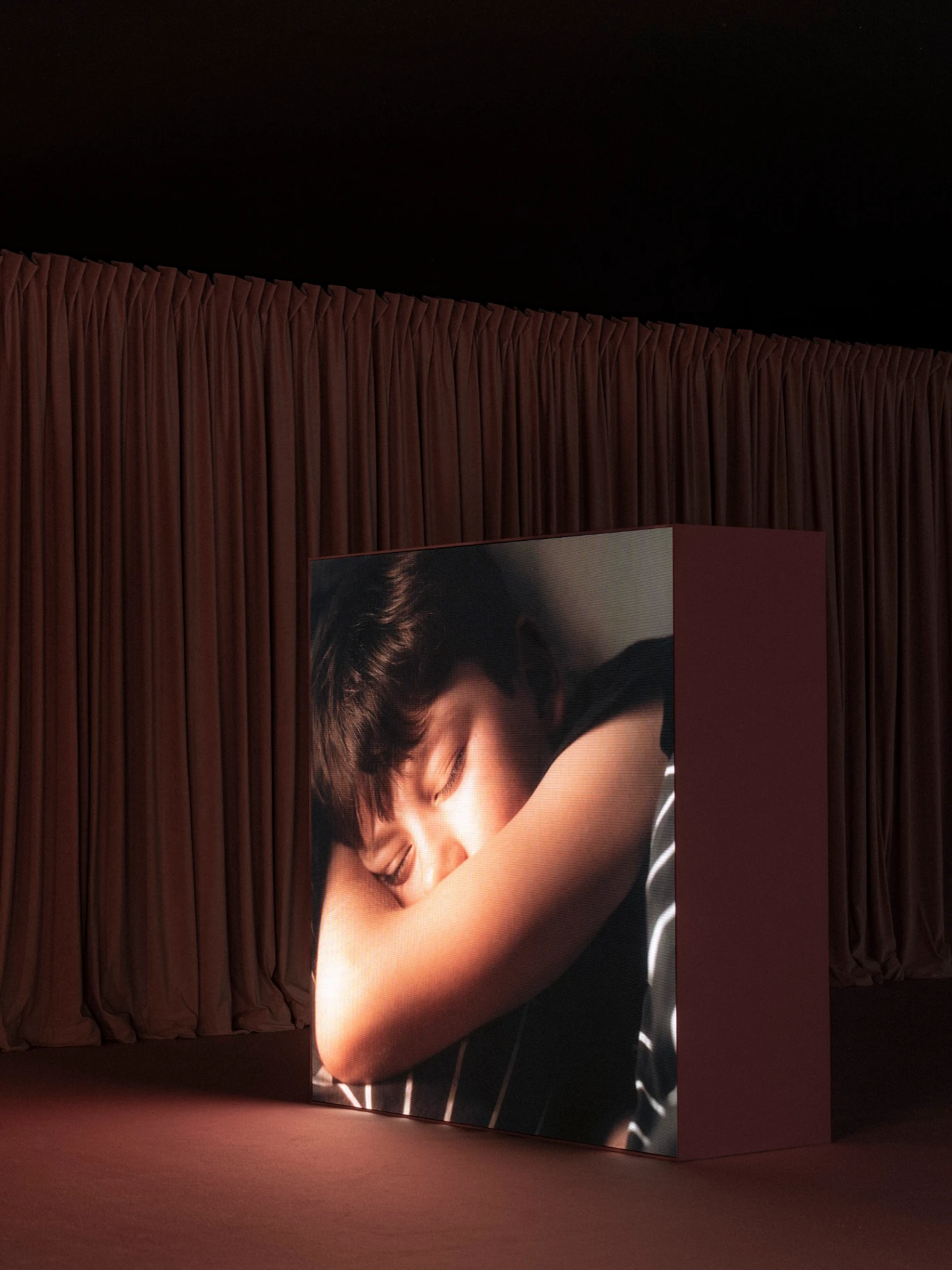
Less than a fifteen-minute walk away, at TBA21, the effort continues—with a real emphasis on the labour and spirit required—to unlearn understanding. Before us are images of war: children sleep; young people chat among themselves, sitting on the steps of a public building; a man rests in a chair, outdoors, while a bee buzzes insistently around his face. No bombardments, no gunfire, only a few people slipping and falling on the icy streets of Kyiv. In Pedagogías de guerra, Roman Khimei and Yarema Malashchuk offer us anything but the usual depictions of violence and tragedy, demonstrating how these seep into our structures of thought and ways of reading the world by reshaping what we see, what we anticipate, and what we fear. There is something unsettling about this narrative displacement: before—or perhaps after, or, more likely, at the very same time as—being a terrible occurrence, war is also a terrible regime of perception. Metaphor coexists with tragedy; it tames it, perhaps, incorporating it as an expectation, as plausible life and death.
As in The Fold, any possible sense to be drawn from the Ukrainian duo’s exhibition will stem from attention, from the duration of time—from the slow reconstruction and expansion of the self, creating enough space between one’s arms to embrace contradictions. When we introduce friction into what once seemed smooth, opacity into what once seemed self-evident, we are left with the strange thickness and the surprise of things, reminded that the reality of every word and every image always runs deeper than its surface. More curved, more creased, more uncanny. The fold of the body, the navel of discernment.
The Fold, by Hoda Afshar, is on view at Casa Encendida until April 26, 2026. Pedagogías de Guerra (Pedagogies of War), by Roman Khimei and Yarema Malashchuk and commissioned by Chus Martínez, can be seen at TBA21 Thyssen-Bornemisza Art Contemporary until June 21, 2026.
[1] This is a direct reference to the text “A conspiracy without a plot” by Valentina Desideri and Stefano Harney, originally published in 2013 in the book The Curatorial: A Philosophy of Curating. Available at .
BIOGRAPHY
Laila Algaves Nuñez is an independent researcher, writer and project manager in cultural communication, particularly interested in future studies developed in philosophy and the arts, as well as transfeminist contributions to social and ecological thought. She has a BA in Social Communication with a major in Cinema (PUC-Rio), an MA in Aesthetics and Artistic Studies (NOVA FCSH) and is a PhD candidate in Artistic Studies - Art and Mediation (NOVA FCSH) with an FCT scholarship. She investigates the potential of writing and fiction as tools for safeguarding the Rights of Nature, proposing and participating in research-action projects that cross the intersections between words, performance, imagination and ecological activism.
ADVERTISING
Previous
article
27 Mar 2026
Luísa Ferreira at Galeria Sá da Costa
By Carla Carbone
Next
article
01 Apr 2026
Meteorizações, by Filipa César
By Débora Valeixo Rana
Related Posts
article
31 MAR 2026
To understand or not to understand—that is the danger
By Laila Algaves Nuñez
article
09 JUN 2025
A fish's preferred angle (and other hypotheses for designing interspecies worlds)
By Laila Algaves Nuñez
article
14 MAY 2025
Various Others 2025, a travelogue
By Laila Algaves Nuñez
article
22 APR 2025
Voice aflame, voice submerged: Julianknxx, Tristany Mundu, Diana Policarpo and Francisca Rocha Gonçalves in chorus at CAM
By Laila Algaves Nuñez